Which leads are the anterior leads?
V1, V2
Which leads are the septal leads?
V3, V4
Which leads are the lateral leads?
I
aVL
V5, V6
Which leads are the inferior leads?
II, III
aVF
Of the praecordial leads, which ones have an isoelectric QRS complex?
V3, V4
Which leads must be looked at to figure out if there is any axis deviation?
I and aVF
(as these are perpendicular)
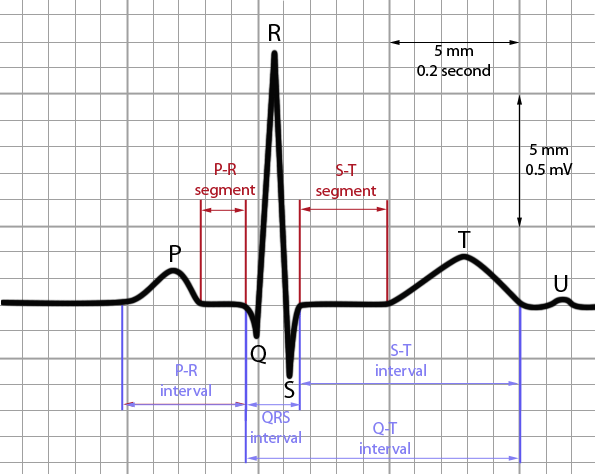
- What does the PR interval represent?
- What is its normal length?
- PR interval = time taken for excitation to spread from SAN, through atrial muscle, the AVN, down the bundle of His and into ventricular muscle (start of p wave to start of QRS complex)
- normal length of PR interval = 120-220ms (3-5 small squares)
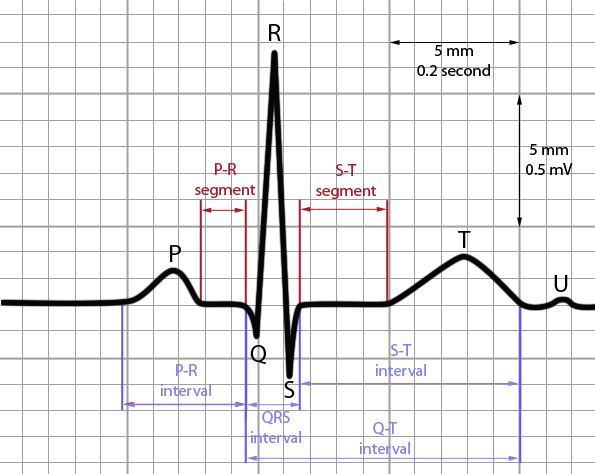
- What does the QRS complex represent?
- What is its normal length?
- duration of the QRS complex shows how long excitation takes to spread through the ventricles
- normal length = 120ms (3 small squares)
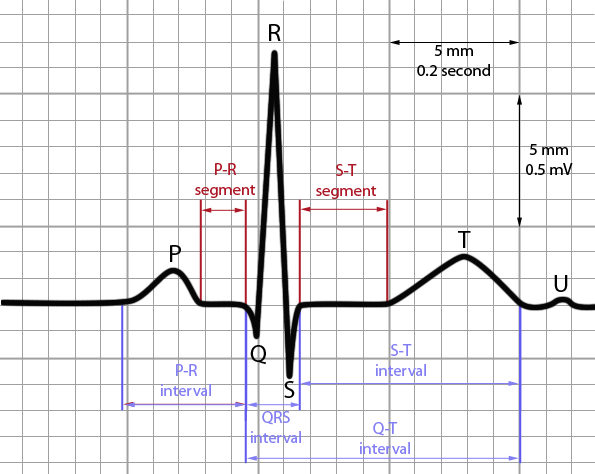
- What does the ST segment represent?
- What is its normal length?
- interval between ventricular depolarization and repolarization (end of s wave to start of t wave)
- should be ~ 80ms (but more than length, whether its elevated or depressed tells us more about pathology)
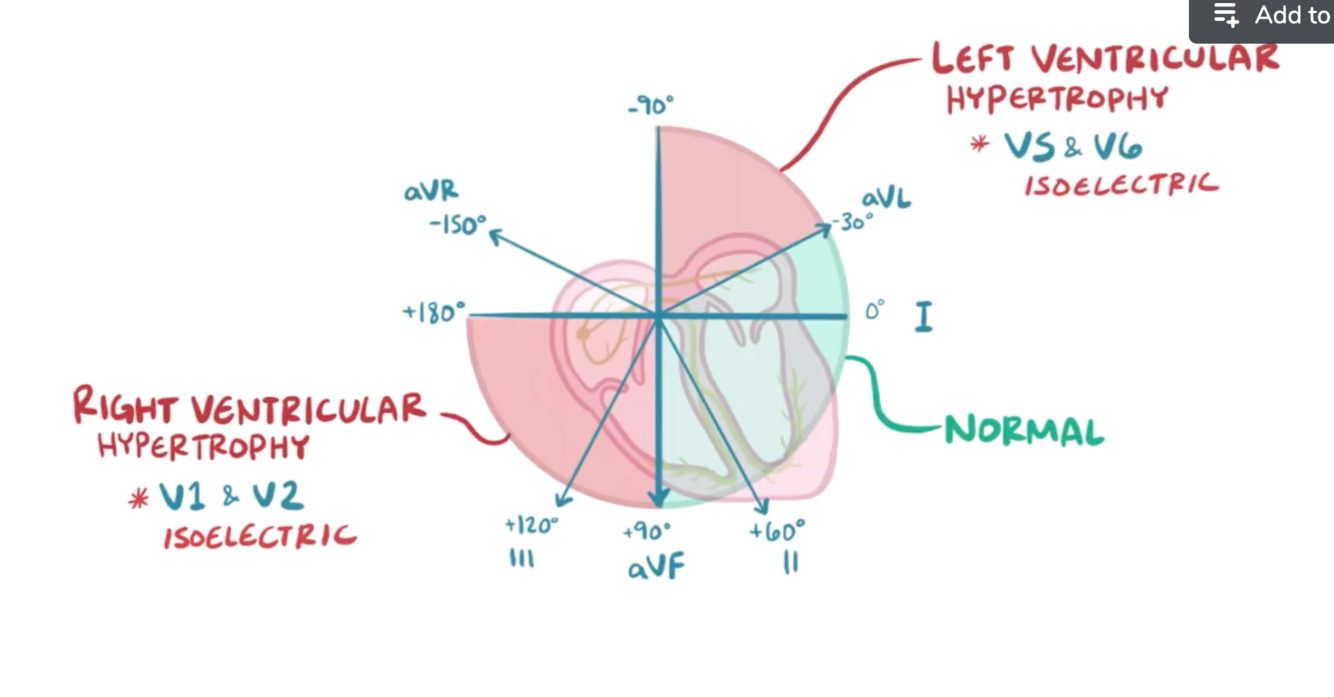
How might you recognise left ventricular hypertrophy (i.e. left axis deviation) on:
a) limb leads
b) praecordial leads
a) I and aVF : if the waves are ‘leaving’ each other
b) V1 and V2 are the isoelectric leads (QRS complex)
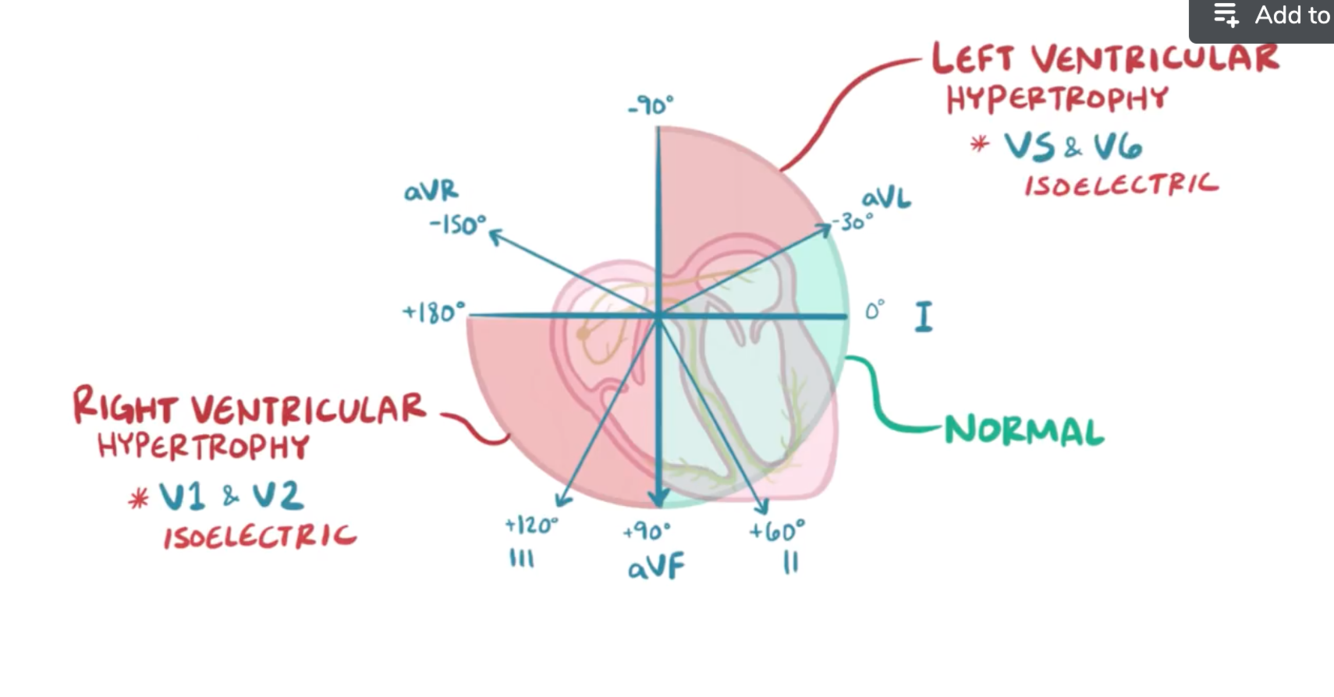
How might you recognise right ventricular hypertrophy (i.e. right axis deviation) on:
a) limb leads
b) praecordial leads
a) I and aVF: waves are ‘coming together’
b) V5 and V6 are the isoelectric leads (QRS complex)
Which lead shows the P wave most clearly?
II
or V1
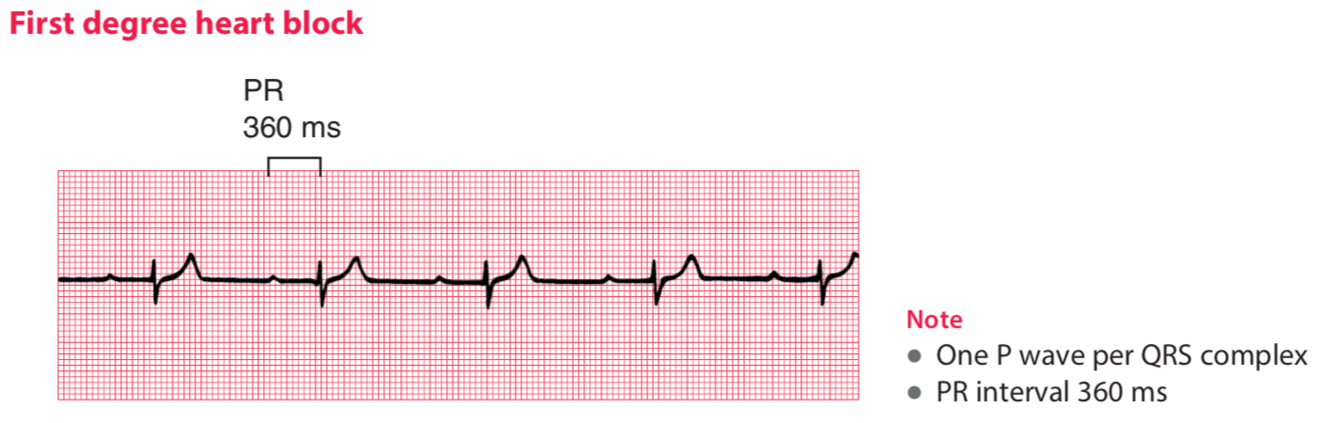
What is 1st degree heart block w.r.t. electrical conduction?
- If each wave of depolarization that originates in SA node is conducted to ventricles
- but there is a delay somewhere along conduction pathway
- –> the PR interval is prolonged
How do you identify 1st degree heart block on an ECG?
PR intervals are lengthened (>220ms)
PR interval = time taken for excitation to spread from SAN, through atrial muscle, the AVN, down the bundle of His and into ventricular muscle
normal length of PR interval = 120-220ms (3-5 small squares)
What is the clinical significance of 1st degree heart block?
Can be a sign of:
- coronary artery disease
- aute rheumatic carditis
- digoxin toxicity
- electrolyte disturbances.
What is the Tx for 1st degree heart block?
No specific action required
What is 2nd degree heart block w.r.t. to electrical conduction?
- excitation completely fails to pass through AV node or the bundle of His
- 2nd degree heart block = this occurs intermittently
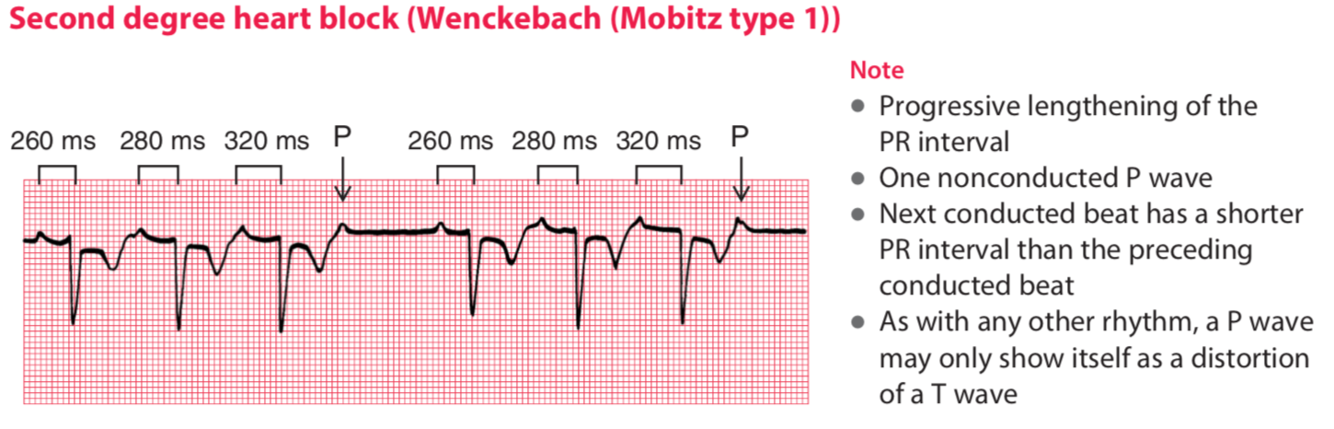
What is 2nd degree heart block (Mobtiz type 1) w.r.t. to electrical conduction
- progressive lengthening of PR interval
- –> failure of conduction of an atrial beat
- followed by a conducted beat w a shorter PR interval
- then a repetition of this cycle.
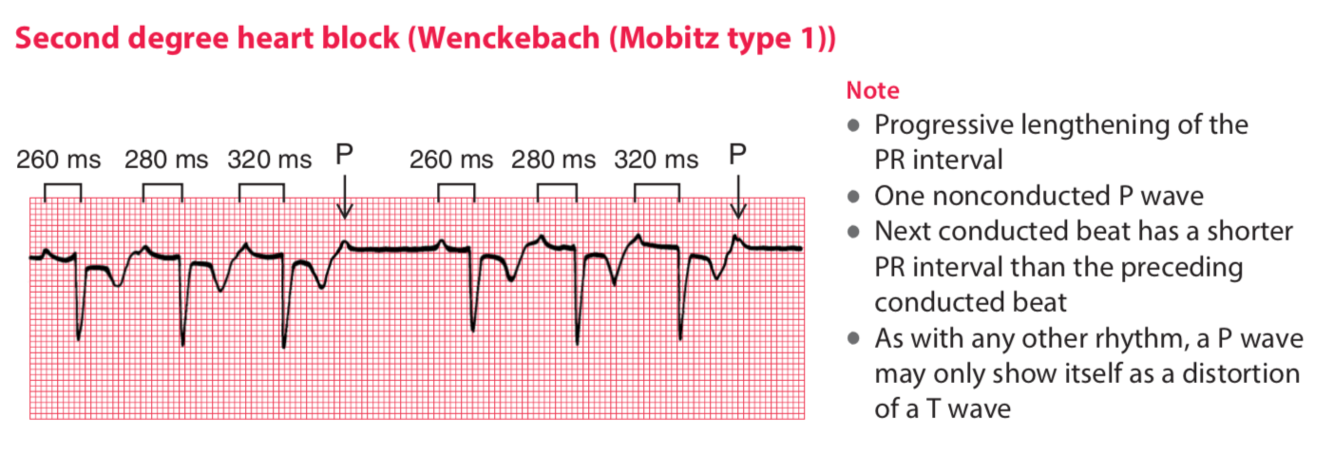
How do you identify 2nd degree heart block (Mobitz type 1/Wenkelback) on an ECG?
see image
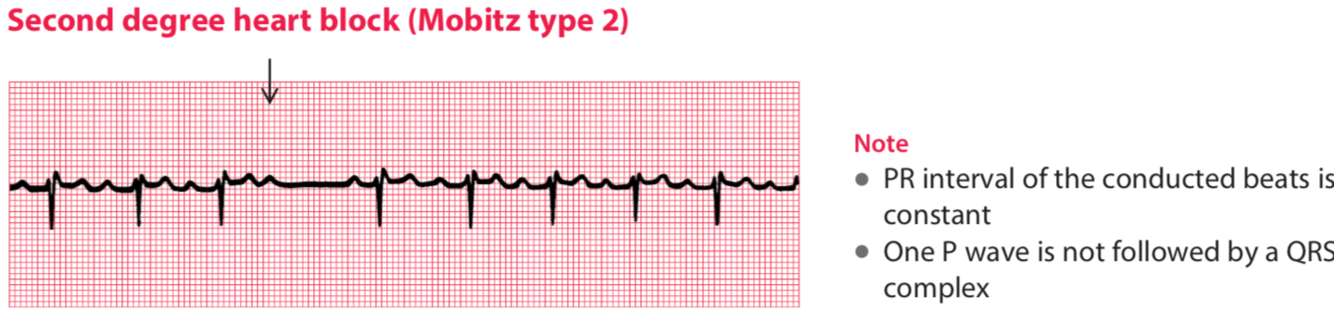
What is 2nd degree heart block (Mobtiz type 2) w.r.t. to electrical conduction?
- Most beats are conducted with a constant PR interval*
- but occasionally there is atrial depolarization without a subsequent ventricular depolarization.
How do you identify 2nd degree heart block (Mobitz type 2) on an ECG?
see image
What is the clinical significance of 2nd degree heart block?
- Usually indicates heart disease;
- often seen in acute MI
During heart blocks, how may a p wave present?
as a distortion of a t wave
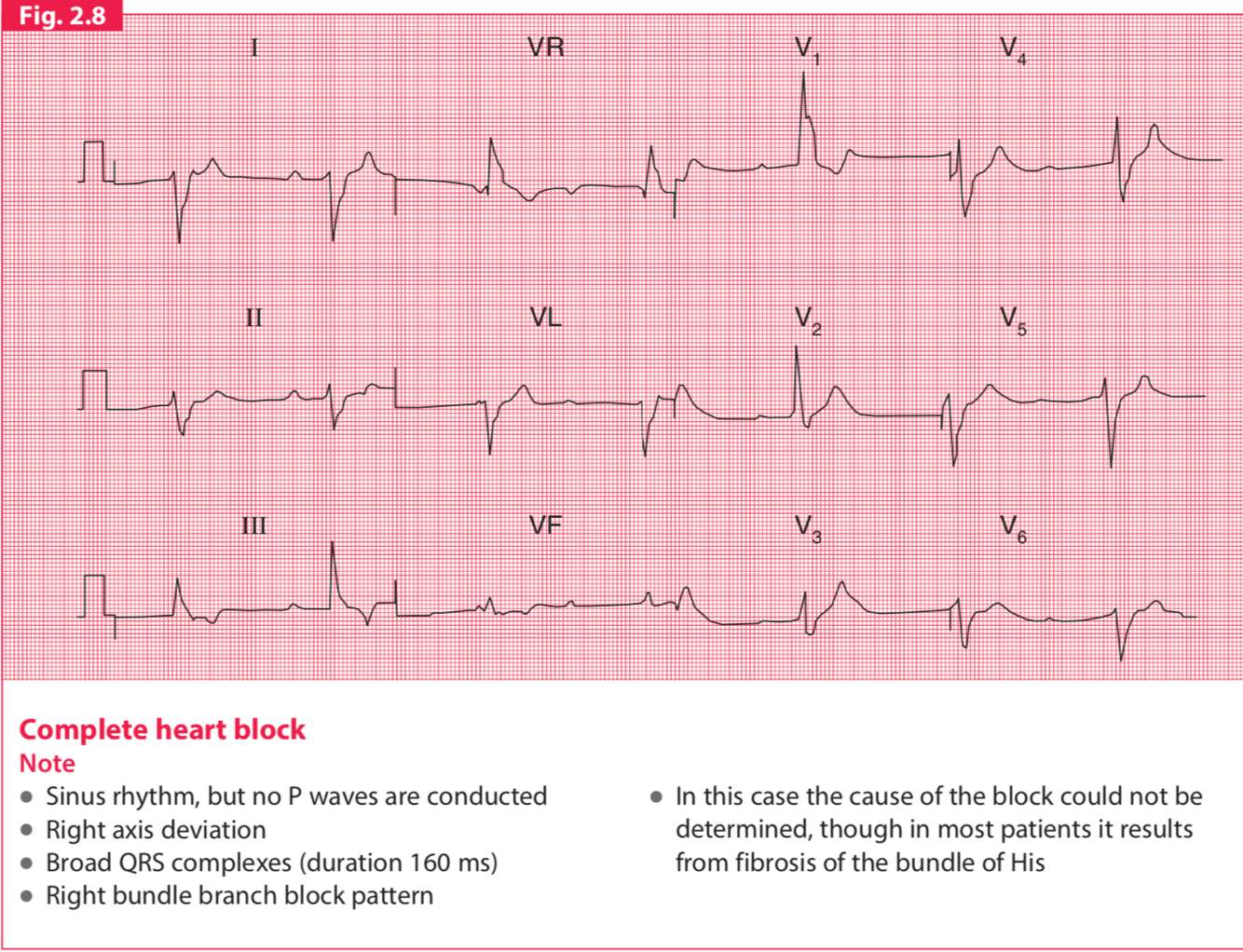
What is 3rd degree heart block w.r.t. to electrical conduction?
- = complete heart block
- atrial contraction is normal but no beats are conducted to the ventricles
- When this occurs the ventricles are excited by a slow ‘escape mechanism’ from a depolarizing focus within the ventricular muscle



-
ECGs121
-
ECG examples10
-
Aortic regurgitation- valvular18
-
Aortic stenosis - valvular18
-
Mitral stenosis - valvular0
-
Mitral regurgitation - valvular0
-
Tricuspid regurgitation - valvular18
-
Atrial fibrillation/flutter - arrhythmias5
-
Cardiac arrest - arrhythmias0
-
Heart block (1st, 2nd, 3rd degree) - arrhythmias10
-
Supraventricular tachycardia - arrhythmias0
-
Vasovagal syncope - - arrhythmias0
-
Ventricular fibrillation - arrhythmias0
-
Ventricular tachycardia - arrhythmias0
-
Wolff–Parkinson–White syndrome - arrhythmias0
-
Cardiomyopathy - intrinsic17
-
Restrictive cardiomyopathy - intrinsic0
-
Pericarditis - intrinsic35
-
Constrictive Pericarditis - intrinsic15
-
Infective endocarditis - intrinsic18
-
Myocarditis - intrinsic19
-
Ischaemic heart disease (angina pectoris, acute coronary syndrome, myocardial infarction) - intrinsic0
-
Rheumatic Fever - intrinsic25
-
Abdominal aortic aneurysm11
-
Aortic dissection - vascular10
-
Dyslipidaema (hypercholesterolaemia & hypertriglyceridaemia)0
-
Hypertension0
-
Rheumatic fever0
-
Amyloidosis16
-
Arterial ulcers0
-
Venous ulcers0
-
Deep vein thrombosis (DVT)0
-
Varicose veins - vascular0
-
Peripheral vascular disease (acute and chronic limb ischaemia)0
-
Cardiac failure (acute and chronic)63
-
Pulmonary HTN - vascular0
-
PE - vascular0
-
Gangrene0
-
Buzz words: Cardiology71
-
Buzz words: Vascular11
-
Blackboard Chest Pain EMQs58
-
Blackboard EMQs CVS80
-
Cardiology - DPD75



