Define aortic dissection.
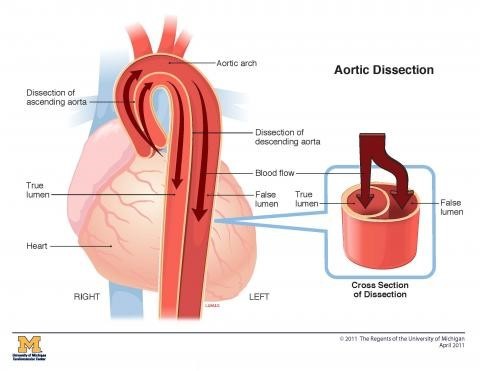
Separation in aortic wall intima, causing blood flow into a new false channel composed of the inner and outer layers of the media.
How common is aortic dissection?
Usually affects men >50yrs
6 in 100,000 incidence in UK
What are the risk factors for aortic dissection?
- Atherosclerotic aneurysmal disease
- Marfan syndrome
- Ehlers-Danlos syndrome
- Bicuspid aortic valve (related to weakness of the aortic wall)
- Annulo-aortic ectasia
- Coarctation
- Hypertension
- Smoking
- FH of aortic aneurysm/dissection
Other: old age, GCA, overlap connective tissue disorders (e.g. RA, SLE, sjogren syndrome), surgical/catheter manipulation, cocaine/amphetamine use, heavy lifting, pregnancy, non-diabetic.
Explain the aetiology of aortic dissection.
Aortic dissection may be caused by:
- arterial wall deterioration by HTN
- hereditary connective-tissue disorders, such as Marfan syndrome and Ehlers-Danlos syndrome.
- birth defects of the heart and blood vessels, such as coarctation of the aorta, PDA,
- defects of the aortic valve.
- arteriosclerosis and trauma.
- Intimal tear extends into the media of the aortic wall (arterial wall deterioration most commonly due to HTN)
- Blood passes through the media, propagating distally and creating a false lumen
- Flow through the false lumen can occlude flow through branches of the aorta, including coronary, brachiocephalic, intercostal, visceral and renal or iliac arteries.
- Most commonly occurs just above the sinotubular junction or just distal to the left subclavian artery.
- May lead to antegrade or retrograde extension of the dissection:
- retrograde - start in the ascending aorta and can lead to aortic incompetence by separating the aortic valve from the aortic root.
- antegrade - dissections which propagate towards the aortic root
Describe the Law of Laplace and how it related to aortic dissection.
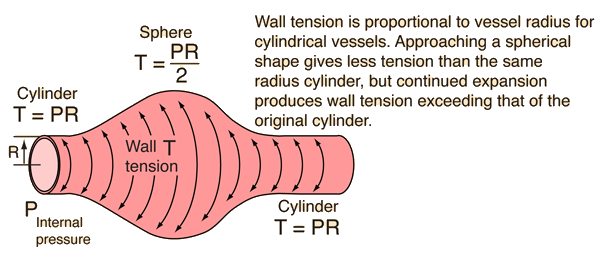
Law of Laplace describes that wall stress is directly proportional to pressure and radius, and inversely proportional to wall thickness.
So factors that weaken the aortic wall (esp lamina media), lead to increased risk of aneurysm formation and dissection, and a cycle of increasing wall stress.
Describe the classification of aortic dissection.
Stanford Classification:
Type A - dissection involves ascending aorta with/without involvement of the arch and descending aorta.
Type B - dissection does not involve the ascending aorta (so only involves the thoracic [distal to left subclavian artery] and/or abdominal)
DeBakey Classification:
Type 1 - tear originates in ascending aorta and involves ascending aorta and arch, and variable amounts of descending thoracic aorta.
Type 2 - dissection confined to the ascending aorta
Type 3 - tear originates distal to left subclavian artery and extends through thoracic aorta or extends below the visceral segment
What are the presenting symptoms of aortic dissection?
- Acute sudden tearing chest pain
- Radiation to the back (interscapular and lower)
- Hypertension and interarm difference - increased sympathetic drive
- Pulse deficit
- Diastolic murmur - descrescendo in distal dissections
- Marfan/Ehlers-Danlos features
- Syncope and hypotension
Other:
- dyspnoea - new onset HF due to acute aortic insufficiency during proximal dissections or cardiac tamponade)
- altered mental status (cerebral ischaemia)
- paraplegia - compromise of intercostal vessels and subsequent spinal cord ischaemia (anterior spinal artery)
- hemiparesis/paraesthesia (cerebral or peripheral ischaemia)
- limb pain/pallor - poor limb perfusion
- abdominal pain - poor visceral perfusion
- anuria(renal arteries)
What are the signs of aortic dissection on examination?
- Patient may have features of Marfan/Ehlers-Danlos syndrome
- Altered mental status
- Pulse deficits (usually in proximal dissection affecting aortic arch)
- Left/right BP differential
- Hypertension (increased symp drive)
- Diastolic murmur - crescendo pattern indicating aortic incompetetnce (but uncommon in distal dissections)
- Left-sided decreased breath sounds/dullness
- Limb pallor/pain
- Paraplegia
- Hemiparesis/paraesthesia
20% present with syncope and no pain. Hypotension in cardiac tamponade and/or hypovolaemic shock.
Describe the features of Marfan syndrome.
Typical marfanoid features include:
- Tall stature
- Arachnodactyly
- Pectus excavatum
- Hypermobile joints
- High-arched palate
- Narrow face
Describe the features of Ehlers-Danlos syndrome.
Type IV Ehlers-Danlos predisposes to both aneurysms and/or dissections. Features include:
- Translucent skin
- Easy bruising
- Hypermobility of small joints
- Premature ageing of skin (acrogeria)
When do you get interscapular and lower pain in aortic dissection?
Whet the disssection is of the descending aorta.
What are the two phases of an aortic dissection?
- After a first event with severe pain and pulse loss, the bleeding stops.
- The second event starts when the pressure exceeds a critical limit and rupture occurs, either into the pericardium with cardiac tamponade or into the pleural space or mediastinum.
What investigations would you do if you suspect aortic dissection?
- CT CAP - 1st line for definitive diagnosis; non-contrast then contrast
- ECG - may show ST depression; in 10-15% MI may mask dissection
- TTE echo - may show intimal flap or two lumens
- CXR - for other causes of chest pain; but may show wider mediastinum
Other:
- cardiac enzymes - exclude MI
- renal function tests - creatinine and urea elevated from poor perfusion
- LFT - hepatic perfusion (elevated AST/ALT)
- lactate - malperfusion
- FBC - anaemia may be present
- Group and save/crossmatch 10U blood - to prep for surgery
- ABG - metabolic acidosis
What are the differentials when diagnosing AD?
- ACS
- Aortic regurgitation
- Aortic aneurysm
- Musculoskeletal pain
- Pericarditis
- Pleuritis
- PE
- Mediastinal tumour
What is shown here? How can this relate to AD?
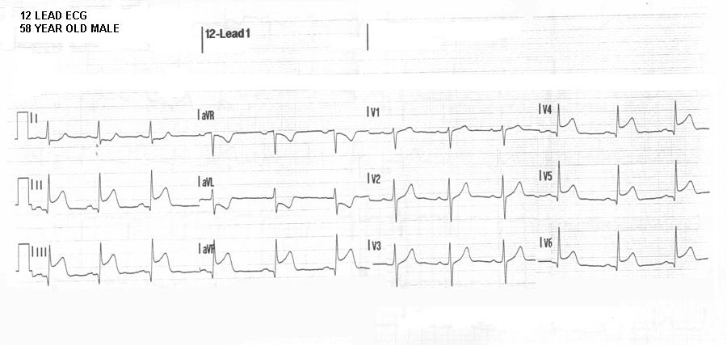
Inferior-lateral MI as a result of dissection involving the RCA
Aortic dissections can involve any branches of aorta which can dissect back to the aortic valve. Must rule out AD in atypical MI cases as if you gave this patient thrombolysis it would drastically worsen the situation.
What kind of murmum might you hear in AD?
Dissection can spread to the aortic valve causing incompetence –> early diastolic murmur.
What is shown here? (2)
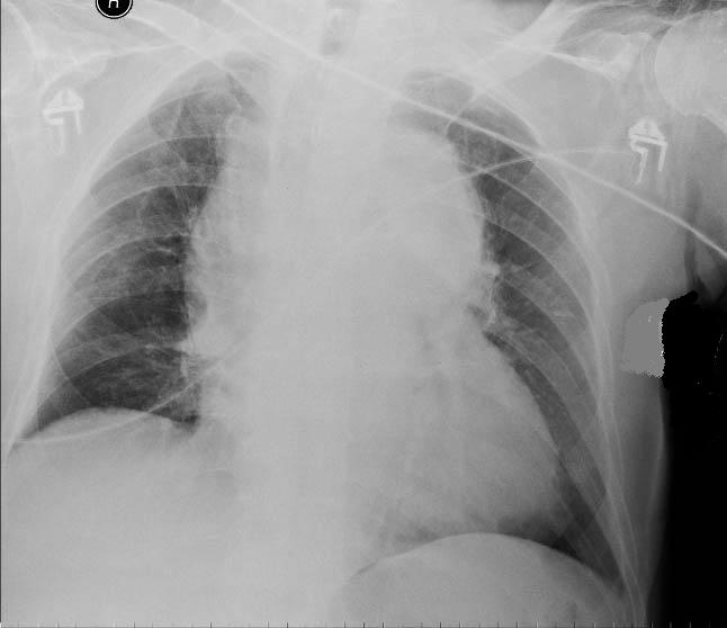
Borderline cardiomegaly
Widened mediastinum
Due to arotic dissection.
Consider CT if uncertain.
What type of dissection is shown here?
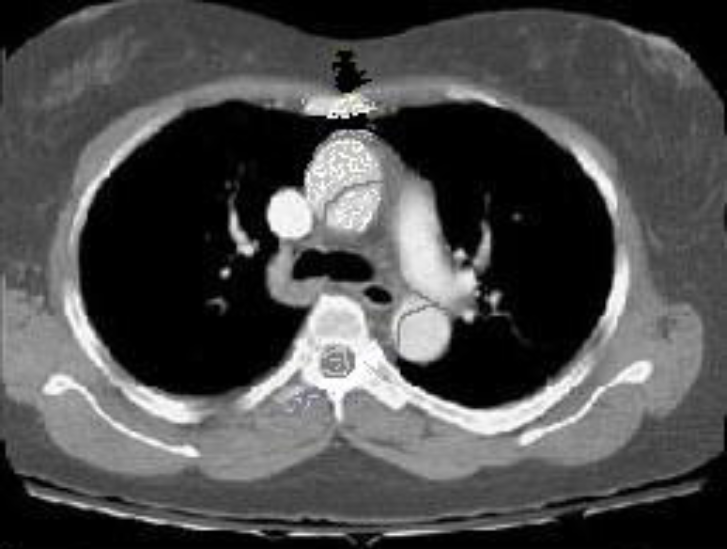
Type A aortic dissection as this is affecting the ascending aorta. The false lumen is clearly visible.
(Most common classification used is the Stanford classification –> split into A(ascending) and B(descending aorta involved)
What is the immediate management of AD?
Conservative:
- Admit to ICU
- Monitor closely - high mortality
- Control HR and BB (HR <60 and SBP 100-120) - sodium nitroprusside + beta-blocker IV
- Oxygen
- Analgesia - opioids decrease sympathetic tone
Definitive treatment:
Type A - immediate surgery
- open aortic arch replacement
- transposition of aortic branches with endovascular repair
- total endovascular repair
- frozen elephant trunk repair technique
Type B
- thoracic endovascular aortic repair (TEVAR)
What is diagnostic for aortic dissection?
Helical CT angiogram
(can be easily mistaken for MI otherwise which would be dangerous if thrombolysis were to be used)
Should you be worried if the pt develops hypotension in aortic dissection?
Ominous sign
Signifies possible tamponade, hypovolaemia.
What is the prognosis with aortic dissections?
The 10-year survival after surgery of ascending aortic dissection is 52%.
5yr survival for TEVAR in type B is 81%
What are the complications of aortic dissection?
- Cardiac tamponade
- Aortic incompetence
- MI - due to proximal propagation
- Aneurysmal degeneration/rupture
- Regional ischaemia
- Left arm ischaemia/subclavian steal syndrome - 15% after endovascular repair
- Endoleak

-
Aortic Stenosis (and Valve Replacement)42
-
Aortic regurgitation18
-
Mitral regurgitation11
-
Mitral stenosis11
-
Tricuspid regurgitation14
-
Rheumatic Fever19
-
Infective Endocarditis23
-
Atrial Fibrillation/Flutter40
-
Ventricular fibrillation11
-
Ventricular tachycardia19
-
Supraventricular tachycardia (SVT)26
-
Heart block (1st, 2nd and 3rd degree) and LBBB/RBBB23
-
Wolff-Parkinson-White syndrome24
-
Abdominal Aortic Aneurysm32
-
Aortic dissection23
-
Carotid Artery Stenosis13
-
Deep Vein Thrombosis44
-
Peripheral vascular disease (acute and chronic limb ischaemia)31
-
Arterial Ulcers24
-
Gangrene21
-
Neuropathic Ulcers (not on Sofia)8
-
Venous Ulcers24
-
Varicose Veins15
-
Amyloidosis24
-
Vasovagal Syncope20
-
*Cardiac Arrest43
-
Cardiac failure (acute and chronic)53
-
Cardiomyopathy45
-
Constrictive Pericarditis13
-
Dyslipidaemia (hypercholesterolaemia & hypertriglyceridaemia)35
-
Hypertension40
-
Ischaemic heart disease (angina pectoris, ACS, MI)54
-
Extra ACS notes51
-
ECGs52
-
Myocarditis11
-
Pericarditis26
-
Pulmonary Hypertension16
-
Coronary artery bypass graft8
-
DC cardioversion5
-
Permanent pacing, external pacing and implantable cardiac defibrillator (ICD)23
-
Coronary angiography and PCI15
-
Amputation (upper limb, above-knee, below knee)8
-
Carotid endarterectomy6
-
Revascularisation surgery5
-
Bradycardia and Tachycardia24
-
Murmur sounds7
-
Everything55



