Define constrictive pericarditis.
Chronic inflammation of the pericardium with thickening and scarring.
How common is constrictive pericarditis?
Incidence is decreasing as with many conditions that have an infectious component
Summarise the pathophysiology of constrictive pericarditis.
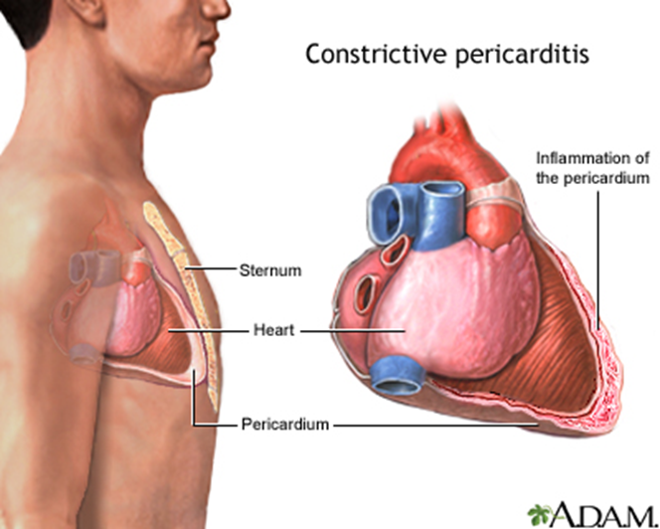
The pericardium is the sac that encloses the heart. It becomes inflamed in constrictive pericarditis.
There are 2 layers of pericardium (visceral and parietal). These 2 layers are normally distensible with a small space between them containing fluid. However, in constrictive pericarditis they become inflamed and they fuse.
Basically it acts as if there was a box around the heart.
What are the most common causes of constrictive pericarditis?
ANY CAUSE OF PERICARDITIS ESPECIALLY TB
- 90% idiopathic or viral e.g., Coxsackie virus A9 or B1-4, Echo 8, mumps, EBV, cytomegalovirus, varicella, rubella, HIV, Parvo-19
- TB, bacterial (include staph and pseudomonas)
Other causes:
- Cardiac surgery and radiation
- Incomplete drainage of purulent pericarditis
- Post-MI
- In association with pulmonary asbestos
What are the clinical features of constrictive pericarditis?
- RHF symptoms (dyspnoea, ↑ JVP, fluid congestion, ascites, hepatomegaly, oedema)
- Kussmaul’s sign positive
- JVP has prominent X and Y descent
- Pericardial knock - loud S3
- Fatigue
What investigations would you do for constrictive pericarditis?
Investigations:
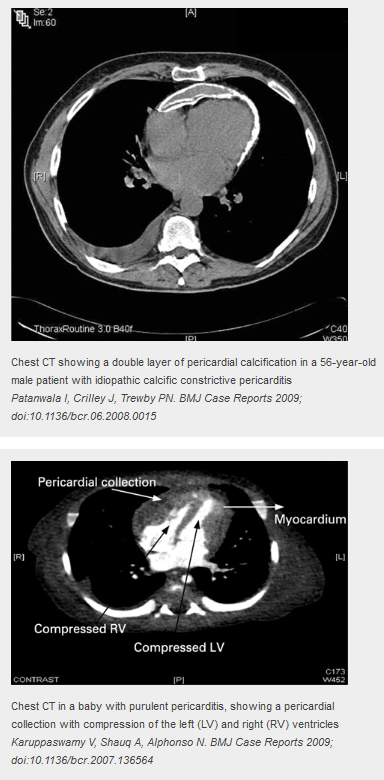
- CXR: pericardial calcification
- ECHO: ↑ pericardial thickness - helps distinguish restrictive cardiomyopathy
- Cardiac CT/MRI - done before surgical management.
What is the main differential for constrictive pericarditis?
Restrictive cardiomyopathy
Other pericardial compressive syndromes = cardiac tamponade, effusion-constrictive pericarditis.

What is seen on echo in constrictive pericarditis?
- Increased pericardial thickness
- Abnormal septal ‘bounce’
- Ventricular and valve flow abnormalities
- Bi-atrial enlargement
- Dilated inferior vena cava and hepatic veins
What is the management of constrictive pericarditis?
Early disease - MEDICAL → NSAIDs + colchicine trial for 2-3months then reassess; corticosteroids/immune modulation for 2-3 months then reassess.
Late disease i.e. calcification, AF, cachexia - SURGICAL - refer to cardiothoracics for pericardiectomy [or medical e.g. diuretics if not suitable candidates for surgery]
What are the complications of constrictive pericarditis and its management?
- Anasarca (swelling of whole body)
- AF
- Hepatic dysfunction
- Pleural effusion
- Ascites
- Pericardiectomy has 4-8% mortality
What is Kussmaul’s sign?
JVP rising on inspiration - this occurs in constrictive pericarditis
What are the differences between cardiac tamponade and constrictive pericarditis on examination?

Define pulsus paradoxus.
an abnormally large decrease in stroke volume, systolic blood pressure and pulse wave amplitude during inspiration. The normal fall in pressure is less than 10 mmHg.

-
Aortic Stenosis (and Valve Replacement)42
-
Aortic regurgitation18
-
Mitral regurgitation11
-
Mitral stenosis11
-
Tricuspid regurgitation14
-
Rheumatic Fever19
-
Infective Endocarditis23
-
Atrial Fibrillation/Flutter40
-
Ventricular fibrillation11
-
Ventricular tachycardia19
-
Supraventricular tachycardia (SVT)26
-
Heart block (1st, 2nd and 3rd degree) and LBBB/RBBB23
-
Wolff-Parkinson-White syndrome24
-
Abdominal Aortic Aneurysm32
-
Aortic dissection23
-
Carotid Artery Stenosis13
-
Deep Vein Thrombosis44
-
Peripheral vascular disease (acute and chronic limb ischaemia)31
-
Arterial Ulcers24
-
Gangrene21
-
Neuropathic Ulcers (not on Sofia)8
-
Venous Ulcers24
-
Varicose Veins15
-
Amyloidosis24
-
Vasovagal Syncope20
-
*Cardiac Arrest43
-
Cardiac failure (acute and chronic)53
-
Cardiomyopathy45
-
Constrictive Pericarditis13
-
Dyslipidaemia (hypercholesterolaemia & hypertriglyceridaemia)35
-
Hypertension40
-
Ischaemic heart disease (angina pectoris, ACS, MI)54
-
Extra ACS notes51
-
ECGs52
-
Myocarditis11
-
Pericarditis26
-
Pulmonary Hypertension16
-
Coronary artery bypass graft8
-
DC cardioversion5
-
Permanent pacing, external pacing and implantable cardiac defibrillator (ICD)23
-
Coronary angiography and PCI15
-
Amputation (upper limb, above-knee, below knee)8
-
Carotid endarterectomy6
-
Revascularisation surgery5
-
Bradycardia and Tachycardia24
-
Murmur sounds7
-
Everything55



