Autoimmune Diseases
Characteristics
Situations where adaptive immunity inappropriately targets self-antigens due to loss of self-tolerance.
- Chronic, progressive, and self-perpetuating
- If autoreactive reaction crosses threshold, resulting tissue damage can further up-regulate immune response
Factors Leading To
Autoimmunity
- Breakdown or failure of tolerance mechanisms
- Genetic susceptibility
- Uncontrolled or misdirected response to foreign antigen
- Injury
- Hormonal influences
Genetic Susceptibility
to
Autoimmunity
- MHC Alleles
- Most associated with class II MHC
- Alkylosing spondylitis shows strongest correlation
- Most encode residues in the peptide binding groove or regions near the groove
- Determines peptide binding, T cell recognition, and selection during thymic maturation
- Non-MHC Alleles
- Genes with role in development and regulation of immune responses
- Most in noncoding regions of the gen e
- Few single-gene abnormalities identified that cause autoimmunity
- High penetrance
Infection
&
Autoimmunity
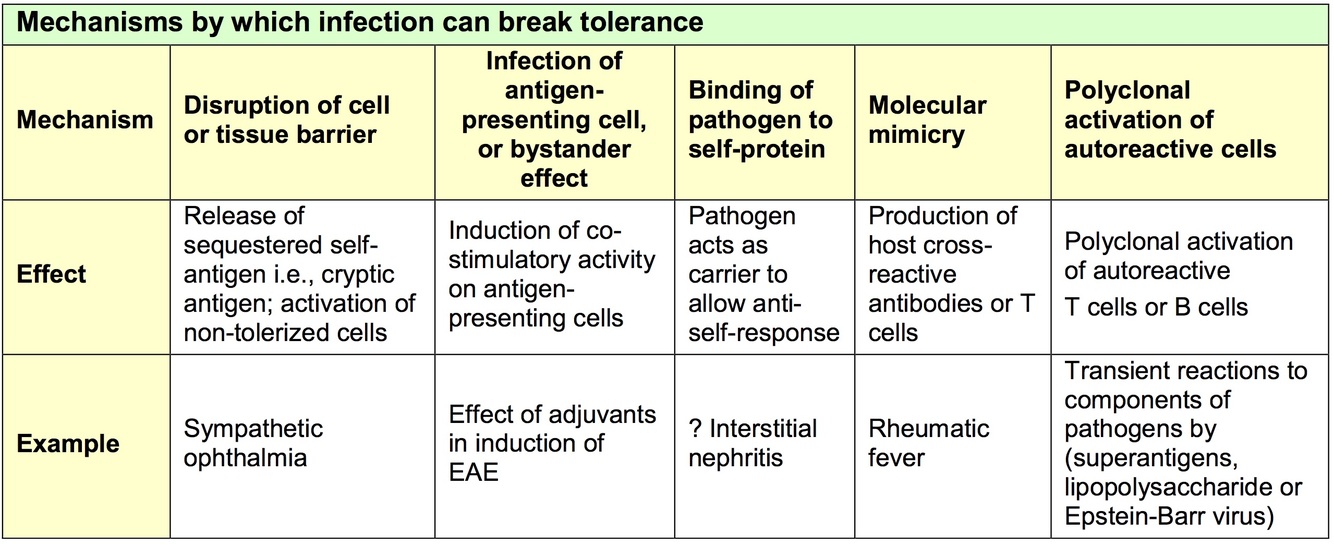
- Release of sequestered Ag
- Break cell/tissue barriers
- Increasing concentration of specific self-Ag
- Triggers activation of un-tolerized (ignorant) lymphocytes
- Triggering a bystander effect
- Infection upregulates costimulators on APCs
- Naive non-tolerant T-cells accidently provided both signals by APC presenting self-Ag
- Altering self-proteins
- Infectious agents bind to self-Ag making them appear foreign
- As immune response develops, epitope spreading could lead to autoimmunity
- Triggering a cross-reactive response due to molecular mimicry
- Foreign-Ag induces T/B cells with cross-reactivity to self-Ag
- Causes naive cells to expand to autoractive effector cells
- Overcoming anergy by the polyclonal activation of lymphocytes
- T-cell activation by superantigen
- B-cell activation by LPS or Epstein-Barr virus
- Can activate previously tolerized or anergized autoreactive cells
Changes in Anatomical Structures
&
Autoimmunity
Inflammation, ischemia, or trauma can result in the release of self-Ag.
- Post-traumatic uveitis and orchitis
- Follows damage to an immunoprivileged site of the eye
- Sympathetic ophthalmia
- Rare bilateral granulomatous uveitis
- Follows ocular trauma or surgery to one eye
- Both eyes affected once tolerance or clonal ignorance lost
Gender Differences
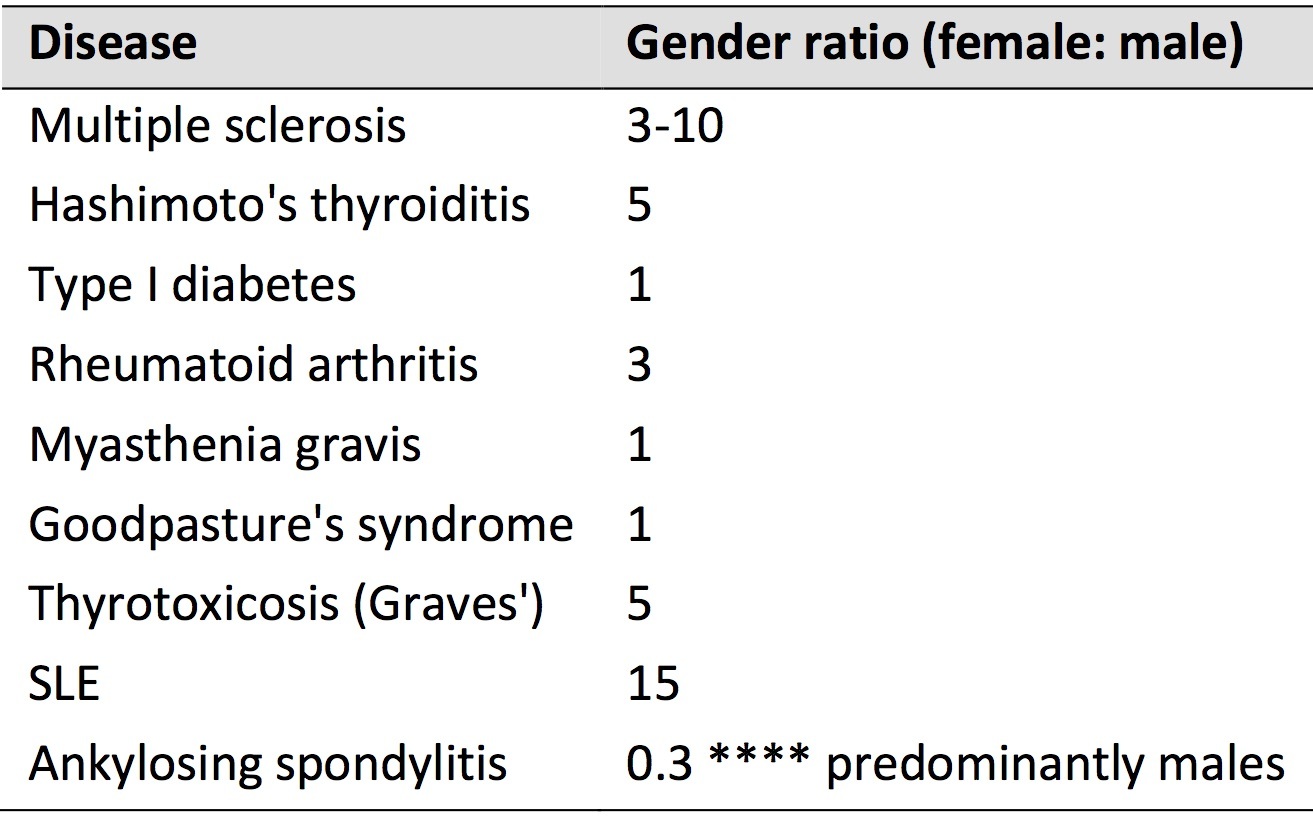
Most autoimmune diseases have high incidence in women.
Thought to be secondary to hormonal changes.
Theories include:
- women have more vigorous immune responses overall
- women with more Th1 like responses
- immunostimulatory role of estrogen and prolactin
- fetal cells in maternal circulation
- maternal cells in male circulation
Self-Tolerance Failure
- defects in deletion
- impacts central tolerance of T & B cells
- defects in apoptosis
- impacts central tolerance and AICD
- defects in anergy
- breakdown of T cell anergy
- inadequate Treg cell generation
Autoimmunity Stages
- Predisposition of an individual to autoimmunity.
- Autoimmune event initiated by an environmental trigger or stochastic event.
- loss of self tolerance
- stimulation of autoreactive lymphocytes
- Autoimmune attack releases additional self-Ag which are not eliminated in an efficient manner
- allows propagation of autoimmune response
- often there is a response against an increasing number of self-Ag
- epitope spread - recognition of additional epitopes within the recognized self-Ag
- development of clinical features
Organ-specific
vs
Systemic Disease
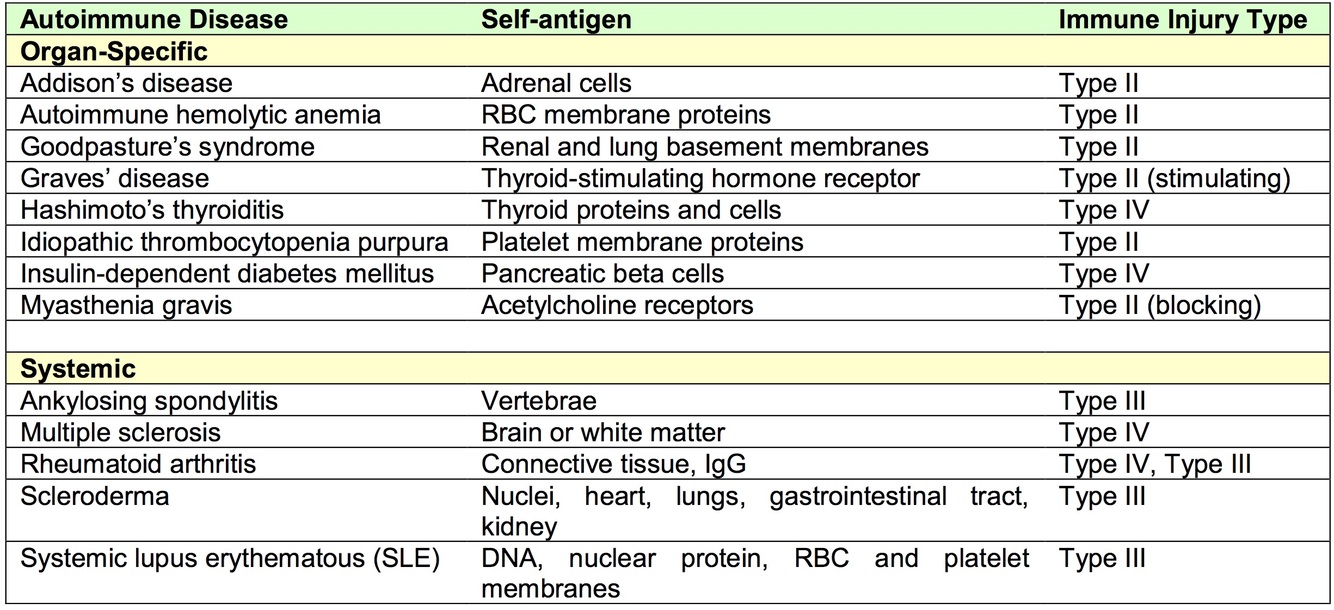
Determined in part by distribution of auto-antigen.
- Organ specific autoimmune diseases
- often involve reactivity against a single antigen or target cell
- can result in systemic symptoms
- Systemic Disease
- tend to be immune complex mediated
- involves auto-reactivity against multiple self-antigens
T vs B
Mediated Damage
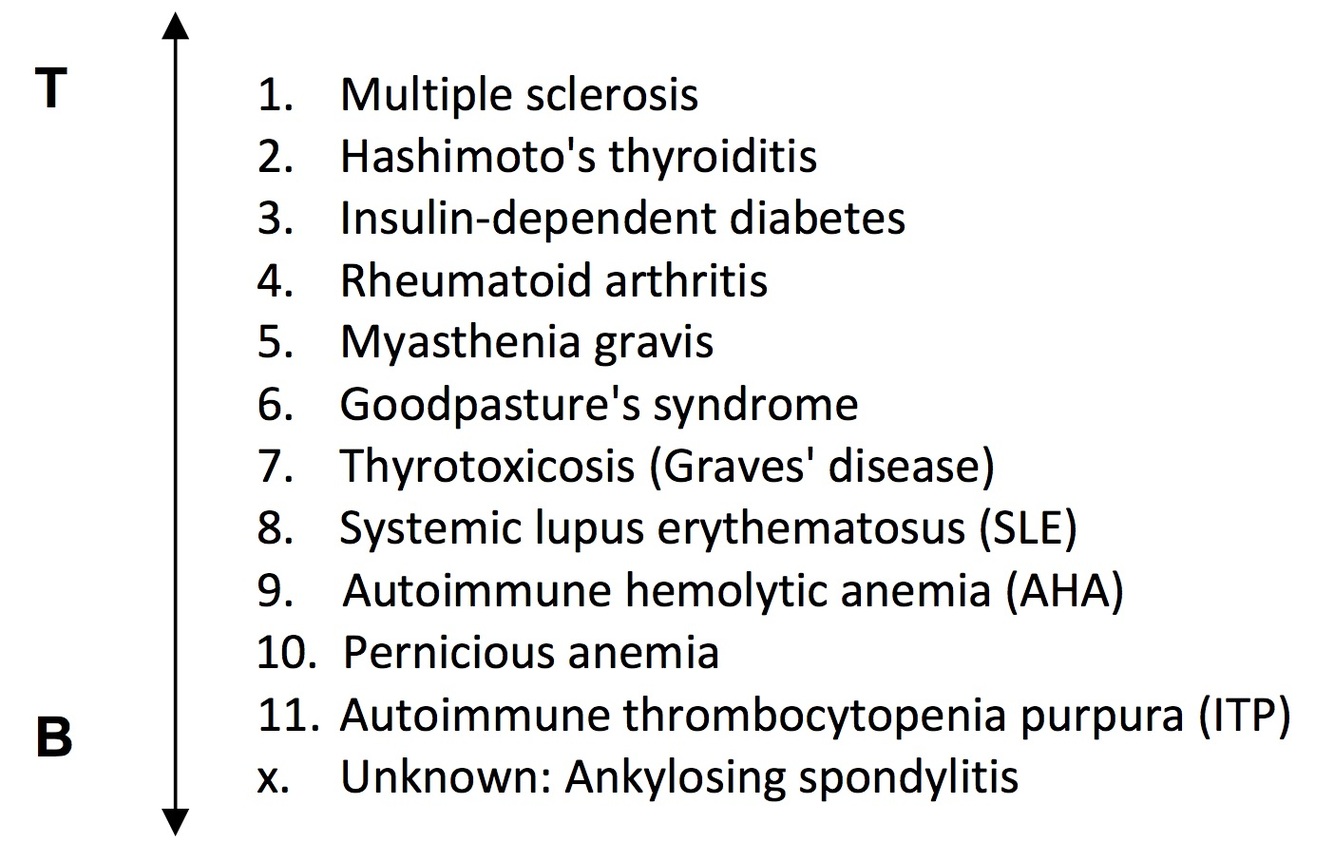
Various effector mechanisms responsible for tissue injury.
Most autoimmune diseases have varying roles for T-cells and B-cells in pathogenesis.
Most B-cell responses are T-cell dependent.
B-cells can act as important APC for T-cell activation.
Multiple Sclerosis
(MS)
Prominent T-cell activity.
Considered a type IV hypersensitivity.
- Mediated by autoreactive CD4+ T-cells
- Inflammatory process upregulates Fas on oligodendrocytes making them targets for FasL expressing T-cells
- Results in demyelination or destruction of myelin sheaths in CNS
- Relapsing-remitting course or chronic progressive form
- Treatments include:
- mAb for IL-2R α-subunit
- mAb for VLA-4 on activated T-cells
- blocking exit of WBC from LN
Type I DM
Prominent T-cell activity.
Considered a type IV hypersensitivity.
- Pancreatic β-cells destroyed by CTL-mediated killing
- Also involves CD4+ T-cells and macrophages
- Secrete proinflammatory cytokines
- Results in insulin deficiency or absence
- Treatment includes:
- insulin
- immunosuppresion
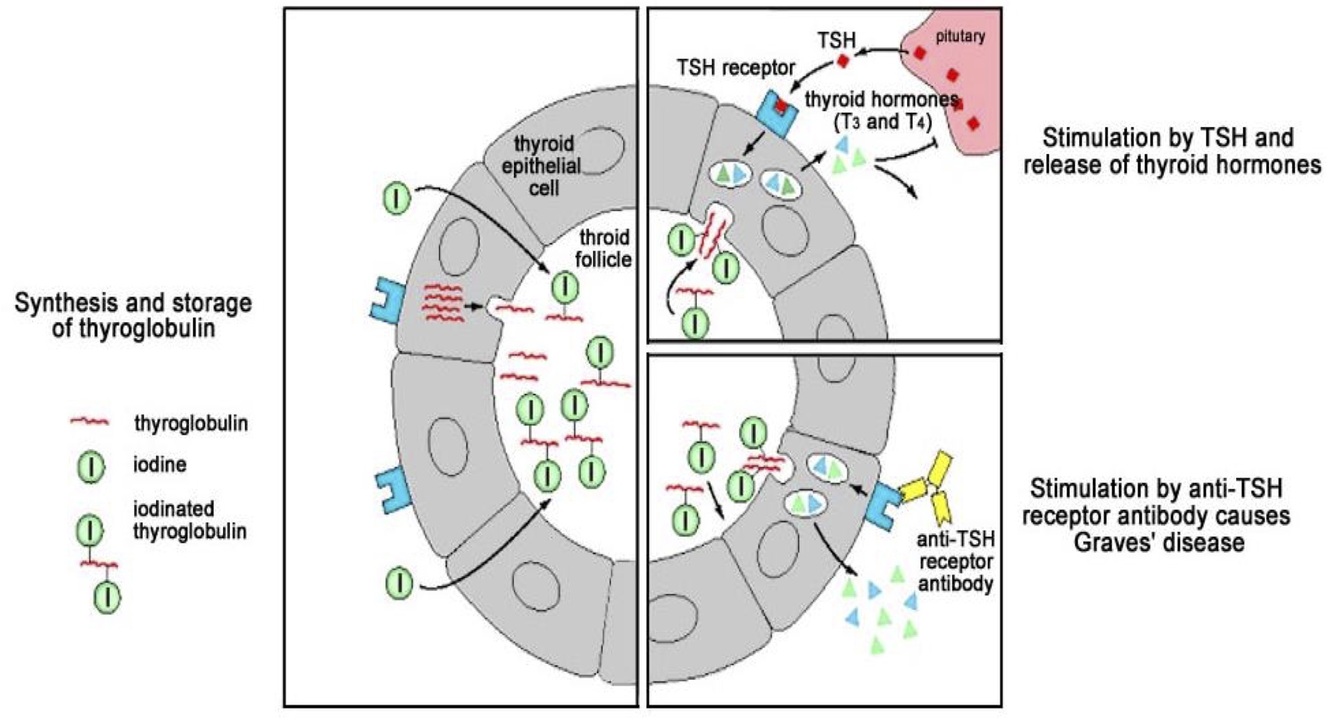
Graves’ Disease
Prominent B-cell activity.
Considered a non-cytotoxic type II hypersensitivity.
- Auto-Ab causes constitutive activation of TSH receptor
- Can be transmitted from motehr to infant via placental igG
- Results in overproduction of T3 and T4
- See metabolic sx
- Treatment includes:
- anti-thyroid drugs to reduce production of thyroid hormones
- surgery, radioiodine
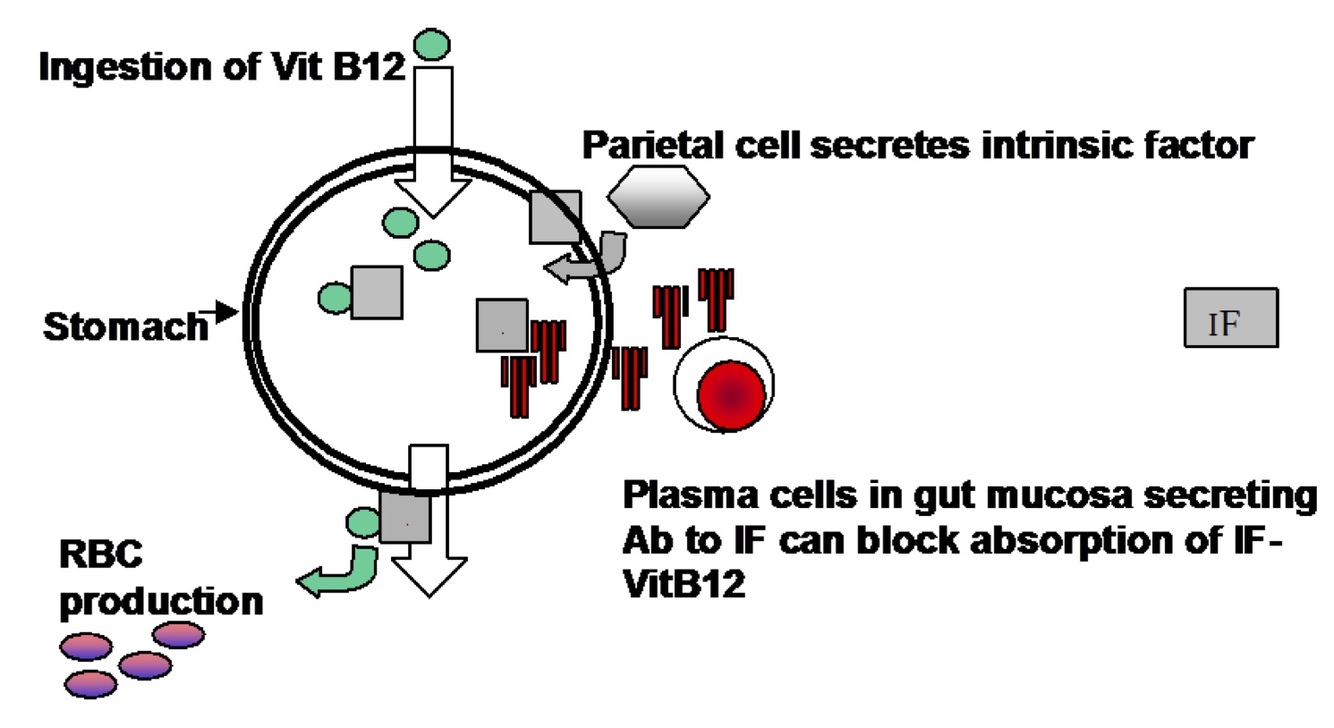
Pernicious Anemia
Prominant B-cell activity.
Considered a type II hypersensitivity.
- Auto-ab against intrinsic factor
- IF needed for absorption of Vit B12
- Erythropoiesis deficient leading to macrocytic anemia
- Treatment with Vit B12 supplementation
Goodpasture Syndrome
Prominent B-cell activity.
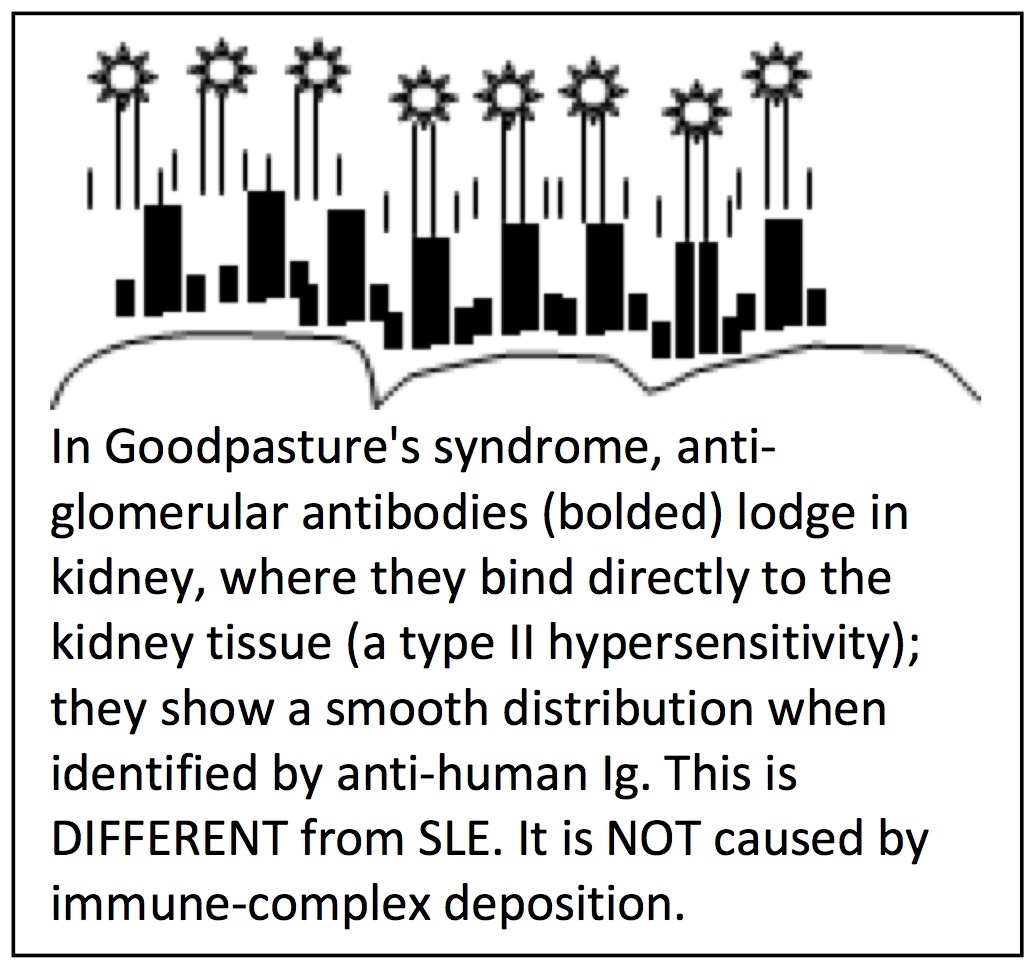
Considered a type II hypersensitivity.
- Auto-ab bind antigenic epitope in basement membranes
- Results in recurrent alveolar hemorrhage
- For Ab deposition, additional lung injury must occur which increases alveolar-capillary permeability
- Rapidly progressive severe glomerulonephritis
- Treatment includes:
- Plasmapheresis
- Prednisone
- ACE inhibitors
Systemic Lupus Erythematous
(SLE)
Combined T and B cell activity.
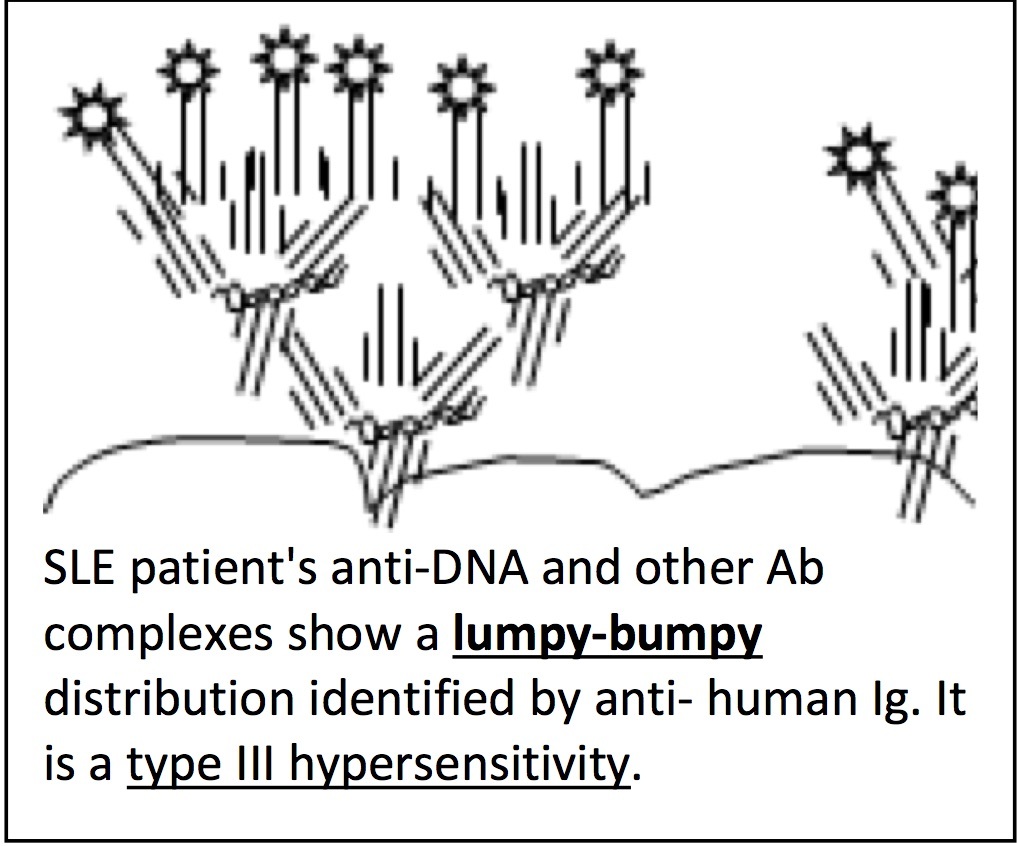
Considered a type III hypersensitivity.
- High titers of antinuclear auto-Ab and nuclear debris form immune complexes
- Often also auto-Ab against platelets, WBC, RBCs
- Complexes activate complement components
- Directs accumulation of granulocytes within glomeruli
- Destruction of blood vessel wall and nephron
- “lumpy bumpy” morphology with immunofluorescence
- Glomerulonephritis most damaging
- Butterfly rash on face
- Auto-reactive T-cells play a critical role
- Can activate auto B cells with more wide range of reactivities
- Abnormalities in macrophage scavenger function results in poor clearance and increased pathogenesis
- Treatment with immunosuppresive drugs
Rheumatoid Arthritis
(RA)
Combined T and B cell activity.
- Inflammatory process in joints results in dysfunction and deformity
- Th1 cells and macrophages play dominant role in RA development
- Rheumatoid factor (RF) with role in inflammation and neutrophil recruitment but likely not causitive
- Early stage:
- Contain infiltrating neutrophils, lymphocytes, and plasma cells
- Advanced stage:
- highly vascular inflammatory tissue = pannus
- mostly lymphocytes, plasma cells, macrophages, and fibroblasts
- undergoes calcification
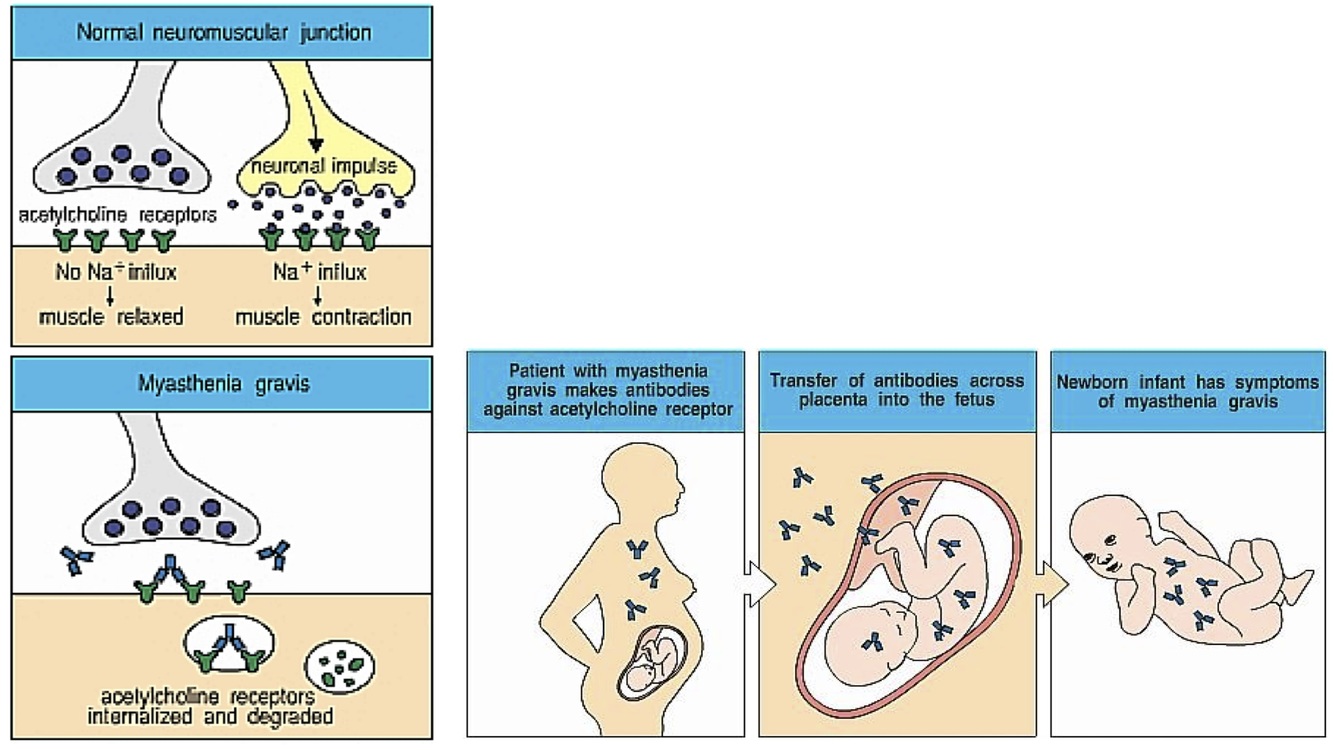
Myastenia Gravis
Combined T and B cell activity.
Type II Hypersensitivity
- Auto-Ab bind Ach receptor at NMJ
- Block interaction of Ach with receptor
- interact with regions near the receptor and physically hinder Ach access
- Bound Ab fix complement
- Induces destruction of the folding membrane
- IgG antibody can cross placenta
- Cause transient disease in newborn
- T-cells can transfer disease in animal models
- Treatment includes:
- plasmapheresis
- exchanges with normal plasma
- thymectomy
- acetylcholinesterase inhibitors
Therapeutic Approaches
for
Autoimmune Diseases
- Corticosteroids
- Reduce tissue injury
- block inflammatory process
- Immunosuppressive drugs
- Cyclosporine
- Blocks T cell activity
- Used to treat severe exacerbations
- Cyclosporine
- Immune mediators
- Antagonists of pro-inflammatory cytokines IL-1 and TNF-α
- Anti-integrins
- inhibit pathologic immune reactions
- Costimulator antagonists
- B7
- CD40 ligand
- Block T-cell activation
- Plasmapheresis
- reduce the amount of circulating Ab
- Induce tolerance
- Oral administration of self proteins
- administration of altered self proteins

-
Introduction32
-
Innate Immunity30
-
Complement27
-
Inflammation & Hematopoiesis30
-
Antibody Structure and Function38
-
Antibody Recognition and Generation of Diversity15
-
B-Lymphocyte Development and Antibody Production14
-
Clinical Applications of Ab/Ag Interactions6
-
TCR and MHC14
-
Antigen Processing and T-cell Ontogeny13
-
T Cell Activation and Effector Functions13
-
TC & TH Cells25
-
Immunity to Infection13
-
Cancer30
-
Hypersensitivities46
-
Immune Regulation & Tolerance24
-
Autoimmunity19
-
Transplantation32
-
Immunodeficiencies30



