Function of the spine?
- The spine allows a range of movement
- The spine protects our spinal nerves
- The spine functions as a shock absorber (as do the legs)
- This occurs because the spine is flexible, and is supported by strong muscles and tendons
- If this is lost, we lose the ability to protect ourselves from abnormal shocks and vibrations
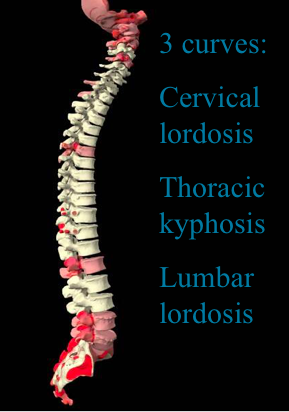
What are the 3 curves of the spine?
- Cervical lordosis
- Thoracic kyphosis
- Lumbar lordosis
Which part of the spine is the most mobile? Why?
The cervical spine - due to having relatively thick discs in comparison to the size of the adjacent vertebrae
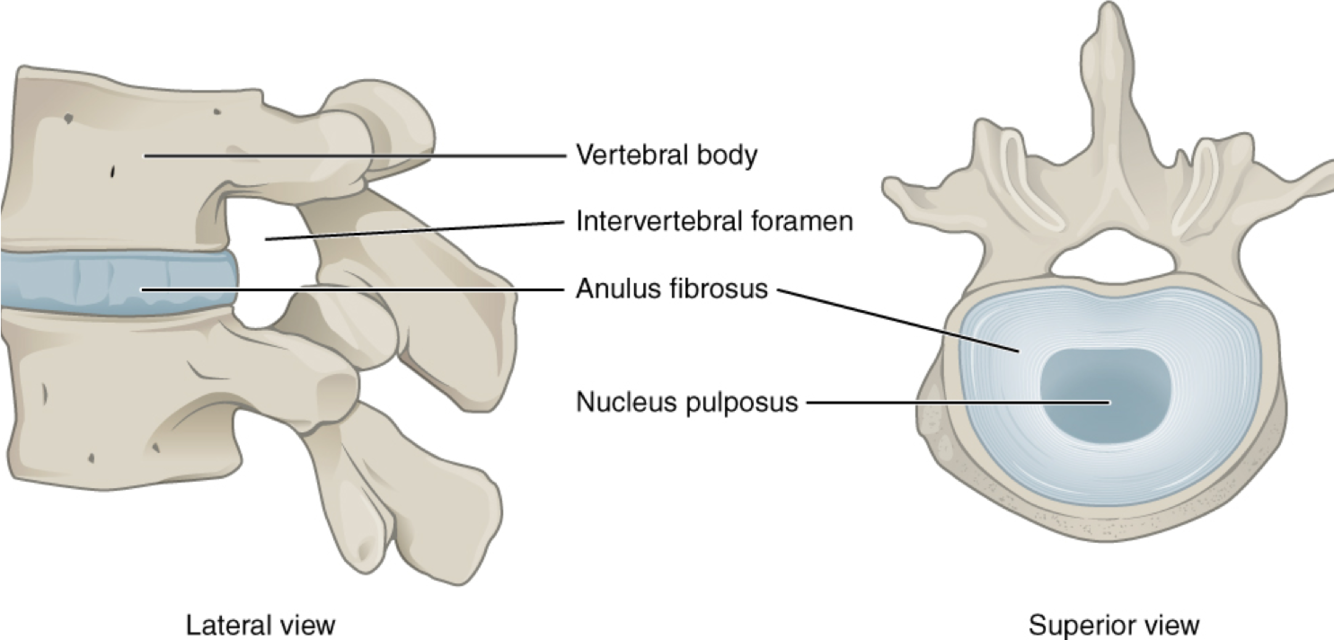
Diagram of intervertebral discs. What 2 components is it made up of?
- Annulus fibrosis (outer portion)
- Nucleus pulposus (inner squidy portion)
What occurs during a slipped disc?
Occurs when the intervertebral disc’s outer fibers (the annulus) are damaged and the soft inner material of the nucleus pulposus ruptures out of its normal space. If the annulus tears near the spinal canal, the nucleus pulposus material can push into the spinal canal.
How does the composition of the intervertebral discs change throughout the day?
- In the morning they are swollen with water so the annulus and intervertebral ligaments resist bending strongly
- More vulnerable to injury as the day progresses as discs lose up to 20% of their water and height so the spine is more supple
- Low back pain can increase during the day and with standing.
How do intervertebral discs change with age?
- Discs lose water and lose strength and become thinner
- Vertebral endplates and underlying bone structure loses strength
- Repetitive loading/trauma can result in annular tears in the discs
- Dryer, weaker discs result in slacker ligaments
- Spine is less stable
- New bone grows (osteophytes) to try to stabilise the spine
- Increased load over the facet joints
What should be told to patients with lower back pain?
Keep flexible and keep strong –> keeps back less stiff
What determines back pain?
- Genetics
- Environment
- Body weight
- Muscle strength
- Mechanical loading strengthens vertebral bodies and increases the water content within discs
- OVERloading should be avoided
What are the risk factors for low back pain (LBP) at work?
- Heavy physical jobs
- Lifting
- Driving to work
- Previous episodes of LBP
- Mental health
- Posture- laptops, seating, desk set-up
Low back pain (LBP) can either be: simple backache, nerve root involvement or even possible serious spinal pathology.
What is the history of mechanical (simple) back pain?
- First episode often sudden onset while lifting/twisting/turning
- Recurrent episodes with decreasing inter-episode frequency
- Variable pain related to position/posture
- Better lying flat
- May radiate to buttock and leg
- Often worse at the end of the day and better with lying down/resting
100% of people over 65 years have radiological changes in their spines. What are examples of these changes?
- facet arthritis
- disc narrowing
- osteophytes
What are the guidelines for LBP - early management
- Simple analgesics
- Physiotherapy if symptoms > few days
- Rest for no longer than 1-3 days
- Psychosocial management
- Work absence only if unavoidable
- Early return to work, possibly graded
- Consider secondary care referral if on going at 6 weeks
What are the drug treatments for LBP?
- Paracetamol
- NSAIDs
- Opioids
- Anti-depressants (amitriptyline, duloxetine)
- Nerve modulators (gabapentin, pregabalin)
What is sciatica?
Sciatica refers to pain that radiates along the path of the sciatic nerve, which branches from your lower back through your hips and buttocks and down each leg. Typically, sciatica affects only one side of your body.
What are the nerve roots of the sciatic nerve?
L4 to S3
What can cause sciatica?
- When the sciatic nerve becomes pinched, usually by a herniated disk in your spine or by an overgrowth of bone (bone spur) on your vertebrae.
- More rarely, the nerve can be compressed by a tumor or damaged by a disease such as diabetes.
Symptoms of sciatica?
- Pain radiating from the back to the leg below the knee
- May be associated with pins and needles in leg
- May be associated with numbness and weakness
- Commonest neurological sign is loss of ankle jerk
- Commonest weakness is foot drop
What is the commonest neurological sign of sciatica?
Loss of ankle jerk
What are rheumatology back pain diagnoses?
- Degenerative disease
- Axial Spondyloarthritis
- Osteoporosis
- Osteomalacia
- Paget’s disease
- Infection
- Tumour
What are the ‘red flag’ symptoms for back pain?
- Age (young or old) at first onset
- History of carcinoma
- Breast, kidney, prostate, lung, thyroid are most likely to spread to bone
- Weight loss
- Constant (24h) pain > 1 month
- No response to treatment
- Pain worse at rest
- History of IV drug abuse or HIV positivity or immunosuppression
- Infections
Inflammatory back pain history:
- Insidious onset
- Nocturnal pain with marked early morning stiffness
- Better with exercise
- Worse with rest
- Family history
- Buttock pain- can alternate
What is axial spondyloarthritis? Symptoms?
Axial spondyloarthritis is an umbrella term for types of inflammatory arthritis that primarily affect the spine and the sacroiliac (SI) joints. Affects young people (men > women).
Symptoms:
- Back pain (main symptom)
- pain and stiffness in the spine
- other joint inflammation
- enthesitis
- iritis
- FH of associated diseases (IBD, psoriasis)
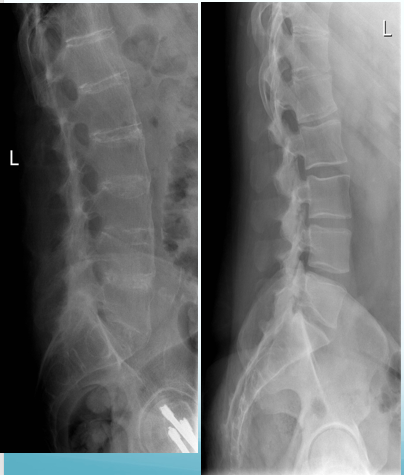
What is osteoporosis?
Osteoporosis is a bone disease that causes a loss of bone density, which increases your risk of fractures.


-
Development of CNS53
-
Intro to Human Brain78
-
The Skull146
-
Head and Neck 1: Front of Neck SDL124
-
Meninges and Ventricles106
-
Blood Supply128
-
Head and Neck Practical 1111
-
Head and Neck 2: Face and Skull93
-
Head and Neck Practical 284
-
Braindeath29
-
Brainstem and Cerebellum118
-
Neuroanatomy 1 SDL59
-
Neuroanatomy Practical 1113
-
Cranial Nerves83
-
Forebrain (Cerebrum)61
-
Control Week 1 MCQs16
-
Neuroanatomy Practical 2112
-
Neuroanatomy 2 SDL: Brainstem, Cerebellum and Cranial Nerves130
-
Localisation91
-
AFL 522
-
Muscles of Mastication12
-
Facial Nerve Revision30
-
Arteries of the Head and Neck29
-
Vertebral Column89
-
Spinal Cord and Nerves90
-
Backpain32
-
Ascending Sensory Pathways122
-
Descending Motor Pathways91
-
Contents of the Vertebral Canal SDL45
-
Vertebral Column and Contents Practical71
-
Revision - Different Regions of the Spine23
-
Control Week 2 MCQs11
-
AFL 624
-
Neuroanatomy 3 SDL: Forebrain, Ventricles and CSF40
-
Neuroanatomy Practical 3107
-
Autonomic Nervous System76
-
Skin Histology0
-
Somatosensory Disorders - Sensory Loss1
-
Headache60
-
Skin SDL44
-
Somatosensation Revision49
-
Epilepsy - Clinical Lecture85
-
Clinical - Tumours of the CNS44
-
Spinal Reflexes54
-
Muscle Weakness37
-
Trigeminal Nerve Revision27
-
Control Week 3 MCQs17
-
Pain & Somatosensory Disorders45
-
Peripheral Somatosensory System17
-
Cerebellum90
-
Head Injuries SDL33
-
AFL 726
-
Pain49
-
Local Anaethesia85
-
General Anaesthesia60
-
Visual Pathway112
-
Visual Defects119
-
Visual Defects40
-
SDL - Eye and Ear70
-
Auditory Pathway95
-
Clinical - Multiple Sclerosis0
-
Control Week 5 MCQs15
-
Control Week 6 MCQs32
-
NeuroAnatomy Revision57
-
ANS Revision97
-
Skin and Sensory Receptors MCQs10
-
Basal Ganglia73
-
Limbic System62
-
AFL 825
-
Physiology of Vision27
-
AFL 925



