what does a chemostat do
- ensures logarithmic growth by constantly adding and removing equal amounts of culture medium (open system)
- allows growth and growth conditions/environment to be highly controlled
explain biofilms
- biofilms: bacteria growing on surface
- bacteria are communal creatures
- vast majority of prokaryotes do not grow as planktonic (single unicellular) sepcies - dont usually grow in suspension like in chemostat
- mroe grow in communities/ consortium of diff species that stick together on organic or inorganic surfaced forming specialized structures called biofilms
- partially true in aquatic ecosystems
- can form on range of surfaces: biotic (heart valves), or abiotics
why are biofilms important in human medicine
- can form in areas where joints have been replaced
- can form on kidney
what are microbial biofilms?
- complex and elaborate assemblages of bacterial micro-colonies attached to surfaces and surrounded/enased in a porous, sticky and adhesive extracellular polysaccharide (EPS) matrix (or slime)
^porous material and sticy to hold bac together and to surface, this maeks them very diffucult to remove
- trapped within the EPS are bacterial secreted proteins and extracellular DNA fragments
-biofilms can be protective
how are biofilms formed?
if find nutrient good condition surface they start to attach
5 Steps:
- Reversible Attachment of Planktonic bacteria
* fimbrea, pilli used for attachment, they lose their flagella - Attached/sessile bacteria form Microcolonies
- EPS secretion
* biofilm will start to extend from surface, becomes deeper and forms towers - Biofilm Elaboration and Maturation
- Form Columns / towers, channels, streamers
- Diversity of microenvironments, bac at surface interacting more with environment while ones deeper in are in lower oxygen conc
- how they grow will be effected, competition for resources
- Dissolution and Dispersal (if nutrients are scarce)
* Sessile cells (attachment bacteria) revert to planktonic state, reexpress their flagella
*biofilm formation is regulated by Quorum sensing
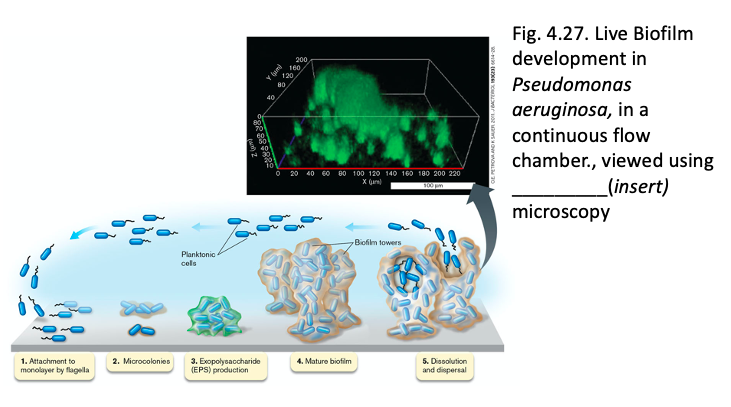
what is the life cycle of a biofilm
- formed when nutrients are plentiful: bacteria attach to surfaces vai cell-envelope/surface appendages)
- once nutreints become scarce, individuals detach from the community to forage for new sources or nutrients
- biofilms in nature can take many iff forms ans serve diff functions for diff species
*most in nature are consortium of diff species
- single species biofilms are foten associated with pathogenic bacteria
ex: Pseudomonas aeruginosa in the lungs of immunocompromised CF - formation of biofilms can be cued by different environmental signals
- regualted by quorum sensing
what is quorum sensing?
- process for assessing bacterial density
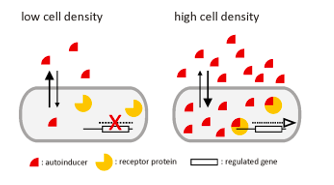
- invovled signalling/communication molecules or autoinducers secreted into surrounding environment
*each bacteria will diffuse this into environment
- asses the signal conc: autoinducers freely diffuse in and out of bacterial cells and bind to cytoplasmic receptor (transcription regulator) protein
- the extracellular concentration of the inducer increases with increase in cell population density (mroe bacteria the more secreted)
- at certain inducer conc (or quorum) the transcription regulator is activated and binds to the DNA activating quorum sensing reg genes
*result: co-ordinated response by ALL cells int he community
*mechanism for regualting/density dependent community behaviours
what is significant about environment around bacteria in microenvironments?
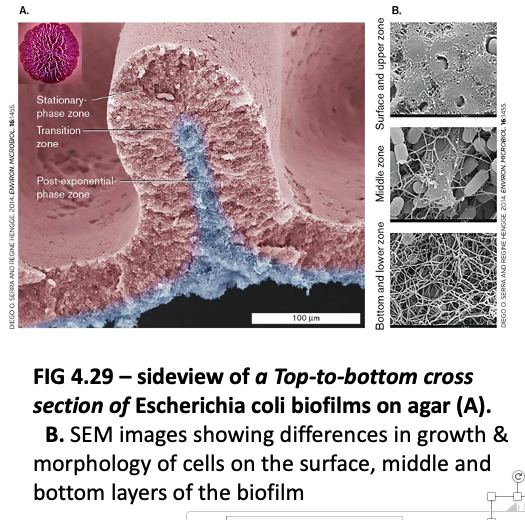
- diff microenvironments develop in diff laers of the biofilm
- gradients of oxygen concentration, nutrient availability an competition by products (by products can alter the pH of their env)
- bacterial cells exhibit different physiological states
- differences in growth rates (ones on surface growing much faster, ones on inside may be dorment), stress response/adaptation, metabolic activity
- biofilm bacteria exhibit differences is susceptibility yo killing antimicrobacterials: ones on surface killed but will get replaced by dorment centre ones, will appear to have gotten rid of bacteria then dorment ones iwll take over
pros and cons of biofilms
Pros:
- allow microbes to work together effectively eg: metabolize complex substrates
- normal microbiota biofilms of plants and animals are beneficial/essential
Cons:
- damage equipment, degrade infrastructure (concrete, metal pipes)
- colonize abiotic surface put into the body (heart vales, replacemnt joints, catheters)
- biofilms of pathogenic bacteria are a huge problem in medicine (biofilms on plaque& tooth decay)
- highly resistant to antimicrobials by killing immune response cells and defences (biofilms are too large for something like a macrophage to have an effect)
what is cell differentiation
- bacteria faced with environmental stess undergo complex molecular reprogramming that includes changes in cell structure
ex: endospores of certain gram positive bac, heterocysts of cyanobacteria, fruiting bodies of myxococcus xanthus, aerial hyphae and arthrospores of Streptomyces
ex: anabaena differentiating into specialized cell
-Anabaena, cyanobacteria a filamentous photoautotroph, differentiates into specialized cells called heterocysts found along the filament
these are specialized structures housing the nitrogen-fixing Nitrogenase enzyme
- the enzyme is sensitive to oxygen & the heterocyst contains oxygen-binding complexes, highly specialized cell wall
*what kind of media would oyu need to grow this, what component would you want to omit?
Actinomycete bacteria
- gram positie streptomyces
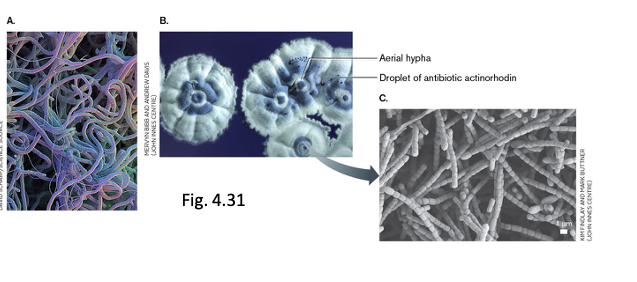
- in growht morphology looks like fungi bc have filementous mycella and aerial sporangia (spore containing bodies)
- as nutrients decline, aerial hyphae divide into arthrospores that are resistant to dying
*differentiation at level of cycelia, spore formation and of the aerial hyphase
describe bacterial cell sporulation
- certain G+ are able to place themselves into suspended animation when going gets tough
- Clostridium, Bacillus & Clostridiodiodes species when starved trigger differentiaon process to produce endospores in mother mody
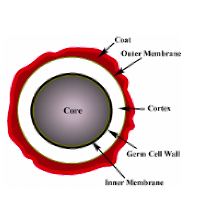
- formant strucutres much smaller than mother cells containing highly complex cell walls & dessicated cytoplasm with no metabolic activity
*looks nothing like gram pos cell wall
- resistant to killing by ‘dry’ heat, radiation and bacteriophages
*killed by autoclaving under high temp, high pressue plus moisture
- endospores can survive in env for decades, once optimal conditions return, germination is tiggered releasing the cell back into vegetative growth cycle
why are endospores an important virulence determinant
- cna be veyr hard t kill bc not actively metabolizing
ex: Bacillus anthracis (anthrax) spores can be weaponized - Clostridium tetani spoes can lurk in soil until inoculated depp into animla flesh
clostrigioides difficile (Cdiff, persistent large bowel infections) spores are difficult to eradicate and easily passed from patient to patient in hospital setting_
what happens to cells which cannot sporulate in harsh conditions
- quickly activate starvation response survival systems including:
- down regulate metabolism (slow growth/ longer generation times)
*can reduce effect of antibioitcs
- cells get smaller, cell walls thicker (resist antimicrobials and env stress), glycogen stores are laid down, nutrient transporters are expressed, stress response proteins are expressed
what are endospores
- bacteria in suspended animation
- certain gram + can develop formant spores that are heat and dessication resistance - do not grow or need nutrients until they germinate
- 7 stages, DNA replciated and is stretched into filament, septum divides cell into 2 unequal compartments (smaller forespore ultimately becomes the spore and the larger mother call)
- mother membrane engulfs forespore then mother chromosome is destroyed
- thick peptidoglycen layer played between 2 membranes, layers of coat proteins then deposit on the outer membrane. finally dipicolinic acid synthesized - sablizes and protexts spore DNA
- fully mature spore can exist for at least 50-100 years
how do cyano bacteria differentate into nitrogen fixing heterocysts
autotrophic cyanobacteria, such as Anabaena, not only carry out photosynthesis but also “fix” atmospheric nitrogen to make ammonia
- nitrogenase which is required to fix nitrogen is very sensitive to oxygen (produced as by product of photosynthesis)
- would think photosynthesis and nitrogen fixation are two mutally exclusive physiological activities
- anabaene covert every 10th photosynthetic vegetative cell into a heterocyst - heterocyst makes nitrogenase, produce 3 additional cell walls and form specialized envelope that provides a barrier to atmospheric O2 and degrades photosynthetic machenery that makes O2

-
History of Microbiology30
-
Microscopy31
-
Bacterial CM transport29
-
Cell envelopes35
-
Virus37
-
Microbial growth30
-
Biofilms18
-
Environmental influences on microbial growth25
-
Microbial diversity16
-
Bacterial diversity27
-
Archaeal Diversity24
-
Microbial Diversity: Eukarya33
-
Microbial Ecology and Microbial Association46
-
Introduction to the innate immune system35
-
Cellular barriers to the innate immune system33
-
Adaptive Immune system27
-
Adaptive Immune system Pt 2: Oct 3021
-
Guest lecture19
-
Microbes in health and disease31
-
Microbes and health: Nov 625
-
Defining the interplay of Klebsiella pneumoniae and host during infection by quantitative proteomics24
-
Viral Pathogens26
-
HIV: Viral pathogen24
-
Guest lecture Nov 1812
-
Physical, chemical and biological control of microbes38
-
Microbes in biocontrol19
-
microbes in food and beverage industry17
-
lab11
-
microbes in food and beverage industry pt 223



