energy to build cells comes from chemical reactions, explain
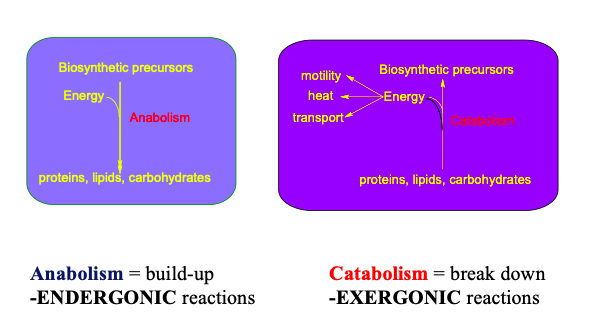
- catabolic rxns/ catabolism = breakdown of complex molecules into smaller ones releasing energy
- anabolism = reactions that build molecules, require energy
*catabolism provides energy from anabolism
cellular metabolism = catabolic + anabolic processes
- not all energy releaed by catabolic rxns can be harnessed, some released as heat
organisms can be described by how they obtain their _____
Carbon
- AUTOtroph: CO2
- HETEROtroph: preformed organic compounds
Energy source
- PHOTO: light photons
- CHEMOLITHOtroph: energy from minerals
- CHEMOORGANOtroph: energy from organic comp
what is the primary energy storage currency in cells
- ATP
- under physiological conditions,ATP always forms a complex w magnesium
(one reasion ehy magnesium is an essential nutrient of all living things
what are teh central reactions for ATP generations in chemoorganoheterotrophs
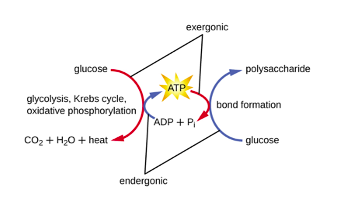
- glycolysis, krebs cycle and oxidative phosphorylation to generate ATP
- glucose into polysaccharides (requires energy)
what are energy carriers in cells besides ATP
- GTP (guanosine triphosphate) provides energy for protein synthesis
- other energy carriers also carry electrons, NADH, FADH
*transfer of electrons from donor to acceptor releases energy
what is NADH
•Nicotinamide adenine dinucleotide (NADH) carries two or three times as much energy as ATP.
- It also donates and accepts electrons.
- NADH is the reduced form (electron donor), NAD+ is the oxidized form (electron acceptor).
*Overall oxidation of NADH exergonic reaction
NADH + H+ + ½ O2 → NAD+ + H2O DGo’ = -52.6 KJ/mol
- releases energy (exergonic reaction), can be harnessed
•Overall reduction of NAD+
NAD+ + 2H+ + 2e– → NADH + H+ DGo’ = 62 KJ/mol
•Reaction requires energy input (endergonic rection)
*also used in reactions that build biomass
What is FADH
•Flavine adenine dinucleotide (FAD) is another related coenzyme that can transfer electrons.
- FADH2: reduced form
- FAD: oxidized form
•- carries less energy than NADH
FAD + 2e- + 2H+ —–> FADH2
what different things can chemoorganotrophs use for energy
- complex and simple glycans
- lipids broken into glycerol and fatty acids
aromatics into simpler comp
- proteins broken down into amino acids
- all feed into central pathways of catabolism: glycolysis, TCA these paths then erve to breakdown organic mol to release energy
What is embden-myerhodd parnas?
- also called glycolysis
- found in many prokaryotes, all animals and plats
- two major phases
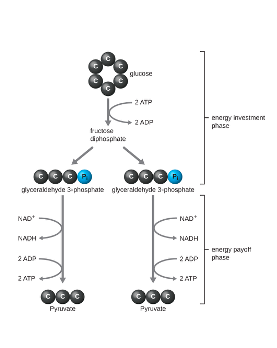
- Activation phase: 2 atp mol to phosphorylate glycose forming fructose 1,6 bisphosphate - this is broken down into 2 glyceraldehyde 3 phosphate mol
- Energy payoff phase: harnesses the energy in the G3P mol, producing four ATP mol, two NADH and teo pyruvates
- generation of ATP directly from catabolic pathways = substratelevel phosphorylation
note: ATP gen from high energy intermediates and not using ETC
describe fermentation
- allows the oxidation of NADH to NAD without the use of ETC
*imp bc some bacteria dont have ETS
- in some bacteria the electron acceptor is pyruvate or another organic compound
- bacteria without these systems rely on fermentation
where did the eukaryotic mitochonria and chloroplast arise from?
mitochonrdia from endosymbiosis of aerobic respiratory bacteria (gram-neg)
chloroplast from a photosynthetic cyanobacterium
*energy-gnerating ocmponents of these organelles are in the cytoplasmic membrane of prokaryotes fo the inner membrane of the organelles in eukaryotes
describe the proton motive force
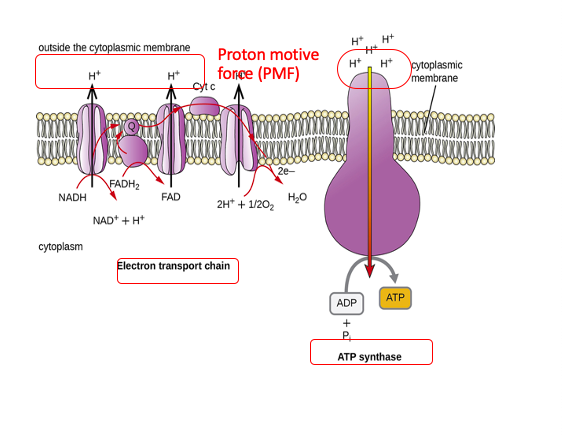
ETC contains: alternative arrangement of proton + electron carriers (NADH oxidoreductase) and electron only carriers (cytochromes)
- H+ is pumped out across the CM and E goes to next component on ETC
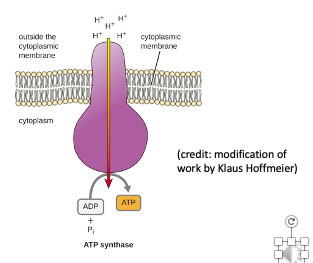
- the transfer of H+ through proton pump generates an electrochemical gradient of protons (proton motive force)
- PMF composed of a transmembrane ph difference.gradient and electric potential (charge difference across the membrane)
- PMF drives conversion of ADP to ATP through ATP synthase
*gradeint is dissipated as protons flow back trhough ATP synthase
*known as chemiosmotic theory/hypothesis
what is ATP synthase
- PMF drives ATP synthase via membrane embedded ATP synthase
- also called F1FoATP synthase (F1F0 refers to the two domains)
- is a complex integral membrane protein through which H+ flows down an electrochemical gradient, providing the energy for ATP production by oxidative phosphorylation.
- Besides ATP synthesis, the Proton gradient drives many cellular functions, e.g. flagella rotation, efflux of toxic antimicrobials, uptake of nutrients
describe oxidative phosphorylation/respiration
- involves the etc- oxidation of an electron donor, reduction of a ifnal electron acceptor, generation of PMF and coupling of energy released from proton gradeint to phosphorylate ADP
- when final acceptor is oxygen = aerobic, when anything else (usually Nitrate) is anerobic
- some bacteria have both
describe the forms of nitrogen, assimilation and dissimilation metabolisms
- respiration using oxidized forms of nitrogen is widespread among bacteria, archaea, some fungi and yeast
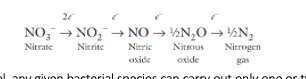
- reduction of oxidized states of nitrogen for energy yeild is called dissimilatory denitrification
- assimilatory nitrogrna metabolism - incorporation of nitrogen into organic molecules
*nitrogen can be assimilated into biomolecules or broken donw (dissimilated) to return to environment
*no one species that can take nitrate to nitrogen gas, diff bacteria do diff steps
what are the 3 major classes of prokaryotic energy generating metabolisms that use an ETS
- Organotrophy (or chemoorganotrophy):
* organic electron donors, inorganic or organic terminal electron acceptors - Lithotrophy (or chemolithotrophy): noly prokaryotes
* inorganic electron donors (e.g. H2S), inorganic (e.g. NO3- ,O2 ) or organic terminal acceptors - Phototrophy:
* involves light energy capture by chlorophyll, obtaining electrons from inorganic compounds (e.g. H2S or H2O) or organic molecules & generating a PMF ^is water used its oxygenic photosynthesis

-
History of Microbiology30
-
Microscopy31
-
Bacterial CM transport29
-
Cell envelopes35
-
Virus37
-
Microbial growth30
-
Biofilms18
-
Environmental influences on microbial growth25
-
Microbial diversity16
-
Bacterial diversity27
-
Archaeal Diversity24
-
Microbial Diversity: Eukarya33
-
Microbial Ecology and Microbial Association46
-
Introduction to the innate immune system35
-
Cellular barriers to the innate immune system33
-
Adaptive Immune system27
-
Adaptive Immune system Pt 2: Oct 3021
-
Guest lecture19
-
Microbes in health and disease31
-
Microbes and health: Nov 625
-
Defining the interplay of Klebsiella pneumoniae and host during infection by quantitative proteomics24
-
Viral Pathogens26
-
HIV: Viral pathogen24
-
Guest lecture Nov 1812
-
Physical, chemical and biological control of microbes38
-
Microbes in biocontrol19
-
microbes in food and beverage industry17
-
lab11
-
microbes in food and beverage industry pt 223



