Explain the development of the neural tube.
What is closure of the neural tube called? Where does closure of the neural tube begin?
In what direction does the neural tube close?
What does the neural tube develop into? What does its cavity become?
Neural tube development (A) begins with an inductive influence of the underlying mesoderm & notochord on the overlying ectoderm resulting in the formation of a neuroectodermal neural plate. This is followed by development of a neural groove and folding of the plate to begin neural tube formation (B). Closure of the neural tube (referred to as neurulation) begins at the mid-region of the embryo during the third week of pregnancy and proceeds to completion during the 4th week closing first at the cranial (anterior) portion of the tube (Day 24) and caudally at posterior neuropore (Day 26). The neural tube develops into virtually all CNS structures. Its cavity becomes the ventricular system.
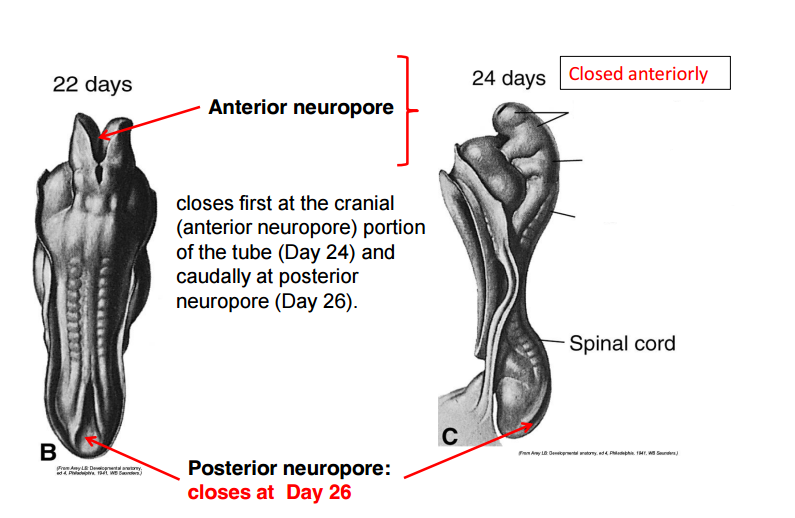
What occurs after closure of the anterior neuropore? Be specific.
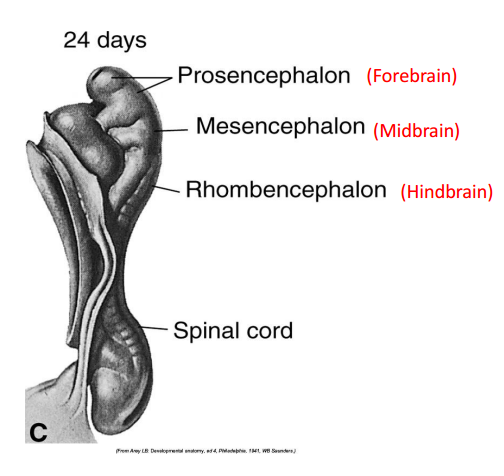
Following closure of the anterior Neuropore there is extensive proliferation of rostral neural tube into 3 primary brain vesicles:
- prosencephalon (forebrain)
- mesencephalon (midbrain)
- rhombencephalon (hindbrain)
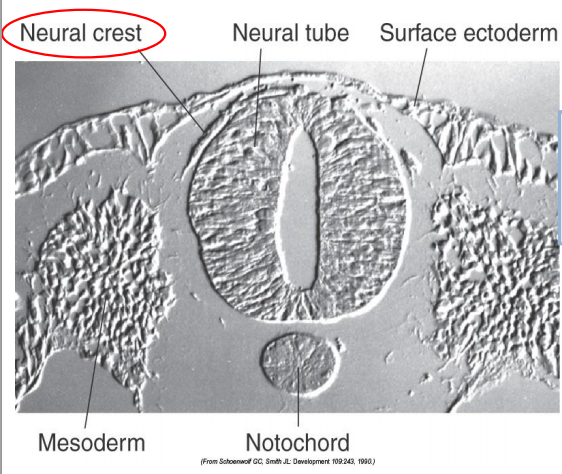
Where do neural crest cells develop with respect to the neural plate?
What do neural crest cells develop into?
Neural Crest Cells develop at the lateral edge of the neural plate and are pinched off as the neural tube closes; they then migrate giving rise to sensory (DRG) and autonomic ganglia in the PNS, some cranial nerve ganglia, Schwann and satellite cells.
They also give rise to:
- Pia and arachnoid mater (Leptomeninges)
- Craniofacial mesoderm (which will give rise to muscles and skeletal structures in the head)
- Melanocytes
- Chromaffin (neuroendocrine) cells of adrenal medulla
What is the sulcus limitans?
What do the cellular zones (gray matter) in the future spinal cord organize into? What do these become?
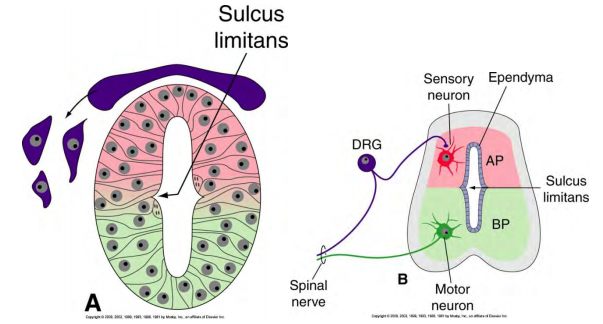
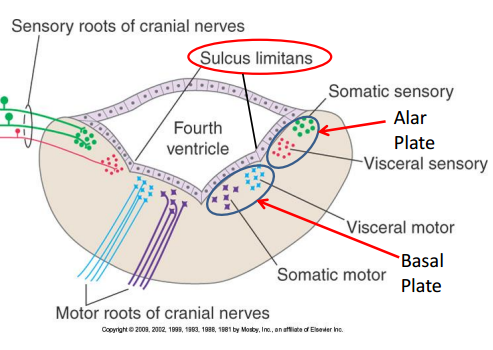
- During week 4 a longitudinal groove called the Sulcus Limitans appears in the lateral wall of the neural tube separating it into a dorsal and ventral half.
- In the future spinal cord, the cellular zones (gray matter) organize into anterior basal plates which become the motor anterior or ventral horns and the posterior alar plates which become the sensory dorsal or posterior horns.
Explain the location of posterior alar plates and anterior basal plates in the brainstem.
Why is the the positions of these plates different in the brainstem?
Where are visceral nuclei located within the brainstem?
- Location of the 4th ventricle and its opening causes the posterior Alar plates to move laterally. Note: Basal Plate derivatives are then in medial locations (GSE, GVE).
- Sulcus limitans still separates all motor and sensory nuclei but explains more lateral location of sensory nuclei (SSA, GSA, GVA) and medial location of motor nuclei
- Visceral nuclei are in intermediate positions
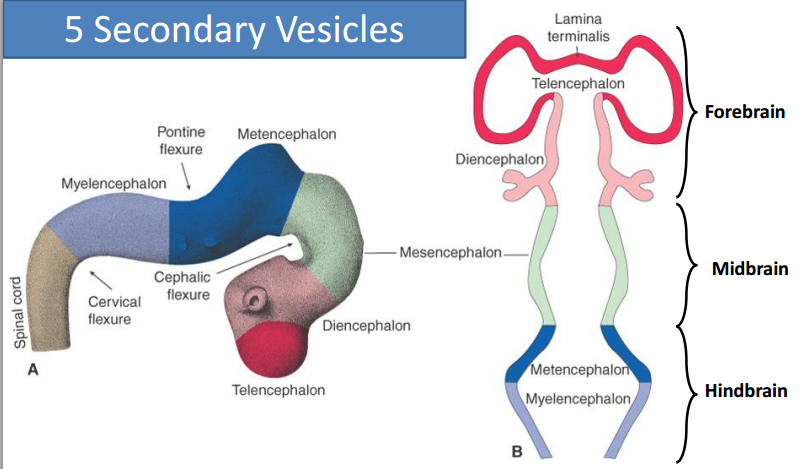
What secondary vesicles are formed from the prosencephalon (forebrain), mesencephalon (midbrain), and rhombencephalon (hindbrain)?
How many secondary vesicles are formed?
What do the central spaces btwn these vesicles become?
Forebrain further develops into the Telencephalon and Diencephalon
Mesenchephalon does not partition further
Hindbrain develops into the Metencephalon and Myelencephalon
Resulting in five secondary vesicles (weeks 5 and 6)
Central Spaces shown on the right are remnants of Neural canal : will develop into the Ventricular system
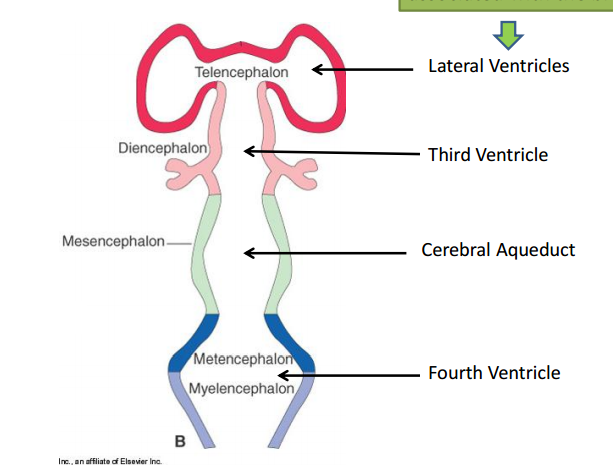
State what the secondary vesicles develop into.
State what ventricles vesicle is associated with (if applicable).
- The telencephalon further develops into the cerebral cortex, basal ganglia and subcortical white matter. Ventricular space associated with telencephalon are the lateral ventricles.
- The Diencephalon develops into the thalamus, hypothalamus, epithalamus (Pineal gland), subthalamus, retina (retinal ganglion cells) and optic nerve. Ventricular space associated with diencephalon is the Third ventricle.
- The mesenencephalon does not further differentiate into anything (stays as midbrain). The ventricular space associated with the mesencephalon is the cerebral aqueduct.
- The Metencephalon develops into the pons and cerebellum
- The Myelencephalon develops into the medulla oblongata.
- The ventricular space associated with the Hindbrain (eventual pons, cerebellum and medulla) is the Fourth Ventricle.
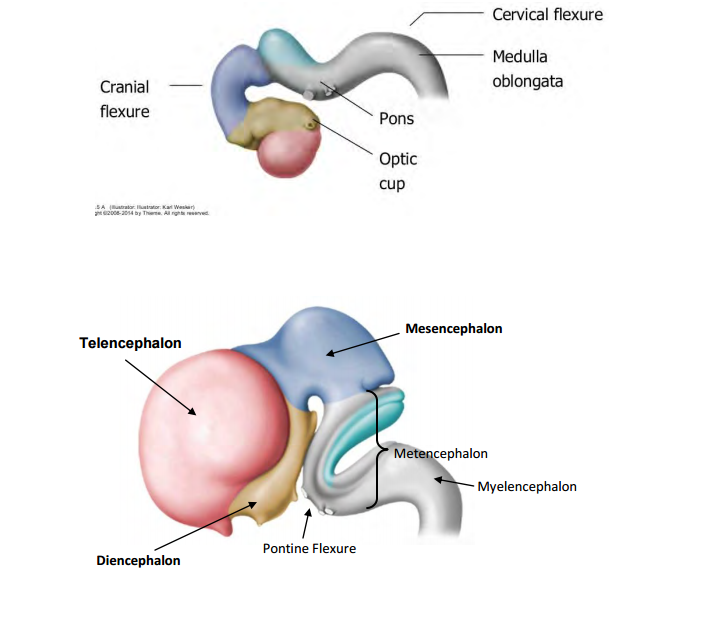
What flexures occur in the developing neuraxis? What order do they occur in? Where do they occur?
The developing Neural tube bends as these regions develop:
First, the Cranial flexure appears at the Mesenchephalon and the Cervical flexure appears at the Myelencephalon.
This is followed by a Pontine Flexure at the Metencephalon.
What happens to the telencephalic vesicles after formation the the flexures?
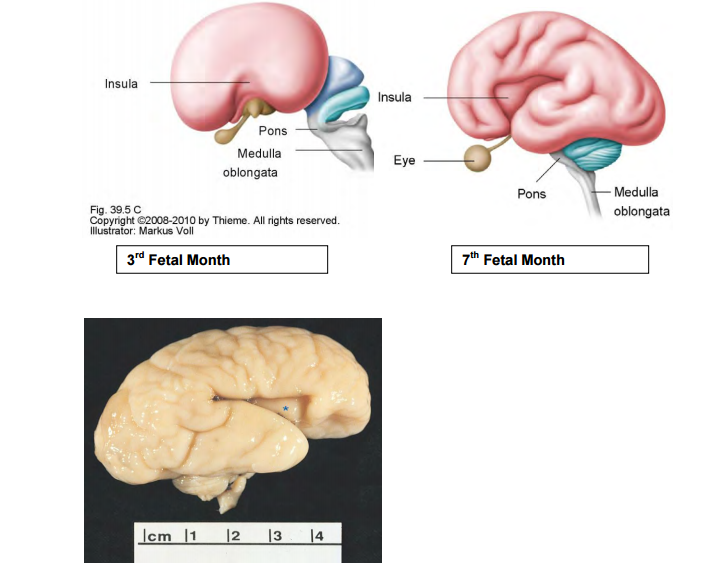
Telencephalic vesicles then expand at the rostral limit of the neural tube. Proliferating cortex expands in a C shape that grows over the brainstem and around into the temporal lobe.
What is the surface of the cerebrum and cerebellum like initially? How does this change and why?
The cortex overgrows itself on the lateral surface to cover the ____ ____.
Each cerebral (and cerebellar) hemisphere starts out with a smooth surface and becomes progressively convoluted. This results from massive proliferation and migration of neurons and glial cells.
Greatest amount of this occurs from the 3rd though the 5th fetal months of development. The formation of neuronal connections continues well after birth.
The cortex overgrows itself on the lateral surface to cover the insular cortex. You can see the insula in laboratory by prying open the lateral fissure.
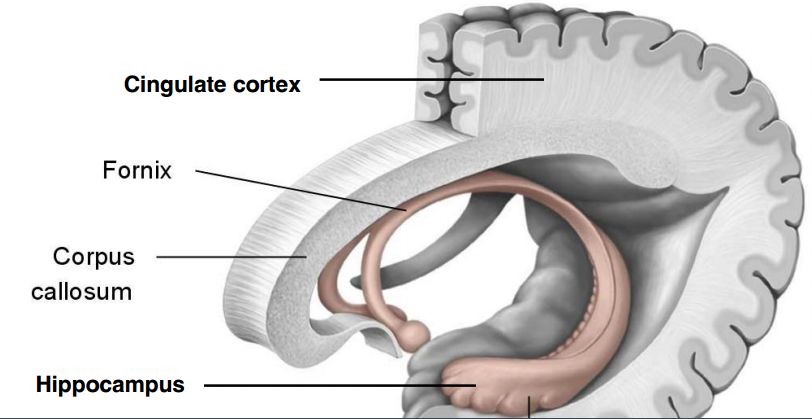
Overgrowth of cerebral cortex around and into the temporal lobe is also manifested in the C-shape of associated structures of the cerebrum and its underlying white matter pathways. What structures does this include?
Overgrowth of cerebral cortex around and into the temporal lobe is also manifested in the C-shape of associated structures of the cerebrum and its underlying white matter pathways. These include the: lateral ventricles (not shown), hippocampus, fornix, corpus callosum, cingulate cortex, and the caudate nucleus (part of basal ganglia; not shown here).
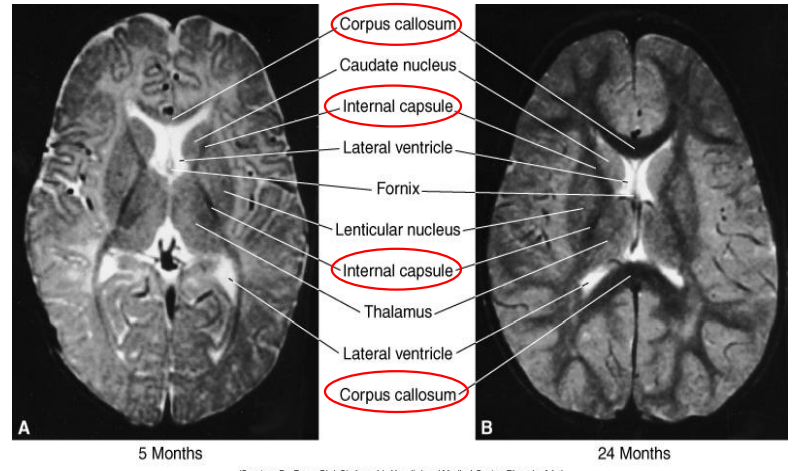
Myelination occurs primarily in the ____ period.
Myelination occurs primarily in the postnatal period.
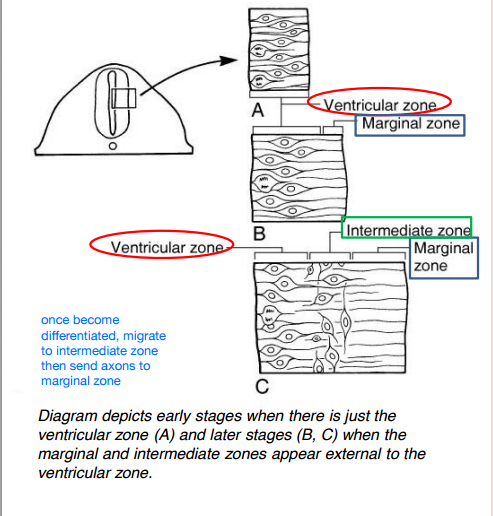
Explain neurogenesis in the spinal cord.
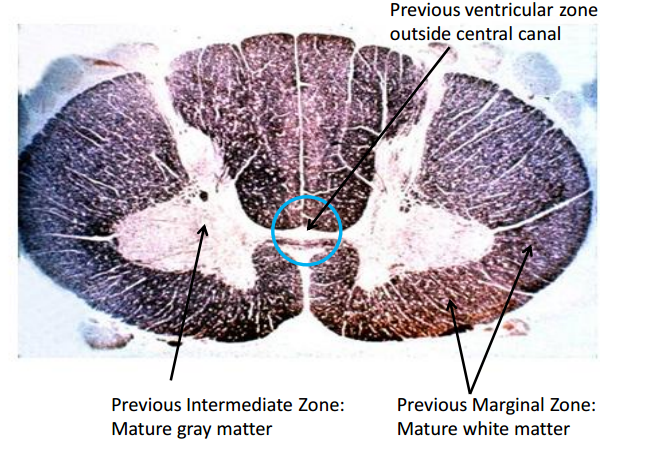
Neuroepithelial cells divide in the subependymal ventricular zone (A and B in attached pic) and then the neuroblasts emerge from this proliferative region and migrate to an intermediate zone where they then send their axons into an external marginal zone (C). Thus the neurons end up in the central gray matter and the white matter is outside.
Note that neuroblasts are young neurons. They are terminally differentiated which means they are post-mitotic.
Explain neurogenesis of the cortex (cerebrum and cerebellum).
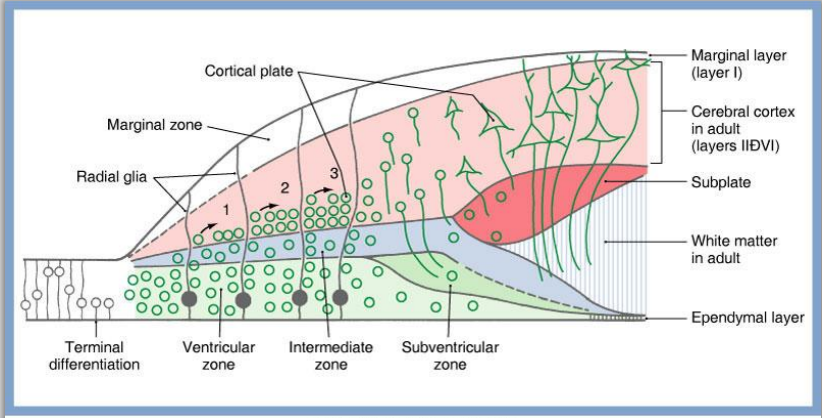
Differentiation of neural tube into future cortex proceeds in an “inside-out” fashion.
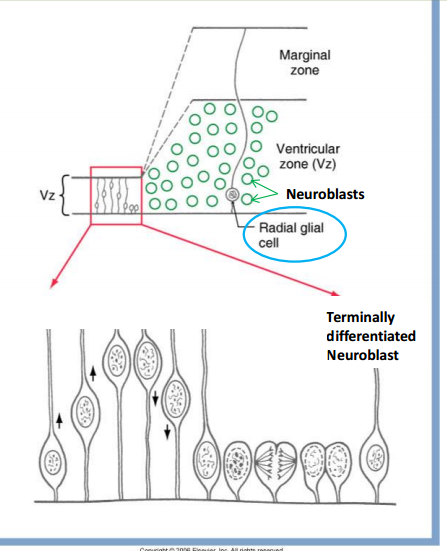
Early development of the cerebral cortex: Neuroepithelial cell nuclei undergo cycle of outward and inward migrations in the Ventricular zone (Vz) as they progress through their cell cycle.
Terminal division occurs in the ventricular zone and then neuroblasts migrate from there on radial glia scaffolding to outer regions of the cortex. Cellular gray matter is located on the external surface of cerebral (and cerebellar) cortex and white matter is located inside. Note: Neuroblasts migrate on stationary radial glia cells. radial glial cells send out processes for Neuroblasts to migrate on (see attached pic).
Where are “older” neurons located in the cortex with respect to “newer” neurons?
Later development of the cerebral cortex: Inner cellular layers (1) are formed first, and progressively more superficial layers (2, 3) are formed later. Thus, youngest neurons are in the outer gray layers. Then neurons send their processes inward to create subcortical white matter (which is more deeply located).
When in development do neural tube defects typically occur?
What is the etiology of neural tube defects?
What supplement can a mother take to decrease risk of a neural tube defect?
- originate during fourth week of pregnancy (21-28 days) when neural tube fusion is supposed to occur
- Etiology multifactoral: chromosomal/genetic, nutritional (e.g. folate or vitamin A deficiency) and environmental factors such as toxins/drugs (e.g. alcohol, certain seizure drugs, teratogens)
- Folic acid supplementation during pregnancy decreases incidence of neural tube defects by 70% and is standard OB management.
- US incidence: 1 - 2 in 1,000 births; higher in certain ethnic groups (e.g. those of Celtic origin have up to 4X higher incidence)
What is spina bifida? What is another name for spina bifida?
Where can spina bifida occur? Where is it most common?
How do earlier and later forms of spina bifida differ?
- Spina bifida (also called myelodysplasia) is a general term used to describe neural tube defects affecting the spinal cord region.
- failure of closure of caudal neural tube (posterior neuropore).
- can occur anywhere from C1 to sacral levels but is most common at lower levels. more common in lumbosacral neuropore
- constitutes a defect or absence of the vertebral arches (part of vertebrae) due to failure of mesoderm to organize over the region of the defect.
- It may or may not involve the underlying meninges and neural tissue.
- Earlier forms produce more severe open defects (no skin); later forms are often covered with skin and hair.
What is spina bifida occulta?
What is another name for spina bifida occulta?
What is it typically associated with?
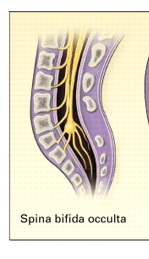
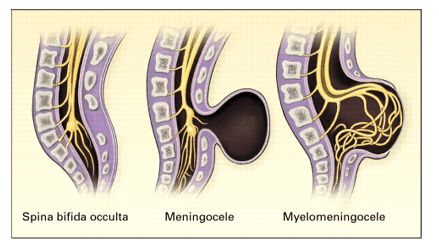
Spina Bifida Occulta (myelocele): is a defect in the vertebral arches that is covered by skin and does not involve the underlying meninges and neural tissue; typically associated with a tuft of hair and/or dimpling of skin in lumbosacral region
What is spina bifida cystica?
What are the 2 types of spina bifida cystica? (just list)
Where do they most often occur?
What does treatment consist of?
Spina Bifida Cystica: is a severe neural tube defect in which neural tissue and/or meninges protrude through a defect in the vertebral arches and skin to form a cystlike sac. Most occur in the lumbosacral region. Treatment consists of surgical sac closure shortly after birth (some surgeries successfully performed in utero)
2 types: meningocele and meningomyelocele (or myelomeningocele)
What is meningocele?
What is meningomyelocele? What are the results of this type of spina bifida?
What does it mean for the pt to have meningomyelocele at a lower level of the spinal cord (vs a higher one)?
a) Spina bifida with meningocele: a defect where only the meninges protrude through the bony defect.
b) Spina bifida with meningomyelocele: a defect where the spinal cord and/or spinal nerves (e.g. caudal equina) and meninges protrude through the bony defect. These are not covered by skin but have a dural sac filled with CSF and nervous tissue. Flaccid paralysis and sensory loss occurs below the level of the lesion like that which occurs in spinal cord injuries. Bowel and bladder dysfunction are common. The lower the level of the lesion, the less muscular paralysis; therefore increased capacity to walk with less assistive devices and bracing.
see pg 409 of first aid (2013)
What is tethered cord syndrome? What is it due to?
How is it treated?
Any form of spina bifida can be associated with tethered cord syndrome where either due to the spinal lesion or the scarring from sac surgery the spinal cord gets tethered during growth (which causes stretching of axons) leading to progressive neurological signs; detethering surgery is performed.
What is anencephaly?
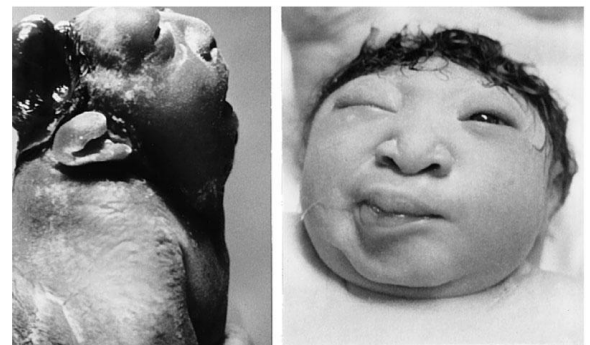
Anencephaly: failure of the cephalic part of the neural tube (anterior neuropore) to close. As a result the skull does not close leaving the malformed brain exposed. This condition is incompatible with life.
In what ways are open neural tube defects (myelocele, meningomyelocele, anencephaly) screened for?
- maternal serum alpha-fetoprotein (AFP) screening: high levels of AFP are associated with open neural tube defects (myelomeningocele, myelocele, anencephaly).
- AFP secreted by fetal liver
- False positives exist so typically follow with amniocentesis and assay for AFP and acetylcholinesterase which leak out through open defect (99% detection accuracy if levels are high)
- subsequent high resolution ultrasound detection allows prenatal option of either pregnancy termination or improved pregnancy outcome by prelabor cesarean section birth (avoiding trauma to neural sac that would occur with a vaginal delivery).
- Surgical closure of the open-back lesion is performed to preserve as much nerve function as possible and prevent infection.
- Intrauterine repair: performed at several US centers; reports of improved outcomes exist but this approach is still controversial and research studies are ongoing in this area.
What are Arnold-Chiari malformations?
What may result from these malformations?
Arnold-Chiari Malformations: Class of cerebellar and posterior cranial fossa abnormalities which causes herniation of cerebellar tissue through the foramen magnum. Hydrocephalus may result from obstruction of the outflow pathway through the foramina of Luschka & Magendie by herniated brain tissue.



-
Self study week 510
-
Brain development week 532
-
Spinal cord week 510
-
The neuron: electrical properties week 511
-
The neuron: synaptic physiology and NTs week 533
-
Pathways focus session week 513
-
Somatosensory physiology week 523
-
Pain week 515
-
Brainstem motor and sensory nuclei week 542
-
Subcortical anatomy week 531
-
Clinical case strategy workshop week 55
-
Visual pathways: anatomy and lesions week 642
-
Visual physiology week 626
-
Anatomy of the Auditory and Vestibular Systems week 626
-
Eye Movements and Gaze week 612
-
Demyelinating disease week 616
-
Neuromuscular diseases week 627
-
Motor systems overview week 613
-
Basal ganglia: movement disorders week 610
-
The cerebellum week 620
-
Reticular formation week 717
-
Limbic system week 718
-
Hypothalamics and visceromotor systems week 728
-
Learning and Memory week 77
-
Epilepsy week 720
-
Traumatic brain injury week 733
-
Language and higher order functions week 713
-
Alzheimer's Disease week 726



