primacy effect
recency effect
The order in which information is learned determines how reliably it will be recalled. The first item in a list is initially distinguished from previous activities as important (primacy effect) and may be transferred to long-term memory by the time of recall. Items at the end of the list are still in short-term memory (recency effect) at the time of recall.
Define the following terms:
habituation
sensitization
classical conditioning
operant conditioning
Non-associative processes: Habituation is a decrease in response to a repeated harmless stimulus. Sensitization is an enhanced response to several different stimuli following presentation of a harmful stimulus.
Associative processes: Classical conditioning is the appearance of a new response to a stimulus following presentation of the stimulus temporally close to an established unconditioned stimulus-unconditioned response pair (as demonstrated by Pavlov). Operant conditioning is the increase or decrease of a behavior that has been temporally associated with reward or punishment (reinforcement).
Define the following types of memory and what part(s) of the brain are involved:
declarative memory
implicit memory
working memory
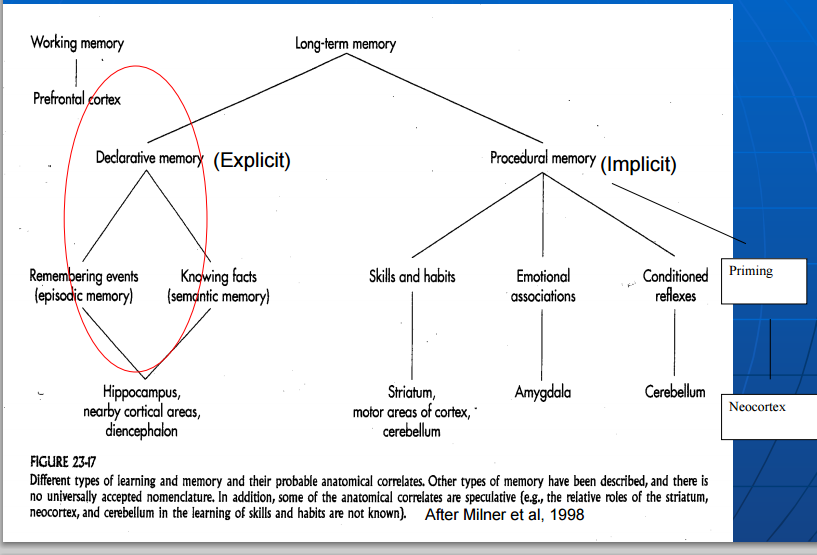
Declarative (explicit) memory
- conscious recollection of facts, events and places
- medial temporal, esp. hippocampus left temporal (verbal), right temporal (non-verbal, i.e. spatial)
Implicit (procedural) memory
- unconscious procedural memories, skills, habits, emotional association, conditioned reflexes, priming
- not dependent on hippocampus
Working memory
- short duration (immediate memory)
- “phone number memory”, used in the midst of an ongoing task
- limited storage
- requires/measures attention : (7+/- 2), easily disrupted
- frontal lobes
What NMDA receptors are synthesized in older individuals vs juveniles? What is the difference btwn these receptors?
■ As individuals age they switch from making NMDA receptors NR2B to NR2A.
■ EPSPs in neurons from NR2B transgenics remain open 230 ms longer than normal and make stronger synaptic connections similar to juvenile mice.
Mice with an over expression of NR2B showed enhanced: ■ retention of visual-recognition memory
■ fear conditioning
■ extinction of fear conditioning
■ spatial learning
Explain why emotional experiences are better remembered than neutral experiences.
Emotionally salient experiences are much better remembered than those that are emotionally neutral. (Faber et al, 2008)
- This enhanced memory formation results from the release of stress hormones, adrenaline and corticosterone, and the activation of beta adrenoreceptors within the basolateral amygdala. (McGaugh, 2004)
- Augmenting the release of noradrenaline immediately after learning improves memory formation.
- Inhibition of beta adrenoreceptors within the basolateral amygdala blocks the memory enhancing effects of emotive experiences.
What part(s) of the brain are affected in Alzheimer’s disease?
What deficits are present?
What are the 2 key neuropathological findings?
Alzheimer’s disease is the most common cause of dementia. Cognitive impairments in memory, language, attention, and visuospatial skills may be seen. The hippocampus and entorhinal cortex appear to be involved early. Loss of neurons in these areas is related to the memory deficit.
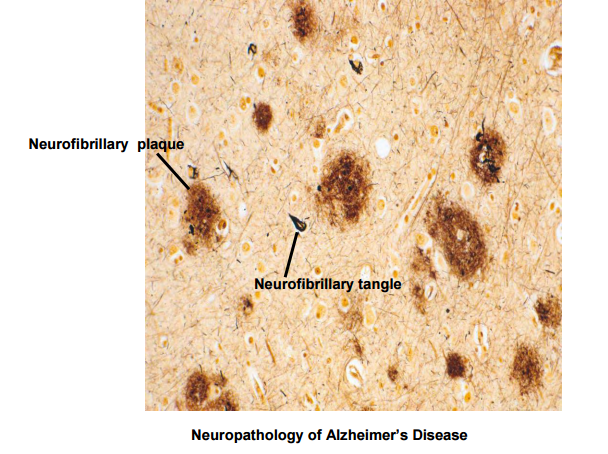
• Neuropathology: 2 key findings
Neuritic (senile) plaques: extracellular accumulation of proteins (including amyloid) and other components
Neurofibrillary tangles: intracellular accumulation of hyperphosphorylated tau
What is anti-NMDA receptor encephalitis?
Who is more affected by this disease?
What are the symptoms?
Anti-NMDA receptor encephalitis
■ Autoimmune response to NMDA receptors
■ Profound memory loss
■ Psychiatric symptoms
■ Much more often in women than men
■ Often associated with ovarian tumors-molecular mimicry (paraneoplastic syndrome)
■ Memory usually recovers after tumor removal, but previous amnestic period is lost forever

-
Self study week 510
-
Brain development week 532
-
Spinal cord week 510
-
The neuron: electrical properties week 511
-
The neuron: synaptic physiology and NTs week 533
-
Pathways focus session week 513
-
Somatosensory physiology week 523
-
Pain week 515
-
Brainstem motor and sensory nuclei week 542
-
Subcortical anatomy week 531
-
Clinical case strategy workshop week 55
-
Visual pathways: anatomy and lesions week 642
-
Visual physiology week 626
-
Anatomy of the Auditory and Vestibular Systems week 626
-
Eye Movements and Gaze week 612
-
Demyelinating disease week 616
-
Neuromuscular diseases week 627
-
Motor systems overview week 613
-
Basal ganglia: movement disorders week 610
-
The cerebellum week 620
-
Reticular formation week 717
-
Limbic system week 718
-
Hypothalamics and visceromotor systems week 728
-
Learning and Memory week 77
-
Epilepsy week 720
-
Traumatic brain injury week 733
-
Language and higher order functions week 713
-
Alzheimer's Disease week 726



