Most common C3 slab fracture configuration
Dorsal/frontal plane slab fracture of the radial facet
Slab means including both proximal and distal articular surfaces (cf chip)
Sagittal slab fractures are less common; more difficult radiographic diagnosis
Doering et al 2019 Vet Surg: Overall return to racing in TBs/Stdbds with C3 slabs (dorsal and sagittal)
Return to racing by breed and fracture type
46% overall
TB - 42% overall
TB with dorsal slab - 35%
TB with sagittal slab - 63%
SB overall - 67%
SB with dorsal slab - 77%
SB with sagittal slab 0% (0/2)
What factors were associated with decr chance of returning to racing following C3 fracture according to Doering et al 2019 Vet Surg
Increased cartilage damage
Incr radiographic C3 lysis
Using 4.5 vs 3.5mm screws
Inserting >1 screw
Fracture displacement (decr change by 25% for every mm of diaplacement)
Which radiographic projection reported by Ramzan (EVJ 2019) is superior for dx of sagittal plane slab fractures of the third carpal bone?
Dorsoproximolateral - dorsodistomedial oblique
i.e distal row skyline from DL to PM oblique
Need 30-40° of proximodistal obliquity and 15-35° of lateromedial obliquity
Highlights pathology within the medial portion of the radial facet of C3
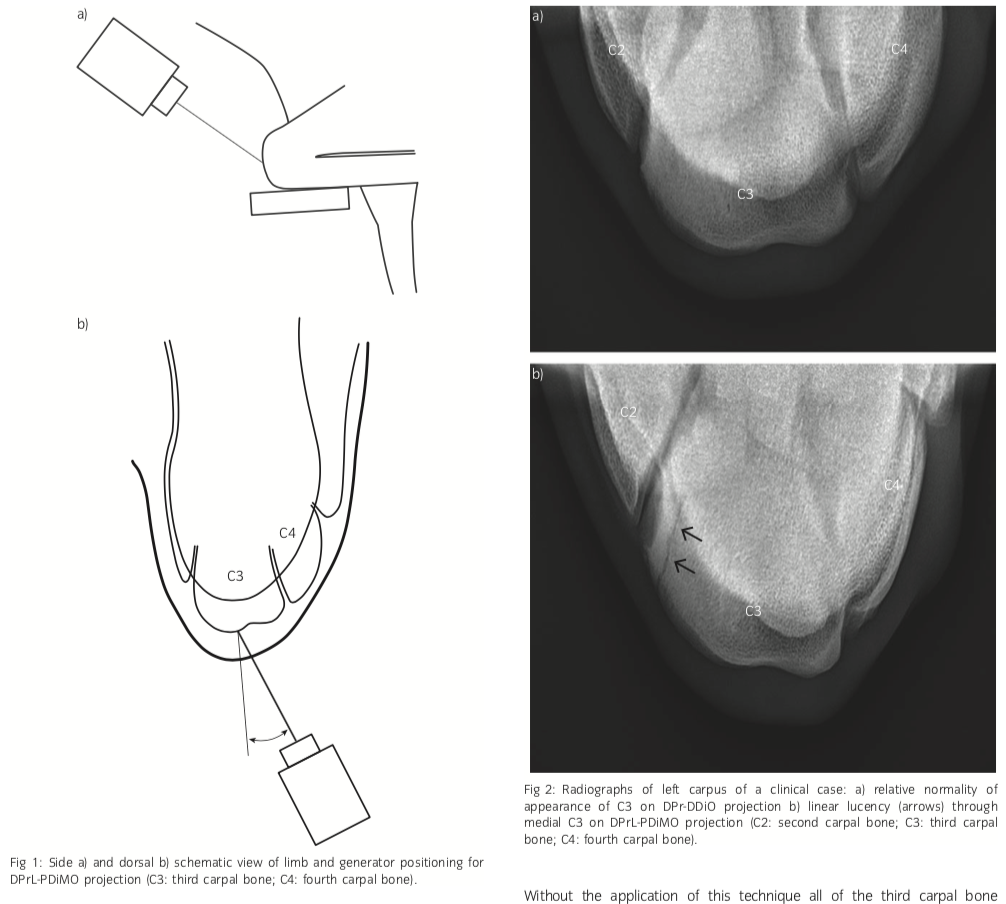
Site of occurrence of sagittal fractures of C3
Occur through the medial portion of the radial facet of C3, hence difficult to see on std skyline; better with DPrL- DDiM oblique skyline to see (Ramzan et al 2019, EVJ)
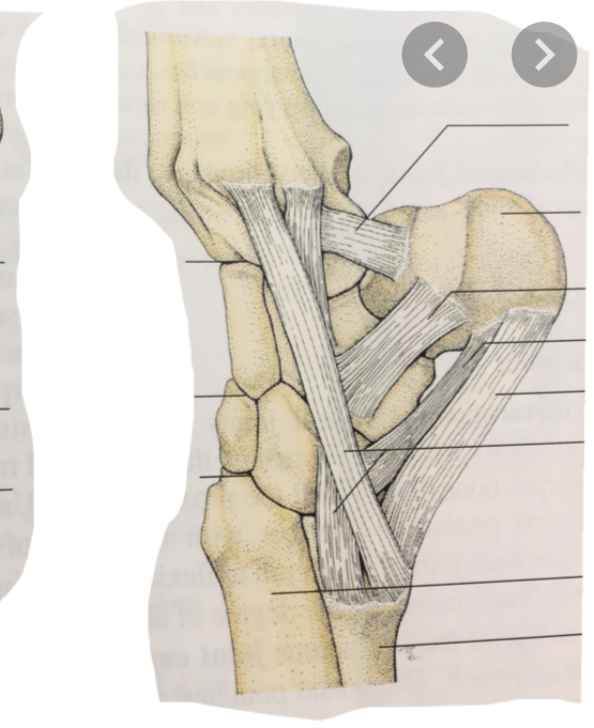
4 ligaments of the accessory carpal bone
- Accessariometacarpal (to MC4 - landmark in the DBLP neurectomy)
- Accessarioulnar (to distal lateral radius/ulna LSP)
- Accessario-carpoulnar (to ulna carpal bone)
- Accessarioquartal (to C4)
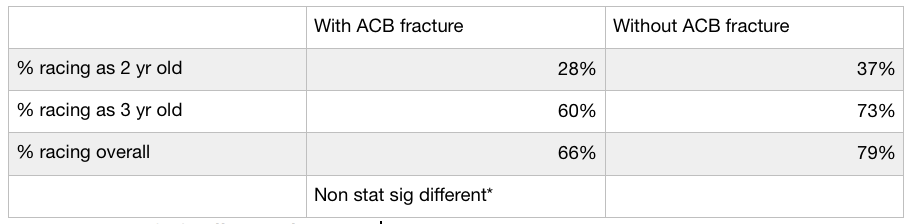
Findings of Davern et al (VCOT 2019) re ACB ostrochondral fracture fragments in yearing rads and affect on racing performance
- Non-lame TB yearlings with ACB fractures, (OC fragmentation not frontal plane fractures), dx on sales radiographs could achieve a level of race performance similar to their matched, unaffected counterparts. Differences between groups were not stat sig different
- ACB fracture on yearling rads did not appear to affect liklihood of racing or any of the performance variables assessed
- At the time of sale, 23 of 47 (49%) yearlings with osteochondral fragmentation of the ACB had radiographic evidence of dorsalcarpal OA; however, its presence was not associated with poorer performance
- Directly contradicts another study of similar cohort which found significantly lower earnings per start and total earnings as a 2- and 3-year-old for yearlings with OC fragments arising from the ACB with versus without corresponding dorsal ABC joint disease. Warrants further investigation
Ddx for carpal sheath tenosynovitis
- Distal radial osteochondromata
- Exostoses of the caudal distal radial physis
- ACB fractures
- SDF tendonitis
- ALSDFT tearing
- Tendonitis of the DDF and its radial head
- Carpal tunnel syndrome (req release of the flexor retinaculum)
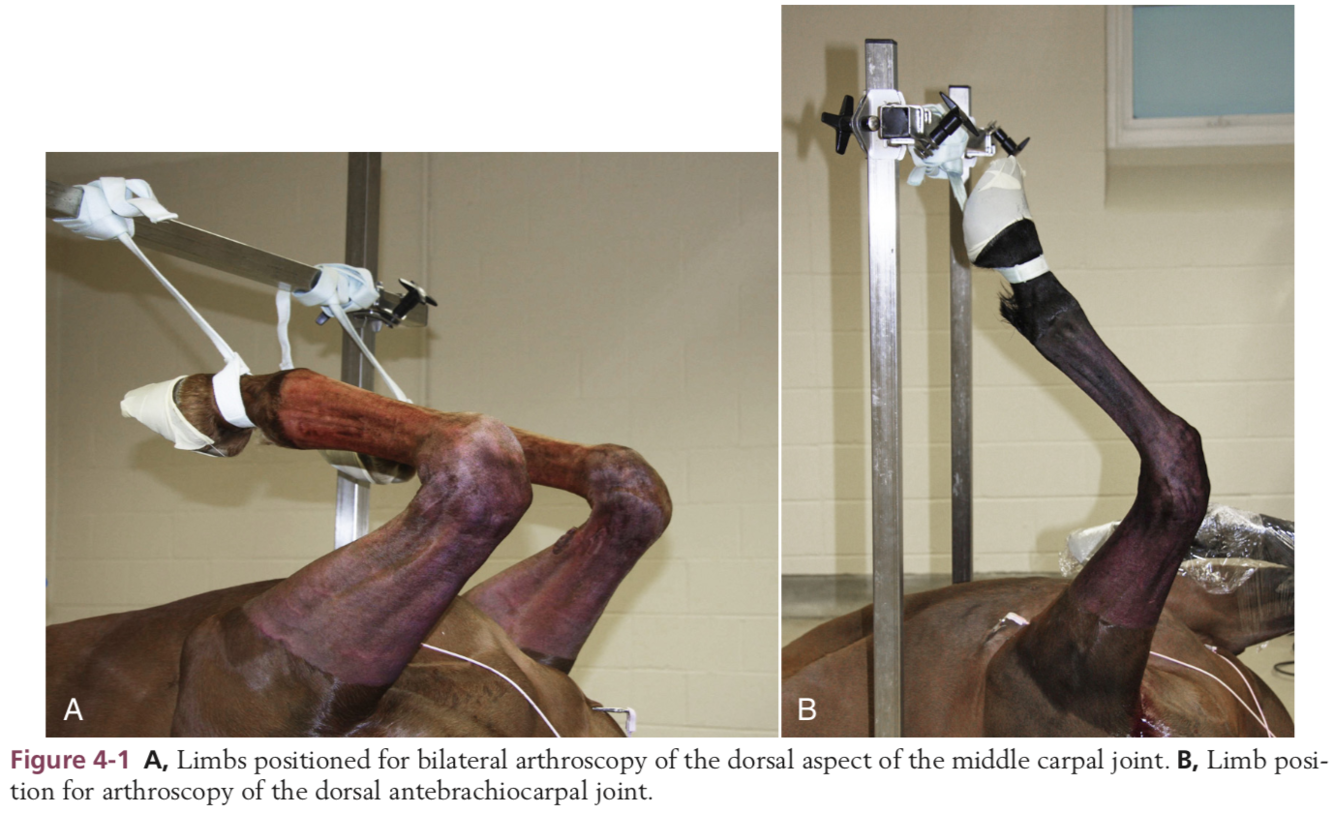
Angles of flexion for std ASY approaches to the dorsal compartments of ABC and MCj
ABC - more straight - approx 110-120°
MCj - more flexed - approx 70°

-
General (Surgery)9
-
General (Pharmacology incl Regeneratives)12
-
Foot16
-
Pastern18
-
Fetlock (incl P1 and condylar fractures)31
-
Carpus9
-
Tarsus23
-
Elbow4
-
Humerus, Shoulder & Scapula8
-
Tibia2
-
Stifle32
-
Hip & Pelvis1
-
SI3
-
Spine17
-
Arthroscopy7
-
OCLL/SCL2
-
Imaging11
-
Tendon and Ligament2
-
Joint Disease3
-
Lameness exam and Diagnostics0
-
Lameness Misc4
-
ALD/FLD0



