Most common location of overriding/impinging DSPs
T10-T18 - often centered on the anticlincal vertebra (T14/15)
Lumar vertebrae less commonly involved
Conservative management options for over-riding DSPs
Corticosteroid administration
Bisphosphonates
Muscle relaxants,
Acupuncture,
Anti-inflammatory medications,
Electrophysical therapy such as ECSWT & cold laser
Surgical tx options for OR-DSPs
1) DSP resection UGA
2) Subtotal ostectomy standing
3) Cranial wedge ostectomy (GA or standing)
4) Endoscopic approach to DSP resection UGA
5) ISLD
Radiographic grading for ORDSPs (Ross and Dyson)
- Grade 1: Narrowing of the interspinous space with mild increased opacity of the cortical margins of the spinous processes
- Grade 2: Loss of the interspinous space with moderate increased opacity of the cortical margins of the spinous processes
- Grade 3: Severe increased opacity of the cortical margins of the spinous processes, caused in part by transverse thickening, or radiolucent areas
- Grade 4: Severe increased opacity of the cortical margins, osteolysis, and change in shape of the spinous processes; overriding (overlap) of the spinous processes
Scintigraphic grading scale (4 point) - Zimmerman 2012
0 = normal RU
1 = mild IRU
2 = moderate IRU
3 = intense IRU
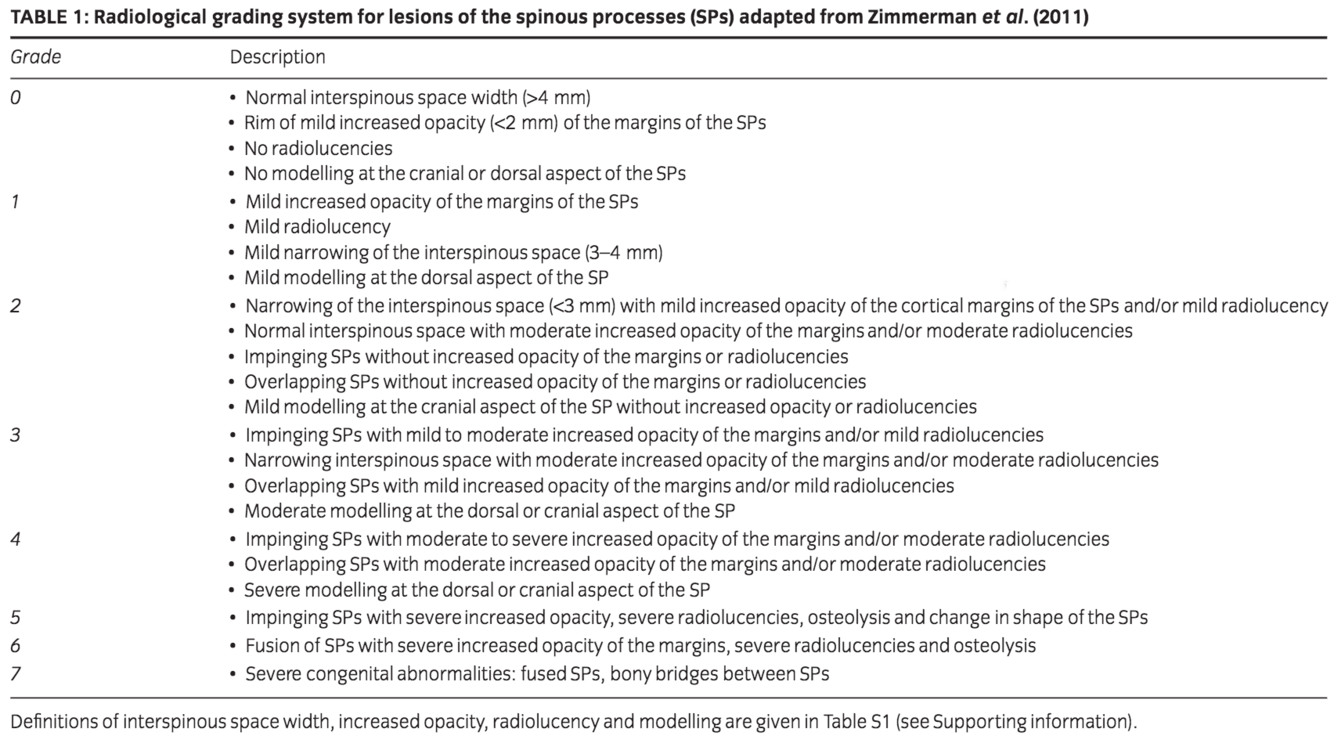
Radiographic grading of OR-DSPs (Zimmerman 2011)
0-7 point scale
Outcomes following ISLD reported by Prisk et al 2019 (VS)
- Overall 51/56 (91.1%) horses returned to some level of performance PO
- 24 of 51 (47.1%) horses achieved a lower level of performance - attributed to lameness (37.5%), ongoing back issues (37.5%) and owner choice (25%)
- 27 of 51 (52.9%) reached the same or better performance levels
- Owner satisfaction WRT cosmesis was 98.2%
- Owner satisfaction WRT performance was 78.6%
- Owners of 46 of 56 (82.1%) horses would recommend the procedure
Briefly describe sx procedure for ISLD (Coomber 2012)
- 2cm paramedian skin incision (cranial to caudal) made 3cm left of dorsal midline, through skin/SQ
- 7” Curved Mayos were used to bluntly penetrate the thoracolumbar fascia and then rotated 90◦
to be parallel with the orientation of the interspinous space
- Scissors continued to bluntly tunnel beneath the SS ligament, ensuring proper placement within the space, confirmed when contacting the dorsally placed 18g spinal needle
- Scissors passed axially from left to right across the top of the interspinous space ventral to the SSL; then just below the SSL they were then used to cut the ISL ventrally for up to 6 cm (moist, crunching sound was appreciated when this was successful)
- Packed with gauze and repeated for other spaces from least to most affected
- Skin closed w No. 0 polypropylene in SI
Approximately what age do the cervical vertebral physes close radiographically?
- Cranial vertebral physes close approx 2years
- Caudal vertebral physes close around 5 years
- The odontoid process (dens) of C2 closes at 7-8months and shouldn’t be mistaken for a fracture (although is fractured on the picture below!)
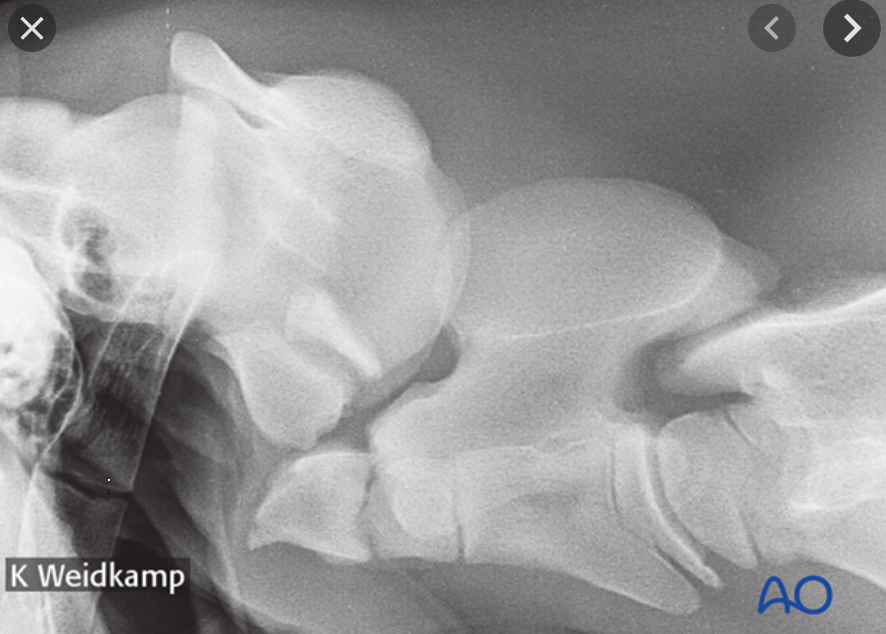
What is the diagnosis?
Label the diagram
Approximately what age is the affected horse likely to be?
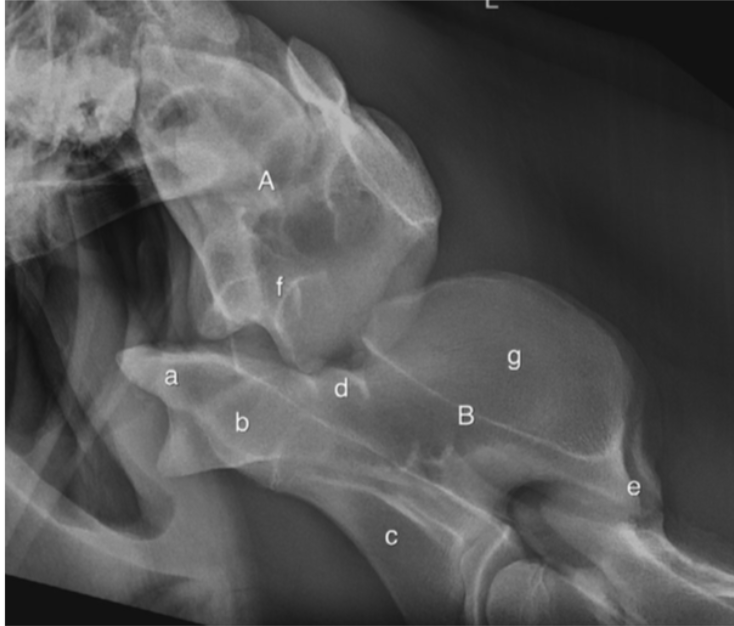
Complete ventral luxation of the dens
A - Atlas
B - Axis
a - odontoid process
b - Body of C2 - cranial
c - Vertebral body of C2, caudal
d - vertebral canal
e - caudal AP of C2
f - concavity of atlas where dens usually site
g - C2 DSP
Dens physis is closed so >8mo but cranial physis of C3 open so <2yrs
Which ligaments attach the dens to the ventral aspect of C1 and occiput?
Apical, transverse and alar ligaments
Must be ruptured for dens luxation to occur
Whats the diagnosis?
Which breeds are most commonly affected?
What is the treatment?
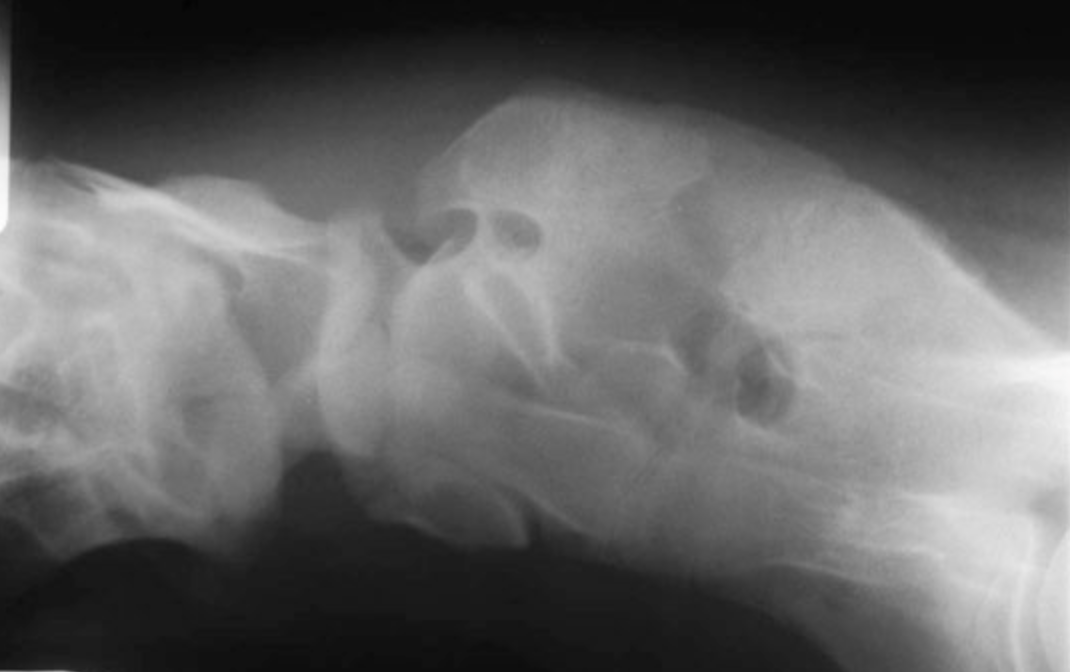
OAAM - various abnormalities incl absence of a dens, hypoplasia of atlas, fusion of the atlas to occiput
Arabs most commonly affected - familial, do not breed
No treatment really
CSs - still birth, progressive ataxia, occasionally only restricted neck movement
Definition of OR-DSPs
Narrowing of the space between two thoracolumbar spinous processes to less < 4 mm
CSs of OR-DSPs
Variable - NB radiographic features are observed in many individuals without clinical evidence of back pain
Usually present w non-specific signs of poor performance to bucking behaviour under saddle. POP of the thoraco- lumbar spine and the epaxial musculature, and/or reduced kinematic measures, including dorsoventral and lateral movement of the spine, are commonly observed
Common radiographic features of OR-DSPs
On lateral-lateral rads: periosteal reactions, increased opacity of subcortical bone, osteolytic cyst-like lesions, malformation of SPs and formation of pseudoarticulations or fusion between SPs
Main findings of Derham and Kelly (2019 TVJ) re ISLD in TB race horses
Key Points
- Treated horses had significantly better improvement in racing performance vs matched controls
- 85.8% of horses w f/u had improved performance for >1 year, remainer needing additional medical (1n=17) or surgical (n=4) management
- Return to training within 4 weeks PO
- R sided epaxial mm atrophy in 5% - didn’t negatively affect racing performance but may pose a cosmetic issue in other breeds and likely arises dt more abaxial incisions (4-5cm off midline vs the 3cm described by Coomer 2012)
5 joints of the lumbosacral articulation
Lumbosacral intervertebral (disc) joint (intercentral joint)
2x lumbosacral intertransverse joints between the L6 and S1 transverse processes
and 2x APjs dorsally between the caudal articular processes of the last lumbar (L6) and the articular processes of the first sacral (S1) vertebra
It is the most mobile joint in flexion and extension motions of the horse’s back. Lumbosacral flexion can reach 20°, and 5-10° extension is possible

-
General (Surgery)9
-
General (Pharmacology incl Regeneratives)12
-
Foot16
-
Pastern18
-
Fetlock (incl P1 and condylar fractures)31
-
Carpus9
-
Tarsus23
-
Elbow4
-
Humerus, Shoulder & Scapula8
-
Tibia2
-
Stifle32
-
Hip & Pelvis1
-
SI3
-
Spine17
-
Arthroscopy7
-
OCLL/SCL2
-
Imaging11
-
Tendon and Ligament2
-
Joint Disease3
-
Lameness exam and Diagnostics0
-
Lameness Misc4
-
ALD/FLD0



