friction of distance // distance decay effect
friction of distance: the reduced likelihood of people using a service the greater the distance that they live from it
Distance is seen to be a disadvantage due to the time and cost involved to overcome it.
distance decay effect: areas that are closer together are more likely to interact, whereas areas further away are less likely to interact with each other
time-space convergence
the reduction in the time taken to travel between two places due to improvements in transport or ICT — reduced friction of distance
causes of shrinking world + pros & cons
(the same arguments as for globalisation and urbanisation…)
Causes of shrinking world:
ICT, transport, urbanisation, TNC’s
pros
- spread of ideas (innovation)/diffusion of technology
- easier organisation of aid and addressing world problems
- spread of goods (living standards)
- a particular improvement tin transport/ICT may stimulate demands for even greater improvements in accessibility. People are more aware than ever of what is possible because of their improved knowledge of events elsewhere in the world. see figure 4
cons
- easier spread diseases/conflict
- some regions benefit while others are left out of the process
- carbon footprint
- erosion of culture
- local business suffer (TNC’s)
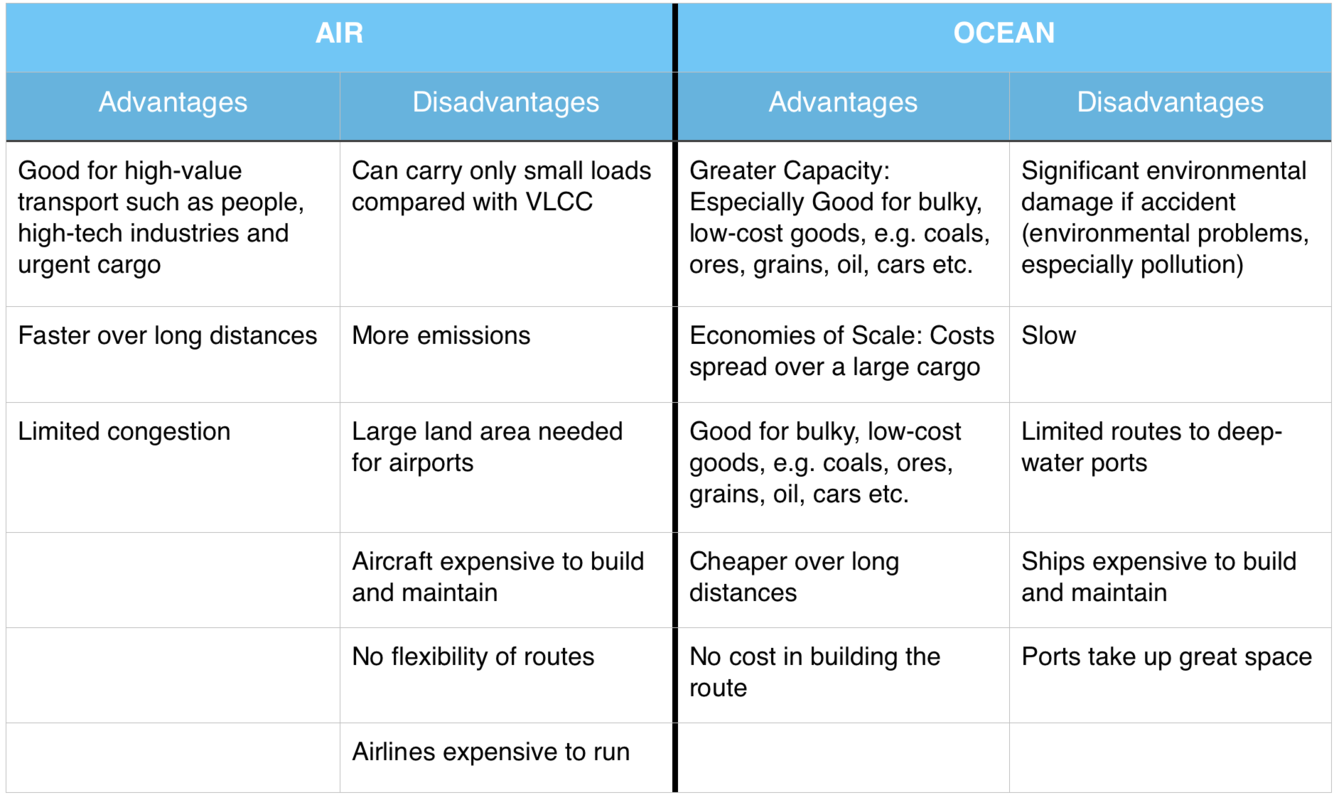
pros and cons for transport via ships or planes
case study: national transportations
Indian Railways
India has a sophisticated network, that has several major positive impacts, such as that network economies and economies of density lead to size advantages at the firm level. Furthermore, rail transport operations are almost universally combined with the supply of infrastructure services, granting rail firms a natural monopoly, at least locally.
Railways in Africa
Transport is a vital element of development and socio-economic growth, and transport infrastructure remains a pillar of development for accelerating growth and reducing poverty. Africa is lagging significantly behind in the growth of the regional trade, particularly because of the lack of reliable and adequate transport. The network shows very little interconnectivity. The use of road sees an increase in popularity, even over long distances.
There are a number of transport development challenges:
- inadequate infrastructural network
- inadequate financing
- lack of appreciate human and institutional capacities
- high transportation costs
- inadequate safety and security
- poor degree to which environmental issues and pollution control are taken into account
- underuse of information and communication technologies (ICT)
intermodal transportation
transporting freight by using two or more transportation modes
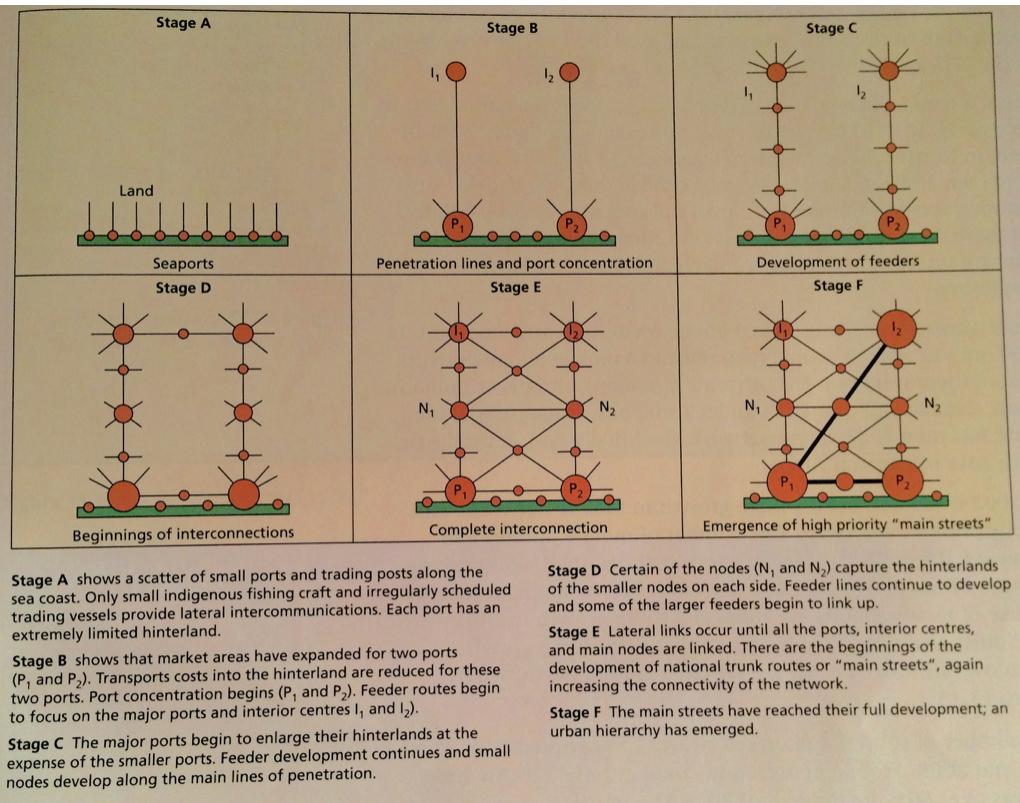
Taafe, Morrill and Gould Model (1970)
Shows the development of transport networks and their stages, often in the developing world.It shows how settlement patterns may emerge.
- Based on external forces (often exploitation)
- Developed to explain the pattern that occurred in West Africa, Brazil and China
mobile phones vs. land lines
Greatest growth is in mobiles phones, while land lines peaked at 19.5 people using landlines out of 100 in 2006
- Mobile phones penetration was at 12% in 2000, 60% by 2008
- The cost of putting in landlines is much more expensive than mobile phone networks: One phone tower can cover more people with cell phones, while land lines cost more and do not connect as many as easy as tower do.
digital divide // internet penetration rate
inequalities in opportunities between individuals, households, businesses and nations to access ICT
The digital divide depends on two factors: income and education. People with higher incomes and education levels are more likely to have access to ICT.
Commonalities of users are: rich, urban, young and male.
- Over 75% of Internet users come from rich countries, which account for just 14% of the world’s population
- In Thailand 90% of Internet users live in urban areas.
- In Chile 74% of Internet users are under 35 years old.
- In Ethiopia 86% of Internet users are male. (because of gender bias culture)
For every $5 billion invested in broadband infrastructure to create high-speed, universal networks, 97,500 new jobs in the telecommunications, computer and It sectors are created.
The trend is that this gap is widening with every year.
(Probably not true… –> Look at all the efforts/projects being done to “connecting the last billion”, for example, Facebook (internet weather balloons), Amazon (cheap mobile phones, especially focus on African and Asian market), bill gates (free technology used for education) etc.)
types of civil societies
Mass organisations — formally constituted organisations which represent the interests of particular population groups.
Trades-related organisations — memberships organisations representing people through the profession or means of employment they pursue.
Faith-based organisations — mostly membership-based religious organisations dedicated either to worship or to the advancement of a creed.
Academic organisations —communities of scholars, researches, intellectuals and other academics.
Public benefit NGOs — organisations formed to provide a benefit to the general public or the world at large, either through the provision of specific services or through advocacy.
digital access index (DAI)
Measures the overall ability of individuals in a country to access and use ICT.
Consists of 8 variables grouped into 5 categories:
infrastructure — combined fixed and mobile teledensity
affordability — Internet access price as % of per capita GNI
quality — international Internet bandwidth in bits per capita and % broadband customers
usage — Internet users per 100 population
knowledge — adult literacy, how the use the technology and availability of tech-support, and combined enrolment up to tertiary level

-
General7
-
People in Transition31
-
Disparities in Wealth and Development34
-
Required Definitions29
-
Patterns in environmental quality and sustainability33
-
Patterns in Resource Consumption31
-
Leisure, Sport, Tourism19
-
Freshwater11
-
Urban Environments33
-
Measuring Global Interactions21
-
Changing Space — The Shrinking World11
-
Economic Interactions and Flows20
-
Environmental Change10
-
Sociocultural Exchanges25
-
Political Outcomes17
-
Global interactions at the local level11



