arguments against globalisation
- Exploitation of labor: prisoners and child workers are used to work in inhumane conditions. Safety standards are ignored to produce cheap goods. There is also an increase in human trafficking.
- makes it easier for rich companies to act with less accountability.
- countries’ individual cultures are becoming overpowered by americanisation
- creates a wider financial disparties
- local companies are outcompeted
- homogenisation of culture
- more terrorism
arguments for globalisation
- creates millions of job
- has brought huge range of affordable goods to consumers in MEDCs
- help aid of catastrophic situation or cures are shared more quickly
- There is more influx of information between two countries.
- Learning about other cultures; socially more open
- internet, fast travel and vast information landscapes
Factors responsible for economic globalisation:
- major advances in trade liberation under the World Trade Organisation — economic and legal barriers (tariffs, quotas and regulations) are much lower today than in the past
- the emergence of fundamentalists free-market governments in the USA (Ronald Reagan) and the UK (Margaret Thatcher) around 1980 — the economic policies developed by these governments influenced policy-making in many other countries.
- the emergence of increasing numbers of NICs
- the opening up of other economies, particular those of China and India
- the deregulation of world finical markets, allowing a much greater level of international competition in financial services
- “transport and communication revolution” that made possible today’s complicated networks
definition of globalisation
“The growing interdependence of countries worldwide through the increasing volume and variety of cross-border transactions in goods and services and of international capital flows, and through the more rapid and widespread diffusion of technology” (source: IMF).
definition of capatalism and anti-capitalism
Capitalism – the social and economic system which relies on the market mechanism to distribute the factors of production (land, labor and capital) in the most efficient way.
Anti-capitalism – a broad term which can cover any challenge as the best or only way to organise the world. It was given media prominence during the 1999 WTO summit in Seattle where a wide range of organisations protested against the workings of the international economic system.
world economy theory (hyperglobalist)
capturing the concepts of core and periphery workers and economies, capatalism and TNCs
- The process by which the capitalists world system spreads across the world.
- TNCs become more important than capitalists-countries. They spread the capitalism. TNCs do not work in an ethical way a country would but rather are interested in money.
- The countries are divided into divisions of labour
- Core countries focus on capital skills (more developed), they are the driving force of globalisation
- Semi-peripheral countries work with the core countries and they count on the semi-peripheral, which go towards becoming core countries
- Peripheral countries are sources for resources
third way theory (transformationlism)
- Relationship between comercial processes at global and local scale
- Aim to restructure local ways in order to cope with globalisation and become one
- Still aim is to preserve their local heritage despite global homogenisation
- Encourage local auto my (self-governing) to maintain diversity
- Creates bigger gap between first and third world countries
- Third World Countries are disadvantaged whereas first world countries succeed under globalisation
- Agree that globalisation encourages stronger global interconnectedness
world culture theory (homogenisation)
- Uniformity is important as that way we will be able to share the social structures
- embracing homogenisation; it’s benefiical for everyone
- opposite to Third Way Theory
Regional Block Theory (scepticism)
- disagree strongly with hyperglobalists
- they dispute that a single world market exists and argue that the aspects of globalisation, like the growing internationalisation of trade and investments is actually the growth of regional economic blocks, such as the European Union
- To expand capitalism seems to be the real goal and strategy of globalisation, benefiting mainly the countries within the “blocks” and more or less excluding other from the economic growth and development.
- Another important point of the theory is that there is no central government or similar controlling the process of globalisation, although capitalism is a main framework of reference.
- Capitalism is seen as a problem, deeply rooted in globalisation, as it is in its pure form emphasises competition and financial efficiency over compassion and care for oppressed and is empowered people.
- It doesn’t benefit everyone
- Capitalism drives globalisation, where ethics are not respected
least and most globalised countries
most
- United Kingdom
- United States of America
- China
- South Africa
- Singapore
least
- North Korea
- Angola
- Chad
- Romania
Kearny Index
four components of global integration
- Political engagement: Foreign aid, treaties, membership in international organisations, and peacekeeping
- Technological connectivity: Counts the number of internet users and hosts, severs
- Personal contact: Telephone calls, international travel and tourism, remittances
- Economic integration: FDI (foreign direct investment), inflows and outflows
- — Culture Experience
6.
KOF Index
Measures globalisation on economic, social and political dimensions
- On a scale of 1 - 100, the higher the number, the more globalized
- Weightings are calculated using principle component analysis
- Using this method, it reduces extreme data points, ensuring fewer fluctuations over time
Economic globalisation:
international flows of ideas, people, goods, capital and services
—> Two dimensions: Actual Flows and Restrictions
Actual flows
- Foreign Direct Investment (FDI) in terms of stock investments or aid, trade (% of GDP), income payment to foreign nationals, the amount of trade a country has (e.g. [made in Germany]) - any flow of income coming from outside the country the money flows into
Restrictions
- Import barriers, tariffs, taxes on international trade, subsidy
NAFTA / EU (free trade (except when coming from outside) opposite of Restrictions)
WTO (against free trade, example of Restrictions)
Political Globalisation
diffusion of government policies
—> Number of embassies and consulates (high commissions)
—> Number of international organisations of which the country is a member
—> Number of UN peace missions it has participated in (blue helmets: different countries contribute troops to conflict zones)
- France, Italy and Belgium rank the highest in this category
Social Globalisation
the spread of ideas, information, images and people
—> Personal contacts: international telecom traffic, degree of tourism a country is exposed to
—> Information flows: number of Internet users, cable televisions providers (teaching english language), number of TV’s (in order to have and operate TVs they need globalised aspects, which tells about their globalisation in the country…), and international newspapers traded
—> Cultural Proximity: domination of US products, measures the number of McDonald’s, Ikea’s, etc. (indicator of the consumption of a nation), the countries footprint of other country on one country
KOF defines globalisation as:
- the process of creating networks of connections among actors at multi-continental distances,
- flows of people, information and ideas, capital and goods
- eroding national boundaries
- integrating national economies, cultures, technologies and governance
- complex relations of mutual interdependence
Countries Ranked with KOF Index (from highest to lowest points)
- Germany
- USA
- China
- Brasil
- Haiti
- Niger
World System Theory
This approach is based on a capitalist world economy
Three main characteristics:
- Global Market
- Political and economic competition (many countries…)
- Three economic levels of countries: core, semi-periphery and periphery
- Countries can move from one level to another depending on their contribution to the global economy
- This model takes into accounts NIC’s (semi-periphery)
Sees the global market as cyclical, with periods of growth and stagnation - Kondratieff cycle. Cycles of depression at roughly 50-to-60-year intervals.
Stagnation is important for restructuring the world system and allows the semi-periphery to become involved in the development process.
Asian Tigers
South Korea
Taiwan
Hong Kong
Singapore
BRIC
Brazil
Russia
India
China
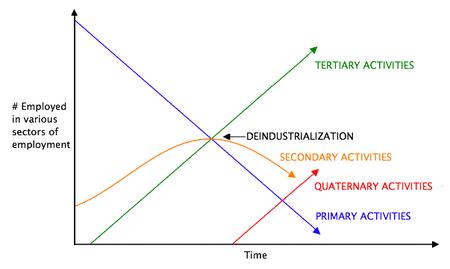
Clark-Fisher Model
changes in sectors:
World Cities Hypothesis // Global City Network
cities are at the core of the world economy because of their intense acitivity in the many areas like:
- business activity
- Human capital
- Information exchange
- Cultural experience
- Political engagement
Core (Alpha++): New York, London, Tokyo
Secondary (Alpha+): Singapore, Shanghai, Dubai, Beijing, Paris, Chicago, Los Angeles, Sydney
This can be expected from world cities:
- Ethnoscapes are produced by flows of business personnel, guest workers, tourists, immigrants and refugees.
- Technoscapes are flows of machinery, technology and software from MNCs (Multinational corporations) and government agencies.
- Finascapes are flows of capital currency and securities.
- Mediascapes are flows of images and information through newspapers, televisions and film.
- Ideoscapes are flows of a western view of life, e.g. democracy, welfare rights and mass consumption.
- Commodityscapes are flows of culture and style encompassing everything from architecture to interior design.
aim of the Organization for Economic Cooperation and Development (OECD)
A grouping of the world’s most advanced economies
- Support sustainable, democratic, economic growth
- Boost employment
- Raise living standards
- Maintain financial stability
challenges to the existing order
- China will become the most powerful country on earth, for the first time after longtime USA
- emerging markets grow double the speed of the established markets
case study: part of the periphery
Mongolia
The country is primary product dependent (mining) and depends heavily on export of commodities for foreign exchange. Mongolia was strongly effected by the global crisis in 2008.
The crisis meant a considerable fall in demand, hence, lower prices. This created payment problems and government spending cuts. International financial help was needed (IMF and China). Programs focus on
- livestock insurance to protect herders from losses due to extreme weather
- expansion of telecommunication networks
- expansion of rural education
Very harsh environmental conditions, like droughts and extreme hot or cold climates, reduce livestock and make working conditions difficult.
least developed countries (LDCs)
The most marginalised countries in the world, relatively unaffected by the interactions between global core and periphery. The list of LDCs is reviewed every three years by the United Nations Economic and Social Council:
- the “low income” criterion, based on a three-year average estimate of the gross national income (GNI) per capita
- the “human assets weakness” criterion, involving a composite index based on indicators of nutrition, health, school enrolment and literacy
- the “economic vulnerability” criterion, involving a composite index based on indicators of natural shocks, trade shocks, exposure to shocks, economic smallness and economic remoteness

-
General7
-
People in Transition31
-
Disparities in Wealth and Development34
-
Required Definitions29
-
Patterns in environmental quality and sustainability33
-
Patterns in Resource Consumption31
-
Leisure, Sport, Tourism19
-
Freshwater11
-
Urban Environments33
-
Measuring Global Interactions21
-
Changing Space — The Shrinking World11
-
Economic Interactions and Flows20
-
Environmental Change10
-
Sociocultural Exchanges25
-
Political Outcomes17
-
Global interactions at the local level11



