characteristics of cities
- intense human interaction
- economies of scale
- concentration of workforce
- high resource consumption and waste production
- cultural diversity and segregation
- their future dependend on sustainable management
centripetal movements
moving inwards towards centers; migrations into cities from smaller towns
rural push factors and urban pull factors
Rural push factors
High rates of population growth have put pressure on natural land resources such as water and energy and reduced the size of land holdings until they become unproductive. New farming technology has favoured the rich farmer but, for those at the other end of the socio-economic scale, unemployment or underemployment are typical.
Urban pull factors
Higher wages and more varied employment and education opportunities. Immigrants are willing to tolerate poor living conditions initially, in the hope for a better future. The attraction of “bright lights” are often cited as a pull factor, but the reality is that many migrants are intimidated by the urban environment and would prefer the tranquility and security of their original community.
centrifugal movements
decentralisation: outward moving populations from the centre of the city to its periphery, resulting in an expansion of the city.
Suburbanisation is the outward growth of towns and cities to engulf surrounding villages and rural areas. It is the result of rapid urban population growth and a demand for better housing and more space. Rising disposable incomes have enabled people to meet both the cost of new housing and the associated transport costs of commuting back to the city centre for work, which is global trend.
Industrial decentralisation may also occur, providing more work in the periphery. Congestion, pollution and lack of community may be the push factor.
family life cycle
A person is likely to move around different zones of the city, depending on their age and their need for a house of a certain size.
economic growth in (mega)cities
Urban economies are almost always more productive than rural ones. Most of the wealth is produced in megacities. 2% of China’s population lives in Shanghai, a city that produces 12% of the country’s output. Industrial activity is higher in cities because of greater efficiency; there will be a large, concentrated, educated, accessible, skilled workforce.
Megacities are large metropolitan areas or urban agglomerations of 10 million citizens or more.
LEDCs now hosts more megacities the MEDCs. Megacities bring together people and resources, and are able to generate wealth efficiently through economies of scale. Many would classify as world cities, global hubs for dynamic economic activity, social interaction and innovation.
Common problems include:
- high population concentration and density, uncontrolled spatial expansion
- increasing wealth disparity
- strains on water supply
case study: megacity
Shanghai
measuring residential segragation
using the location quotient (LQ)
For example:
- Neighbourhood X has 25% of Bangladeshi population and the city average is 10%.
- The LQ would be 2.5, a higher than average concentration.
LQ < 1 means no concentration
- LQ = 1 means average concentration*
- LQ > 1 means above average concentration*
reasons behind segragation
- late arrival in the city
- inability to speak English on arrival
- wish to maintain cultural identity
- common original of migrants, so that segregation brought security
- poverty, which leads to high concentration and overcrowding
measuring deprivation (lack of benefits)
physical indicators — such as quality of housing, levels of pollution, incidence of crime, vandalism, graffiti
social indicators — including crime (reported and fear of), levels of health and access to health care, standards of education
economic indicators — access to employment, unemployment and underemployment, levels of income
political indicators — opportunities to vote and to take part in community organisation
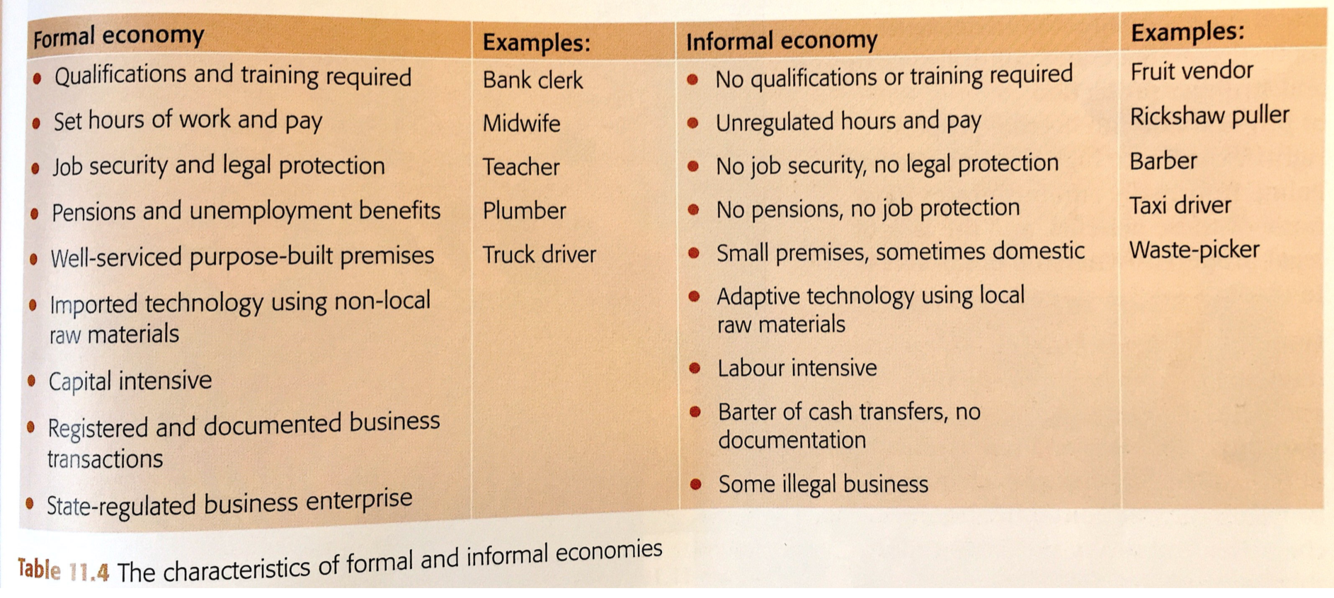
why are informal economies growing?
+ pros and cons
It is an inevitable outcome of rapid urbanisation.
Informal economies employ more than 60% of the urban population in South America and Asia and more than 70% in sub-Saharan Africa.
Most of the time they are unskilled and poorly paid employees.
Advantages
- Plays a vital role in the developing urban economies of many LEDCs and semi-LEDCs, as it provides unskilled and semi-skilled workers (e.g. migrants) with casual, temporary, but immediate work.
- much easier, cheaper and faster to set up; preferable in low-income countries.
- are often interdependent; goods produced at minimum costs in small workshops are then passed on to be finished and sold within the formal economy on the national and international market.
- Makes a significant contribution to urban wealth and is the basis of development (e.g. Industrial Revolution in 19th century Europe).
Disadvantages
- It has been unfairly associated with activities such as drug pushing, prostitution, political corruption, bribery, and smuggling. This threatens the security of the residents, turns away potential visitors and downgrades the city’s international image.
- It lacks the legal property ownership, limiting access to credit.
- Workers are often exposed to health and safety risks and deprived of the rights and benefits associated with law and regulation. Lack of protective clothing, adequate instructions, etc.
case study: informal economies
Dharavi, Mumbai
Its population has achieved a unique informal “self-help” urban development over years, without any external aid.
…
case study: overcoming housing problems
Mumbai and nanohomes outside cities
In conclusion, there is no easy solution to Mumbai’s housing problems.
pros:
- inexpensive
- can be built by unskilled workers
- overcomes problems of overcrowding
cons:
- insufficient opportunities for informal business
- Ex-slum dwellers will now have to commute back to the centre to work, causing further problems of traffic pollution, cost and congestion.
- Displacement will disrupt extended families, their social networks and security
- Close business linages that existed within the informal economy of the slum will be lost.
Large cities are attractive for industries because:
- good infrastructure
- large markets
- best access to international markets (especially with ports)
- the place where major innovation and ideas come from
- a variety of labour is avaiblable
main components and causes of the Brown Agenda (environemtal issues) in cities
+ the case with Mexico City
The greatest concentration of environmental problems occurs in cities experiencing rapid growth, such as Mexico City.
main components:
- issues caused by limited availability of land, water and services
- problems such as toxic hazardous waste, pollution of water, air and soil, or industrial accidents
In the case of Mexico City, it is a basin where cool air can remain trapped by a larger layer of warm air above it: temperate inversion. The air fails to mix and vehicle emissions create intense pollution. Ozone is a byproduct, and is a strong respiratory irritant (causing discomfort).
consequences of urban heat island intensity (mircoclimate)
the difference in temperature between the urban and the surrounding rural area, which is usually 2-4°C and causes:
- respiratory problems
- human discomfort due to high levels of humidity, atmospheric dust and poor air quality
- diseases due to the increased likelihood of vector-and waterborne diseases in poor cities
- energy waste as warmer climate boosts the use of air-condition systems
- causes heat stress and illness, through which working days are lost and productivity lowered
- increases environmental degradation, where urban fabric such as rubber and tarmac degrade, due to the intense heat, creating a long-term costs to city authorities
case study: urban heat waves
a growing problem, affecting cities irrespective of their latitude and climate type with high death rates
- associated with UHI, high-density residential living, high levels of vehicles and industrial emissions
In the daytime, in stark contrast to rural areas, intense solar radiation heats the ground surface. The weather it typically anticyclonic — clear and calm — during heat waves.
For instance, during the Paris heatwave of 2003, a persistent anticyclone over Europe blocked rain-bearing winds from the North Atlantic, allowing hot air from North Africa to penetrate. It killed 30 000 people in Europe, most of them in cities where heating was most intense. 9 consecutive days of more than 38°C caused dehydration and cardiovascular lines, and high levels of ground-level ozone and nitrous oxides induced or aggravated respiratory problems. Most afflicted were the elderly and people with pre-existing health problems. Because intense heat never experienced by Europe, air conditioning was not common, even in hospitals. The french “heatwave emergency plan” was successful but not a long term solution over overheating cities.
causes and features of social urban stress
rapid expansion of urban populations, particularly in developing countries, overwhelms the abilitiy of cities to provide adequate and fair services like
- housing
- sanitation
- drinking water
- education
- employment
What adds to social urban stress is:
- Rising inequalities - intense class differences
- noise and pollution
- overcrowding
- fear of crime
elements of housing management
- quality of housing — with proper water, sanitation, electricity, and space
- quantity of housing — having enough units to meet demand
- affordability of housing
- tenure or housing (ownership and rental) (i.e. residents are not at risk of eviction)
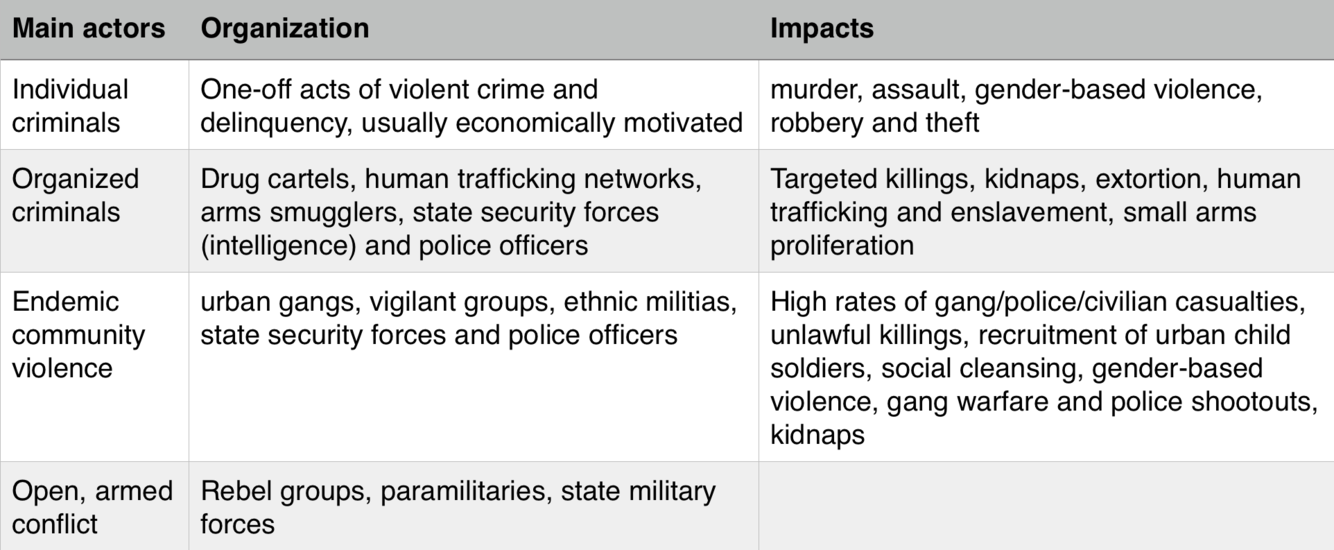
types of actors in crime
+
causes of crime and violence
Causes:
- Inequality (Gini coefficient positively correlates with crime)
- Unemployment; particularly youths from 15 - 24
- Limited police presence; due to rapid urbanisation
- Opportunity; there is a greater concentration of wealthy potential victims, more opportunities to commit crime, and a more developed second-hand market for expensive stolen goods. Criminal networks can be persuasive and influential towards certain disadvantaged groups.
- Poor urban planning; for example, unlit or hidden streets with few escape routes
- Globalisation and ICT; ease of communication through mobile phones and other devices assists the efficiency of organised crime
consequences of urban crime
Endemic insecurity can generate a culture of fear, leading to segregation and social fragmentation and the creation of fortified spaces. Tourist and FDI are dramatically reduced.
Gated communities
While high levels of violence do occur, anxiety generated by the perception of crime and endemic violence often outstrips the actual level of danger. Gated communities predominate where inequalities are pronounced and public security is inadequate. Most are found in North America, South Africa, and Brazil. Unfortunately, this often results in segregation along ethnic, religious or racial lines.
benefits of compact cities
- minimise the amount of distance traveled
- use less space
- require less infrastructure (pipes, cables, roads, etc.)
- are easier to provide a public transport network for
- reduce urban sprawl
vertical development and urban biocapacities
cities like Toyko, use less than the average biocapcity of 1.7 hectars per person due to vertical development - using land in several ways at the same time, in contrast to extended cities, as seen in Australia or US.

-
General7
-
People in Transition31
-
Disparities in Wealth and Development34
-
Required Definitions29
-
Patterns in environmental quality and sustainability33
-
Patterns in Resource Consumption31
-
Leisure, Sport, Tourism19
-
Freshwater11
-
Urban Environments33
-
Measuring Global Interactions21
-
Changing Space — The Shrinking World11
-
Economic Interactions and Flows20
-
Environmental Change10
-
Sociocultural Exchanges25
-
Political Outcomes17
-
Global interactions at the local level11



