Vertical transformations
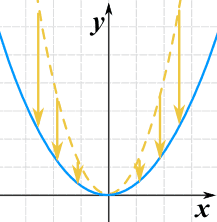
stretching and shrinking original function vertically
- vertical transformations change only the y coordinate, leaving x alone
- multiply the whole function by a number
- constant added > 0 expands function
- constant added < 0 shrinks function
g(x) = 0.35(x2)
Horizontal transformations
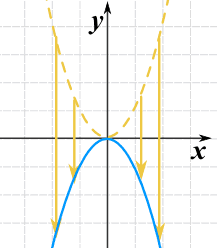
reflection over they y axis
- changes only the x coordinate, leaving y coordinate unchanged
- We can flip it upside down by multiplying the whole function by −1
- or by multiplying the x in y = 2ˣ by -1
- i.e. points (1, 2) become (-1, 2)
g(x) = −(x2)
Horizontal transformations
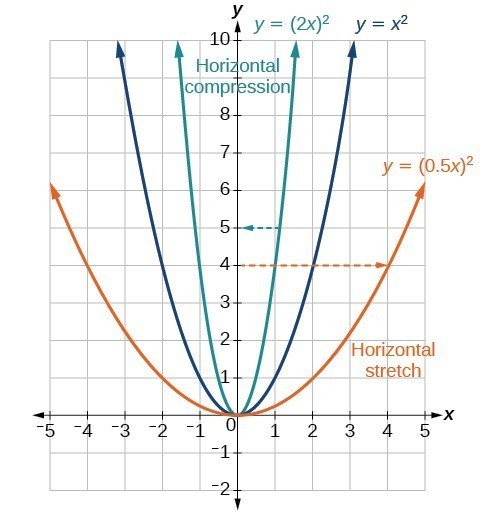
shrinking and expanding a function
- changes only the x coordinate, leaving y coordinate unchanged
- can shrink or expand graph by multiplying x by a number
- multiplying by a # > 1 shrinks the function
- multiplying by a # < 1 expands the function
- whatever number you multiply by, its reciprocal denotes the distance changed
Vertical transformations
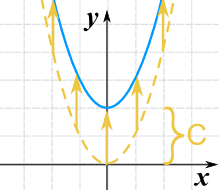
moving graphs up or down
- vertical transformations change only the y coordinate, leaving x alone
- add a number to or subtract a number from the entire function
- constant added > 0 moves function up
- constant added < 0 moves function down
original function: (x) = x2
g(x) = x2 + C
Horizontal transformations
moving graphs left to right
- changes only the x coordinate, leaving y coordinate unchanged
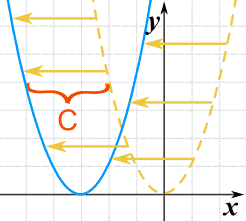
- can move graph left or right by adding a constant to the x-value
- constant added > 0 moves function to the left (the negative direction)
- constant added < 0 moves function to the right (the positive direction)
g(x) = (x+C)2
inverse functions
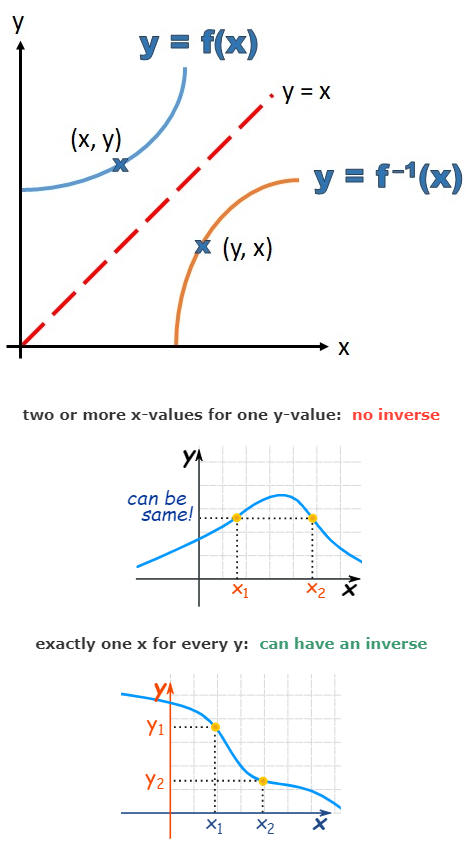
- The inverse of f(x) is f⁻¹(y): used y instead of x to show a different value
- shown by putting a “-1” superscript after the function name
- read as “f inverse of y”
- The inverse of f(x) is f⁻¹(y)
- applying a function f and then its inverse f-1 gives us the original value back again
- f⁻¹( f(x) ) = x and f( f⁻¹(x) ) = x
- when graphed, each is the mirror image of the other, reflected over the line y = x
- if a point is (2,4) on one function, the other will have point (4,2)
- the domain of one is the range of the other
- the range of one is the domain of the other
- To be able to have an inverse we need unique values.
Example:
- the inverse of f(x) = 2x+3 is: f⁻¹(y) = (y-3)/2
- f(4) = 2×4+3 = 11
- f⁻¹(11) = (11-3)/2 = 4
- “f inverse of f of 4 equals 4”
logarithmic functions
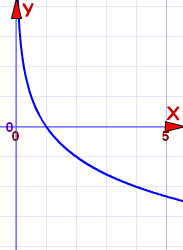
f(x) = logₐ(x)
When a between 0 and 1:
- As x nears 0, it heads to positive infinity
- As x increases it heads to negative infinity
- f(x) = log½(x)
logarithmic functions
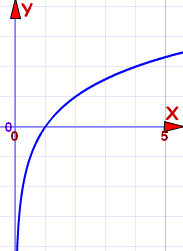
f(x) = logₐ(x)
When a > 1:
- As x nears 0, it heads to negative infinity
- As x increases it heads to positive infinity
- f(x) = log2(x)
logarithmic functions
f(x) = logₐ(x)
exponential function reversed
- a is any value greater than 0, except 1
- when a = 1 the graph is not defined
- goes through the point (1, 0) intersecting x axis at 1
- never touches the y axis, always greater than 0
- Domain: Real Numbers
- Range: Real Numbers
- aˣ (exponential function) is the inverse function of logₐ(x)
- can be “reversed” by the Exponential Function
exponential function
f(x) = aˣ
When a between 0 and 1:
- exponential decay function
- like exponential growth but in reverse
- goes up as x decreases (to left)
- goes down as x increases (to right)
- models things that shrink over time, like radioactive decay
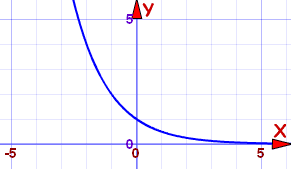
exponential function
f(x) = aˣ
When a > 1:
- exponential growth
- goes higher w/out limit as x increases (to right)
- goes lower w/out limit as x decreases (to left)
- for figuring out things like investments, inflation, and growing populations
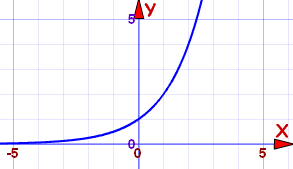
exponential function
f(x) = aˣ
When a = 1:
graph is a horizontal line @ y = 1
exponential function
- f(x) = aˣ
- a is any value greater than 0
- a has a power that contains a variable
- goes through the point (0, 1) intersecting y axis at 1
- never touches the x axis, always greater than 0
- Domain: Real Numbers
- Range: Positive Real Numbers: (0, +∞)
- aˣ is the inverse function of logₐ(x) (the Logarithmic Function)
- can be “reversed” by the Logarithmic Function.
exponential function
when an exponent is an even integer
- function values are positive
- graph passes through the origin
- opening upward
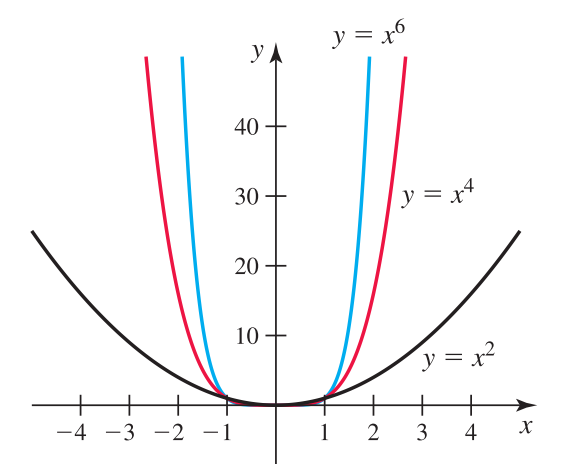
exponential function
when an exponent is an odd integer
- function values are positive when b is positive
- function values are negative when b is negative
- graph passes through the origin
- opening upward
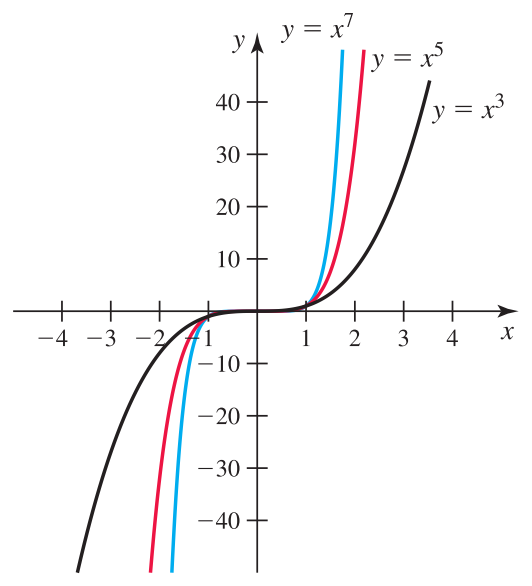
The only function that is even and odd is
f(x) = 0
is f(x) = x/(x2−1) Even or Odd or neither?
substitute −x for x:
f(−x) =(−x)/((−x)2−1)
=−x/(x2−1)
=−f(x)
So f(−x) = −f(x) , which makes it an Odd Function
sine function
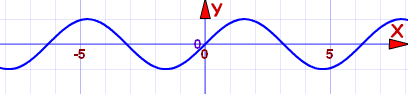
- odd function
- f(x) = sin(x)
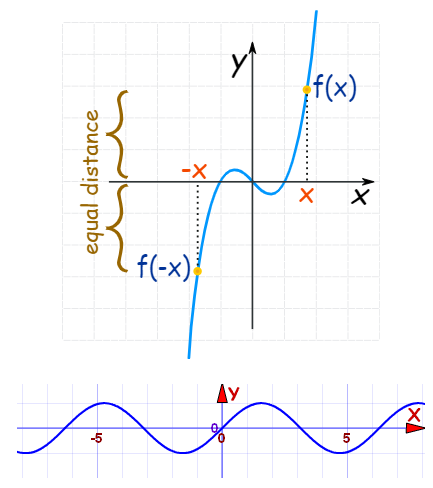
odd function
- −f(x) = f(−x) for all x
- has origin symmetry
- called “odd” because the functions x, x³, x⁵, x⁷, etc behave like that
- sine functions are also odd: sin(x)
- odd exponents don’t always make an odd function: x³+1 is not an odd function
- cannot contain a constant term: y = x³ - 5x + 2
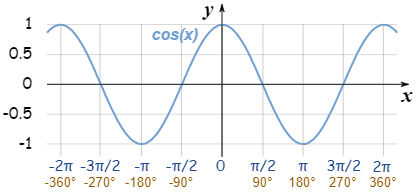
cosine function
- even function
- like Sine, but starts at 1, heads down until π radians (180°) and then up again
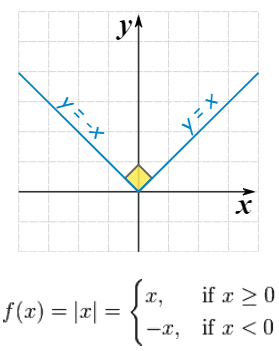
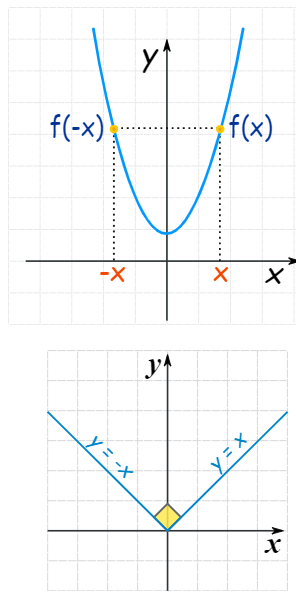
absolute value function
- g(x) = |x|
- even function
- makes a right angle at (0,0)
- Domain: Real Numbers
- Range: Non-Negative Real Numbers: [0, +∞)
- can be a piecewise function
- Are you absolutely positive? Yes! Except when I am zero
parabolic function
- f(x) = x²
- f(x) = x²+1
- even function
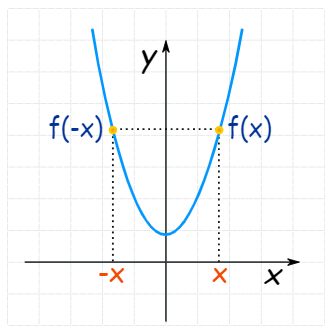
even functions
- f(x) = f(−x) for all x
- there is symmetry about the y-axis (like a reflection)
- called “even” functions because the functions x2, x4, x6, x8, etc behave like that: y = 9x⁴ - 4x² + 3
- But an even exponent does not always make an even function: example (x+1)² is not an even function
- constant term like 3 is the same as 3x⁰ and zero is even
- y = cos(x) is also an even function
to use point-slope form you need to know 2 things:
- a point on a line
- the line’s slope
- y - y₁ = m(x - x₁)
- y - 11 = 3(x - 2) → y = 3x + 5






