Voltage difference for capacitors
V= E(lectric Field) * d V= Ed
Power loss in wires
P(loss in wire) = [I^2 * Voltage drop at the wire] (Not V-terminal)
E stored in capacitor
E = 1/2 Q V
U = (1/2) CV2
C of capacitor (capacitance)
C= k(Ę)A/d (Let Ę mean epsilon naught constant)
Dialectic Constant (k)
Medium between capacitor plates *all about polarizability *more polar the medium, the higher the k Vacuum k=1 Glass k=5 Water k=80 (HUGE)
How do you raise Q for a given battery? (3 ways, hint: capacitance)
1) decrease distance between plates 2) increase area of plates 3) raise dielectric constant
Capacitors & time (graph: I = y, x = t)
Slope: Current will decrease exponentially with time Area: I x t= C/s x s = C
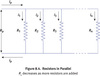
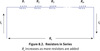
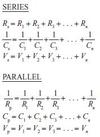
Resistors wired in series
-Current through each R is equal. -Voltage drop on each at is a fraction of the terminal voltage. -Voltage drop on each R is PROPORTIONAL to resistance I(1) = I(2) V(1) = I(1)*R(1) V(2) = I(2) * R(2) R=R(1) + R(2) + R(3)
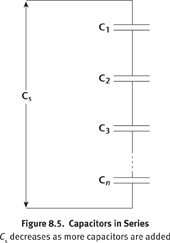
Capacitors wired in series
- “Seri-Q”; Veq is the sum of all individual V’s
- Q1=Q2
- Vs=V1+V2+V3+…+Vn
V is proportional to 1/C
- V1=Q1/C1
- V2=Q2/C2
- 1/Ceq = (1/C1) + (1/C2)+…+(1/Cn)
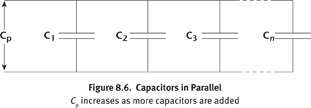
Capacitors wired in parallel
- “Par=C” ?
- resultant capacitance that is equal to the sum of the individual capacitances
- Cp=C1 + C2 + C3+…+Cn
- Vp=V1=V2=V3=…Vn
V of capacitor
Q/C
V of resistor (Vr)
Vr=IR
V terminal of RC circuit
V terminal = V of capacitor + V of resistor Vt=Vr + Vc
conventional current
convention assumes that all moving charges are positive, and thus, conventional current moves from regions of high electric potential to regions of low electric potential.
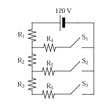
In the figure above, the conventional current moves through the circuit, from the positive terminal to the negative terminal.
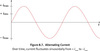
direct current
where Δ q is the amount of charge that passes by in a certain amount of time, Δ t.
magnitude stays constant over time
electromotive force (EMF)
the electric potential difference (or voltage) that drives current. EMF isn’t really a force, it’s a potential difference.
Kirchhoff’s Loop Rule
The sum of the voltage drops across a closed circuit has to equal the sum of the voltage gains across the circuit.
resistance
of a conductor, R, is a measure of a particular conductor’s resistance to current flow
resistors.
Devices used to intentionally cause a voltage drop
resistivity, ρ
of a material is a measure of its resistance to current flow; if a material has a higher resistivity, then applying a given potential difference across it will produce a lower current. The resistance of a resistor depends of the resistivity of the material:
where A is the cross-sectional area through which the current flows, and L is the length of the resistor
ohmic
the voltage drop across them will be proportional to the current passing through them (conditions on MCAT unless otherwise stated)
Ohm’s Law
V=IR
Electric current
ampere
current units are coulombs per unit time
From Ohm’s Law, we see that the units of resistance must then be a volt per unit ampere, or an ohm

-
Physics: Building Blocks28
-
Circuits69
-
Physics 1: Kinematics & Newton55
-
Physics 1.5: Thermodynamics30
-
Physics 3: Springs & Waves36
-
Physics 4: Light & Sound46
-
Chemistry 118
-
Chemistry 2111
-
Chemistry 326
-
Chemistry: Acids & Bases59
-
Organic Chemistry 133
-
Organic Chemistry 21
-
Organic Chemistry 316
-
Organic Chemistry 40
-
Biology 132
-
Chemistry 40
-
Physics: E & M42
-
Orgo: Nomenclature & Functional Groups34
-
Physics 2.5: Electrostatics20
-
Physics 2.6: Magnetic Fields18
-
Physics: Nuclear and Atomic8
-
Physics 3.5: Fluids23
-
Biology 218
-
Biology 33



