Simple Harmonic Motion
- First, it always acts to restore the particle or object to its equilibrium position any time it is displaced. That is, the direction of the restoring force is always toward the equilibrium position.
- Second, the magnitude of the force is directly proportional to the magnitude of the displacement of the particle or object from its equilibrium position.
Springs
F=-kx (Hooke’s Law)
higher k=stiffer spring
Oscillating Systems
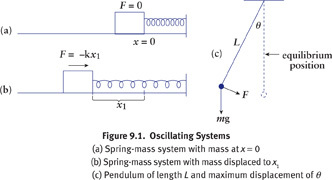
Angular Frequency
ω
- radians per second.
- **ω=2πf=√(k/m)=2π/T **
- where T is the period, 1/f (time to complete one cycle)
- measure of the rate at which the oscillating object would move through an arc of a particular size if the object were traveling around a perfect circle (for which one revolution around the circle equals one cycle).
- dependent on the spring constant and mass attached to the spring but not on the displacement x of the spring.
radians
180/π degrees
360 degrees = 2π radians
Equation for Position of a spring as it moves through its cycle as a funciton of time
x= X cos (ωt)
- X is the amplitude (maximum displacement from equilibrium), ω is the angular frequency (ω = 2π f = π /T, where T is the period, ,1/f the time to complete one cycle), and t is time*.
- assuming that the spring has maximum displacement at t = 0.
Springs as Conservative Systems
(2 conditions, 1 formula)
Conditions: 1) small oscillations, 2) short periods of time
[assume all the potential energy of the spring will be converted to kinetic energy as it oscillates.]
U=(1/2)kx2
K=(1/2)mv2
E=K + U = constant
Simple Pendulum
F= -mg sinθ
- where m is the mass attached to the end of the pendulum, g is the acceleration of gravity (9.8 m/s2), and θ is the angle between the pendulum arm and the vertical
- force equation has a negative sign, reminding us that this is a restoring force, always directed in the direction opposite to the displacement and in the direction of the equilibrium position.
Angular Frequency of a Pendulum (of length L)
ω= 2πf=√(g/L)
- NOTE: Neither the mass m attached to the pendulum nor the angular displacement θ determines the angular frequency ω
- Can change angular frequency by changing: length or gravity (ie elevator)
- <em>Therefore, if two pendulums have the same length, they will demonstrate the same angular frequency irrespective of the masses attached to them or their respective initial displacements. As with two identical springs stretched to different lengths with the same angular frequency but different linear velocities, the two pendulums will be traveling at different velocities.</em>
Pendulums as Conservative Systems
Neglect air resistance and friction and mechanism supporting pendulum above:
- When pendulum is pulled back to its maximum displacement θ, the pendulum has maximum potential energy (U) = mgh
- K=(1/2)mv2
- E=K+U=constant
*
Comparing: mass-spring system and the simple pendulum
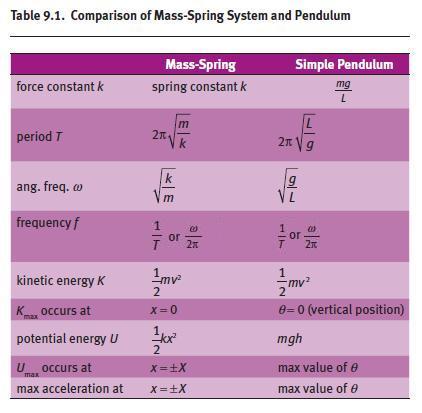
Frequency and Period
Frequency:
- f=ω/2π
- f=1/T
Period:
- T=2π/ω
- Wavelength*: λ=2π/k
- Speed*: v=fλ
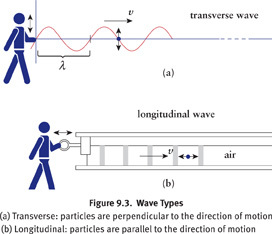
Transverse Waves
- sinusoidal waves
- a waveform in which the direction of particle oscillation is perpendicular to the movement (propagation) of the wave
- the particles are oscillating perpendicular to the direction of energy transfer
- ie: Electromagnetic radiation
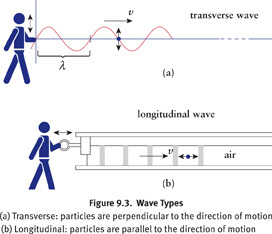
Longitudinal Waves
- sound waves
- particles of the wave oscillate along the direction of travel of the wave motion; that is, the wave particles are oscillating along the direction of energy transfer
Displacement (y) of a particle in a wave at a point (x)
y=Y sin (kx - ωt)
where Y is the amplitude (maximum displacement), k is the wavenumber (don’t confuse this k, wavenumber, with the spring constant k in Hooke’s law!), ω is the angular frequency, and t is the time.
speed of the wave (v)
v= (fλ) = (ω/k) = (λ/T)
because
v=fλ
k=2π/λ
ω=2πf=2π/T
f=1/T
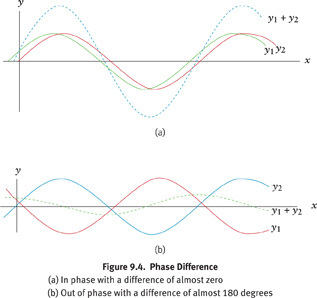
Phase difference
Destructive (vs constructive) interference
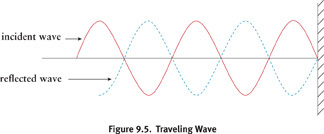
Traveling Wave
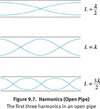
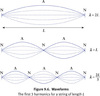
standing waves
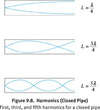
Points in the wave that remain at rest (i.e., points where amplitude is constantly zero) are known as nodes, and points that are midway between the nodes are known as antinodes.
Antinodes are points that fluctuate with maximum amplitude.
The length of the medium dictates the wavelengths of traveling wave that are necessary for establishing the standing wave. Furthermore, the nature of the boundary dictates the appearance of a node or antinode at the boundary itself.
- Closed boundaries are those that do not allow oscillation and that support nodes. The closed end of a pipe and the secured ends of a string are both closed boundaries.
- Open boundaries are those that allow oscillation and support antinodes. The open end of a pipe and the free end of a flag are both open boundaries.
Natural Frequency
frequency or frequencies at which an object will vibrate when disturbed
forced oscillation
- If a periodically varying force is applied to a system, a system will then be driven at a frequency equal to the frequency of the force
- If frequency of the applied force is close to that of the natural frequency of the system, then the amplitude of oscillation becomes much larger.
- ie: parent pushing a child on a swing
Resonance
If the frequency of the periodic force is equal to a natural frequency of the system, then the system is said to be resonating, and the amplitude of the oscillation is at a maximum.
If the oscillating system were frictionless the periodically varying force would continually add energy to the system, and the amplitude would increase indefinitely.
Dampening
because no system is completely frictionless, there is always some dampening, which results in a finite amplitude of oscillation.
Sound
transmitted by the oscillation of particles along the direction of motion of the sound wave. Therefore, sound waves are longitudinal.


-
Physics: Building Blocks28
-
Circuits69
-
Physics 1: Kinematics & Newton55
-
Physics 1.5: Thermodynamics30
-
Physics 3: Springs & Waves36
-
Physics 4: Light & Sound46
-
Chemistry 118
-
Chemistry 2111
-
Chemistry 326
-
Chemistry: Acids & Bases59
-
Organic Chemistry 133
-
Organic Chemistry 21
-
Organic Chemistry 316
-
Organic Chemistry 40
-
Biology 132
-
Chemistry 40
-
Physics: E & M42
-
Orgo: Nomenclature & Functional Groups34
-
Physics 2.5: Electrostatics20
-
Physics 2.6: Magnetic Fields18
-
Physics: Nuclear and Atomic8
-
Physics 3.5: Fluids23
-
Biology 218
-
Biology 33



