What is a Stationary Wave
A wave which transfers no energy and whose positions of maximum and minimum amplitude are constant
How are stationary waves produced
A stationary wave is produced from the superposition fo 2 progressive waves travelling in opposite directions
What is Interference
The superposition of waves from two coherent sources of waves
What are the conditions for a stationary wave to be produced
- The waves must be of the same frequency, wavelength and amplitude (cohernet)
- They must be travelling in opposite directions
- This normally happens when a wave is reflected back onto itself
What does Coherent mean
When two waves have a fixed phase difference and same frequency
What are the Different Types of Interference
- Constructive interference - when 2 waves have displacement in the same direction
- Destructive interference - when one wave has positive displacement and the other has negative displacement
Describe Destructive and Constructive Interference Diagram
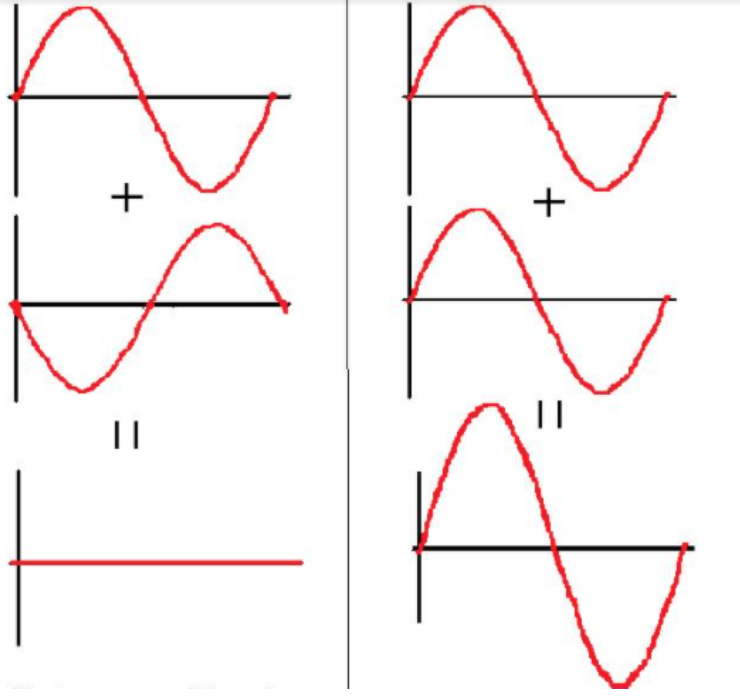
What is Total Destructive Interference
If the waves have equal but opposite displacements so they cancel each other out
Describe Young’s Double Slit Experiment
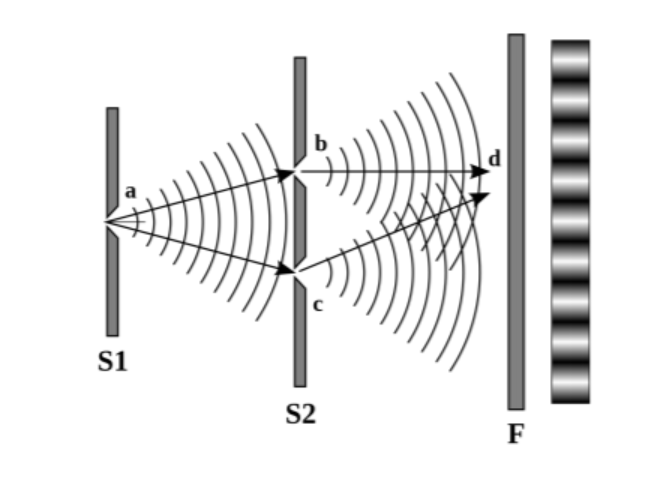
- Shine a coherent light source through 2 slits about the same size as the wavelength of the laser light so the light diffracts
- Each slit acts as a coherent point source making a pattern of light and dark fringes
- Light fringes are formed where the lights interfere constructively, this occurs where the path difference between waves is a whole number of wavelengths (nλ, where n is an integer)
- Dark fringes are formed where the light interferes destructively, this occurs where the path difference is a whole number and a half wavelengths ((n+½)λ)
Describe Young’s Double Slit Experiment Diagram
Describe what happens using White Light rather than Monochromatic in Young’s Double Slit
Gives wider maxima with a central white fringe with alternating bright fringes (violet is closest to the central maximum and red furthest)
Explain what happens to the amplitude of two wave superposing when the frequency of them decreases
- If the frequency decreases then their wavelengths will decrease
- So the path difference will get closer and closer to one wavelength
- Therefore the ampltiude will get bigger as the waves become more in phase
How would you increase the accurancy of finding the wavelength of Young’s Double Slit Experiment
- Increase the distance from the screen to the slits - when the distance is greater the fringe spacing is greater so the maximas are easier to read off
- Measure across 2 maximas and taking the mean - reduces percentage error
What is the FringeSpacing Equation
w = λD/s
Fringe Space (m) = Wavelength(m) x Distance from slits to screen(m) / Slit Spacing (m)
Describe the Safety Procuations of Using Lasers
- Wear laser safety goggles
- Don’t shine the laser at reflective surfaces
- Never shine the laser at a person
Why do we use a lazer to show iterference and diffraction
Lazers produce monochromatic light so diffraction and interference patterns are more defined
How was the knowledge and understanding of the nature of electromagnetic radiation changed over time
- Young’s double slit experiment showed that light can diffract and have interference
- These are wave properties so proved that electromagnetic radiation must act as a wave (at least some of the time).
- At the time some theories suggested light was formed of tiny particles, however this experiment disproved that theory
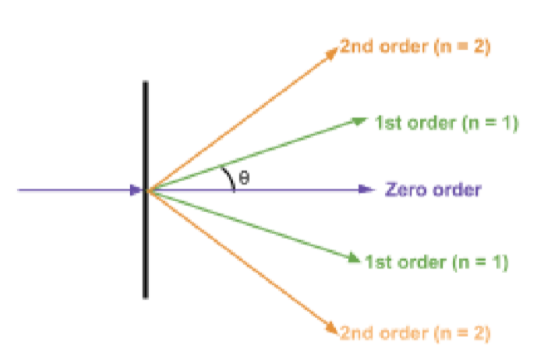
Describe the Different Orders Diagram
What is a Node and an Antinode
- Node - a point on a stationary wave where the displacement is 0
- Antinode - a point on a stationary wave with maximum displacement
What is a Harmonic
A mode of vibration that is the multiple of the first harmonic
Describe Three Lowest Harmonics in a Diagram
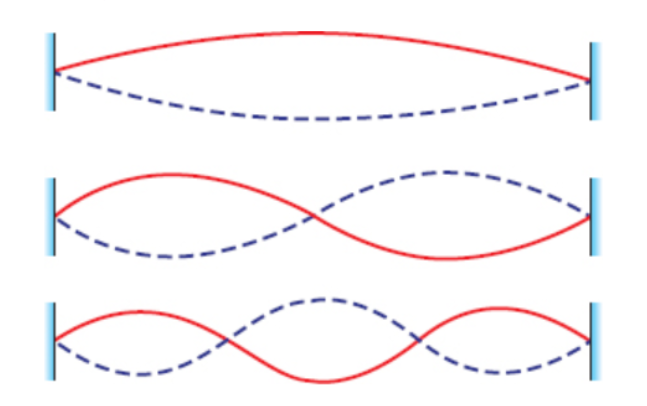
Describe the Three Lowest Harmonics of a Stationary Wave
- First Harmonic- two nodes at either end and an antinode in the middle, wavelength is 2L
- Second Harmonic - three nodes and two antinodes, wavelength is L
- Third Harmonic - four nodes and three antinodes, wavelength is 2L/ 3
What is the Fundamental Mode of a Stationary Wave
The Lowest Harmonic
What is First Harmonic Equation
f = 1/2 x L x square root T/u
Frequency (Hz) = 1/ 2 x Length (m) x Tension (N) / Mass per unit length (kg m-1)


-
Measurements and Their Errors13
-
Particles and Nuclides28
-
Fundamental Particles25
-
Electrons and Energy Levels14
-
Particles of Light20
-
Waves50
-
Combining Waves36
-
Current Electricity25
-
Electrical Current28
-
Introduction to Mechanics22
-
Motion and it's Measurements27
-
Momentum12
-
Newton's Laws and Work, Energy and Power19
-
Materials31
-
Further Mechanics35



