What is Electric Current
The flow of charge per unit time
Electric Current Equation
I = Q /t
Current (A) = Charge (C) / Time (s)
What directions do electrons move in a wire
Electrons normally drift in random directions but there is no net movement of charge
What is Potential Difference
The energy transferred per unit charge
Potential Difference Equation
V = W /Q
Volatge or Potential Difference (V) = EnergyTransferred (J) / Charge (C)
Why do you want your voltmeter to have infinite resistance and your ammeter to have zero resistance
- Voltmeter - current takes the path of the least resistance so if the voltmeter has infinite resistance no current will flow through it, therefore all the current will flow through the appliance
- Ammeter - if there is zero resistance that means there would be zero voltage across the ammeter so no energy would be lost across it
What is a Conventional Current
- The idea that potential difference always goes from positive to negative
- Even though in reality the negative electrons are attracted towards the positive
What is Resistance
The ratio of voltage to current
What is the Resistance Equation
R = V / I
Resistance = Voltage (V) / Current (A)
What factors effect the resistance of a material
- Cross Sectional Area
- Length of a Wire
- Temperature
- Material of Wire
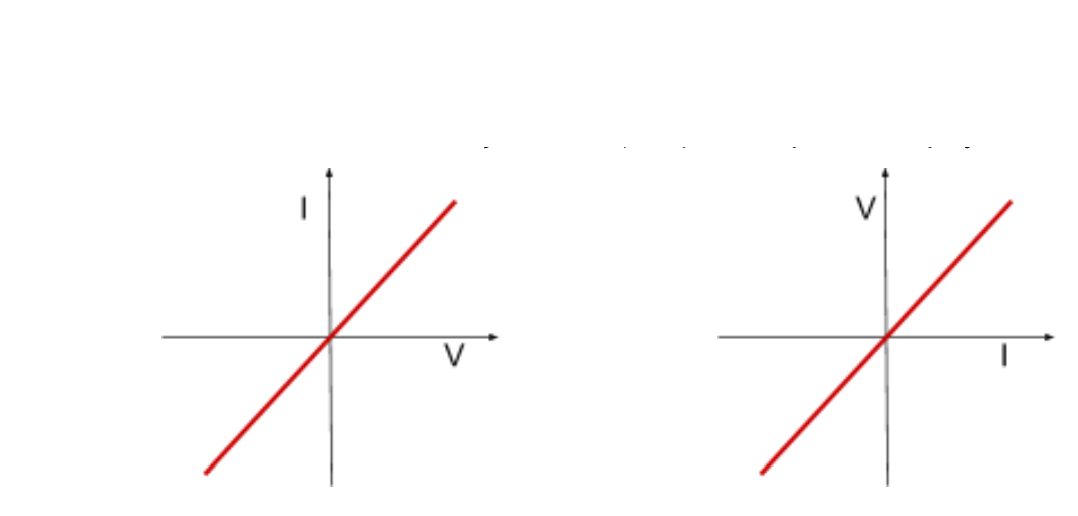
What does Ohm’s Law state
For an ohmic conductor current is directly proportional to the voltage, provided that the physical conditions such as temperature are kept constant
What is a Non-Ohmic Component
A component that does not obey Ohm’s Law meaning the current and voltage are not directly proportional
Describe the Ohmic Conductor Graphs
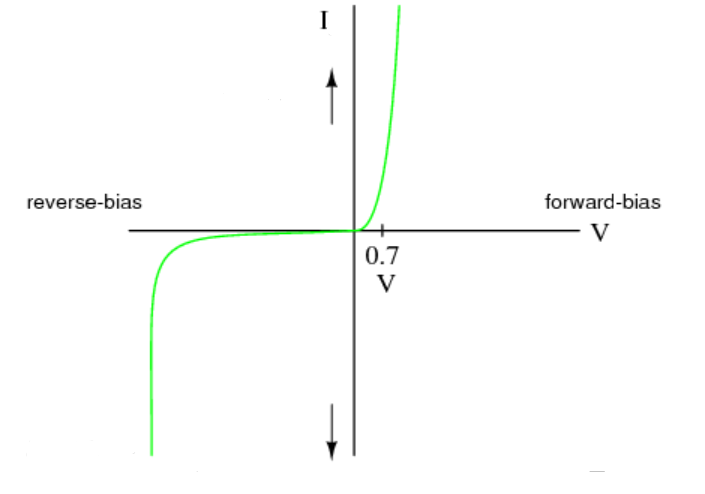
Describe the Semiconductor Diode Graph and Explanation
The diode will allow current to flow in the forward bias past the thresold voltage (0.7v). In the direction of the reverse bias, the resistance of the diode is extremely high meaning that only a very small current can flow
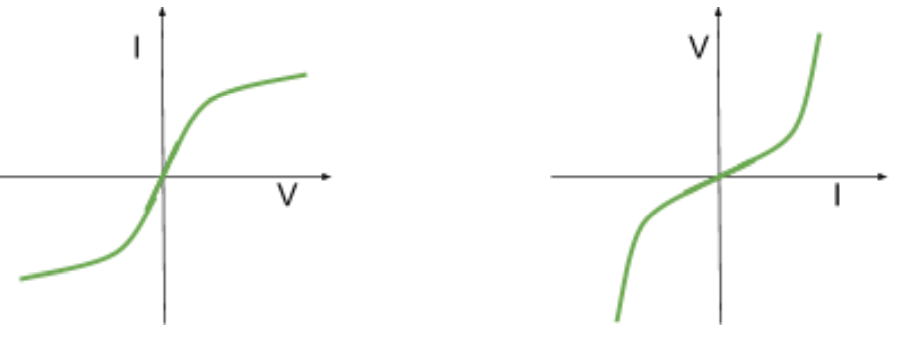
Filament Lamp Graph and Explination
- At low current Ohm’s Law is obyed
- As the current increases, the temperature increases, increasing the frequency of electron collisons, this causes the electrons to slow down
- Therefore current decreases and so resistance increases
What is the Resistivty Equation
p = RA / L
Resistivty (Ωm)= Resistance (Ω) x Cross Sectional Area (m^2) / Length (m)
Why do we use Resistivty
It is useful to compare different materials because resistivty gives the value of resistance through a material independent of other factors (apart from temeprature)
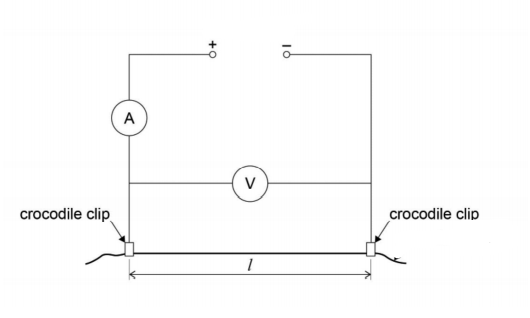
Describe how you would find the resistivity of a wire and describe the labelled circuit diagram
- Measure the diameter the wire at various points, using the micrometer and find and record the mean diameter
- Set up the apparatus as shown in the diagram.
- Adjust the length to 0.1m using the crocodile clips, measured using the metre ruler.
- Read and record the current on the ammeter and the voltage on the voltmeter
- Calculate the resistance using R=V/I
- Repeat this at 0.1m intervals from 0.1 - 0.8m
- Calculate the cross-sectional area of the wire using A = πr^2
- Plot a graph a graph of Resistance against Length and draw a line of best fit, the resistivity will be the gradient multiplied by the cross-sectional area of the wire
Explain what happens to resistance when the temperature of a metal conductor increases (Explain in terms of energy of metal ions)
- When the temperature increases the positive metal ions gain more kinetic energy
- This means the positive ion cores vibrate more and more
- Increasing the frequency of electron collisons
- This causes the electrons to slow down
- Therefore current decreases and so resistance increases
What is a Thermistor
A component those resistance varies with temperature (when temperature increases, their resistance decreases)
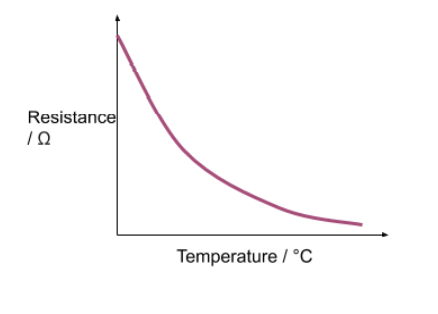
Thermistor Graph and Explanation
- As the temperature of a thermistor increases, its resistance decreases.
- This is because increasing the temperature of a thermistor causes electrons to be emitted from atoms, therefore the number of electrons increases and so current increases causing resistance to decrease
What is an Application of a Thermistor
A temperature sensor, for example, it could be used to turn on the heating once room temperature drops below a specific value
What is a Superconductor
A material which below the critical temperature, has zero resistiance (the critical temperature depends on the material)
What are the Application of Superconductors
- Power cables - superconductors would mean energy loss would be zero beacuse the cables would not heat up at all
- Strong magnetic fields - superconductors would not require a constant power source. In magnetic trains there would be no friction between the train and rail
- Less fuel is needed when using superconductors which reduced greenhouse gases produced


-
Measurements and Their Errors13
-
Particles and Nuclides28
-
Fundamental Particles25
-
Electrons and Energy Levels14
-
Particles of Light20
-
Waves50
-
Combining Waves36
-
Current Electricity25
-
Electrical Current28
-
Introduction to Mechanics22
-
Motion and it's Measurements27
-
Momentum12
-
Newton's Laws and Work, Energy and Power19
-
Materials31
-
Further Mechanics35



