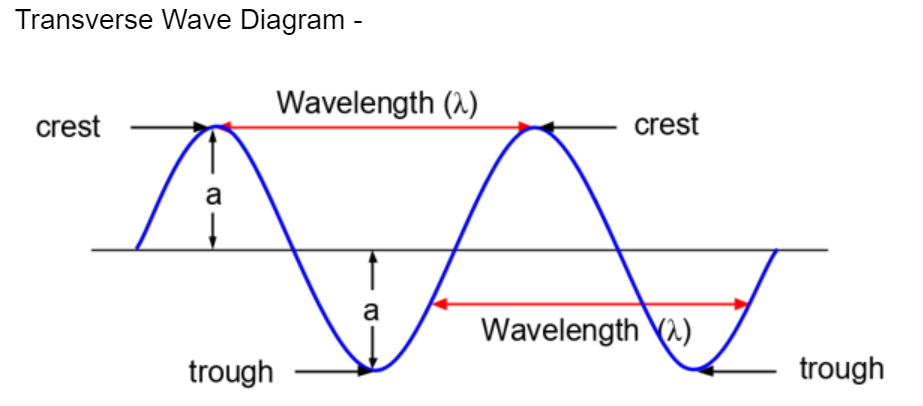
Describe a Transverse Wave Diagram
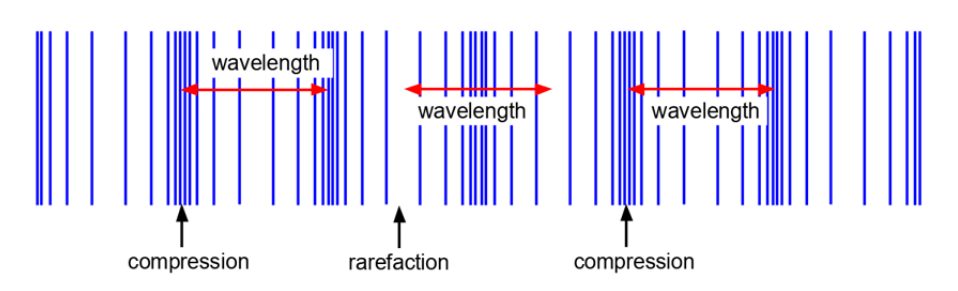
Describe a Longitudinal Wave Diagram
What is a Transverse Wave
When particles of the wave vibrate at right angles/ perpendicular to the direction that energy travels in
What is a Longitudinal Wave
When particles of the wave vibrate parallel to the direction that energy travels in
What is a Wavelength (λ)
The distance from any point on the wave to the next identical point
What is Frequency (f)
The number of vibrations/cycles of the wave per second
What is Time Period (T)
The time for one complete cycle. This is equal to 1/f
What is Amplitude (A)
The maximum displacement from the equilibrium position
What is Phase (e)
The position of a particle within the cycle relative to the start of the cycle
What is the Wave Speed Equation
c = f x λ
Wave Speed ( m s-1) = Frequency (Hz) x Wavelength (m)
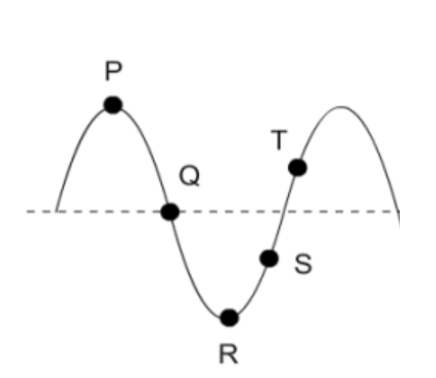
Describe the Direction of Particles in Transverse Waves (When the Wave Direction is Towards the Right)
- P - Down
- Q - Up
- R - Up
- S - Down
- T - Down
What are Progressive Waves
A wave that travels through a substance or space, transferring energy
What is Phase Difference
The fraction of a complete cycle between two point of a wave
Describe different Phase Differences
- In Phase - particles in parts of a wave that are moving at the same speed in the same direction
- Out of Phase - particles in different parts of a wave at a particular time
- Antiphase - particles in parts of a wave moving at the same speed in opposite directions
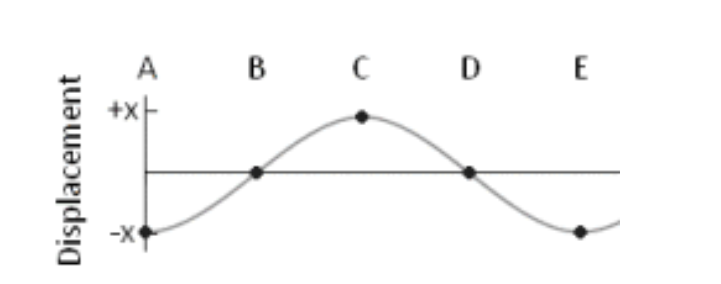
Describe a Phase Difference Diagram
- Phase Difference -
- A - 0° or 0 radians
- B - 90° or ℼ/2 radians
- C - 180° or ℼ radians
- D - 270° or 3ℼ/2 radians
- E - 360 or 2ℼ radians
What is a Mechanical Wave
Waves that cannot transmit energy in a vacuum, either transverse or longitudinal
Give Examples of Mechanical Waves
- Sound waves
- P and S waves
- Water waves
What are Electromagnetic Waves
Waves that can transmit energy through a vacuum, always transverse waves
Describe the Properties of All Electromagnetic Waves
- All travel at the speed of light in a vacuum
- Energy carried by oscillating electric current and magnetic field
- All are in phase and vibrating at 90° to each other
Describe the Electromagnetic Spectrum (Smallest Wavelength First)
- Gamma Rays
- X-Rays
- Ultra
- Visible Light
- Infrared
- Microwaves
- Radio Waves
What is the wavelength of visible light, red light and violet light
Visible Light = 400nm - 700nm
Red = Approximately 700nm
Violet = Approximately 400nm
What is Polarisation
When the oscillations of a wave are confined to one plane (e.g. vertically or horizontally polarised) and only happens to transverse waves
Describe a Polarisation Diagram
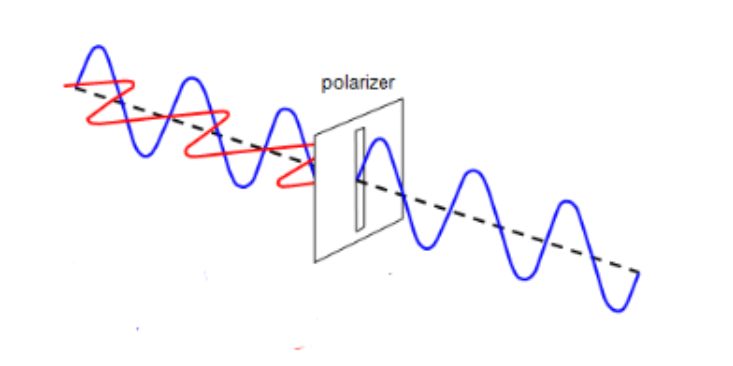
Why can only transverse waves be polarised
- Transverse waves’ displacement is at a right angle to the direction of energy transfer
- Longitudinal waves’ displacement is parallel to the direction of energy transfer
- Longitudinal is not vibrating in the direction of travel it is vibrating parallel and therefore will not be restricted to one plane


-
Measurements and Their Errors13
-
Particles and Nuclides28
-
Fundamental Particles25
-
Electrons and Energy Levels14
-
Particles of Light20
-
Waves50
-
Combining Waves36
-
Current Electricity25
-
Electrical Current28
-
Introduction to Mechanics22
-
Motion and it's Measurements27
-
Momentum12
-
Newton's Laws and Work, Energy and Power19
-
Materials31
-
Further Mechanics35



