what is there a triad of
autoimmunity, fibrosis and vascular endothelial changes
fibrosis causes subsequent atrophy of the skin and subcutaenous tissue
what is usually responsible for death
renal and lung changes
pulmonary hypertension - 12% deaths
what is a common early finding and is unlikely to have SS without
Raynaud’s
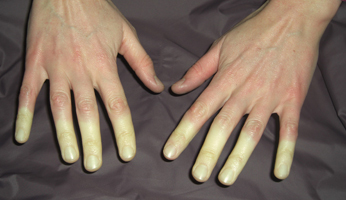
what are the 3 phases of cutaenous involvement
oedematous
indurative
atrophic
- skin becomes thickened and tight
major features
centrally located skin sclerosis that affects face arms and neck
minor features
- Sclerodactyly (skin thickening) of the fingertips and atrophy of the underlying tissues
- Internal organ fibrosis and/or vascular damage (lungs, heart, G.I. tract ± kidneys)
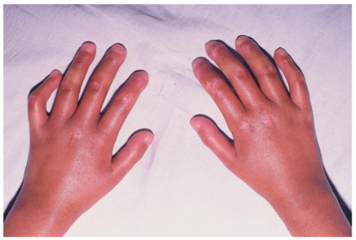
what features are needed to make a diagnosis
1 major and 2 minors
what happens when the skin of the face is affected
pinching of skin of nose - beaking
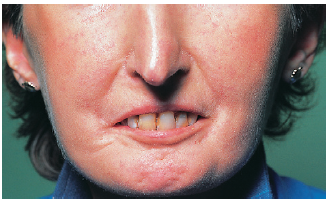
what can be seen on the face along with beaking of the nose
telangectasia
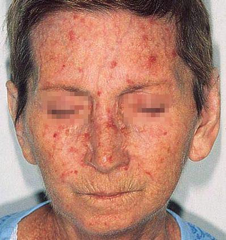
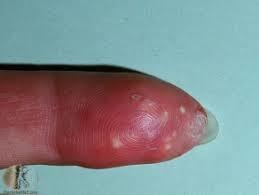
calcinosis
Calcinosis (skin can breakdown and discharge chalky material (calcium)).
lung involvement
- Pulmonary hypertension, pulmonary fibrosis and accelerated hypertension leading to scleroderma renal crisis (10% patients).
renal involvement
Scleroderma renal crisis is characterised by accelerated hypertension, rapidly progressive kidney failure and proteinuria.
GI involvement
- Gut involvement leading to dysphagia, dyspepsia, malabsorption and bacterial overgrowth of small bowel
- Importantly oesophageal dysmotility
- Lower G.I.: bloating, distension, nausea, vomiting, pain, diarrhoea, constipation
what can gut invovlement lead to
oesophageal dysmotility
limited
- formerly CREST syndrome
- skin involvement confined to face, hands and forearm
- organ involvement tends to occur later
CREST
calcinosis
raynaud’s
oesophageal and gut dysmotility
sclerodactyly
telangiectasia
antibodies for limited
anti-centromere antibody and ANA
diffuse
- Skin changes more rapidly and scleroderma tends to affect trunk and proximal limbs predominantly
- Can present acutely with intense skin itching
- Early significant organ involvement (hypertension, lung fibrosis and renal crisis)
antibodies for diffuse
anti-topoisomerase
anti SCL-70
anti RNA III polymerase antibody
investigations
auto antibodies
organ screening regularly
urinalysis
management
tailored to specific issues
tight control of BP
raynaud’s treatment and definition
spasm of blood vessels in fingers in cold
calcium channel blockers - vasodilate
medication if there is renal involvement
ACE inhibitors
what can reflux cause
fibrosis

-
Anatomy: Overview of the Lower Limb108
-
Physiology: Skeletal Muscle 121
-
Anatomy: Femoral Triangle44
-
Physiology: Skeletal Muscle 243
-
Anatomy: Gluteal Region19
-
Histology40
-
Physiology: Joints47
-
Physiology of Pain18
-
Anatomy: Hip Joint and Posterior Thigh14
-
Pathology: Benign Bone Tumours48
-
Pathology: Malignant Bone Tumours49
-
Pathology: Soft Tissue Tumours39
-
Pathology: Osteochondritis and Avascular Necrosis31
-
Physiology: Skeletal Muscular Junction11
-
Anatomy: Popliteal Fossa and Posterior Leg29
-
Anatomy: Knee, Anterior and Lateral Leg23
-
Anatomy: Foot37
-
Rheumatoid Arthritis46
-
Osteoarthritis33
-
Crystal Arthropathies58
-
Connective Tissue Diseases: SLE62
-
Connective Tissue Diseases: Sjogren's Syndrome18
-
Connective Tissue Diseases: Systemic Sclerosis28
-
Seronegative Inflammatory Arthropathies: Ankylosing Spondylitis32
-
Seronegative Inflammatory Arthropathies - Psoriatic Arthritis29
-
Muscle Disease: Polymyositis and Dermatosyitis47
-
Muscle Disease: Polymyalgia Rheumatica35
-
Muscle Disease: Fibromyalgia12
-
Immunology of Autoimmune Disease24
-
Vasculitis41
-
MSK Infections71
-
Infections of the Bone78
-
Rheumatoid Drugs25



