What is a spurious correlation
Spurious correlation, or spuriousness, occurs when two factors appear casually related to one another but are not. The appearance of a causal relationship is often due to similar movement on a chart that turns out to be coincidental or caused by a third “confounding” factor.
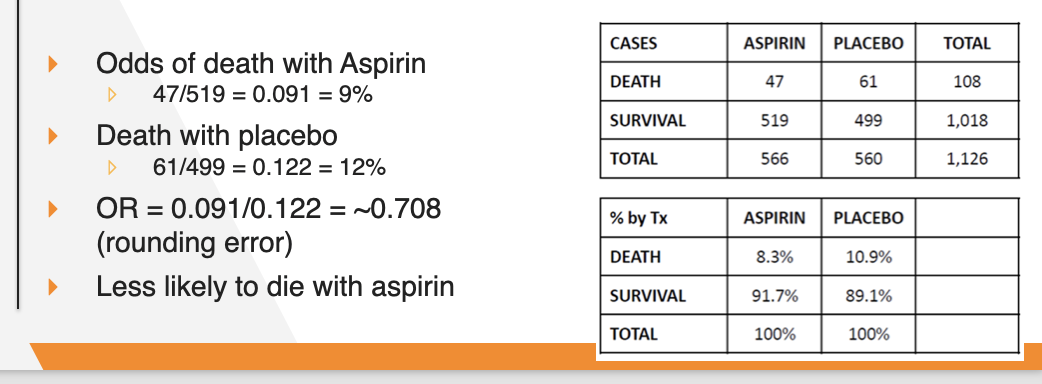
What is an odds ratio and example
Ratio of two odds
- Likelihood of an outcome
- Measure of association between exposure and outcome…
Cross sectional vs cohort stufy
- Interested in exposure and outcome
- Through some type of observational study
- Observe, not manipulateMight observe - risk, group frequency, treatment
- But we do not change or alter this.
- Association -> difficult to show causality
- Cross-sectional studies
- Analyse data from the population at a specific point in time
- Cohort study
- Subset of defined population who are, have been, or will be exposed “analysed” at specific time intervals – cross-sections
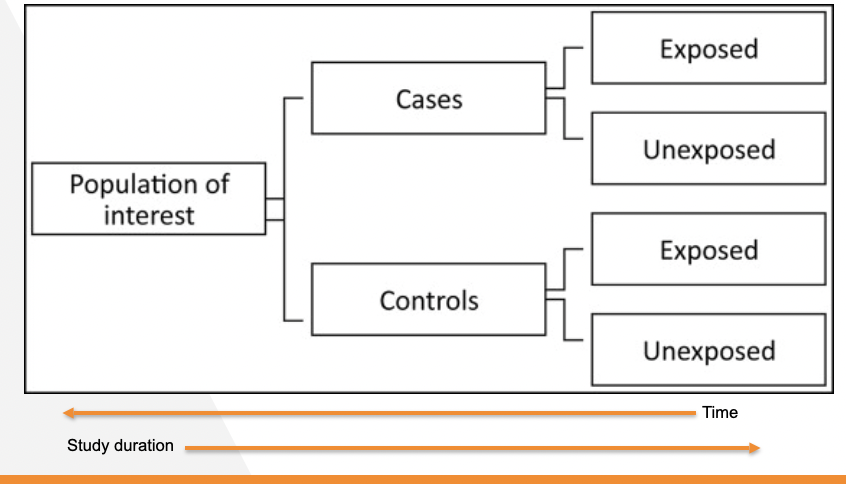
Case control study - why? and the epidemiological designs
Observation of 2 existing groups:
- Differ in outcome
- Compare those who have the condition (ie cases) AGAINST
- Those who do not have the conition/disease but otherwise similar (ie controls)
How to interpret an odds ratio?
> 1 = more association
< 1 = less association
~1 = equally likely
Association is correlation and correlation isnt alwyas ewual to causations
WHat are the strengths and weaknesses of a case control study?
Pros:
- Cases already exist – quick
- Cheap – can manage smaller sample sizes
- Flexibility in how many exposures you consider
- Great for uncommon/rare diseases - Or preliminary research
- Tend to have greater statistical power than alternatives i.e. cohort study- Not waiting for people to develop disease
Weakness:
- Observational – less causative in design
- Finding a result doesnt always reflect reality - comes form good design.
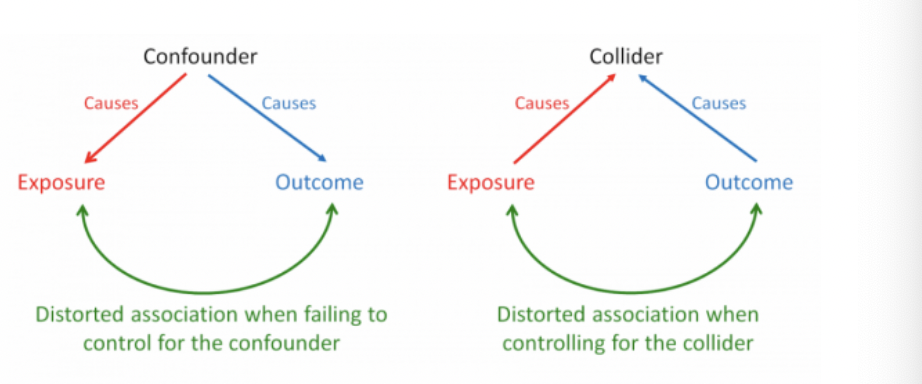
- Easily confounded – depends on what exposures you ask for. Influences both exposure and outcome. Should control for ensure exposure causes outcome and not oconfounder.
- Colliders - exposure and outcome independenlty influence third variable. Can obscure real or reveal false assoocations/
- Small numbers = difficult to study rare exposures
- Exposures depend on participant recall accuracy
- Difficult to match controls
- Prone to selection bias
- Difficulty in determining timeline of exposure to disease outcome
WHo do we select in a case control study
- Sample from limitless population
- Much like case definition - Clear definition of the outcome
- Focus on incidence cases than prevalent cases - Diagnostic criteria change all the time
- Appropriate controls
- Free from outcome i.e., disease of study
- Should have potential to become cases
- Matched case-control - Clear definition of demographics
- i.e., our cases need to be as like our controls as possible
- Demographics are potential confounders
Population studies and their weaknesses
- In the various fields of healthcare, a population study is a study of a group of individuals taken from the general population who share a common characteristic, such as age, sex, or health condition.
- Selected from the population /Assured cases and controls come from same population.Usually a lot of people to choose from
- but time ocnsuming to entine participants, therefore expensive. Cooperation is difficult to achieve and maintain.
Hospital based studies and their weaknesses
- Cases and controls selected from admission in hospital
- Likely similar across cases and controls - Same factors led both to hospital
- Easy to identify and access- In hospital with contact information. Less expensive and time consuming as a result
- Generally, more willing to participate
- However…
- Actual patients and therefore ill - May not represent exposure history accurately, Confounders
- Hospital catchment areas vary
Confounder and collider
Bias in case controls?
- At all stages, there is risk of bias
- Something in your collection, analysis, interpretation, publication or review of data leads to conclusions that are systematically different from the truth
- Known or unknown
- We talked about recruitment
- Well, that can lead to selection bias as discussed
- No random sampling
- Noncompliance
- Who volunteers for research? Do you?
- Information/ observation bias:
- Retroscpective measurement of exposure. How accurate, have they estimate dcorrectly, memory fills gaps with plausible data. Spuriou sassociation.
- Meausrmeent error -difference between measured value and true value
- Confirmaiton bias - see what we expect to see
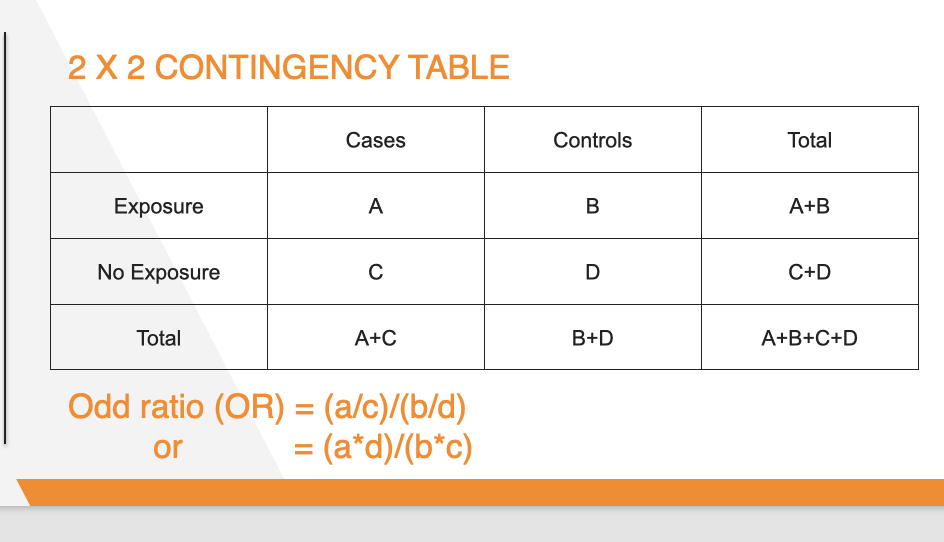
Odds ratio calculation
What type of study design is a case-control study?
Observational. Case-control studies are a form of observational design used in epidemiological and clinical research. They are “observational” in the sense that investigators DO NOT allocate the exposures, risk factors, or other forms of interventions under investigation to participants. Investigators evaluate the effects of observed exposures that happen to people during the usual course of their lives and healthcare. They are used to investigate the causes of disease; specifically they can be used to tell us the strength of the relationship between one or more risk factors and a health outcome of interest. Classic example are studies in the 1950s that established the link between lung cancer and smoking. Modern case-control studies include genome-wide association studies (GWAS) that look to investigate which genetic factors may be associated with a particular disease.
Summarise the key characteristics of the case-control study design
Cases who have experienced the outcome of interest (e.g. with incident disease) and controls who have not experienced the outcome of interest (e.g. without incident disease) are compared with respect to their level of exposure to a suspected risk factor
Unlike cohort studies, case-control studies START WITH THE DISEASE OUTCOME and LOOK BACK AT PRIORHISTORY OF EXPOSURES (“all effects are already produced before the investigation begins”)
The association between exposure and outcome is usually summarised as an ODDS RATIO
Under what circumstances are case-control studies generally most useful?
They can be an efficient way of looking at LOTS OF DIFFERENT RISK FACTORS and is often QUICKER and LESS COSTLY than starting up a new cohort of people and following them over years to see who develops the disease of interest
They are particularly useful for relatively RARE DISEASES
What are the main possible weaknesses to consider in the case-control design?
There can be problems with RECALL BIAS when investigators rely on asking cases and controls to remember past exposures
It is important that controls come from the same underlying population as the cases. If not, there is a risk of SELECTION BIAS
What is blinding
- Randomly allocating groups but want to hide who is in which group
- Single blind = participants unaware which treatment they are getting
- DOuble blind = Experimenter and particpants unaware
- If those involved are unaware then difficult to be biased.
Types randomised control trials
▸Trial type
▹Superiority
▹Noninferiority
▹Equivalence
▸In essence, RCTS might consider
▹The superiority of new treatment
▹The noninferiority of the new treatment
▹The equivalence of the two treatments
▸Placebo
▹If a proven treatment already exists, avoid a placebo

-
GI patho41
-
Spinal cord pathology16
-
dermatology142
-
Public Health13
-
Sexual health history taking1
-
CNS Pathology44
-
Bone Pathology38
-
LECT: Difficult behaviours in CYP12
-
Osteoporosis15
-
Palliative care16
-
PNS Ws25
-
Biothethic day2
-
HPB Patho57
-
breast pathology48
-
Control case studies19
-
Pastic surgery22
-
Female gentila tract histology57
-
Endo patio15
-
Resp Patho62
-
Urinary pathology30
-
Health tech2
-
Male repro pathology67



