What are the three types of method of accounting for investments?
- 0-20% Cost method or Marketable securities
- The implication is that no influence over the investee company exists
- If the security isn’t marketable, use the cost method
- 20-50% Equity Method
- The implication is that the investor has significant voting influence over the investee
- 50%+ Consolidation
- The implication is that the investor has control over the investee
- Members of the investor company constitute a majority of the board of directors of the investee.
Equity Method (ASC 323) characteristics
- used when the investor has significant infuence over the operating and financial policies of the investee.
- method is more consistent with accrual accounting.
- investment is still recorded initially at purchase price but subsequent income changes the account balance on a continuous basis.
- even if ownership is less than 20%, one must consider how much influcence exists between the two entities.
- Some factors to consider:
- significant intercompany transactions
- technology dependecny
- officers of the investor serving as officers or board members of the investee
- investor is a major customer or supplier of the investee
- investor owns at least 20% of the voting stock of the investee(but not if another shareholder/small voting block owns a majority and exercises total control)
- investor has definite plans to acquire additional stock in the future to bring thier interest up to at least 20%
Equity Method (ASC 323) Recording
Some points of interest (equity method)
- The investment is orginally recorded at Cost (Debit Investment/Credit Cash)
- As the investee earns money, this is recorded as an increase on the investor’s books based on the % the investor owns. This is considered “equity in earnings” and is shown on the income statement as a component of continuing operations. (Debit Investment/Credit Equity earnings)
- Dividends received are considered a reduction of the investment account and do NOT show up on the income statement (Debit Cash/Div Rec/Credit Investment)
- Any difference paid between the purchase price paid for the investee and the book value of the investee’s net assets must be accounted for. These differences are considered:
- FMV write up of assets (FMV increment)
- PP&E - depreciated
- Inventory - written off when sold
- Land - not depreciated but written off when sold
- Goodwill - not amoritized but impariment losses recognized.
- FMV write up of assets (FMV increment)
Equity Method Accounting - Preferred Stock
Ownership of preferred stock cannot, by itself, give an investor significant influcence, but the investor may have such influence due to other causes, and use the equity method of accountinf for the preferred stock investment.
Preferred stock income under the equity method is equal to the dividends allocated to it.
- For non-cumulative preferred stock, this will equal declared idvidends only.
- For cumulative preferred stock, this will equal the annual dividend preference regardless of payment in that year.
Equity Method Example
Investor paid $300 on 1/1/X1 to acquire 30% of the stock of the investee when investee’s net assets equaled $1,000. In 20x1, the investee reported net income of $400 and paid dividends totalling $100 to stockholders of record on 12/31/x1 with a payment date of 1/7/x2. What are the investment entries?
Record the intial investment purchase at cost:
1/1/x1
Investment 300
Cash 300
Report investor’s share of income:
12/31/x1
Investment 120
Equity in Investee 120
($400 * 30%)
Record dividend:
12/31/x1
Dividends Receivable 30
Investment 30
($100 * 30%)
Equity Method Example 2
Investor paid $380 on 1/1/x1 to acquire 30% of the stock of the investee when investee’s net assets equaled $1,000. $10 of the excess was attributable to inventory, which was sold during 20x1, $30 was attributable to land, which was still owned by investee at year end and the remaining $40 repesented a building with an estimated useful life of 40 years. In 20x1, the investee reported net income of $400 and paid dividends totalling $100 to stockholders of record on 12/31/x1 with a payment date of 1/7/x2. What are the investment entries?
Record the intial investment purchase at cost:
1/1/x1
Investment 380
Cash 380
(BV $300, Inventory $10, Land $30, Building $40)
Report investor’s share of income:
12/31/x1
Investment 120
Equity in Investee 120
($400 * 30%)
Record dividend:
12/31/x1
Dividends Receivable 30
Investment 30
($100 * 30%)
Record use of Inventory
Equity in earnings 10
Investment 10
Record Depreciation on building
Equity in Earnings 1
Investment 1
Equity Method: excess of the cost of the investment over book value.
- The excess of the cost of the investment over book value is not reported separately on the financial statement; it is included in the investment.
- It will have an impact on the subsequent reporting of incoe by the investor that depends on the nature of the asset causing the difference:
- Depreciable and amoritzable assets - differences will be amoritzed against the reported equity in ivestee income based on the appropriate life of an asset
- Goodwill - amount initially recorded will later reduce reported income in periods that impairment losses are recognized.
- All assets - outstanding differences will be written off against reported income at the time the asset is sold.
Cost Method (ASC 325)
When no significant influence exists, we then must determine if the investment has a readily determinable market value.
- If a market value exists
- use marketable securities rules (trading, avail-for-sale, held to maturity)
- If no market value exists
- Use the cost method
Some points of interest:
- Original investment is recorded at cost
- When the investee earns money, NO JE is recorded
- When a dividend is received it is recorded as Dividend Income on the income statement (not a reduction of the investment)
- In rare cases, if the dividend received is greater than the investor’s proportionate share of the investee’s income since acquisition, then it is recorded as a reduction of the investment (these usually are distributions of an investee’s earnings that occrued BEFORE the investor made thier purcahse of the investee)
- No difference between BV and the purchase price is taken into consideration (no excess amortization or depreciation as in the equity method)
Return of Capital or Liquidating Dividend (Cost Method)
Dividends received under the cost method are not aloways distributions of income to the investor. If the investee declares dividends which exceed the cumulative income it has earned since the date of the investment, the excess distribution is a return of capital to the investor, and is accounted for as a reduction in the carrying value of the investment.
For example, if the investee declares a dividend of $450 and the income earned since the investment date is only $400, the entry on the dividend record date by a 10% investor would have been:
Dividends receivable $45
Dividend income $40
Investment 5
Stock Dividend
If an investee declares a stock dividend or issues stock rights or other classes of stock to existing shareholders, no income is reported. Instead, the carrying value of the investment is simply allocated over the increased quantity of securities. If the securities are all of the same class, no entry is needed (the number of shares is disclosed in the notes to the financial statemnts, if material). If the new securities are in a different class, an entry is made to transfer part of the carrying value, using the relative FMV approach.
For example, assume a client purchased 100 shares of stock at a price of $22/share or a total of $2,200
Investment in Stock 2,200
Cash 2,200
If the investee declares a 10% stock dividend, then the # of shares held by the investor will increase to 110 so the cost basis of the each share goes from $22 to $20.
If the investee issues a stock right for each existing share, and the FMV of the stock and the stock rights on the record date are $24 per share and $6 per right, respectively, then the rights will be allocated 6 / (24+6) = 20% of the carrying value of the securities:
Investment in rights 440
Investment in stocks 440
Dividends in arrears under the Cost Method
No income is reported on dividends in arrears on cumulative preferred stock under the cost method, since this represents dividends that have not been declared. Only once they are declared and the date of record is reached can they be reported in the investor’s records as dividend income.
Life Insurance as an investment
- The purchase of life insurance on an officer can be a form of investment, when it builds up a cash value (cash surrender value).
- The portion of the premium that increases the cash value is accumulated as an asset (non-current asset) on the balance sheet, and the rest of the premium is recognized as life insurance expense.
- If the officer dies, the proceeds from the policy are recognized as income only to the extent they exceed the cash value.
- Dividends on life insurance are treated as reductions of the net premium cost, and are not reported as dividend income.
- Expense 15
Invest 10
Cash 25
Equity vs Cost Method of Accounting
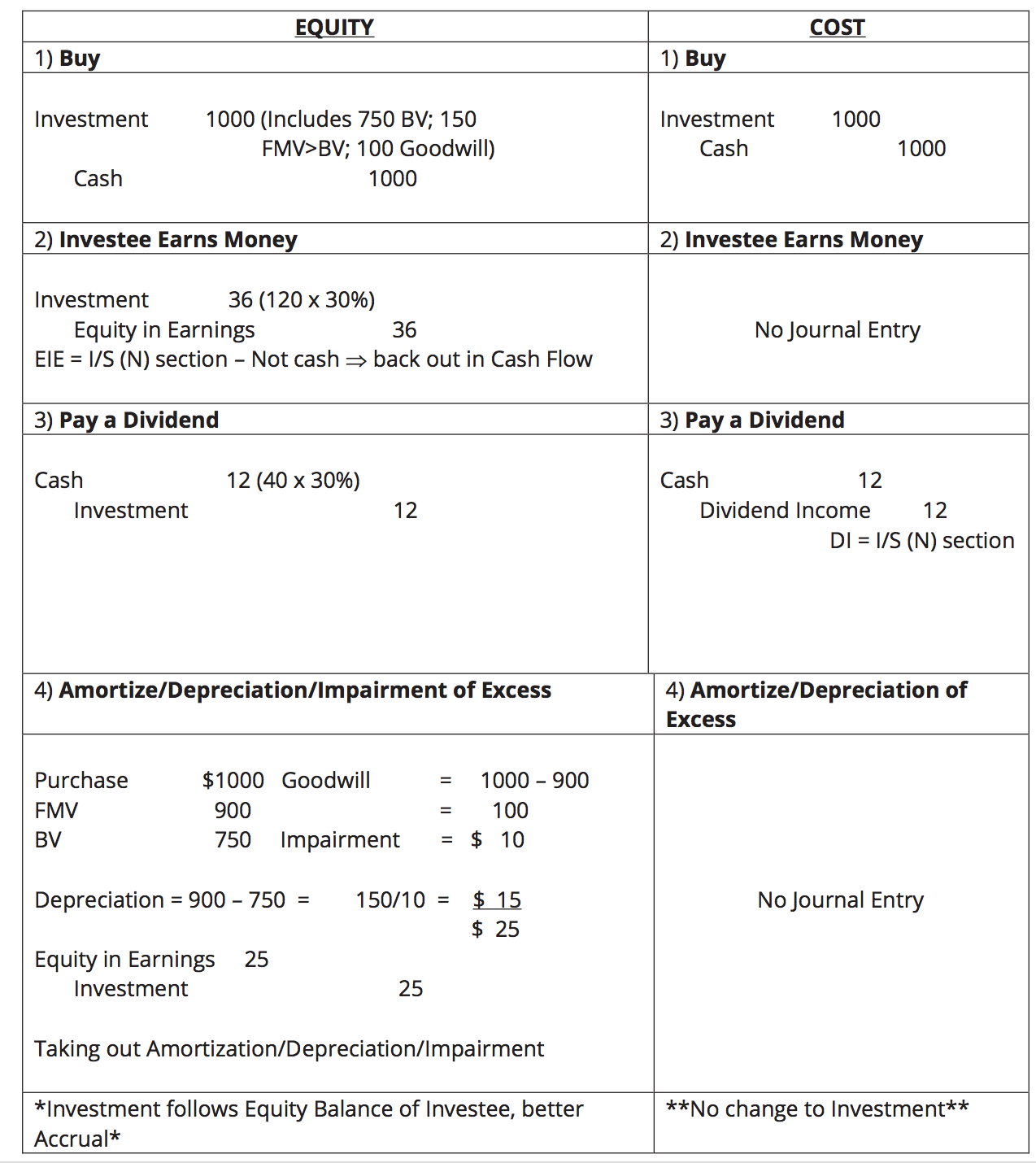
Changes in Ownership Percentages
- An entity may change its % of ownership in another entity by selling some shares, in which case the entity may lose the ability to exercise significant influence, requiring a change from the equity to the cost method.
- Or by acquiring additional shares, in which case the entitiy may obtain the ability to exercise signifcant influence, requiring a change from the cost to the equity method.
- The ownership percentage may also change if the ivestee issues additonal shares, which will decrease the percentage, or reacquires shares, which will increase it
- Equity to Cost (e.g. ownership changes from 40% to 10%) use the cost method going forward (prospective)
- Cost to Equity (e.g. ownership changes from 10% to 40%) prospectively apply the equity method after increasing the carrying value of the investment by the cost of any additional investment made to obain significant influence
- When an investment that has been accounted for as an AF4S security becomes eligible for the equity method of accounting, any unrealized holding gain or loss that is in accumulated OCI will be recognized in earnings.
Available for Sale Security JE’s as become eligible for equity method
Assume an investor has an investment in a marketable equity secuirty that is accounted for as an available for sale (AFS) security. The investment was obtained at a cost of $1,200,000 in 20x1 and had a fair value of $1,350,000 as of the end of 20x1. The increase in value of $150,000 represents an unrealized holding gain that will have been recognized with an increase or decrease to the investment and the recognition of a corresponding unrealized gain or loss in comprehensive income.
The entry to record the acquisition would be
20x1 Invest in AFS Securities 1,200,000
Cash 1,200,000
At the end of 20x1, the investment was worth $1,350,000
12/31/x1 Invest AFS securities 150,000
Unrealized gain * 150,000
* Reported as a component of OCI and closed into the equity account entitles accumulated other comprehensive income (AOCI)
Assume that in 20x2 the investor became a member of the BOD and determined that the ability to significantly influcence the investee had been achieved, qualifying the investment for the equity method of accounting. Since no additional investment had been made, the investment would be reclassified from an AFS security to an equity investment. An addition, the unrealized gain that had been recognized in the previous period will be reclassifed from AOCI and reported in the current period’s earnings
20x2 AOCI 150,000
Gain 150,000
due to increase in value of Investment
Fair Value Accounting Option (ASC 825)
FASB ASC 825, FInancial Instruments, includes a provision that allows an entity to choose to report almost any of its finacnial instruments, including both its finacnail assets and liablities, at fair value. This is referred to as the FV option and may be applied to eligible financial instruments on specified election dates on a security by security basis and may be applied to some or all of a group of securities.
Financial Instrument Defintion
Under GAAP, a finacnail instrument is defined as “cash, evidence of an ownership interest in an entity, or a contract that both:
- imposes on one entity a contractual oblication (financial liability) either:
- To deliver cash or another financial instrument to a second entity.
- To exchange other financial instruments on potentially unfavorable terms with the second entity.
- Conveys to that second entity a contractual right (financial asset) either:
- To receive cash or another financial instrument from the first entity.
- To exchange other financial instruments on potentially favorable terms with the first entity”
As a result, all recivables and payables are financial investments as are derivatives and investments in debt and equity securities.
Eligible Financial Instruments
- Recognized financial assets and liablities
- Firm commitments that involve only financial instruments or written loan committment
Election Dates
The election dates on which an entity may elect the fair value option include:
- When the eligible item is first recognized
- when an eligible firm commitment is entered into
- when items previously presented at fair value due to specialized accouting principles, with unrealized gains or losses recognized in earnings, no longer qualify for the specialized accounting principles.
- When there is a change in the method of accounting for an equity investment, such as to or from the equity method or ceasing to consolidate an investee.
- When an item is required to be measured at fair value on a one-time basis but is not required to be adjusted to fair value on subsequent financial statement dates.
On a given election date, the entity may elect ro report the item(s) at fair value or may apply the election to only some of the items, with the decision being made on a security by security by basis.
- an entity with numerous firm commitments may elect to report some, all, or none of them at fair value.
- an entity with several investments accounted for under the equity method may elect to report some, all, or none of them at fair value.
Fair Value Elections
Once made, a fair value election is irrevocable. It may, however, be changed on a subsequent election date. When the fair value election is made, the eligible item will be measured at its fair value on each balance sheet date. Any unrealized gain or losses will be recognized as a component of income. If the fair vale electon were applied to:
- an equity method investment, it would be measured at FV on each B/S date and any changes, net of dividends received will be recognized as a gain or loss.
- an AFS investment, will be reported as the same value as before the election but the unrealized gain/loss will be reported as a component of income rather than OCI
- a held to maturity investment, it would continue to be accounted for under the amoritzed cost method, applying the effective interest method, but after amoritzation of discount or premium, the carrying value will be increased or reduced to fair value at the B/S date and the unrealized gain/loss will be recognized in income.
- a firm commitment, such as a foreign currency forward exchange contract, an asset or liability would be recognized at fair value as the subject of the committment, such as the foreign currency exchange rate, changes.
Three general approaches for investments in financial instruments under IFRS
- Amortized Cost Approach
- Fair Value through OCI (FVTOCI)
- Fair Value through profit or loss method (FVTPL)
Amortized Cost Approach
Under the amortized cost approach, any difference between the original cost and the face amount is treated as a discount or premiu and the effective interest method of amortizaton is applied. The conditions are:
- the instrument calls for scheduled payments that consist exclusively of principal and interest
- the entity’s business model has, as an objective, to hold until maturity such instruments in order to collect the contractual cash flows.
Fair Value through other comprehensive income (FVTOCI)
- accounted for at fair value with unrealized gains/losses recognized in OCI.
- it is applied to financial assets when two conditions are met:
- the instrument calls for scheduled payments that consist exclusively of principal and interest
- the entitiy’s business model has, as an objective, to either hold such instruments in order to collect the contractual cash flows or to sell them.
- these conditions are similiar to those for using the amoritzed cost approach except FVTOCI approach is required if the entity, as a business model, may either hold the financial asset to maturity or dispose of it, whereas the amortized cost approach is only applied when the entity, as a business model, holds the financial asset to maturity.
- under this approach, such items as interest income, foreign exchange gains/losses, and impariment losses are recognized in income. After recognizing those items and adjusting the investment to its fair value, the net differne is recognized as an adjustment to other comprehensive income.
- may only be applied only to those equity securities that are neither held for trading nor as contingent consideration recognized by an acquirer in a business combination
- the entity must make an irrevocable election when the investment is intially recognized.
- while changes in fair value are recognized in OCI, dividends are recognized in profit or loss
Fair value through profit or loss method (FVTPL)




