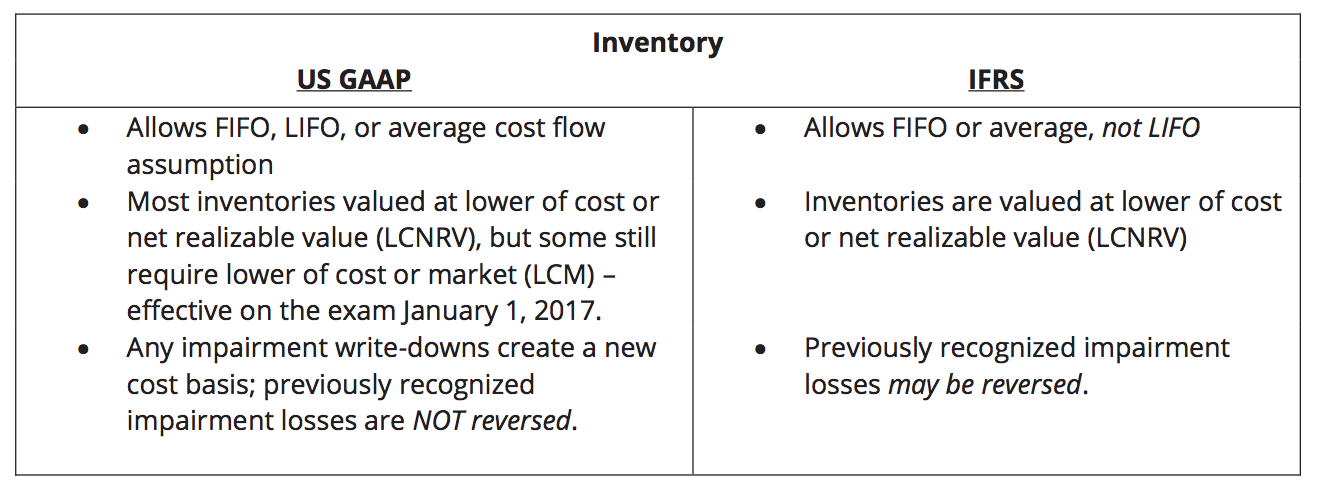
Cost of Inventory
Includes all costs of acquisition and preparation for sale:
- Warehousing cost prior to sale.
- Insurance, repacking, modifications
- Freight-in paid by the buyer
- Transportation costs paid by the seller on consignment arrangements.
- Do NOT include abnormal costs for idle factory expense, unallocated fixed overhead costs, excessive spoilage, double freight, and rehandling costs (these should be expensed immediately)
All of the costs associated with inventories will remain on the B/S until the point of sale, consistent with the matching principle. This means that the inventory account will included the purchase price of the goods as well as freight-in paid by the buyer and warehousing costs of goods prior to resale.
Financing costs are not, however, treated as part of the cost of inventory, and should be reproted as interest expense.
Costs incurred at the time of sale, such as freight-out paid by the seller and sales commissions, are generally recognized as selling expenses at the time of sale, consistent with the matching principle.
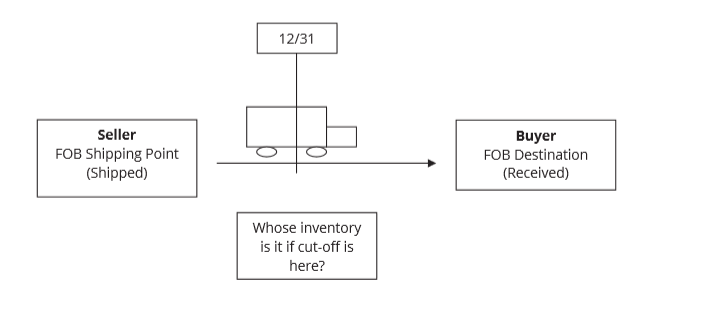
Goods in Transit
FOB Shipping point
- Title passes to the buyer when the seller delivers the goods to a common carrier (shipped).
- Included in buyer’s books at year end.
FOB destination
- Title passes to the buyer when the buyer receives the goods from the common carrier (received).
- Included in seller’s books until received by buyer.
Returned Inventory
The seller should reduce Net Sales and add the cost of the items back to inventory.
Sales return and Alllowance or Sales XX
AR/Cash XX
Inventory XX
COGS XX
This should take place as soon as the seller has authorized the goods for return, so long as the actual return of the item is considered probable.
Financing Costs as part of Inventory
Financing costs are not, however, treated as part of the cost of inventory, and should be reported as interest expense. This will include interest on loans obtained in order to purchase inventory, as well as additional payments made to the seller of the goods as a result of iterest on unpaid balances or early-payment discounts not taken. For example, if goods are purchased with a $100 invoice 2/10, net 30, then the client is entitiled to a 2% discount if payment is made within 10 days and records the inventory at $98 (net method). If payments is made more than 10 days after invoicing, the extra amounts paid will be recognized as financing expenses and not included in inventory.
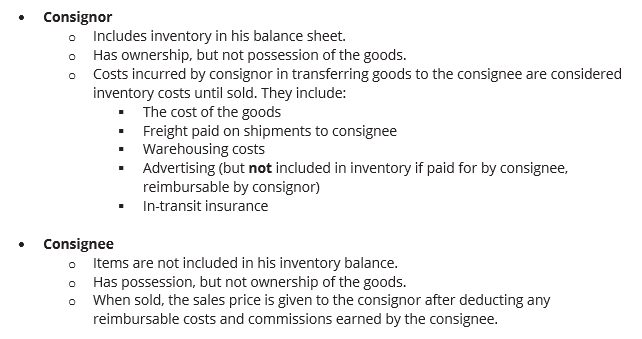
Consignment Inventory
- When a buyer is acquiring goods for resale, but only wants to purchase those goods once they have been able to arrange the resale.
- In these circumstances, the potential seller (consignor) arranges for the goods to be delivered to the potential buyer (consignee), but retains legal ownership of the goods.
- The consignor usually pays the transportation costs as well, and these are added to the consignor’s inventory cost (notice these are not the same as freight-out costs, since no sale has occured yet.)
- Actually, the consignee never owns the goods, since their purchase only occurs at the time they are able to resell them, and will be reproted immediately as cost of sales.
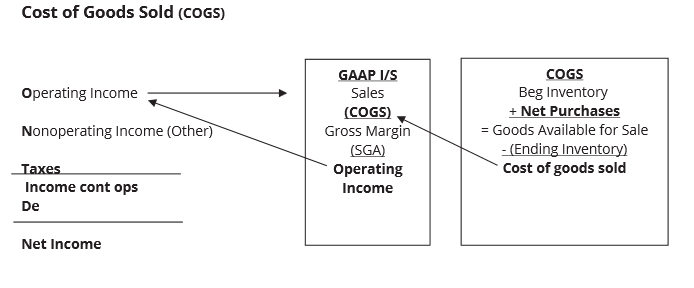
Cost of Goods Sold (COGS)
Beg Inventory
+ Net Purchases
Goods Available for Sale
- Ending Inventory
Cost of Goods Sold
Periodic Inventory System
- Inventory quantity is determined by a physcial count, usually done at year end.
- inventory purchases are debited to purchases
- No adjustment is made to inventory until the end of the period, when a physical inventory count is made and ending inventory is calculated.
- COGS is the plug and the exact amount of inventory shortages cannot be determined since it is buried in COGS.
- At time of purchase:
Purchases XX
A/P XX
- At year end:
Ending Inventory XX
COGS (plug at YE) XX
Purchases XX
Perpetual Inventory System
- on-going, real-time count
- inventory purchases are debited to Inventory.
- Quantity on hand can be determined at any point in time. (Advantage)
- At time of purchase:
Inventory 80
A/P 80
- As Sales Occur:
A/R 100
Sales Revenue 100
COGS 80
Inventory 80
Inventory Reconciliation Steps
To reconcile from recorded amount to physical count:
- Begin with recorded amount
- Add goods held on consignment
- Add goods sold FOB shipping point and set aside but included in count
- (Subtract goods in transit that were sold FOB Destination)
- (Subtract goods in transit that were pruchase FOB shipping point)
The result should be equal to the physical count. (Any differences will be due to errors/fraud)
To reconcile from physical countto recorded amounts the process will be reversed:
- Begin with the physical count
- Add goods in transit that were purchased FOB Shipping point
- Add goods in transit that were sold FOB destination
- (Subtract goods sold FOB shipping point that are set aside but included in the count)
- (Subtract goods held on consignment)
The result shold be equal to the amount recorded. (Any differences will be due to errors/fraud)
Types of Inventory Costing Methods
- Specific Identification
- FIFO
- LIFO
- Average Inventory
Specific Identification
- Must be able to identify each unit sold.
- Used when inventory is few in number, very expenseive and can be clearly identified, very heterogeneous items.
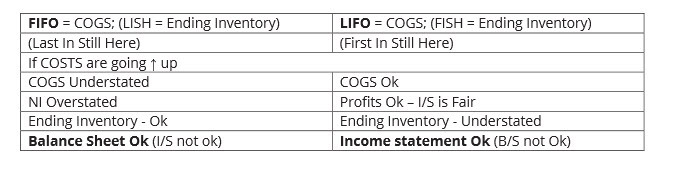
FIFO: First-in, First-Out
(LISH)
- the inventory remaining on hand is presumed to consit of most recent purchases
- in periods of rising prices, FIFO resulted in the highest ending inventory, lowest COGS, and highest net income
- FIFO assumes the goods are sold in the order of acquisition
- Closely relates to the actual physical flow of goods
- first items acquired are the first items sold (FIFO)
- Last items acquired are still here in ending inventory (LISH
- perpetual and periodic inventory systems are the same
LIFO: Last-in, First-Out
(FISH)
- most recent costs are expenses and matched with current reveneues
- inventory remaining on hand is presumed to consist of the goods acquired first.
- in periods of rising prices LIFO results in the lowest ending inventory, highest COGS, and lowest net income.
- better represents the flow of cash
- last items acquired are the first items sold (LIFO)
- first items acquired are still here in ending inventory (FISH)
- perpetual and periodic inventory systems are different
- LIFO does not, however, assume goods are sold in the reverse order of acquisition. Instead the use of the most recently acquired items as the COGS is an attempt to approximate the replacement cost of the item.
- This is based on an idea known as the capital maintenance concept, which presumes that a company that wishes to remain a going concern must maintian a basic level of investment in the assets that comprise the business.
- Thus the true cost of an item that has been sold is the cost of replacing it in inventory. LIFO is as close as a company can get to replacement cost while still matching costs to the point of sale.
- If used for tax purposes, must also be used for financial reporting purposes. This is known as the LIFO conformity rule.
FIFO vs LIFO
Dollar Value LIFO
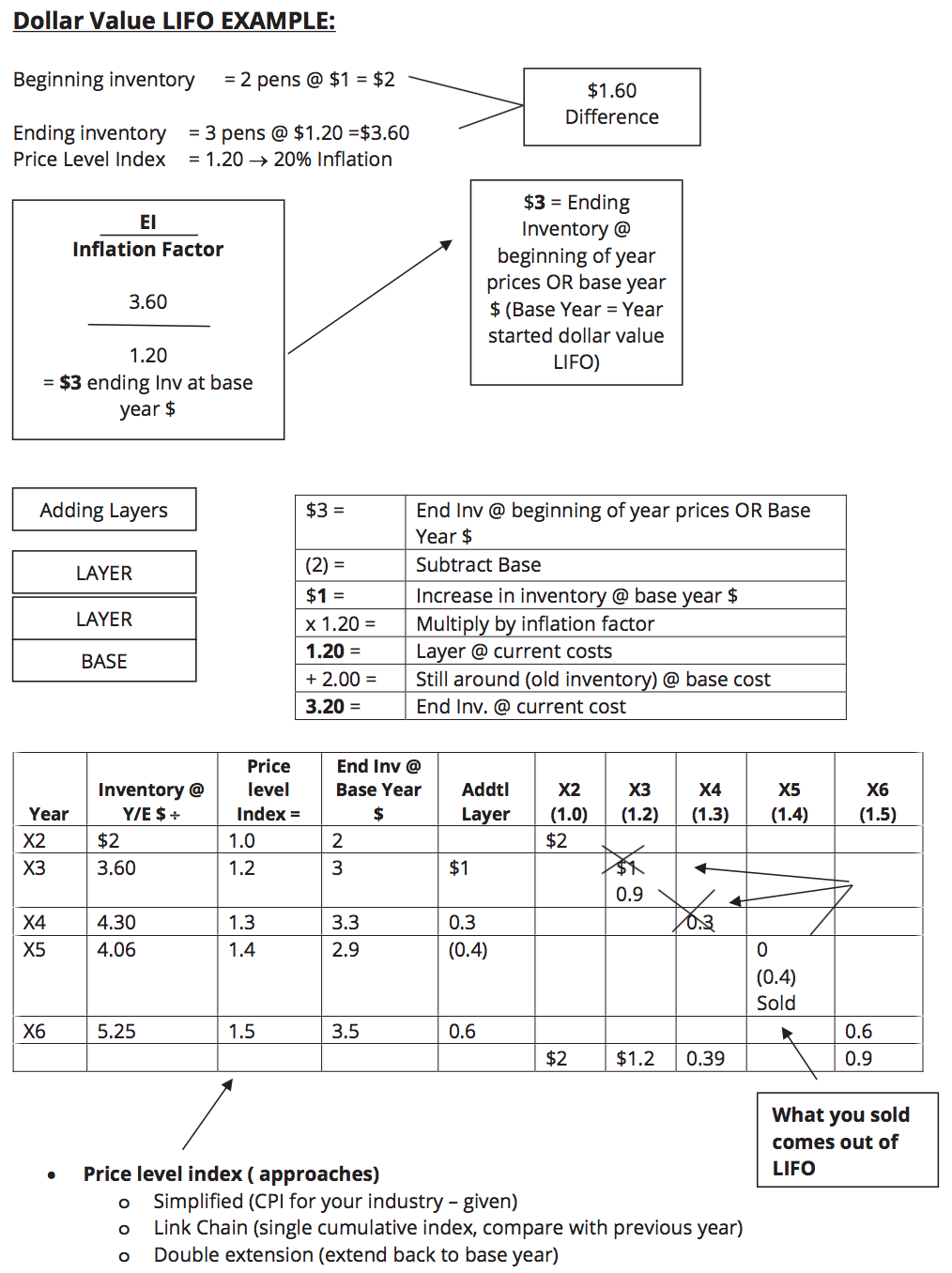
To apply the DV LIFO method, two figures are needed:
- The total current cost of inventory in the pool at the end of each year (this would usually be the replacement cost or the ending inventory under FIFO approach)
- A price index indicating the overall price level compared to the base date (the date the method was first adopted)
Lower of Cost or Market
(Only used for LIFO or Retail Inv Methods)
- Conservatism & Matching principle
- Cost = Original Cost
- Market = Middle of 3 Numbers:
- Ceiling (NRV = Selling Price - Disposal Costs)
- Floor = NRV - normal Profit Margin
- Replacement Cost = Purchase or reproduction
- Middle of these numbers is used as market, then compare market with cost and take the Lower (LCM)
- To summarize, apply the Lower of Cost or Market rule only to inventory accounted for under the LIFO or retail inventory methods. For all other inventory apply the simplified Lower of Cost or NRV rule.
Retail Inventory Methods
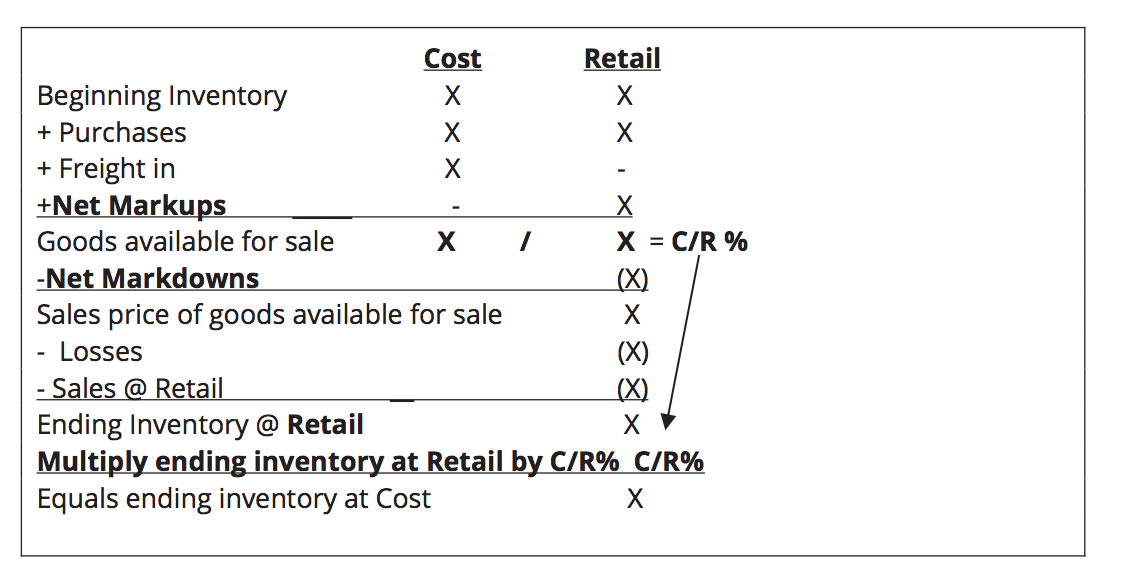
- Conventional Retail Inventory Method
- The company keeps track of inventory osts at both cost and retail. Sales, theft losses and EE discounts during the year are recorded at retail and at EOY, the comp. converts EI from retail back to cost by using a cost/retail %. This method approx the results that would be obtained by taking a physical inventory and pricing goods at LCM
- net markups are included in the cost to retail % calc (net markups = markups - mark up cancellations)
- net markdowns are not included in the cost to retail % (markdowns = markdowns - markdown cancellations)
- The company keeps track of inventory osts at both cost and retail. Sales, theft losses and EE discounts during the year are recorded at retail and at EOY, the comp. converts EI from retail back to cost by using a cost/retail %. This method approx the results that would be obtained by taking a physical inventory and pricing goods at LCM
- LIFO Retail Inventory Method
- The LIFO Retail method approx the orignal cost of the merchandise as opposed to the conventional retail method which approx. LCM
- The differences are that:
- Net markups and net markdowns are both included in the cost to retail % calc
- Beginning inventory is not included in the cost to retail % calc
- The differences are that:
- The LIFO Retail method approx the orignal cost of the merchandise as opposed to the conventional retail method which approx. LCM
Difference between IFRS and GAAP