Valuation of Receivables
A/R should be reported at their NRV. The NRV is the gross amount of A/R less estimates of amounts that won’t be collected due to:
- uncollectible A/R
- discounts for prompt payment
- Gross method - show at gross, if discount is taken considered a reduction of sales
- Net method - show at net, if discount not taken, considered interest income
- Trade discounts - recorded net of any sale or trade discounts
- Sales returns and allowances - an estimate of amounts expected to be returned in the future. Considered a reduction of sales and receiveables
J/E for Sales Return and Allowance
Sales Returns (contra to sales) X
Allow for sale returns (A/R contra) X
J/E for Uncollectible A/R
A/R 100
Sales 100
Bad debt Expese 5
Allow for doubtful a/c 5
NRV of A/R is 95 (A/R less Allowance for doubtful A/c)
Bad Debt Expense Calculations
- Direct Write-off method (Non-GAAP)
- Income Statement Approach (GAAP)
- Balance Sheet Approach (GAAP)
Direct Write-Off Method
- bad debt expense is reco/Sgnized when a specific account is determined to be uncollectible. No valuation account is used
- A/R is reduced when accounts written off and recorded as bad debt expense.
- Violates GAAP in two ways (but used for tax purposes)
- Not Matching - bad debt expense is not recorded at time of sale
- Not conservative - A/R carried at face amount which will overstate the A/R balance in the B/S
Income Statement Approach - % of Credit Sales Method
- base expense on a % of credit sales
- record expense at POS. The emphasis is on the matching principle
- Credit sales x % estimate not collectible = Bad debt expense
- Allowance for bad debts reduces the carrying amount of A/R to NRV
- Referred to as valuation account
- reported as contra-asset to A/R
- Increased when bad debt expense is recorded
- decreased when accounts written off
- increased when recoveries occur.
Balance Sheet Approach - % of receivables method
- Aging of A/R
- Age all the outstanding A/Rs
- Emphasis on Asset Valuation principle
- Outstanding A/R x % uncollectible A/R (mgt estimate) = allowance for bad debts (target amount not amount for JE)
- seperate calcuation may be done for different A/R categories based on age.
- entry is made to adjust allowance to calculated amount - offset is adjustment to bad debt expense.
Sale and Pledging of Receivables
4 basic techniques available:
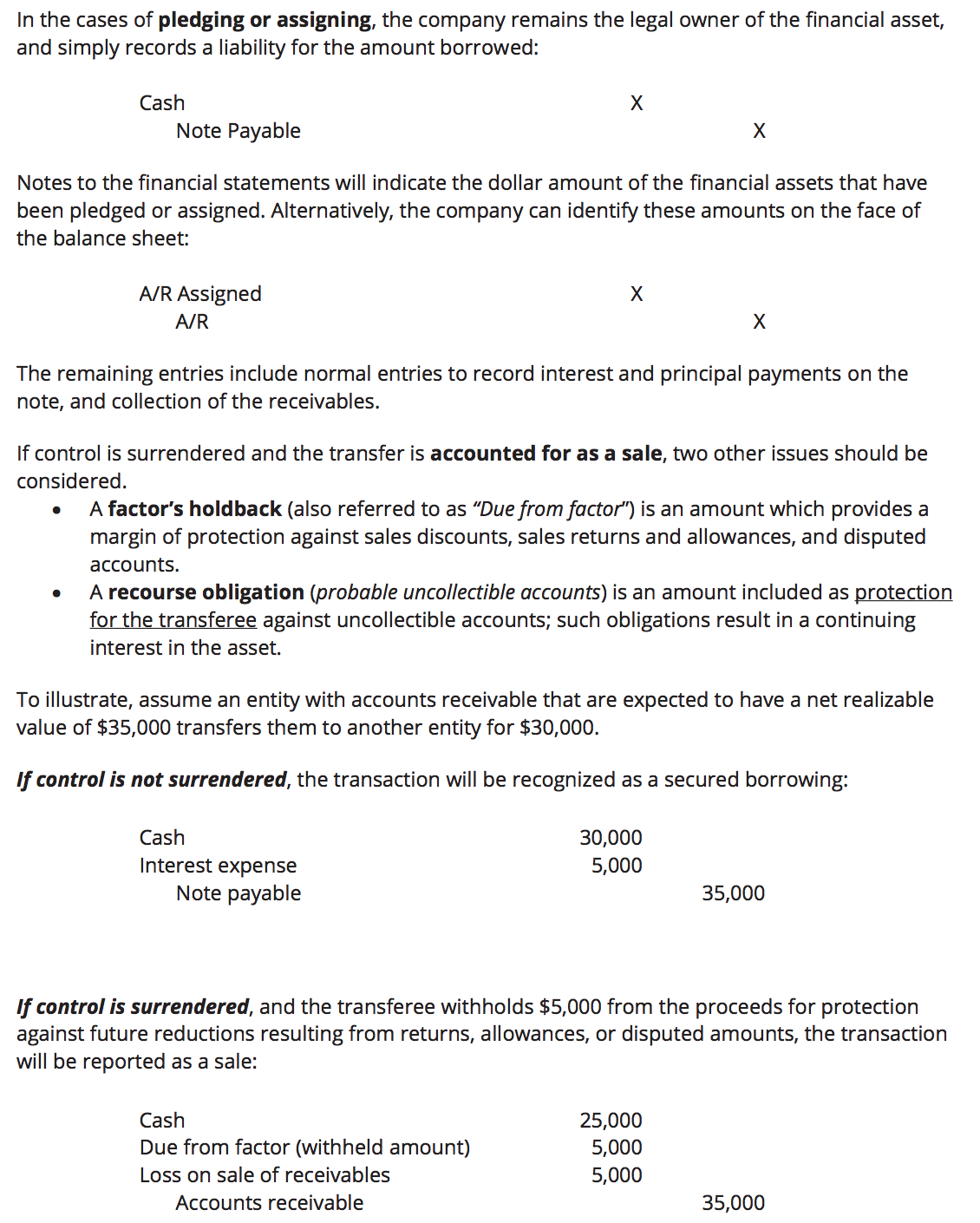
- Pledging - client borrows the necessary cash, and “pledges” (offers) the receivable to the lender as collateral to secure the loan. When this occurs it must be adequately disclosed in a footnote in the F/S.
- Assigning - client borrows the necessary cash, and agrees to use the proceeds from the receivable to repay the lender. Sometimes, the customer is notified to make payment directly to the lender instead of the client.
- Factoring - a company converts its A/R into cash by assigning or selling it either with or without recourse to a factor
- sale without recourse - the client sells the receivable to another party (a factor), with the buyer assuming the risk that the receivable may not be collectible
- Sale with recourse - the client sells the receivable to another party, with the buyer retaining the right to demand the client make good on the receivable if the customer does not pay as promised
Surrendering Control of a F/S
Transfers and Servicing of Financial Assets
Control of a financial instrument has been surrendered (considered a sale) only when all of the following three conditions are met:
- The transferred financial instruments have been isolated from the transferor and beyond the reach of the transferor or its creditors, including creditors in bankruptcy.
- Transferees have the right to pledge or exchange the asset it received without restrictions and without providing more than a trivial benefit to the transferor.
- The transferor does not maintain effective control over the financial instrument, considering all of the transferor’s continuing involvements with the instruments. The transeferor does maintain effective control when:
- An agreement, entered into contemporaneously with the transfer, both entities and obligates the transferor to repurchase or redeem the transferred financial assets at a fixed or determinable price.
- An agreement allowing the transferor the unilateral ability to require the transferee to return specific financial assets.
- An agreement allowing the transferee to require the transferor to repurchase the transferred financial at a price significantly favorable to the transferee.
Unless all 3 of these conditions are satisfied, the financial asset is considered to have been merely pledged or assigned as collateral for a loan (borrowing transaction)
Factoring
The sale of short-term A/R. A factoring fee is applied by the buyer, and is a straight percentage of the factored receivables.
Discounting
The sale of long-term notes receivable. A discount rate is applied by the buyer, and is an annualized rate that will vary depending on the length of time until collection is due.
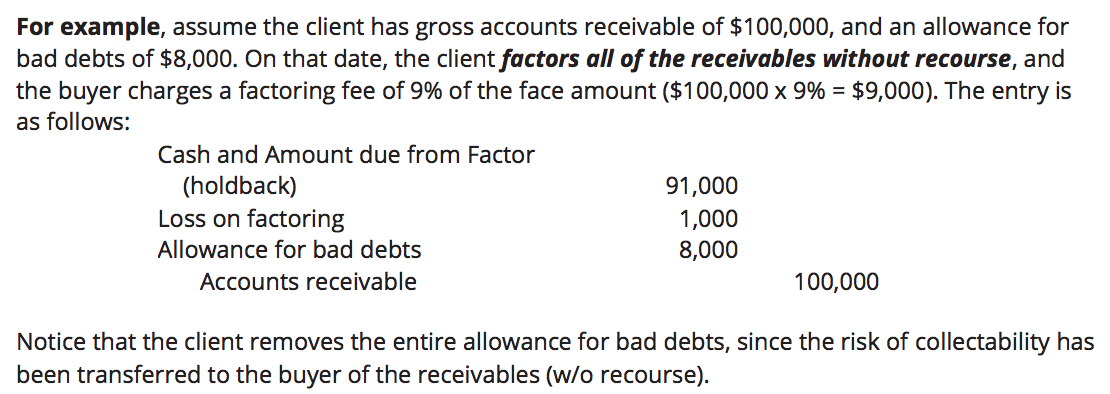
Sale without Recourse example
In the case of a sale without recourse, the seller is relieved of any obligation on the receivable. Thus, if the buyer of the receivable is unable to collect from the customer, they cannot require the seller of the receivable to compensate them.
- the transferee (buyer) bears the risk of uncollectible accounts
- the transferee does not, however, bear the risk of goods being returned, allowances made for nonconforming goods, or disputed balances.
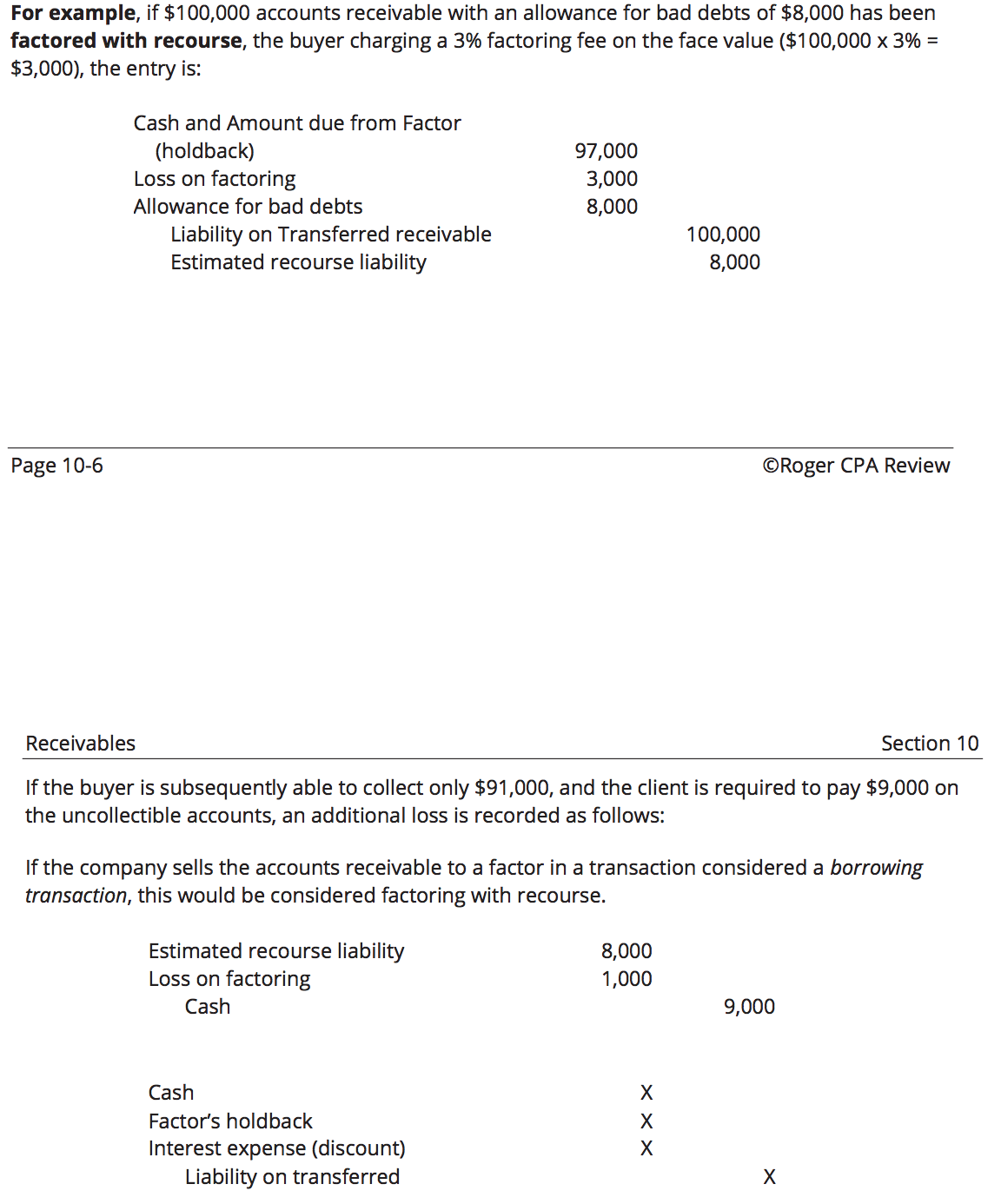
Factored with Recourse Example
When receivables are factored with recourse, the client is liable for uncollectible accounts, and must report an estimated liablity for the addtional amounts that are expected to be paid to the buyer.
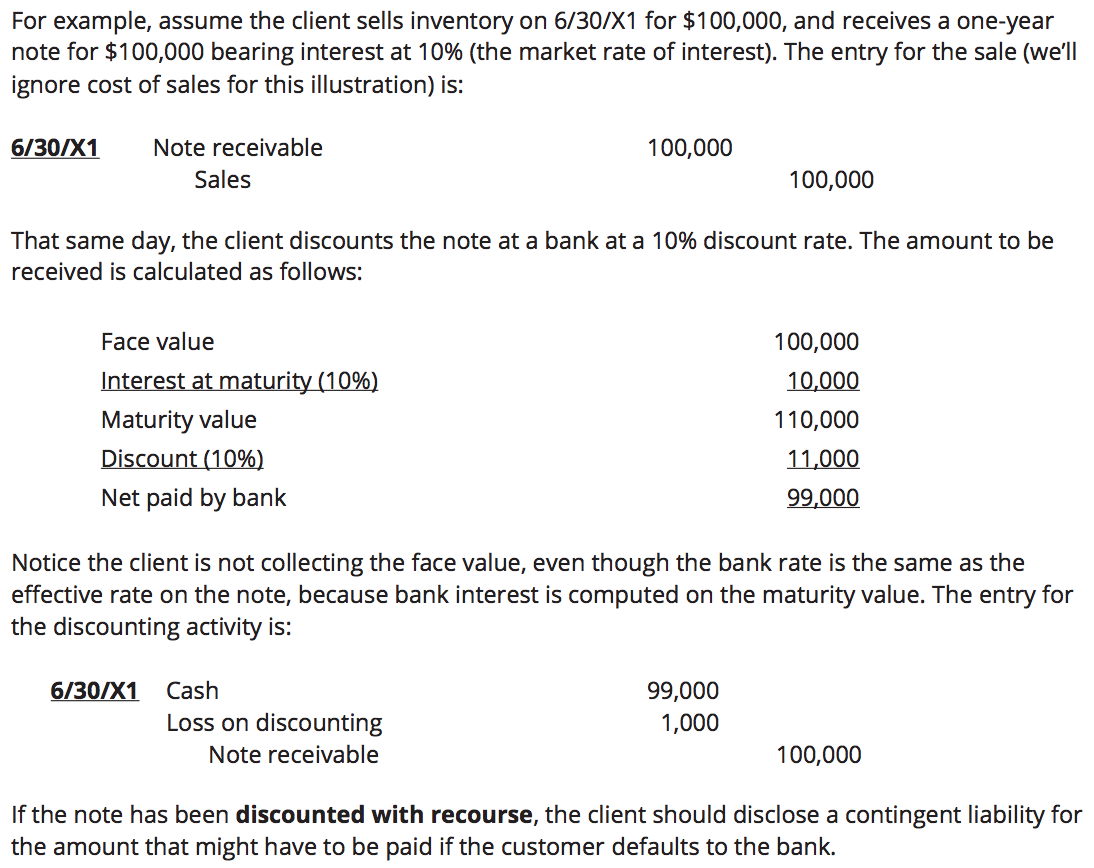
Discounting Example
When an interest-bearing note receivable is sold to a bank, the usual process is known as discounting. The bank first determines the maturity value of the note, meaning the total payment of principal and accrued interest that is due at maturity. This amount is then reducted by a discount rate, and the bank pays the net result. Notes receivable that have been discounted with recourse are reported on the B/S with a corresponding contra account (notes receivable discounted). Notes receivable discounted without recourse have essentially been sold and should be removed from the B/S.
If the note has been discounted with recourse, the client should disclose a contingent liablity for the amount that might have to be paid if the customer defaults to the bank.
Both the interest rate on a note and the discount rate charged by a bank are annual rates, so the calculations are affected by the holding period.
Face amount
+Interest (interest = Face x interest rate x term)
=Maturity Value
-Discount (= maturity value x discount rate x time remaining)
=Proceeds
Participating Interests: Characteristics
Entity may have only a participating interest in a financial instrument. In order to be considered a participating interest, certain characteristics must apply:
- the interest represents a proportionate interest in the entire instrument
- all cash flows from the instrument are divided proportionately among all particpating interests
- each particpating interest is given the same priority
- No entity has the abilty to pledge or exchange the entire instrument without the consent of all participating interest holders.
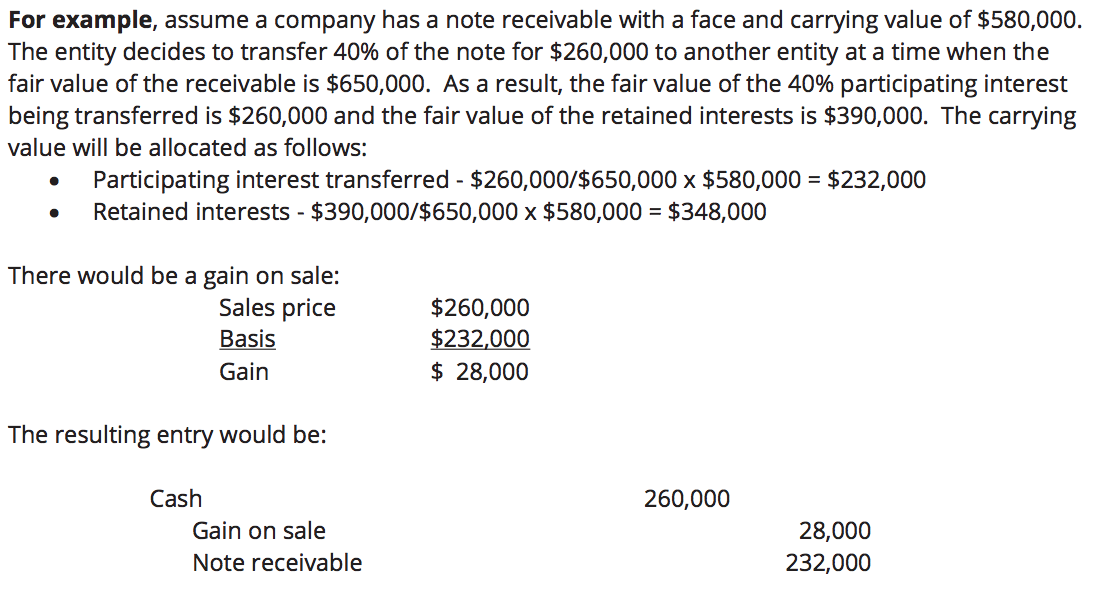
Sale of Participating Interest
When a transfer of a participating interest qualifies as a sale, the transaction is accounted for as follows;
- Consideration received is recognized at its FV
- The CV of the entire instrument is allocated between the participating interest transferred and the interests retained on the basis of their relative fiar values.
- The portion allocated to the participating interest sold is eliminated
- the difference between that and the FV of consideration received is recognized as a gain or loss in earnings.
- The remaining CV becomes the CV of the retained interests.
Servicing of Financial Assets
Servicing of a note receivable includes such administrative functions as sending debtors monthly statements, collecting payments, allocating payments between principal and interest, and sending tax information forms to the debtor. It is fairly common for the seller of a financial asset or a participating interest in a financial asset to retain the obligation to service the receivable, referred to as servicing rights.
- the entity with the servicing rights may not receive any compensation or may receive compensation that is below the fair compensation for performing the servicing obligations in which case the entity has a servicing liability.
- the entity may receive compensation that exceeds the fair compensation for performing the servicing obligations, in which case the entity has a servicing asset.
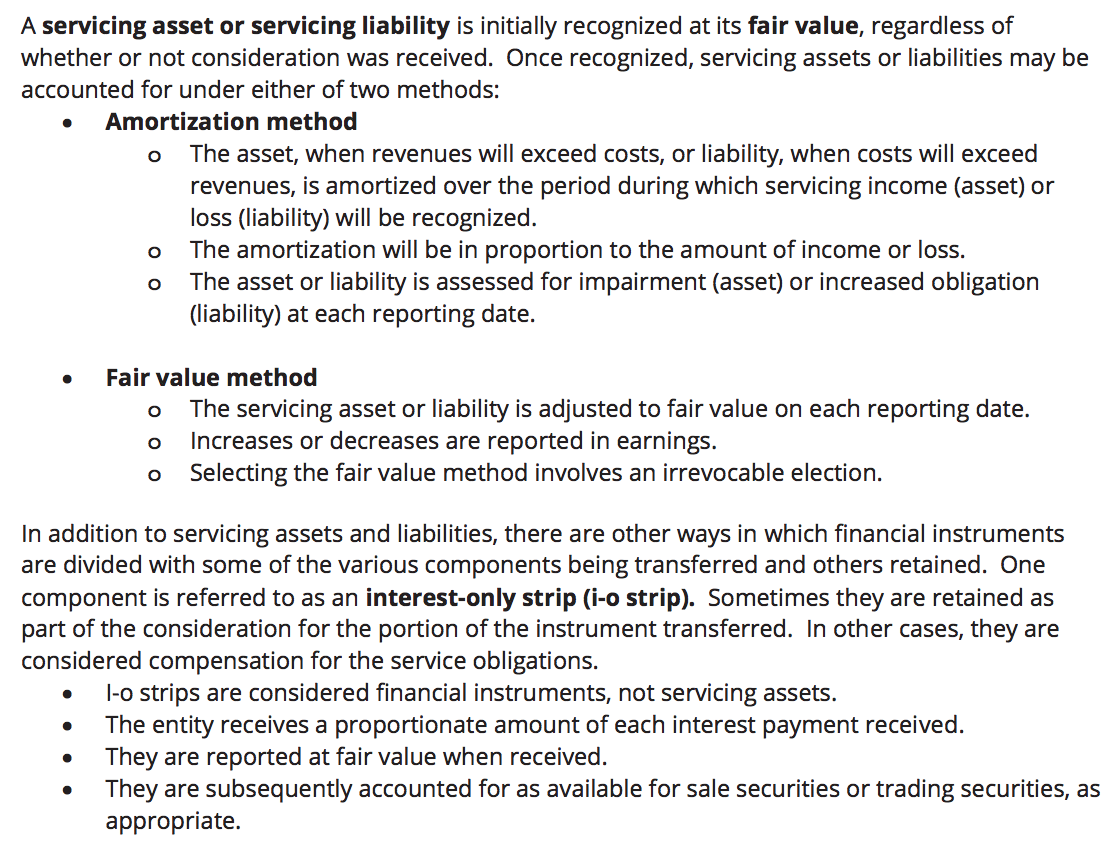
Interest Only Strip
These are sometimes are retained as part of the consideration for the portion of the instrument transferred. In other cases, they are considered compensation for service obligations.
- i-o strips are considered financial instruments not servicing assets
- the entity receives a proportionate amount of each interest payment received
- they are reported at FV when received
- they are subsequently accounted for as available for sale securities or trading seurities, as appropriate.
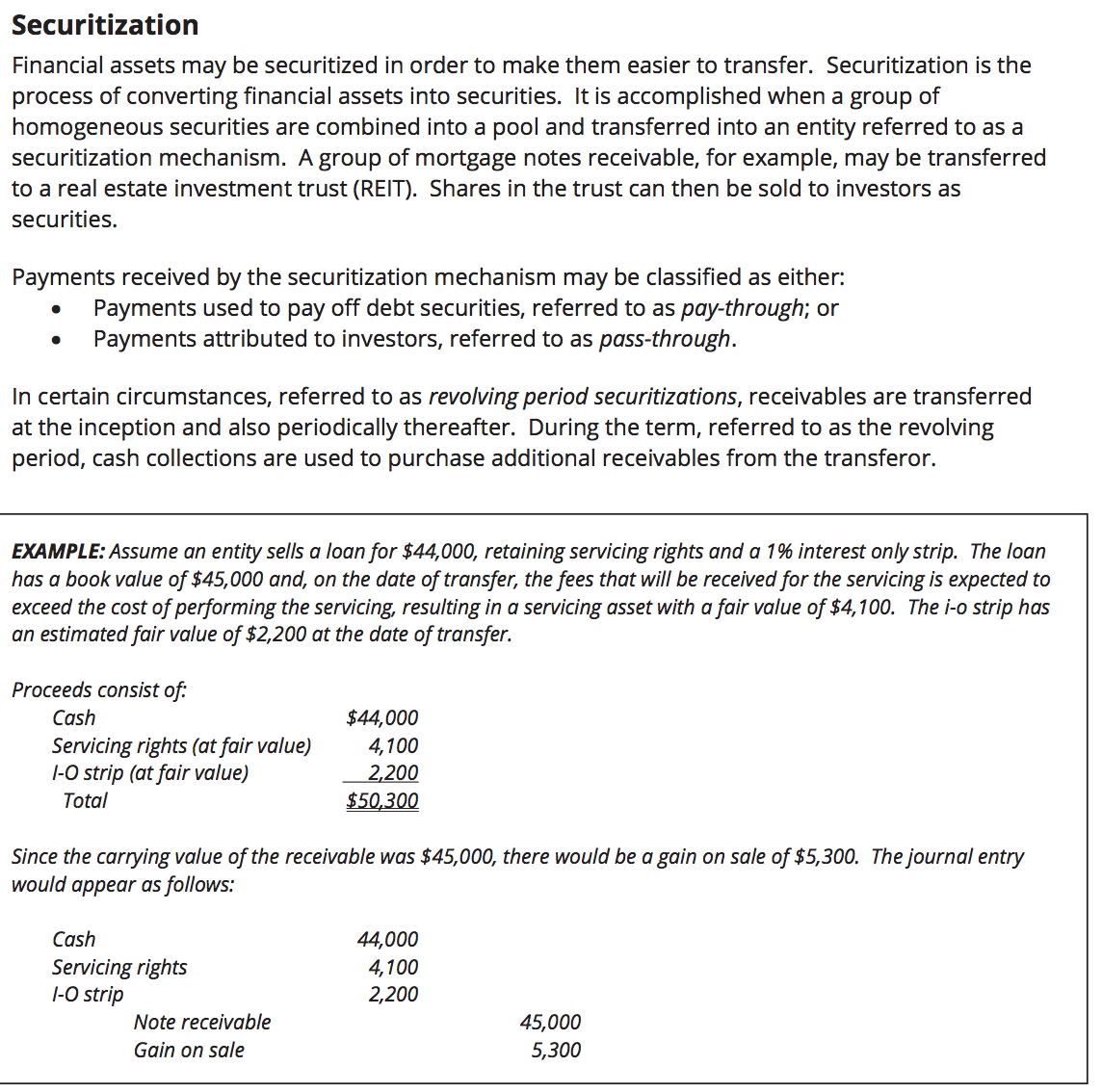
Securitzation
Financial assets may be securitzed in order to make them easier to transfer. Securitzation is the process of converting financial assets into securities. It is accomplished when a groupof homogenous securities are combined into a pool and transferred into an entity referred to as a securitization mechanism. A group of mortgage notes receivable, for example, may be transferred to a real estate investment trust. Shares in the trust can then be sold to investors as securities.
Payments received by the securitization mechnanism may be classfied as either:
- payments used to pay off debt securities, referred to as pay-through; or
- payments attributed to investors, referred to as pass-through
Accounting for Collateral
When a debtor provides a creditor with collateral for a loan, the accounting for it depends on who retains control of the collateral. In most circumstances, the transferor (debtor) retains control of the collateral.
- it remains as an asset on the debtor’s F/S
- the fact that is collateral for debt is disclosed
- the transferee (creditor) does not recognize the asset in its F/S
Upon default, the creditor will take control of the collateral
- the debtor will eliminate the CV of the asset, CV of the debt and related accounts such as accrued interest, and recognize a gain/loss for the difference
- the creditor will recognize the asset at FV, derecognize the receivable, and recognize a gain/loss (generally a loss) as appropriate.
When the transferee has control of the collateral, it recognizes an asset and corresponding liability, recognizing the obligation to return the collateral upon settlement of the debt instrument. Since the transferor will no longer have possession of the collateral, it will be reported as a receivable.
If the debtor defaults:
- the creditor will eliminate the receivable and liablity to return the collateral with the difference representing a gain/loss
- the debtor will eliminate the liablity and the receivable with the difference representing a gain/loss
Impairments
A receivable is evaluated for impairment any time it appears that any or all payment will not be received when they are scheduled to be.
- appears won’t collect the amount loaned
- write loan down to either
- PV of Future Principal and Interest Inflows
- Loan’s market price
- FV of the collateral
JE:
Bad Debt Expense X
Allowance for Impaired Loan X
Interest on Receivables
- A/R occurs in the ordinary course of business, so record at Face Value
- L/T receivables are not in the ordinary course of business, so record at Present Value
- The future value factor is equal to 1/PV Factor
Notes Received for good or services
- Note receivable at a reasonable rate. The PV of the note is the same as the Face amount of $10,000. Assume the asset book value is $6,000.
- Notes Receivable 10,000
- Discount on NR (CV = $10,000 so no discount)
- Asset 6,000
- Gain on Sale 4,000
- If the interest rate is not stated or is unreasonable, use the FMV of the goods or the FMV of the note, whichever is more easily determinable. Assume the FMV of the asset is $9,000.
- Notes Receivable 10,000
- Discount on NR 1,000 (CV = $9,000)
- Asset 6,000
- Gain on Sale 3,000
- If the interest rate is not stated, the FMV of the goods or the FMV of the N/R is not determinable, IMPUTE an interest rate. Use a reasonable rate for a note of this type. PV of a note in 2 years at 10% is .8265 x 10,000=8,265
- Notes Receivable 10,000
- Discount on NR 1,735 (CV = $8,265)
- Asset 6,000
- Gain on Sale 2,265
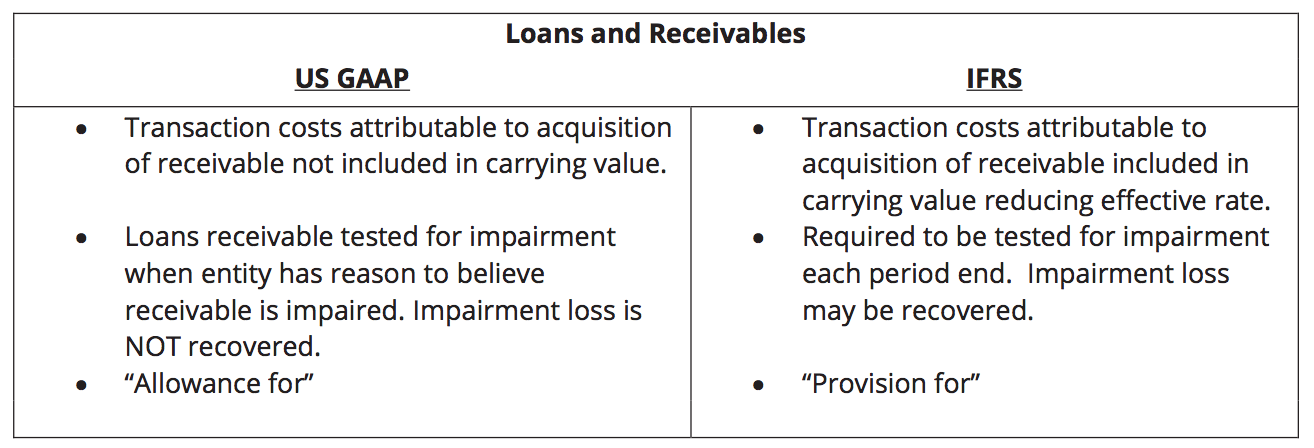
Loans and Receivables under IFRS