Cunsumer Behavior
Consumer behavior is the study of processes involved when individuals or
groups select, purchase, use or dispose of products, services, ideas, or experiences that satisfy
needs and desires.
Consumer behavior graph
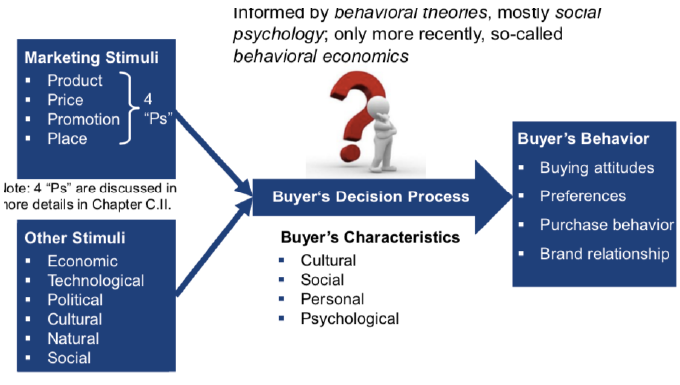
Consumer Behavior and Marketing Management
Pre-purchasing issues

Consumer Behavior and Marketing Management
Purchase issue

Consumer Behavior and Marketing Management
Post-purchase issue

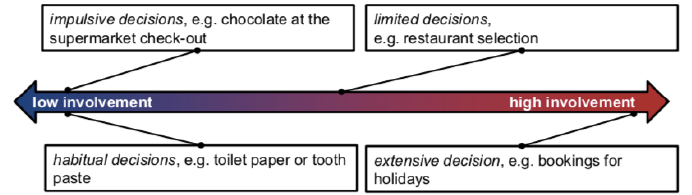
Involvement
Product involvement
Product involvement = a consumer’s level of interest in a particular product/service
Involvement
Purchase situation involvement
Purchase situation involvement = differences in motivation during process of interacting with store or website
Involvement
Message-response involvement
Message-response involvement = customer’s willingness to seek out, assimilate, process and store information
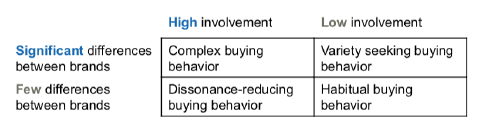
Low vs High involvement
Elaboration Likelihood Model
Elaboration Likelihood Model is a model for how information is processed.
- high involvement processing: cognitive responses, belief and attitude change, behavior change
- low involvement processing: belief change, behavior change, attitude change
In high elaboration likelihood consumers are interested and willing to process advertising messages actively. Information will take a central route to persuasion. Arguments can be more complex and have more content.
Low elaboration likelihood consumers are not willing to process information actively. Arguments must be easy to memorize, the substance is rather unimportant
Characterization of buying decision behavior
The buyer’s decision process
- Need recognition (potential buyer perceives a difference between his ideal and his actual
state of affairs, which leads to the realization of a need) - Information search (seeking relevant information about potential satisfiers of this need from
an external environment and/or activating knowledge from memory) - Evaluation of alternatives (evaluating/judging competing alternatives, combining his
knowledge to make a choice, formation of attitudes, preferences and purchase intention) - Purchase decision (buying the chosen alternative)
- Post-purchase cognitions (using the chosen alternative and evaluating it in light of its
performance)
Decision Process and Marketing
- Need recognition : What are the consumer’s needs?
- Information search : How does the potential buyer gather information?
- Evaluation of alternatives : How do potential buyers perceive and evaluate available brands, products and service offers?
- Purchase decision : What type of decision does the consumer make?
- Post-purchase cognition : How do these cognitions influence the future behavior of the
consumer (word-of-mouth, complaint behavior, repurchasing, etc.)?
Need recognition
Happens through internal stimuli. Needs can either be physiological (hunger,
thirst) or psychological (increasing self-esteem ® buying new clothes, getting a haircut, etc.) in
nature.
Information search
Information search can be both internal and external. Internal search is a passive approach to gathering information in which the consumer’s own memory is the main source
of information about a product (low interest in the product or already enough information available for making a decision). External search is a proactive approach to gathering information in which the consumer collects new information from sources outside the consumer’s own experience
(happens when the decision maker believes that more information is necessary to make a
decision).
Attitude
An attitude is a lasting, general evaluation of people (including oneself), objects,
advertisements or issues. An attitude typically has three components:
- Affect (how a consumer feels about an object)
- Behavior (refers to the consumer’s intention to take action)
- Cognition (what the consumer believes to be true about the attitude object)
Hierarchies of effects
Are constructed of the three components of attitude: Affect, Behavior, Cognition
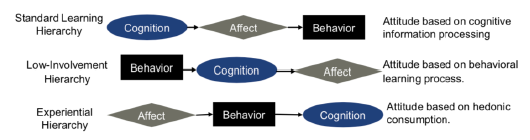
Example for low involvement hierarchy
Attitudes not only determine behavior - behavior also determines attitudes
Asking consumers to state the benefit of the product
Example for an experimental hierarchy
Prompting affective reactions, which lead to impulsive buying behavior
-> often used when launching special offers
Multi attribute attitude models
Attitude models specify the different elements that might work
together to influence people’s evaluations of attitude objects. Multi attribute attitude models are
used to understand complex attitudes. Basic multi attribute models contain three specific elements:
- Attributes (characteristics of the attitude object)
- Beliefs (cognitions and/or emotions about the specific attitude object (usually relative to others within the comparison set)
- Importance weighs (reflect the relative priority of an attribute to the consumer
Intention vs. behavior
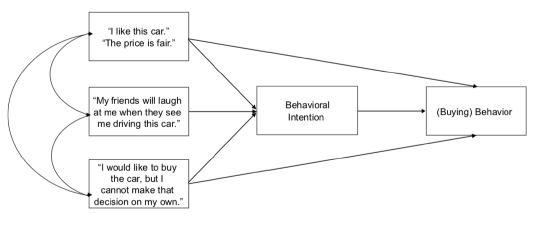
Attitudes are not always consistent with behavior because there are many factors interfering with behavior intentions ( = intention-behavior gap). The Theory of Planned Behavior was aimed to overcome this problem.
The theory of planned behavior
Tries to explain why attitudes are not always consistent with
behavior, designed to predict and explain human behavior in specific contexts.
Behavior: depends on motivation (intention) and ability (behavioral control)
Intention: cognitive representation of a person’s readiness to perform a given behavior, indicates how hard people are willing to try in order to perform the behavior, determined by attitude toward behavior, subjective norms, and perceived behavioral control.
Attitude toward behavior: degree to which a person has a favorable or unfavorable evaluation of the behavior in question
Subjective norms: social factor, perceived social pressure to perform or not to perform behavior
Perceived behavioral control: a person’s confidence in his/her ability to perform a behavior, perceived as ease or difficulty of preforming the behavior, reflects past experience and anticipated
impediments
Customer (Dis)Statisfaction
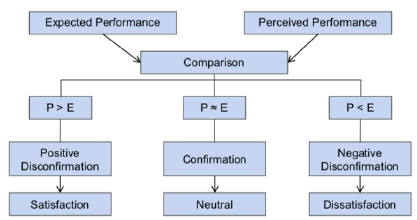
Satisfaction = Perception -Expectation
Confirmation-Disconfirmation Paradigm (C-D-Paradigm)
- Positive Disconfirmation = better than expected = satisfaction
- negative disconfirmation = worse than expected = dissatisfaction