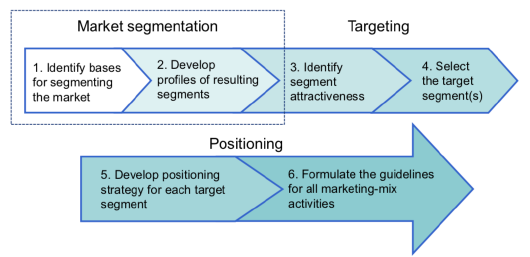
Market segmentation
Dividing a market into distinct groups of buyer with different needs,
characteristics or behavior, who might require separate products and Marketing-Mixes
Targeting
The process of identifying each market segment’s attractiveness and selecting one or
more segments to enter.
Positioning
Arranging for a product to occupy a clear, distinctive, and desirable place relative to
competing products in the minds of target customers
Market segmentation, Targeting, Positioning
Market segmentation vs. mass marketing
- Heterogeneity of costumer needs and wants
- Differences in customer buying power and potential CLV
- Individualization in costumer behavior
- Targeted communication
- Advantages through specialization
Useful market segments must have the following characteristics
- Measurability (degree to which size, purchasing power and profiles of a market segment can be measured)
- Accessibility (degree to which a market segment can be reached and served)
- Substantiality (degree to which a market segment is sufficiently large and profitable)
- Differentiability (degree to which a market segment is conceptually distinguishable and responds differently to a different marketing mix)
- Actionability (degree to which effective programs can be designed for attracting and serving a given market segment)
Segmentation Variables – Consumer Markets
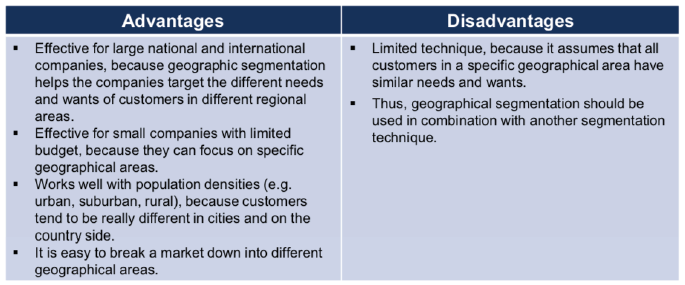
Geographic variables:
Geographic variables include segmentation by nations, regions, states, cities, neighborhoods, urban, suburban, and rural regions. Segmentation by neighborhoods (together with
socio-demographics) is often used when planning direct marketing campaigns.
Socio-demographic Variables
Socio-demographic segmentation occurs according to:
- age
- race
- religion
- family size
- ethnicity
- income
- education
- socio-economic status
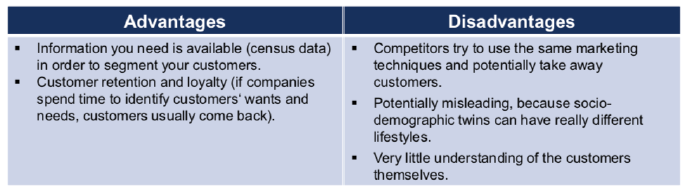
It is very popular
because of the availability of data and because consumers/businesses with common demographics
often have similar needs/wants and behave similarly.
Psychographic Variables
Psychographic variables are used to divide a market into different segments based on social class, lifestyle, or personality characteristics (needs, wants, attitudes, preferences,
individual value system, personality, etc.). These segmentation variables are of crucial importance because they are the underlying drivers of the buying and usage behavior.

Benefit segmentation
Benefit sought by one customer may differ from those sought by another.
Benefit segmentation techniques segment the market based on needs/preferences/relative importance
of central product attributes (e.g. price-conscious segment vs. brand-conscious segment vs. qualityconscious
segment).

Behavioral Variables
Segmentation occurs on the basis of behavioral variables such as occasions,
user status (non-user, ex-user, potential user, first-time user, regular user), usage rate (light, medium,
heavy), loyalty status, up-buying, cross-buying behavior.

How to build segmentation
Segmentations are derived from market research. Typical steps are:
- Desk research (what data is available already)
- Qualitative market research (focus groups, shop-alongs, in-depth interviews) ® to get first insights and ideas about possible segments
- Quantitative market research (online, telephone survey) ® test and quantify findings from the qualitative research ® cluster analysis (find groups of participants with very similar answer patterns = segments)
Segmentation variables - organizational Markets
Here, businesses are usually transformed around customer groups (of bigger firms). However, product
groups do not equal a costumer segment.
Consumer vs. business markets
Both consumer and business markets have individuals that assume buying roles and purchase decisions are made to satisfy needs. The differences between the consumer
and business markets are:
- market structure and demand (fewer, but larger buyers in business sectors, derived and inelastic demand, fluctuating demand)
- nature of the buying unit (buying center, professional purchases in the business sector)
- Types of decisions and the decision process (complex decisions, formal purchasing process, close and long-term buyer seller relationships in the business sector)
Selecting Target segments
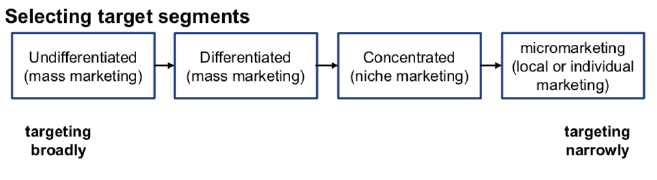
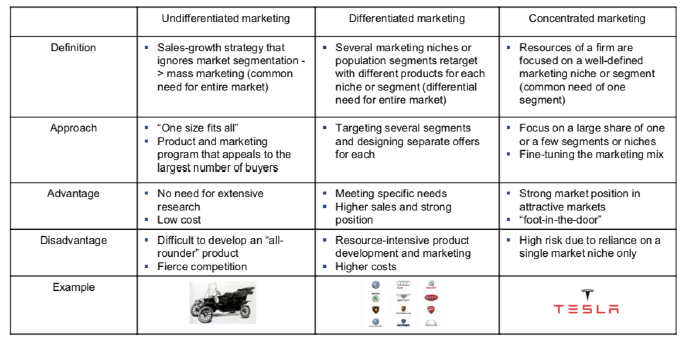
Undifferentiated marketing
Differentiated marketing
Concentrated marketing
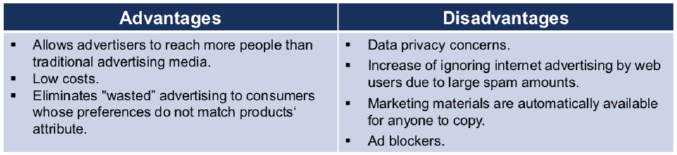
Online Targeting
Is done by using IT-related options (i.e. cookies). It is possible to track customers
online by doing this. This facilitates a goal-oriented sales approach.
Importance of Positioning
An example would be Proviande using a new slogan “Der feine
Unterschied” compared to their old one “Alles andere is Beilage”. With the new slogan, Proviande is
now addressing a new target group; i.e. the vegetarians or occasional meat eaters that want good quality
and high welfare for the animals when they do decide to consume meat.
The Value Proposition
The value proposition describes the full positioning of a brand, i.e. the full mix of benefits on which it is positioned (clarity, consistency, credibility, competitiveness).
Developing a positioning strategy
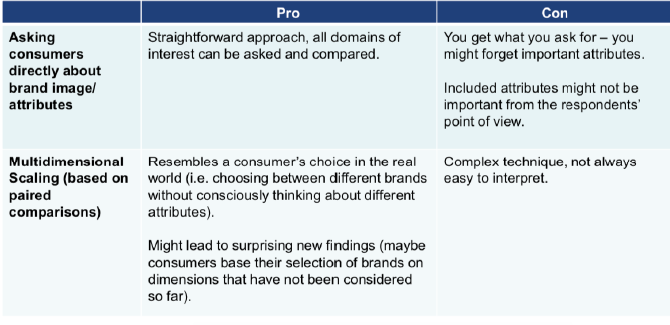
- By asking customers more or less directly via surveys or interviews about brand attributes/connotations (“How do you perceive brand X?”)
- By perceptual mapping (method for visualizing costumer’s minds concerning certain objects, shows perceived similarities and differences among objects, can be derived from data on consumer perceptions of brands)