Deck 1 Flashcards

(50 cards)

1
Q

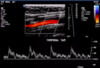
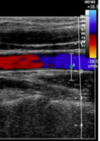
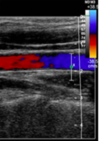
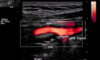
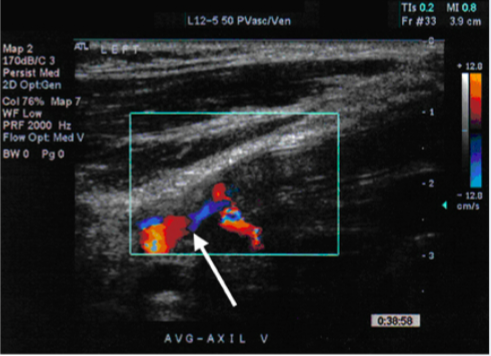
For the following arterial duplex US (DUS) image:

comment on the PRF setting
A

PRF is set very low

you can tell this based on the velocity range of the color bar (range of 12 cm/s, relatively low setting

recall that PRF value is directly-related to color doppler frequency parameters (and the associated blood velocity)

2
Q

Name 7 indications for carotid duplex ultrasound (DUS) exam.

A

screening (primary prevention)

  • asymptomatic bruit
  • prior to CTS

monitoring known disease (2o prevention)

  • f/u of known atherosclerotic carotid dz (ACaD)
  • f/u after carotid revascularization

acute ischemic cerebrovascular event (r/o carotid etiology)

  • r/o carotid dissection
  • r/o carotid source of embolus (in setting of stroke or amaurosis fugax)

other → suspected subclavian steal

3
Q

Where should CCA velocity ideally be measured?

A

a few cm proximal to carotid bifurcation

4
Q

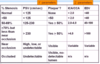
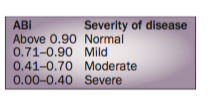
Give the range of ABI values that correspond to borderline, mild, moderate, and severe PVD.

A

ABI values:

  • 0.91-0.99→borderline abnormal
  • 0.71-0.90→mild PAD
  • 0.41-0.70→moderate PAD
  • _<_0.40→severe PAD

normal ABI range is 1.0-1.40
5
Q

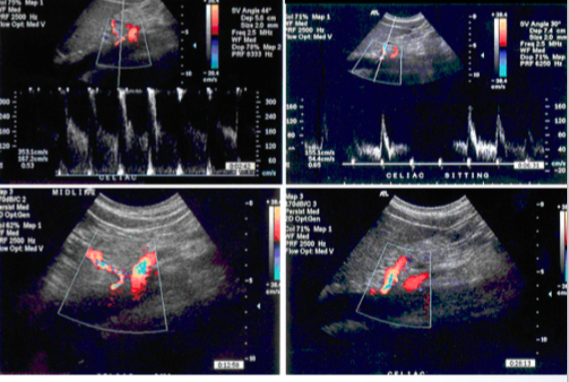
Pt with abdominal pain after eating has arterial duplex US images shown below. Most likely diagnosis?

*Note that left panel images were taken from supine position and right panel from sitting position.
A

median arcuate ligament syndrome

  • velocities increase with expiration in supine images only
  • above occurs due to compression of celiac artery by median arcuate ligament
6
Q

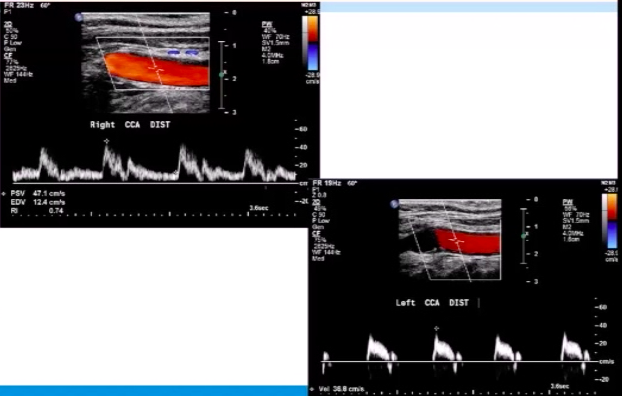
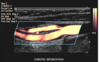
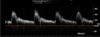
Carotid DUS images shown below. Diagnosis?
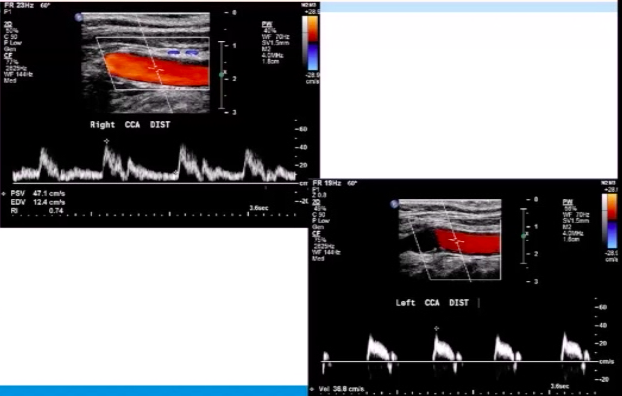
A

left ICA occlusion

note the externalization* of the left CCA in the DUS image

*occurs when CCA waveform has solely a low-resistance pattern (implies blockage of high-restistance ICA branch)

7
Q

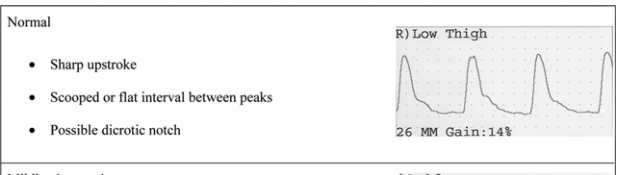
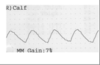
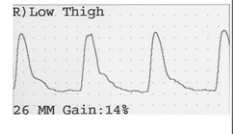
For the PVR tracing below, what is the severity of PAD?
A

normal PVR tracing ⇒ no vascular disease present

normal PVR contour looks like a handgun:

  • ​brisk upstroke
  • scooped/flat diastolic interval (+/- dicrotic notch)
  • normal amplitude
8
Q

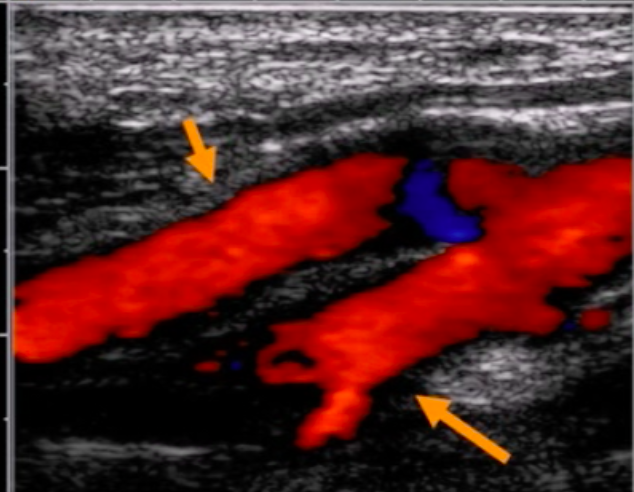
Identify the 2 vessels* in the images shown below.

*the vessels with arrows pointing to them
A

top vessel is ICA and bottom vessel is ECA
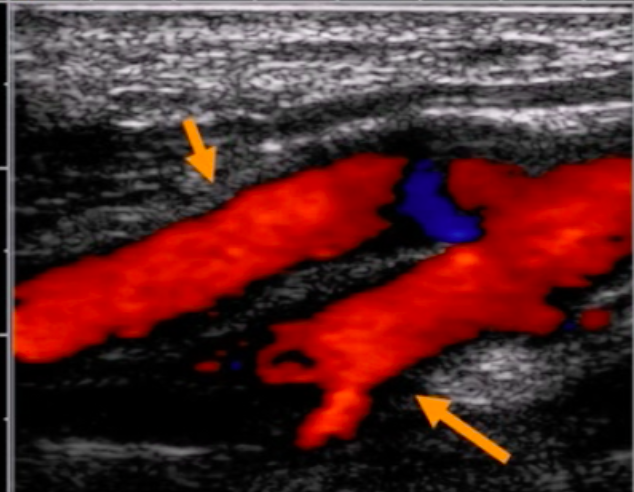
bottom vessel has branches ⇒ it is the ECA

9
Q

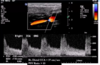
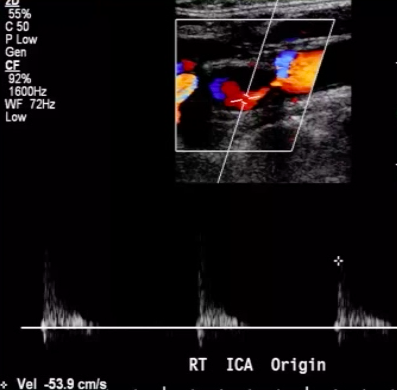
Carotid DUS imaging shown below. Diagnosis?
A

near-total ICA occlusion

note significant ICA plaque with low velocities distal to lesion (“falling off spencer-reid curve”)

10
Q

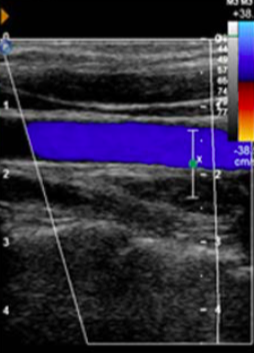
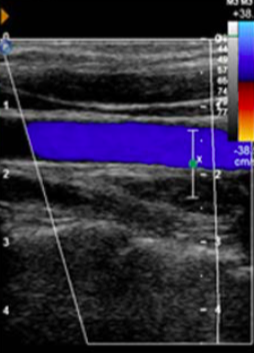
In which direction is blood flowing in the vascular duplesx US (DUS) image shown below?
A

to the left

  • image is steered to right ⇒ blood flowing to right will appear as (-) ðf* and blood flowing to left will be a (+) ðf
  • color bar shows blue as (+) ðf
  • blood is blue in image ⇒ blood is flowing to left

ðf = doppler shift
11
Q

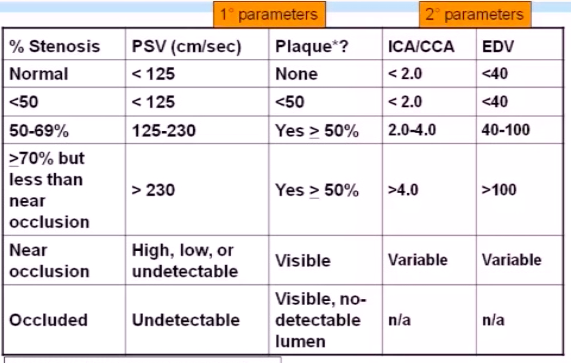
Give the algorithm for DUS grading of carotid stenosis (NASCET based, 4 steps).

A

step 1: assess PSV

  • <125 cm/s → go to step 2
  • 125-230 cm/s → go to step 3
  • >230 cm/s → go to step 4
  • undetectable → 100% occlusion

step 2: assess plaque burden

  • < 50% ⇒ mild (<50%) stenosis
  • >50% → indeterminate, go to step 3

step 3: assess EDV

  • <40 cm/s ⇒ mild (<50%) stenosis
  • 40-100 cm/s ⇒moderate (50-69%) stenosis
  • >100 cm/s ⇒ indeterminate, go to step 4

step 4: assess ICA/CCA ratio

  • >4.0 ⇒ severe (>70%) stenosis
  • 2.0-4.0 ⇒ ⇒moderate (50-69%) stenosis
12
Q

Name 7 carotid diseases that can be identified on carotid duplex imaging.

A

dysplastic - fibromuscular dysplasia

neoplastic - carotid body tumor

inflammatory - large vessel vasculitis (GCA and Takayusu’s)

degenerative

  • carotoid aneurysm
  • ACaD (Atherosclerotic Carotid Disease)

trauma

  • carotid pseudoaneurysm/AVF
  • carotid dissection
13
Q

Name the 3 secondary parameters that are used in the NASCET (aka SRU) criteria for assesment of carotid stenosis.

A
  1. extent of plaque on 2D US
  2. PSVICA/PSVCCA ratio
  3. EDV
14
Q

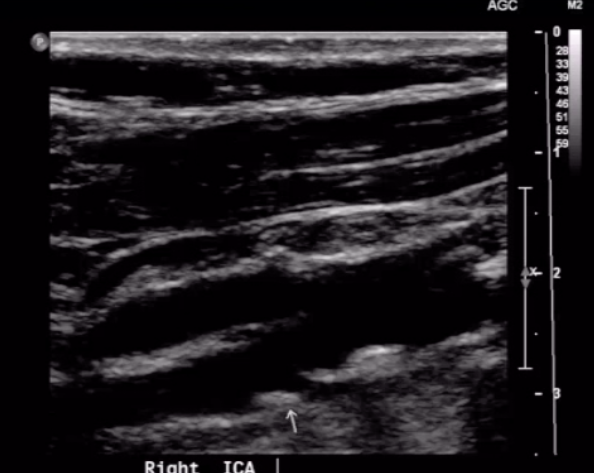
Patient has Lt ICA 100% occlusion. Rt carotid system shown below. PSV = 208 cm/s in proximal Rt ICA.

Most likely diagnosis?
A

mild Rt ICA stenosis (<50%)

since Lt ICA is 100% occluded, there should be elevated Rt CCA velocities (CCFA*)

plaque in proximal Rt ICA is <<50% ⇒ elevated velocities across Rt ICA are likely due to CCFA

*CCFA = compensatory carotid flow augmentation

15
Q

What are the 3 descriptors that you should use when characterizing luminal plaque in your report?

A
  1. echodensity of plaque:
    • ​​hypoechoic (reference = blood)
    • isoechoic (reference = sterncleidomastoid m.)
    • hyperechoic (reference = bone)
  2. uniformity of plaque
    • ​​homogeneous - has uniform echogenicity
    • heterogeneous - has both hypoechoic AND hyperechoic regions
  3. shape of plaque
    • ​smooth
    • irregular
    • ulcerated
16
Q

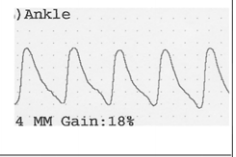
For the PVR tracing below, what is the severity of PAD?
A

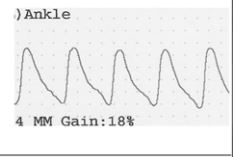
mild PAD

mild PVR contour looks like a capital N

  • brisk upstroke
  • gradual downstroke without flattening/scooping (and no dicrotic notch)

17
Q

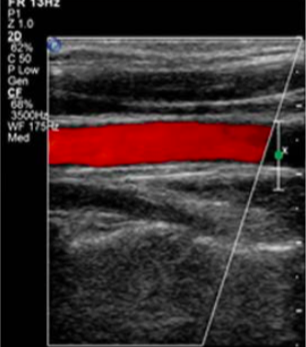
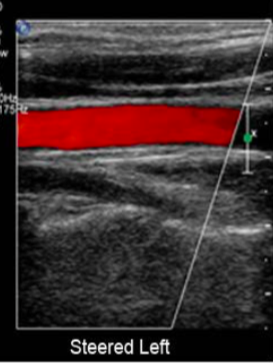
In which direction is this image steered?
A

to the left

steering color doppler imaging to left → diagonal border points to 6-9 o’clock region
18
Q

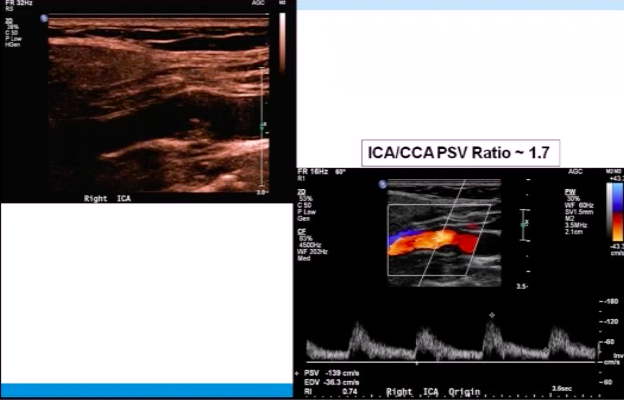
Carotid DUS imaging shown below. Diagnosis?
A

50-69% ICA stenosis

19
Q

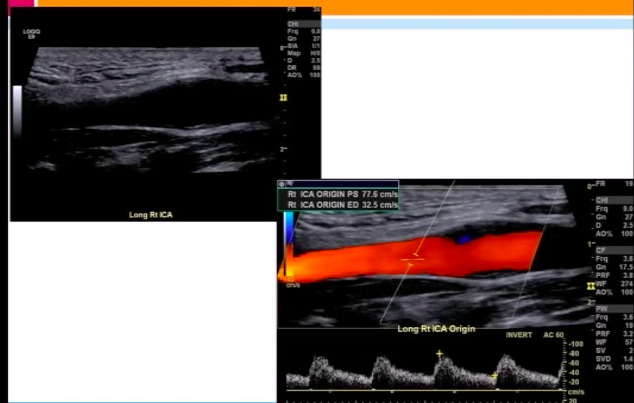
Carotid DUS imaging shown below. Diagnosis?
A

normal exam

20
Q

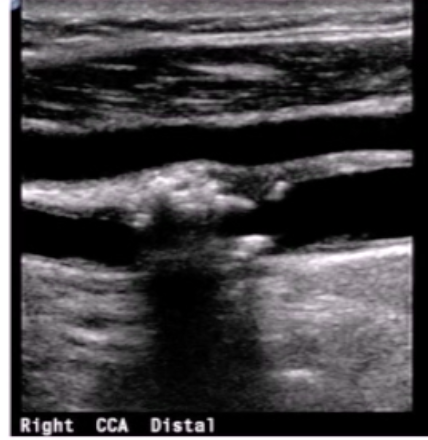
Name the artifact and associated pitfall shown in this image.
A

artifact: acoustic shadowing due to calcific plaque

pitfall: blood velocity distal to calcium often cannot be assessed

*image shows ICA lesion

21
Q

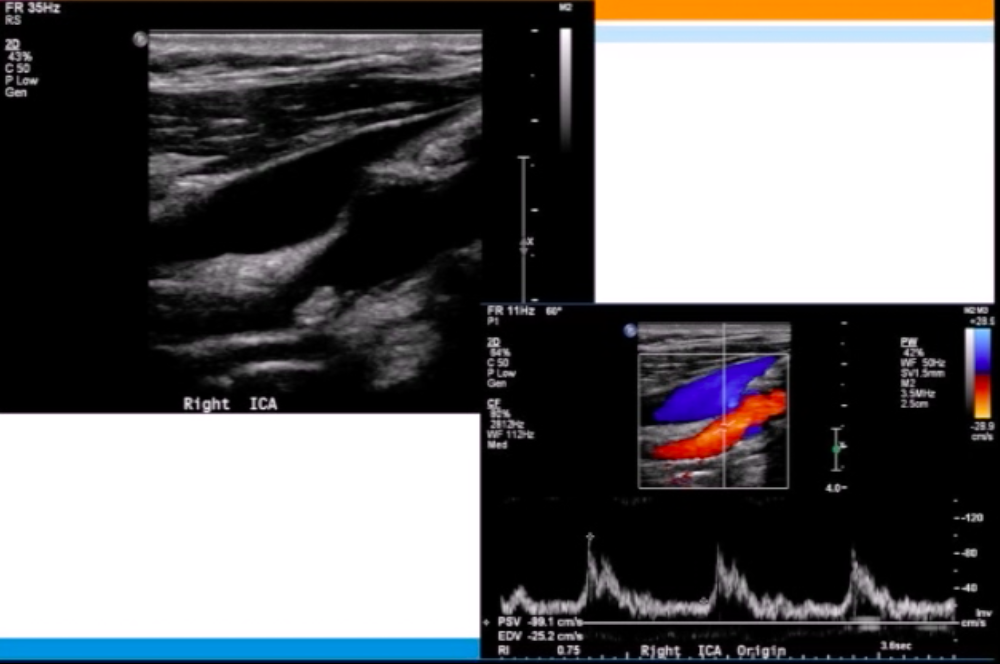
Carotid DUS imaging shown below. Diagnosis?
A

<50% stenosis

note the <50% atheroma in the proximal ICA with PSV ~80 cm/s

22
Q

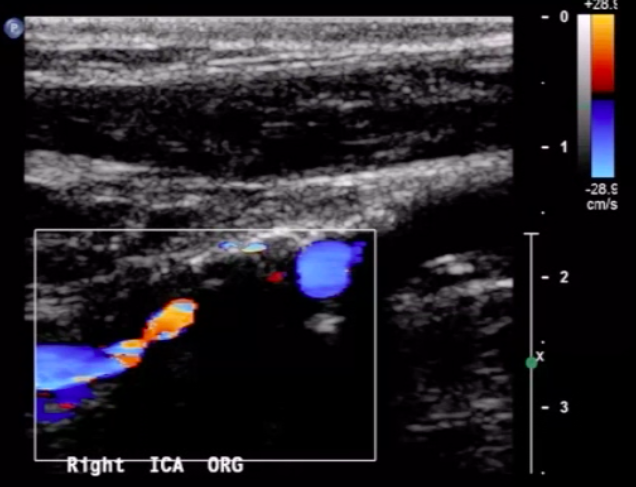
Tech calls you asking for your advice on the carotid DUS shown below. What to tell her?
A

try power doppler or changing the DIA*

image shows calcific lesion in right ICA → region of stenosis cannot be interrogated w/ color doppler due to acoustic shadowing

*DIA = doppler interrogation approach

23
Q

With regard to vascular duplex US (DUS) imaging:

Positive doppler shifts (ðf) are encoded with which color?

A

whichever color is a/w plus sign on color bar
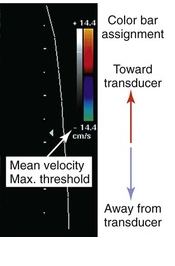
i. e. (+) sign on color bar ⇒ (+) ðf
note: if no sign is present on color bar, then whichever color is above the baseline (red in this example) is assigned (+) ðf
note: the mnemonic BART (blue away, red towards) does not always hold for vascular imaing

24
Q

The external carotid artery has a _____ resistance wave form (on arterial dopple imaging).

A

The external carotid artery has a high resistance wave form.
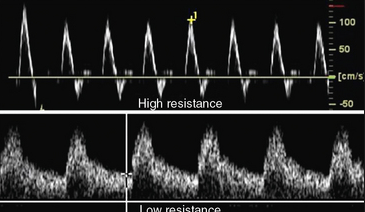
25
With respect to unilateral 100% ICA occlusion, the contralateral carotid system will have ________ \_\_\_\_\_\_\_\_\_ \_\_\_\_\_\_\_\_\_.
With respect to unilateral 100% ICA occlusion, the contralateral carotid system will have **compensatory flow** **augmentation\*.** **\*aka CCFA (compensatory carotid flow augmentation)**
26
What are the basic components of a carotid DUS exam? (2)
1. **2D grayscale imaging**\* → looking for the following: * atherosclerotic plaque * stenotic regions of vessels 2. **color doppler and pw interrogation**\* * PSV and EDV are recorded * stenotic regions are vigorously interrogated \*region of study typically includes CCA, ICA, ECA, vertebral arteries, and somtimes subclavian & innominate arteries
27
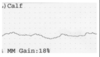
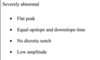
For the PVR tracing below, what is the severity of PAD?
**severe PAD** ## Footnote severe PVR contour looks like _asystole:_ * parabolic flow * very low amplitude
28
Which vessel is shown below?
**external carotid artery** ## Footnote vascular tech is tapping on termporal artery, causing doppler reverberations (most notable in diastole)
29
In which direction is this image steered?
**it is not steered** ## Footnote note the following features of _unsteered_ DUS images: * imaging box is square (where as steered imaging boxes are trapezoidal) * often times will see 2 different intraluminal colors NOT separated by anatomic barrier (red-blue inside vessel below) \*DUS = duplex US
30
Which branch of the CCA is being imaged below?
**the external carotid artery (ECA)** ## Footnote **note the triphasic (high-resistance) wave form and (+) DDU on temporal tap maneuver** **\*DDU = diastolic doppler undulation**
31
With regard to the NASCET (SRU) criteria: what are the 6 grades of % carotid stenosis that can be reported?
1. **normal** 2. **\<50%** 3. **50-69%** 4. **70% - NeOc\*** 5. **NeOc** 6. **100% occluded** ## Footnote NeOc = near occlusion
32
Which carotid plaque characteristics are a/w increased incidence of cerebrovascular event? (3)
1. **dark (hyperechoic) plaques** 2. **heterogeneous plaques** 3. **ulcerated plaques**
33
How specific is (+) DDU\* with temporal tap for identifying the internal carotid artery?
**less than 100% specific** ## Footnote studies have shown that the ICA can exhibit (+) DDU with temporal tap on occasion bottom line: presence of branch vessels trumps temporal tap and high resistance wave form for identification of ECA
34
Give the Cleveland clinic lab recommendations for DUS-guided diagonsis of carotid ISR.
presence of either of the following is suggestive of carotid ISR: 1. **ICA/CCA \> 14** 2. **PSV \> 300 cm/s AND significant stenosis on B mode imaging**
35
What is the primary parameter for determining percent stenosis of ICA?
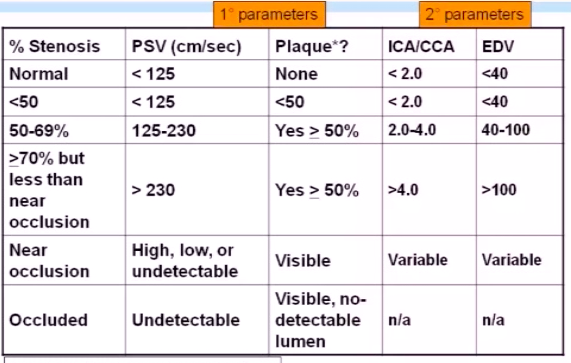
**peak systolic velocity (PSV)** ## Footnote note that EDV is used to distinguish between high-grade and moderate-grade stenoses Shown below is the NASCET criteria (the most widely-used guidelines for grading carotid stenosis)
36
with regard to vascular US imaging: By convention, the left side of the imaging screen is which anatomic direction?
**rostral (toward patient's head)** ## Footnote shown below is power doppler image of carotid bifurcation (with patients head toward left of image)
37
Algorithm for reading ABI/PVR study? (4)
the mnemonic is **ASS-Toe:** * **A**BI * **S**egmental Pressures * **S**egmental PVRs (Pulse Volume Recordings) * **T**BI (toe brachial index)
38
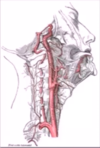
This artery is the first branch coming off of the subclavian artery.
**vertebral artery**
39
Carotid DUS imaging shown below. Diagnosis?
**\>70% ICA stenosis**
40
For the PVR tracing below, what is the severity of PAD?
**moderate PAD** ## Footnote moderate PVR contour is _parabolic_ (looks like flow through cardiac valve) * slurred upstroke * gradual diastolic downslope (without dicrotic notch) * flattened peak
41
Carotid DUS imaging shown below. Diagnosis?
**100% ICA occlusion** ## Footnote power doppler is shown with no flow through ICA
42
Name the 2 most important duplex US (DUS) features of the internal carotid artery.
1. **low-resistance waveform (shown below)** 2. **no branches outside of skull**
43
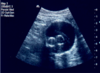
Pt with h/o aortic endovascular graft placed 2 years ago has image shown below. Most likely diagnosis?
**imaging is suggestive of type II endoleak** ## Footnote image shows echolucent region in front of graft that is likely an endoleak in this clinical context _type II endoleaks:_ * retrograde flow through branch vessel causes blood to collect around graft ("endoleak") * tend to be later-onset (gradual endoleak formation)
44
Carotid DUS imaging shown below. Diagnosis?
**50-69% ICA stenosis** ## Footnote note the \>50% plaque burden, PSV ~200 cm/s, ICA/CCA ratio 2.1
45
What is "falling off the Spencer-Reid Curve"?
**parodoxically low velocities distal to a near-100% occlusion**
46
Name **_2 abnormal post CAS_** carotid DUS findings.
1. **jailing of ECA** (plaque shifted toward ECA, elevated PSV in ESA) 2. **carotid intimal hyperplasia\***
47
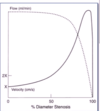
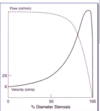
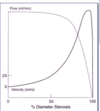
Which important vascular US concept is illustrated by the graph shown below?
**RBC velocity increases exponentially as % stenosis increases** **this curve is termed the Spencer-Reid curve** **for example:** * doubling of doppler velocity ⇒ ~50% stenosis of vessel * a quadrupling of doppler velocity ⇒~75% stenosis of vessel
48
The CCA doppler waveform is a _______ of its branches.
The CCA doppler waveform is a **hybrid** of its branches. i.e. CCA has some both low and high-resistance waveform components (see below)
49
Carotid DUS imaging shown below. Diagnosis?
**\>80% ICA stenosis** ## Footnote **note that a common non-SRU criterion for very severe (\>80%) stenosis is EDV \> 140 cm/s\*** \*when very high EDV is found in addition to other SRU criteria for severe stenosis
50
Pt with 100% Rt ICA occlusion has elevated doppler velocities in Lt ICA. What are 2 things you can do to determine if there is real obstructive disease in the left ICA?
1. **evaluate size of plaque on B-mode imaging** → should see significant _(\>50%)_ plaque if there is mod-severe dz 2. **look at ICA/CCA ratio** → should be _\> 2.0_ if there is mod-severe dz