What does the term duplex refer to with regard to vascular US imaging?
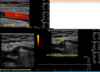
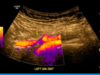
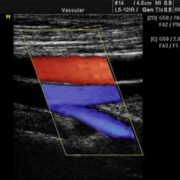
the term “duplex” is used to describe US study that uses both:
- B-mode (2D greyscale) imaging AND
- doppler (color flow vs. pw)
*usually B-mode and doppler are shown in same image (see example below)
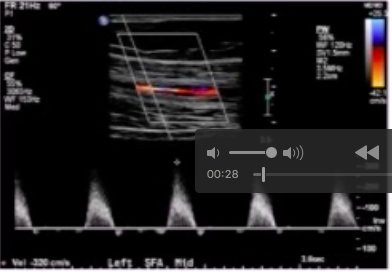
Echo is to EKG for coronary disease as _________is to ABI for peripheral arterial disease.
Echo is to EKG for coronary disease as ADUS is to ABI for peripheral arterial disease.
i.e. ADUS* can help you localize PAD with more precision in pt with abnormal ABI (but arterial DUS is not always necessary)
*ADUS = arterial DUS
Indications for lower extremity ADUS (arterial DUS)? (6)
acute PAD event
- trauma w/ suspectic LE arterial injury
- cardiac/vascular cath complications (PSA, AVF, device closure complication, etc…)
chronic lower extremity PAD*
- dx of ALEPAD* in setting of claudication
- planning for revascularization of ALEPAD
- suspected LE arterial aneurysm
secondary prevention of ALEPAD
- surveillance after revascularization (with bypass graft or stent)
*ALEPAD = atherosclerotic lower extremity arterial disease
Name 2 DUS characteristics of normal lower extremity arteries.
- Triphasic high resistance waveform* (see below)
- PSV usually < 125 cm/s
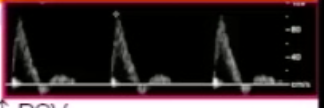
*exception is during exercise (hyperemia), when waveform may change to low-resistance due to arteriolar vasodilation
DUS characteristics that are suggestive of lower extremity arterial disease? (3)
as vascular tech interrogates lesion, will see the following (usually from proximal to distal):
- change in waveform (triphasic →→ monophasic)
- turbulence (color turbulence or spectral broadening)
- step up in PSV (as lesion is crossed)
Proximal to distal PSV trend for normal lower extremity arteries?
gradual decrease in PSV values as you go from proximal to distal
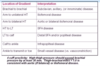
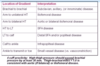
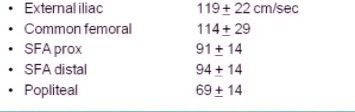
- upper limit of normal PSV values are shown below
Interpret the pw arterial doppler signal shown below.
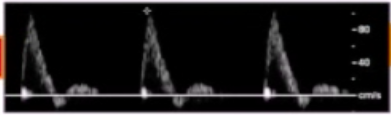
normal flow
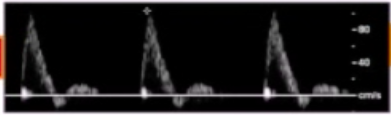
triphasic doppler signal with normal velocity
triphasic or biphasic ⇒ normal flow
Interpret the pw arterial doppler signal shown below.
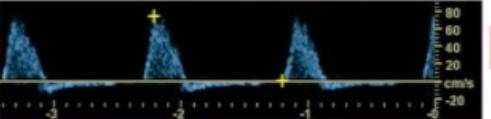
normal flow
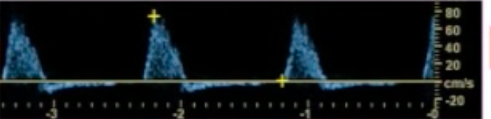
bisphasic signal w/ normal velocity
triphasic or biphasic ⇒ normal flow
Interpret the pw arterial doppler signal shown below.
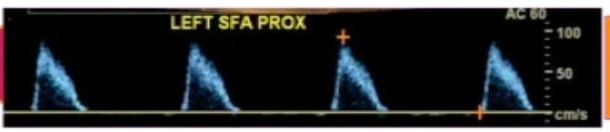
probable distal abnormal flow
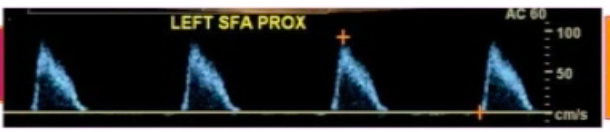
monophasic signal w/ sharp upstroke
monophasic w/ sharp upstroke ⇒ pre-stenosis blood flow
Interpret the pw arterial doppler signal shown below.
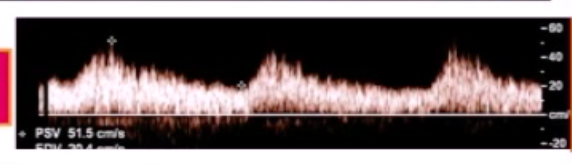
always proximal abnormal flow
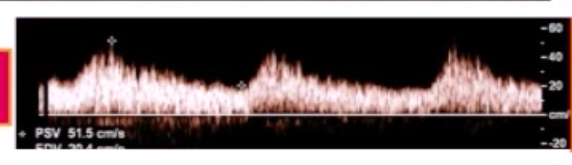
spectral widening w/ blunted velocities and sluggish upstroke
PETW (parvus et tardus waveform) ⇒ post-stenosis blood flow
aka the “bart simpson sign”
Describe the 5 grades of % LE arterial stenosis that can be identified using the SLED criteria*.
*SLED criteria = Simplified Lower Extremity Duplex criteria
- normal (no stenotic dz)
- plaque noted, <50% stenosis
- 50-99% stenosis
- 75-99% stenosis*
- 100% occlusion
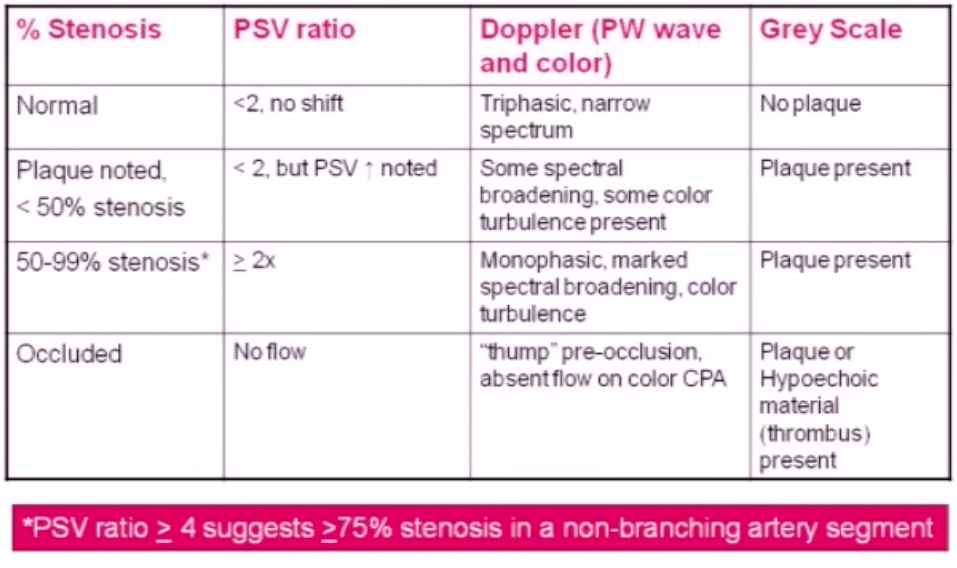
*can only use this descriptor when PSV elevation is downstream from a stenotic non-branching vessel
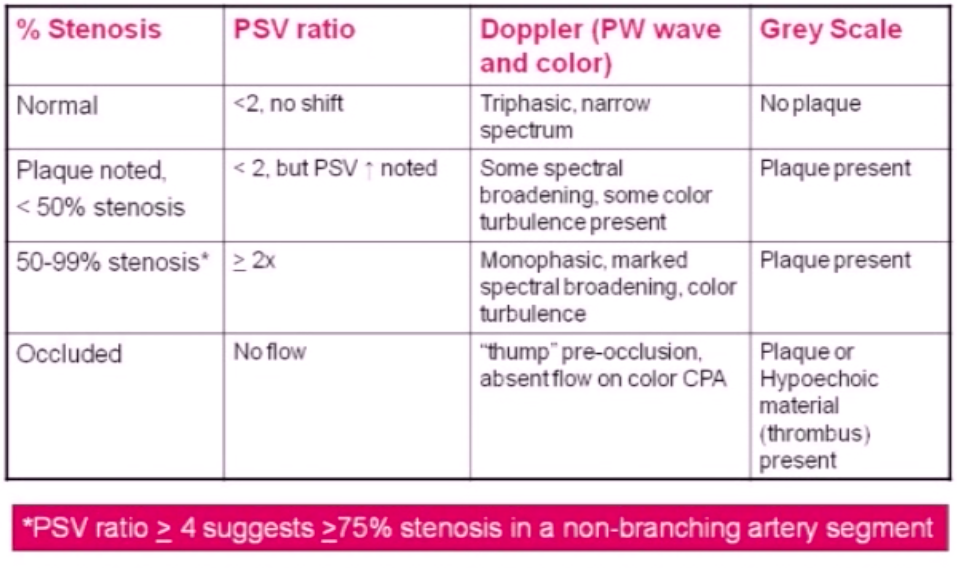
Describe the algorithm for grading stenotic LE arterial disease (SLED criteria).
*SLED criteria: Simplified Lower Extremity Duplex criteria (used by Cleveland Clinic)
step 1: look for occlusive disease*on 2D imaging
- yes → proceed to step 2
- no → no stenotic arterial dz present
step 2: Assess PSV near lesion
- PSV ratio > 4 → 75-99% stenosis
- PSV ratio= 2-4 → 50-99% stenosis
- PSV ratio = 1-2 → <50% stenosis
- PSV ratio = ~ 1 → probably no significant arterial dz**
- no distal velocities → confirm no flow w/ power doppler → 100% occlusion present
*“occlusive disease” → plaque or thrombus
**may look at doppler waveform morphology to help guide borderline cases
Pt w/ claudication at rest has arterial DUS image shown below. Note that PSV proximal to popliteal lesion is 60 cm/s.
How will you report the findings in the images?
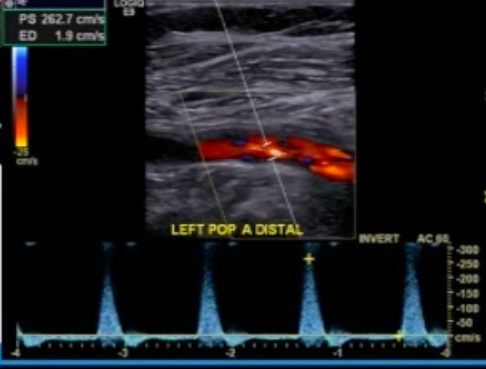
75-99% stenosis in distal popliteal artery
lesion in distal popliteal artery w/ elevation of PSV > 4x ⇒ 75-99% stenosis
Diabetic with LE ulcers has arterial DUS images shown below.
- left image: distal popliteal artery
- right image: PTA
How will you report the findings in the images?
75-99% occlusion in PTA
PSV near lesion in PTA is ~160 cm/s, which is _>_4x proximal flow (~40 cm/s, in distal popliteal artery)
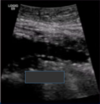
Pt undergoes LE arterial DUS. Interrogation of proximal peroneal artery is shown below.
Most important finding to report?
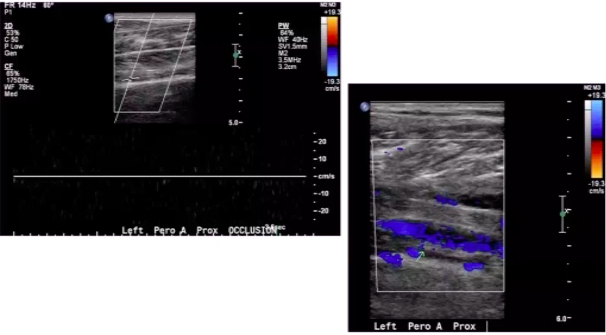
100% occlusion of proximal peroneal artery
- note that the peroneal artery normal courses between 2 veins
- you can see the veins in the image at right, but no artery is seen
What is the concept of assisted patency?
periodic imaging of revascularized vessels w/ surveillance program to allow for intervention prior to complete occlusion of a vessel.
e.g. if pt has a profunda artery stent, then “assisted patency” program would involve reimaging the artery periodically to look for restenosis
Change in ABI that is considered significant in patients with LEAPAD s/p stenting.
*LEAPAD = lower extremity atherosclerotic PAD
ðABI > 1.5
With regard to revascularization of infra-inguinal arterial disease, which types of grafts have the best outcome?
venous grafts
- prosthetic grafts have lower patency rates than venous grafts for infra-inguinal arterial disease
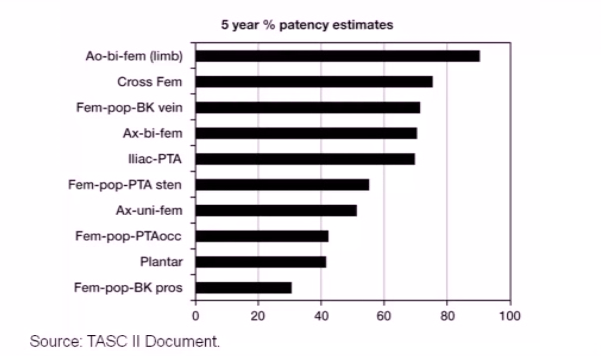
With regard to revascularization of LEAPAD, long-term patency for stents is best in the ____________ vessels.
LEAPAD = lower extremity atherosclerotic PAD
With regard to revascularization of LEAPAD, long-term patency for stents is best in the aortoiliac vessels.
- infra-inguinal percutaneous interventions classically had poorer patency rates compared to grafting, however this is changing w/ the advent of drug-coated balloons
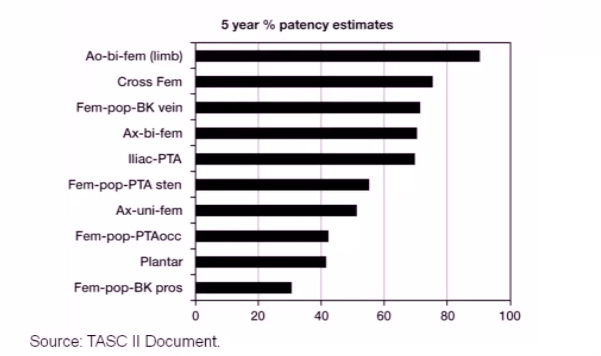
Regarding lower extremity arterial bypass graft surveillance:
Where are stenotic lesions most likely to develop?
at anastomotic sites
- however, stenosis can potentially occur anywhere, so your vascular techs should scan the entire graft when performing surveillance study
Name the 4 pertinent components of a limited surveillance graft study.
- Duplex imaging of proximal vessel (including proximal graft anastomosis)
- Duplex imaging of graft itself (including proximal, mid, and distal intra-graft sites)
- Duplex imaging of distal vessel (including distal graft anastomosis)
- limited ABI study
Regarding lower extremity arterial bypass graft surveillance:
When should you recommend angiography +/- intervention?
when vascular surveillance exam is c/w severe graft stenosis*
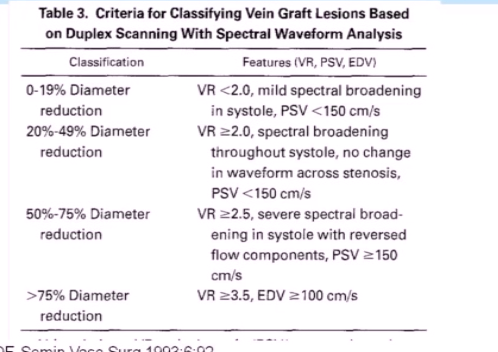
*i.e. >75% stenosis, defined by PSV ratio > 3.5 and EDV > 100 cm/s
Pt undergoes LE arterial DUS. Interrogation of CFA is shown below.
Most important finding to report?
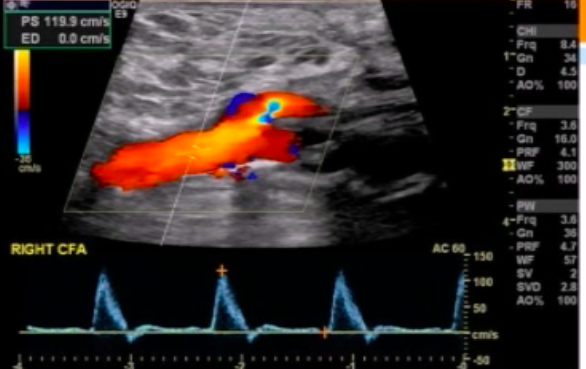
patent CFA-graft anastamosis
- note the triphasic waveform and no B-mode evidence of stenotic disease in anastomosis
- also note the distally-occluded CFA
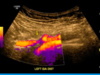
Pt undergoes LE arterial DUS. Interrogation of femoral-ATA graft is shown below.
Most important finding to report?
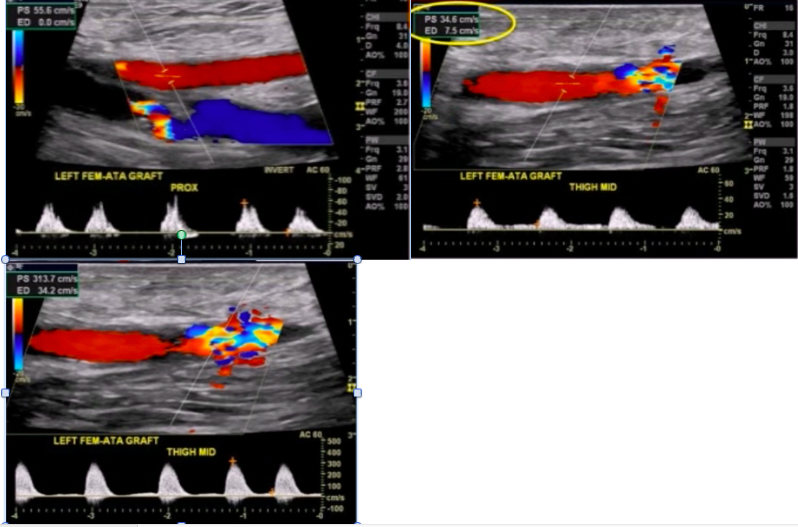
50-99% gypass graft stenosis
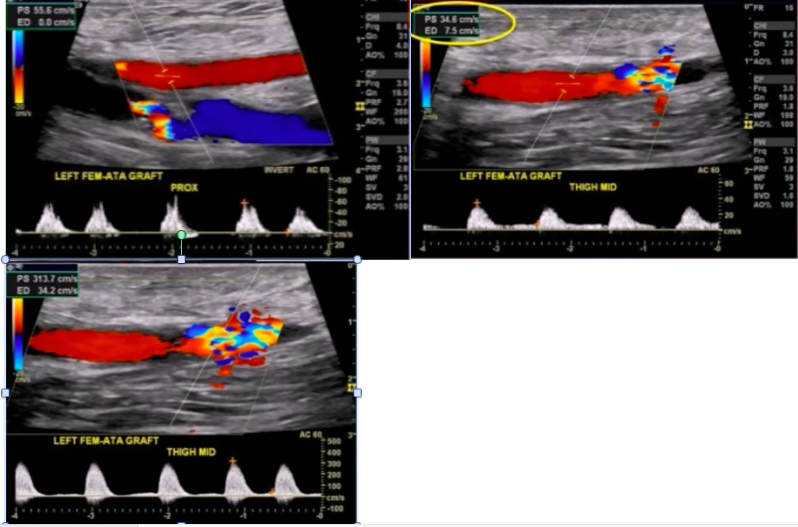
note the PSV ratio ~10, monophasic waveform proximal to lesion, and turbulent color flow near lesion