Delerium Flashcards

(90 cards)

1
Q

What makes up the “DON’T” cocktail?

A

Dextrose

Oxygen

Naloxone

Thiamine

2
Q

 3% of patients arriving to ED are altered

◦ ___% metabolic or systemic derangements

◦ ___%structural lesions

A

85%

15%

3
Q

Define Arousal and where in the brain this system acts?

A

awareness of self and surroundings

 Ascending reticular activating system in the dorsal brainstem

4
Q

This area of the brain controls input of somatic and sensory stimuli, arousal from sleep and is vulnerable to small lesions in the brainstem

A
5
Q

– combo of orientation (accurate perception of experiences), judgment (process input into meaningful info), and memory (store and retrieve info)

A

Cognition

6
Q

Where in the brain is the area respsonsible for cognition?

A

Cerebral cortex (rare to have bilateral lesions here causing AMS)

7
Q

unconsciousness > 6 h

◦ Cannot be awakened

◦ No response to painful stimuli, light, or sound

◦ No normal sleep-wake cycle

◦ No voluntary actions

A

Coma

8
Q

Possible causes of Coma

A

◦ Damage to brainstem, cortex, both

◦ Susceptible to toxins, metabolic derangements, mechanical injury

9
Q

Three most common causes of AMS (altered mental status)

A

• Dementia • Delirium • Psychosis

10
Q

Common causes of delerium

A
  • Metabolic/Endocrine
  • Infectious Disease
  • Cerebrovascular event/Structural CNS – Both hemispheres or brainstem
  • Cardiovascular
  • Drugs/Toxic
  • Hypoperfusion
11
Q

What medications can cause delirium

A

Alcohol withdrawal , Diuretics , Anticholinergics , Corticosteroids Digoxin Opioids, Antidepressants, Anxiolytics ,Hallucinogens/Dissociatives * Benzodiazepines Sympathomimetics

12
Q

Structual causes of AMS

A

Trauma (like subdural or epidural hematoma)

Stroke syndromes–>lead to embolism or throbmoembolism

Hemorrhage

Tumor (originates in brain or mets to)

Pituitary issues

Acute hydrocephalus

Infection

13
Q

Key characteristics of Delerium (making it diff then dementian)

A

Acute and rapid onset lasting days to weeks.

Flucuates in course and level of conciousness

Recent memory markedly impaired

visual hallucinations and disrupted sleep-wake cycles

Reversible with prominent physiological changes

14
Q

What are common causes of AMS in an infant?

what about Child?

A

Infatnt: infection, trauma, metabolic

Child: think toxic ingestion

15
Q

Common cause of AMS in young adults?

Elderly?

A

Young adults: toxic ingestion, drug use or trauma

Elderly: Medication, OTCs, infection (UTI), alterations in envrioment

16
Q

More common causes of delerium

A

 Severe illness

 Drug toxicity

 Fluid and electrolyte disturbances ◦ hyponatremia and azotemia

 Infections

 Hypothermia or hyperthermia

17
Q

 delirium is a______ that has an underlying cause that mush be recognized and identified.

 Almost any illness can present as delirium in a susceptible patient.

A

SYMPTOM

18
Q

The most important clue to delirium is the ____and ______

A

acuity of onset and fluctuation in course.

19
Q

 Delirium most commonly occurs in _____ and in patients with ____

 Delirium is very common in sick, hospitalized patients over the age of 65.

A

older persons, underlying neurologic disease.

20
Q

Predictors of delerium

A

 Abnormal sodium level

 Severe illness

 Chronic cognitive impairment

 Hypothermia or hyperthermia

 Moderate illness

 Psychoactive drug use

 Azotemia

21
Q

First steps in managing pt with delerium

A

First – ABCs ◦ Airway ◦ Breathing ◦ Circulation

22
Q

What resources do you need to utilize when dealing with pt with delirium?

A

 All sources of information

◦ EMS (Emergency Medical Services)

◦ Family

◦ EMR (Electronic Medical Record)

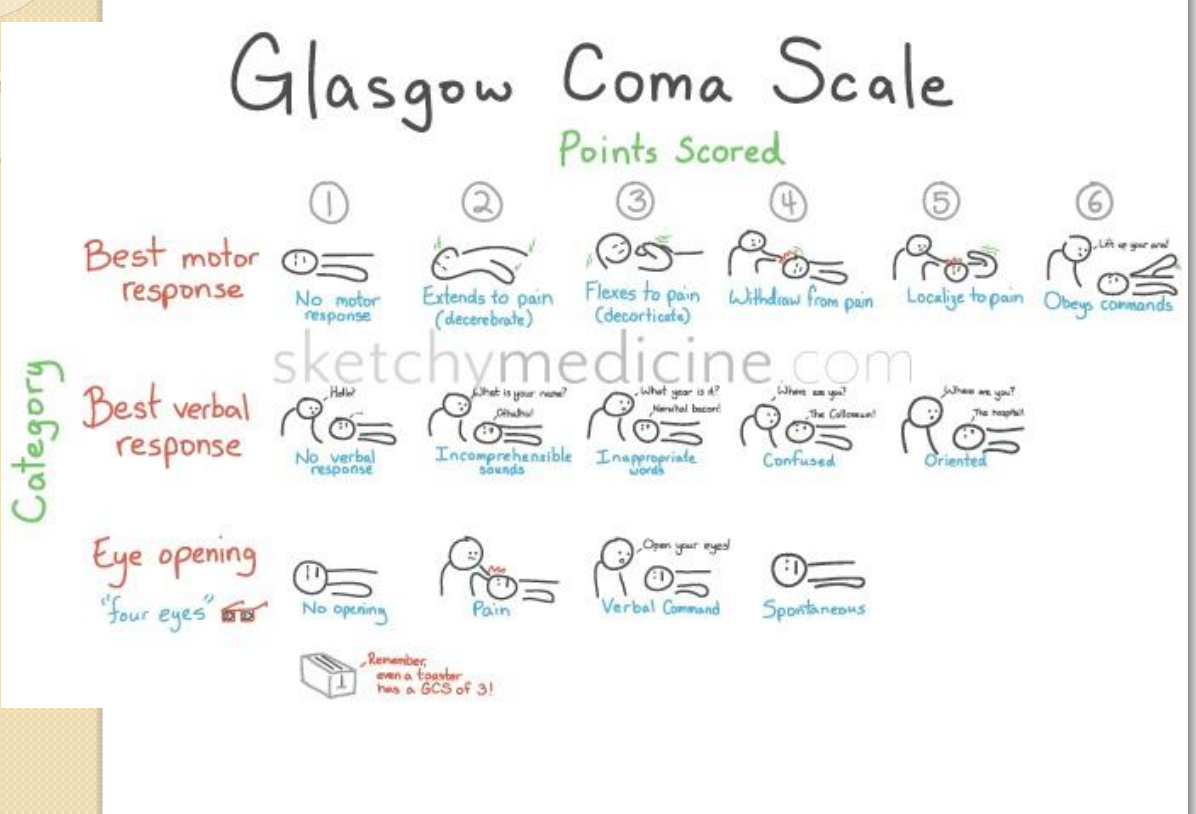
GCS for classification

◦ GCS = Glasgow Coma Scale  What is this?

23
Q

What is the Glasgow coma scale?

A

Low is BAD

High is GOOD

24
Q

How do we manage a pt with Delirium after we have assessed ABCs

A

 Basic neuro exam: devo Differential ◦ This is the list of things you need to be worried about

 Work-up –> “DON’T” coma cocktail

◦ Labs ◦ Imaging ◦ Other tests

 EKG, lumbar puncture

 Treatment ◦ Antidotes, antibiotics, surgery, supportive care, metabolic cofactors (thiamine, folate)

25
Best-validated and most widely used tools for diagnosing delirium
Confusion Assessment Method (CAM)
26
What are the criteria for CAM?
The CAM is considered positive when a patient fulfills **both criteria a and b** as well as **either c or d:** ◦ A) The mental status change is of acute onset and fluctuating course. ◦ B) There is inattention. ◦ C) There is disorganized thinking. : The patient’s thinking is disorganized or incoherent. ◦ D) There is an altered level of consciousness.
27
What are some of the negative outcomes associated with delirium?
patients who experienced delirium had a higher risk of death, institutionalization, and dementia during follow-up Mortality rate over 2 yrs = 38% Rate of institutionalization in next year = 33.4%
28
Many acutely ill, older patients, who have an acute deterioration in mental status are suffering from delirium.  The prognosis of delirium is \_\_\_\_\_\_\_.
poor \*\*\*Delirium can occasionally “unmask” an underlying dementia. This occurs when a patient with a mild, undiagnosed dementia becomes delirious in the hospital and is then evaluated more fully for cognitive impairment.
29
1 day old M born at term, still in hospital, you are called bedside because he is lethargic ◦ ABCs – A intact, B slow respirations, C femoral pulses intact, cap refill 5 seconds ◦ C-section due to large gestational size; mom was IDDM ◦ Poor suck DDx?
Check blood glucose! mom was IDDM and you would give glucose Possible opiate baby (usually have shrill cry)
30
What would your differential diagnosis be if the child was 6 weeks old, had no prenatal care, and was febrile to 38°C, and came in lethargic?
Check for honey--\> Botulinum toxin also think dehydration if not getting enough fluids Meningitis: bacterial or herpes at this time
31
What would your differential diagnosis be if this child were 1 year old, hypoglycemic, lethargic, just at grandma’s house, who has past medical history of Diabetes mellitus and Hypertension?
Worry about insulin injection or talking grandmas B-Blockers or sulfonureas
32
1 day old M born at term, still in hospital, you are called bedside because he is lethargic ABCs – A intact, B slow respirations, C femoral pulses intact, cap refill 5 seconds C-section due to large gestational size Poor suck PMH - mother IDDM What bedside test woudl you want to give?
Check glucose Normal is \>70.. our baby is at 20-yikes!
33
Hypoglycemia:\_\_\_\_\_\_\_\_ symptoms predominate Brain relies almost entirely on \_\_\_\_\_ During prolonged starvation, the brain can use\_\_\_\_\_ Other major organs (heart, liver, and skeletal muscle) function during hypoglycemia (use various fuel sources (ie., fatty acids)
Central nervous system (CNS) glucose ketones
34
In **_diabetes_**, density of _______ varies with glycemic control ◦ What happens in poor glycemic control?
neuronal insulin receptors ## Footnote Poor glycemic control--\> fewer neuronal **glucose** receptors thus see hypoglycemic symptoms at higher concentrations of glucose
35
What is the mean glucose level for symptomatic hypoglycemia in diabetics vs normal?
78 ± 5 mg/dL versus 53 ± mg/dL
36
Normally, insulin released with elevation of intracellular ATP, these potentiate the effects of ATP at its "sensor”
Sulfonylureas
37
How is insulin release usually regulated in regards to K and Ca?
◦ Increased intracellular K--\>increased intracellular potential opens voltage-gated Ca2+ channels--\>increases intracellular calcium concentration--\> release of insulin
38
bind to K+ channels on pancreatic cells--\>increased insulin secretion ◦ Hypoglycemic effects shorter duration
Meglitinides
39
How does Metformin stabalize Glucose? There are 5 ways
Inhibits gluconeogenesis--\>decreased hepatic glucose output Enhanced peripheral glucose uptake Decreased fatty acid oxidation Increased intestinal use of glucose In skeletal muscle and adipose cells, enhanced activity and translocation of glucose transporters
40
 Which of the following medications would not cause hypoglycemia a) Sulfonylurea b) Beta-blocker c) Insulin d) Metformin
Metformin!
41
 Previously healhty17 year-old male presenting with AMS  He was found on doorstep by parents, acting paranoid, confused and inappropriate. Has a history of drug and alcohol abuse. ABCs – A intact, B normal breath sounds BL, C bounding peripheral pulses, tachycardic Other history: Had been at a party with some friends, possibly used drugs. Differential diagnosis?
Stimulants: amphetamines, possibly using someones Rx (aderol) or cocaine, meth, PCP, extasy \*seem lik sympathomimetic issues Possible: head trauma, thyrotoxicosis, hypoglycemia, meningitis
42
Sympathomimetics: How do direct-acting and indirect actig differ?
 Direct-acting: Bind post-synaptic receptors--\>direct stimulation  Indirect-acting: Increase synaptic concentration of neurotransmitters
43
All of the following sympathomimetic drugs **inhibit the uptake of norepinephrine** EXCEPT ◦ Cocaine ◦ Amphetamine ◦ Venlafaxine ◦ Bupropion ◦ Dobutamine
Dobutamine: it's adrenergic
44
In the monoamingergic synpase, what is the order of events for NT release?
1. DA, Epi, Nepi, or 5-HT are packaged via MAO packer into vesicle 2. Exocytosis to cleft 3. Reuptake via DAT,NET or SERT or will experience degredation post synapse via COMT or presynapse via MAO
45
What is the precursor aa for Dopamine and what enZ convertis it to Dopmamine
Tyrosine --\> Dopa Tyrosine Hydroxylase Dopa--\> Dopamine via AADC
46
How does DA get converted to NE?
VMAT2 puts DA into vesicles that have B-hydroxylase that converts DA--\> NE
47
What is the role of the alpha-2 autoreceptor on the presynaptic side?
NE binds alpha2 and activates Gi Gi is an inhibitory path you can alsoh have DA bind to alpha 2 to inhibit NE release
48
What happens when NE binds to alpha-1 on the postsynaptic side?
alpha-1 is a Gq protein thus get activation: see CNS inhibiton and peripheral see VASOCONSTRICTION
49
What happens when NE binds to B receptor on the post synaptic side?
CNS: excitation Peripheral bronchodialation, increased HR and vasodilation
50
What receptor would Dopamine bind to to inhibits its release?
D2 autoreceptor (via negative feedback)
51
Dopamines binds to D1 or D5 and what happens in the brain? What about if it binds D2,3,4?
D1 or D5: addiction, craving, choreathesosis, Tourettes, psychoese D2,3,4 are inhibitory
52
What drugs inhibit MAO degredation?
Clorgyline, Pargyline, Selegiline
53
This drug blocks DAT, NET, SERT via transport blocking
Cocaine
54
This drug blocks DAT, NET, VMAT by acting like a FALSE SUBSTRATE
Amphetamines
55
This drugs blocks DAT, NET, SERT, VMAT by blocking transport and acting as a false substrate
Bath salts
56
Understand false substrate mechanism in image
57
 Hypertension  Hyperthermia  Tachycardia  Mydriasis  Diaphoresis
Sympathomimetic Toxidrome
58
What is the toxidrome for Anticholinergic drugs?
Tachycardia, Hypertension, Increased temperature, Dialated pupils, Decreased bowels, Decreased sweating
59
Mydriasis, Increased bowel sounds, Diaphoresis
Cholingeric toxidrome: SLUDGE ACh Receptor agonist or AChE; Donepezil
60
Bradycardia, decrease RR, Decreased temp, myosis, lack of bowel sounds, not sweating
Opiods: morphine, heroin, hydromorphone
61
What is the constellation of symptoms you would expect to see with sympathomimetic intoxication? a) Tachycardia b) Hypotension c) Elevated temperature d) Miosis e) Agitation f) All of the above g) a,c,e
G: Tachy, high temp, Agitation
62
If you were to give medications to calm a patient that is sympathomimetic (or if you were performing procedural sedation) – what would you give?
Benzos
63
What do you give to pt that ODs on benzos?
Flumazenil
64
What do we need to be careful of when using Flumazenil to tx Benzo OD?
seizures and dysrhythmias may develop when the effects of a benzodiazepine are reversed in a mixed overdose.
65
When is it safe to use Flumazenil for Benzo OD?
are both naïve to benzodiazepines and who overdose solely on a benzodiazepine OR ◦ benzodiazepine-naïve patients whose benzodiazepine component must be reversed after procedural sedation.
66
50 year old M found down by family in bathroom. ABCs – A intact, B RR 4, C weak pulses, cyanotic Other history: Chronic back, multiple ED visits for pain in the last month Dx?
Opioid Toxidrome  Altered mental status (Stupor, coma)  Miosis  Respiratory Depression
67
Which of the following would you use to reverse this patient’s toxidrome? a) glucose b) naloxone c) thiamine d) bicarbonate
Naloxone
68
What is the mechanism by which opioids such as morphine produce respiratory depression?
They decrease chemoreceptor sensitivity to carbon dioxide.
69
What aa sequence simularities are there in endogenous opiates?
Tyr-Gly-Gly-Phe
70
Opiods bind the Mu receptor which is what kind of receptor and has what effect on the post-synaptic cell?
Gi they DECREASE cAMP = hyperpolarized cell, blocks Ca+ entry and promotes opening of K+ channels ultimately less NTs are release
71
Cardiovascular and Dermatologic effects of Opiods Orthostatic hypotension, Bradycardia, Peripheral vasodilation Itching, Flushing (histimine)
72
Endocrine effects from Opiods
Prolactin release, Reduced ADH and gonadotrophin release
73
In the patient’s past medical history, he is a recovering alcoholic. At a prior ED visit several years ago, the patient had presented with Wernicke’s Encephalopathy.This classic triad includes the following symptoms EXCEPT:  a) agitation  b) confusion  c) ophthalmoplegia  d) ataxia
agitation
74
What is Wet beriber/CV disease?
 High-output cardiac failure  Peripheral vasodilation and the formation of arteriovenous fistulae
75
76
What is Wernicke Korsakoff Triad
Classic Wernicke triad ◦ Oculomotor abnormalities ◦ Ataxia ◦ Globalconfusion
77
What can Werniki transition into?
Korsakoff ◦ Confabulation ◦ Chronic  10-20% mortality  Peripheral neuropathy common
78
how does ethanol effect GABA and NMDA
Ethanol binds GABA-A to maintain state of depression
79
Describe GABA-A and it's function
 Pentameric receptor complex most commonly containing 2 alpha, 2 beta, and 1 gamma subunit  Activation promotes hyperpolarization via chloride flux
80
What do we need to be aware of as far as drug interactions are concerened in chronic alcoholics?
There is cross tolerance with sedative hypnotics
81
What are the two major pathways for alcohol metabolism
1. Alcohol Dehydrogenase or ADH: lower stomach ADH in women 2. Microsomal Ethanol oxidizing system; MEOS) which is CYP system--\> 2E1, 1A2, 3A4
82
What CYP is induced in chronic alcholics?
2E1
83
What is the pathway for EtOh break down?
Ethanol--\> acetaldehyde (hangover) via ADH Acetaldehyde--\> Acetate via Aldehyde dehyrdrogenase
84
What drug inhibits Aldehyde dehyrdogenase thus increase Acetaldehyde making people that drink feel AWFUL?
Disulfiram
85
What drug blocks the action of ADH preventing EtOH--\> Acetaldehyde?
86
What drugs are antagonists of NMDA receptors?
Ketamine, PCP and Alchol
87
What is the timeline of symptoms we see in alchol withdrawl?
10-36 hrs: seizures 12-48 hrs: alcohol hallucinosis from 24-\>48 hrs is major withdrawl
88
Describe Delirium Tremens
 Hallucinations – usually visual and tactile  Disorientation  Hypertension  Tachycardia  Fever
89
In Delerium tremens, pts are at risk for
 High risk for seizures and dangerous ventricular arrhythmias  Seen in 5% of patients with alcohol withdrawal  2-4 days after the last drink  Untreated mortality – 30% (\<5% with treatment)
90
What can we do to minimize and tx delirium?
 Treat the underlying cause  Administer fluids to treat and prevent dehydration.  Avoid sleep deprivation.  Provide a quiet environment.  Keep nighttime awakenings to a minimum.  Protect from falls or self-inflicted injury. ◦ Sitters ◦ Low-dose neuroleptics