No-arbitrage principle
There should be no riskless profit to be gained by a combination of a forward contract position with positions in other assets.
Assumptions:
- Transactions cost are zero
- There are no restrictions on short sales or on the use of short sale proceeds
- Both borrowing and lending can be done in unlimited amounts at the risk-free rate of interest.
Forward price = price that prevents profitable riskless arbitrage in frictionless markets
Cheapest-to-deliver bond (CTD)
The cheapest-to-deliver bond is the debt instrument with the same seniority as the reference obligation but that can be purchased and delivered at the lowest cost.
Day count and compounding conventions vary among different financial intstruments
- Libor-based contracts such as FRAs swaps, caps, floors
- 360 days per year and simple interest
- Multiply “r” by (days/360)
- Equities, bonds, currencies, and stock options
- 365 days per year and periodic compound interest
- Raise (1 + r) to an exponent of (days/365)
- Equity indexes
- 365 days per year and continuous compounding
- Raise Euler’s number “e” to an exponent of “r” times (days/365)
Eurodollar
Eurodollar deposit is the term for deposits in large banks outside the United States denominated in U.S. dollars.
London Interbank Offered Rate (LIBOR)
The lending rate on dollar-denominated loans between banks is called the London Interbank Offered Rate (LIBOR). It is quoted as an annualized rate based on a 360-day year.
Pricing Forward Rate Agreements (FRA)
- LIBOR rates in the Eurodollar market are add-on rates and are always quoted on a 30/360 day basis in annual terms.
- The long position in an FRA is, in effect, long the rate and benefits when the rate increases.
- Although the interest on the underlying loan won’t be paid until the end of the loan, the payoff on the FRA occurs at the expiration of the FRA. Therefore, the payoff on the FRA is the present value of the interest savings on the loan
Arbitrage with a one-period binomial model
- If the option is overpriced in the market, we would sell the option and buy a fractional share of the stock for each option we sold.
- If the call option is underpriced in the market, we could purchase the option and short a fractional share of stock for each option purchased.
Black-Scholes-Merton Model
BSM option valuation model values options in continuous time, but is based on the no-arbitrage condition we used in valuing options in discrete time with a binomial model.
Assumptions:
- The return follows a lognormal distribution.
- Continuously compounded Rf is constant and known
- The volatility is constant and known
- Markets are “frictionless”
- Continuously compounded yield is constant
- The options are European options.
Interest Rate Cap and Floor
- A series of interest rate call options with different maturities and the same exercise price can be combined to form an interest rate cap. (Each of the call options in an interest rate cap is known as a caplet.) A floating rate loan can be hedged using a long interest rate cap.
- Similarly, an interest rate floor is a portfolio of interest rate put options, and each of these puts is known as a floorlet. Floors can be used to hedge a long position in a floating rate bond.
Swaption
- Payer Swaption: the right to enter into a specific swap at some date in the future at a predetermined rate as the fixed-rate payer.
- Receiver Swaption: the right to enter into a specific swap at some date in the future as the fixed-rate receiver (i.e., the floating-rate payer) at the rate specified in the swaption.
Combinations of interest rate options can be used to replicate other contracts
- P - C = Short FRA
- Receive fixed, pay floating
- C - P = Long FRA
- Pay fixed, receive floating
- Floor - Cap = Receiver swaption - payer swaption = Receiver Swap
- Cap - Floor = Payer swaption - Receiver swaption = Payer Swap
Five inputs to BSM model
- Asset price
- Exercise price
- Asset price volatility
- Time to expiration
- Risk-free rate
The relationship between each input (except the exercise price) and the option price is captured by sensitivity factors known as “the Greeks.”
Delta
- Delta describes the relationship between changes in asset prices and changes in option prices. Delta is also the hedge ratio. Delta is the slope of the prior-to-expiration curve.
- Assuming that the underlying stock price doesn’t change, if the call option is:
- Out-of-the-money (the stock price is less than exercise price), the call delta moves closer to 0 as time passes.
- In-the-money (the stock price is greater than exercise price), the call delta moves closer to e–δT as time passes.
- 0 < Call option delta < 1
- If the put option is:
- Out-of-the-money (the stock price is greater than exercise price), the put delta moves closer to 0 as time passes.
- In-the-money (the stock price is less than exercise price), the put delta moves closer to –e–δT as time passes.
- -1 < put option delta < 0
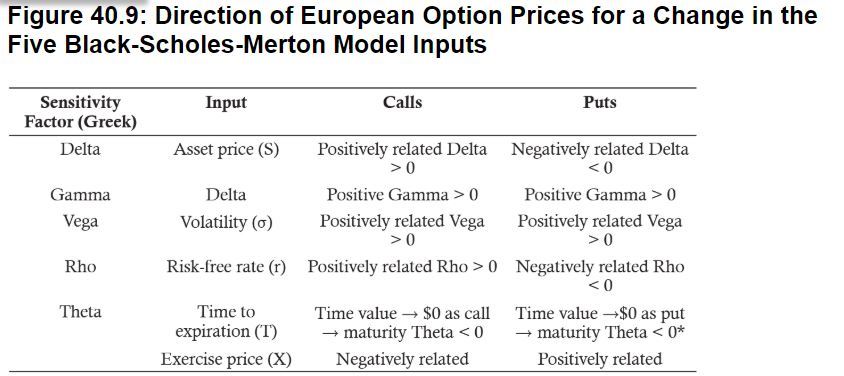
Gamma
Gamma measures the rate of change in delta as the underlying stock price changes.
Gamma risk is the risk that the stock price might abruptly “jump,” leaving an otherwise delta-hedged portfolio unhedged.
Because a stock’s delta is always 1, its gamma is 0. A delta-hedged portfolio with a long position in stocks and a short position in calls will have negative net gamma exposure.
Vega
Vega measures the sensitivity of the option price to changes in the volatility of returns on the underlying asset, . Both call and put options are more valuable, all else equal, the higher the volatility, so vega is positive for both calls and puts. Note that vega gets larger as the option gets closer to being at-the-money.
Rho
Rho measures the sensitivity of the option price to changes in the risk-free rate. The price of a European call or put option does not change much if we use different inputs for the risk-free rate, so rho is not a very important sensitivity measure. Call (put) options increase (decrease) in value as the risk-free rate increases
Theta
Theta measures the sensitivity of option price to the passage of time. As time passes and a call option approaches maturity, its speculative value declines, all else equal. This is called time decay. That behavior also applies for most put options (though deep in-the-money put options close to maturity may actually increase in value as time passes). Theta is less than zero.
Covered call
A covered call option strategy is a long position in a stock combined with a short call:
- Gives up the upside on the stock (when the stock price rises, the short call loses value—offsetting the gain on the long stock)
- Earns income via the premium on the call.
Investment objective:
- Income generation
- Improving on the market
- Target price realization
Protective Put
A protective put position is composed of a long stock position and a long put position. The long put serves as an insurance policy to provide protection on the downside for the long stock position.
- Does not give up the upside on the long stock position
- Maximum loss is the deductible (S0 - X) plu the premium cost (P0)
Bull spread versus bear spread
- Bull spreads can be established with calls or puts where the exercise price of the long option is lower than the exercise price of the short option.
- A bear spread has a higher exercise price for the long position and lower exercise price for the short position.
Bull call spread
A bull call spread can be constructed by purchasing a call option with a low exercise price, XL, and subsidizing that purchase price by selling a call with a higher exercise price, XH.
- XL < XH
- CL0 > CH0
A bull call spread produces a gain if the stock price increases, but at a lower cost than the cost of the single lower exercise price call alone. The upper limit is capped, however, which is the price of lowering the cost.
Bear Put Spread
A bear put spread entails buying a higher exercise price put and writing a lower exercise price put. A bear put spread provides (limited) upside if the value of the value of the underlying falls.
Collar
- The objective of a collar is to decrease the volatility of investment returns. To set up a collar, the owner of the underlying stock buys a protective put and simultaneously sells a call to offset the put premium. If the premiums of the two are equal, it is called a zero-cost collar.
- Generally for a collar, the put strike (XL) < the call strike (XH).
- A collar structured such that XL = XH = X ensures a locked-in profit or loss of (X – S0)
Straddle
- A long straddle consists of a long call and a long put with the same strike price and on the same underlying stock.
- A straddle is based on an expectation of higher future volatility: the investor will lose only if the stock price doesn’t change much (option value increases with volatility).




