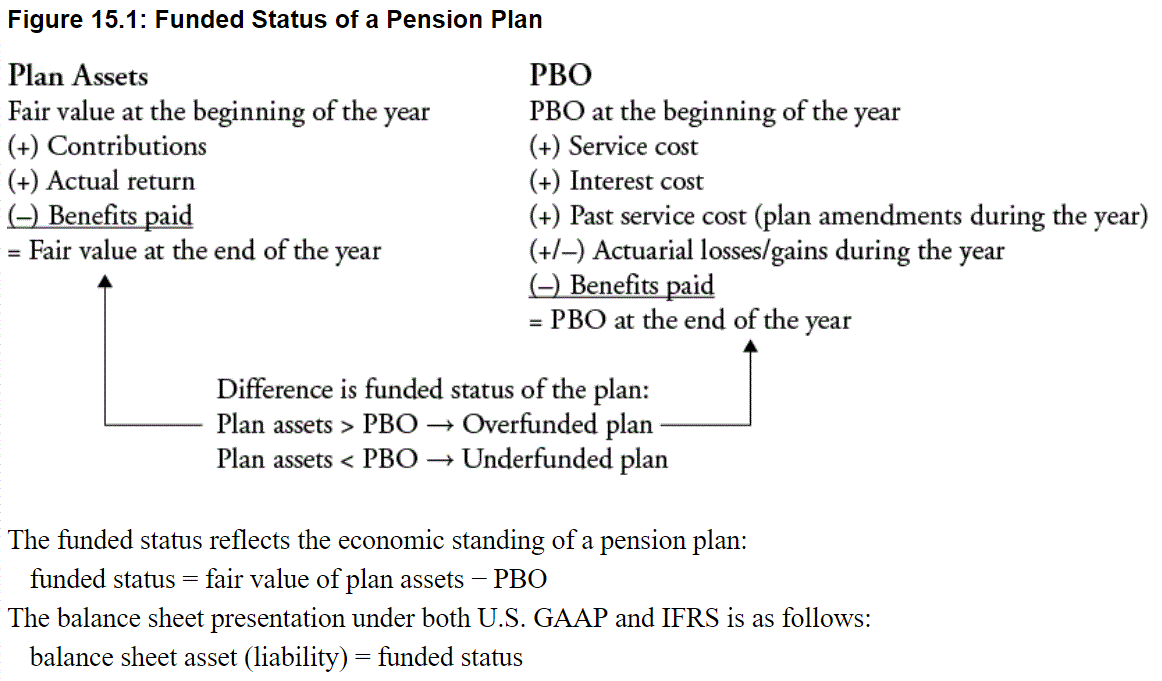
Categories of intercorporate investments
- Investments in financial assets. An ownership interest of less than 20% is usually considered a passive investment. In this case, the investor cannot significantly influence or control the investee. IFRS and GAAP classify investments in financial assets as held-to-maturity, available-for-sale, or fair value through profit or loss (which includes held-for-trading and securities designated at fair value).
- Investments in associates. An ownership interest between 20% and 50% is typically a noncontrolling investment; however, the investor can usually significantly influence the investee’s business operations. The equity method is used to account for investments in associates.
- Business Combinations. An ownership interest of more than 50% is usually a controlling investment. When the investor can control the investee, the acquisition method is used.
- Joint ventures. A joint venture is an entity whereby control is shared by two or more investors. Both IFRS and U.S. GAAP require the equity method for joint ventures. In rare cases, IFRS and U.S. GAAP allow proportionate consolidation as opposed to the equity method.
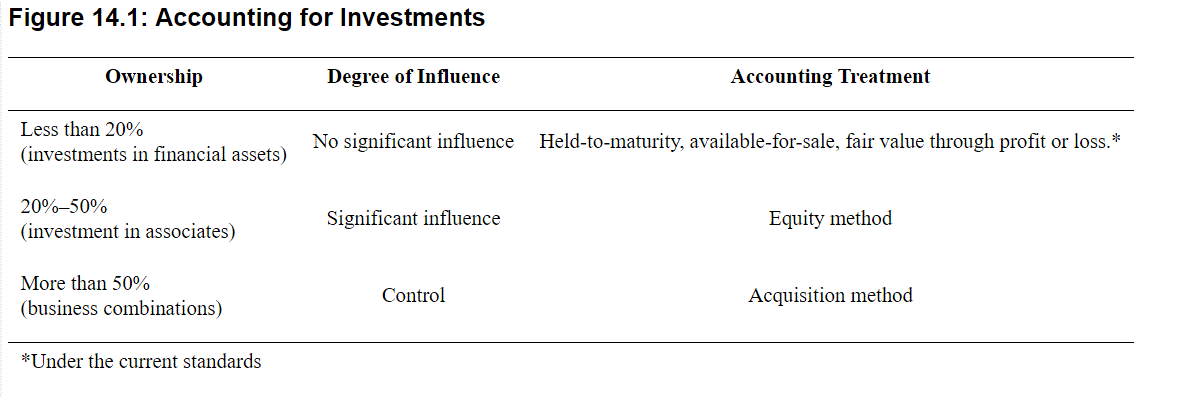
Reclassification of Investments in Financial Assets
Impairment of Financial Assets
If the value that can be recovered for a financial asset is less than its carrying value and is expected to remain so, the financial asset is impaired. IFRS and U.S. GAAP require that held-to-maturity (HTM) and available-for-sale (AFS) securities be evaluated for impairment at each reporting period.
- GAAP: A security is considered impaired if its decline in value is determined to be other than temporary. For both HTM and AFS securities, the write-down to fair value is treated as a realized loss (i.e., recognized on the income statement). Reversal of impairment losses is not allowed.
- IFRS: If a held-to-maturity security has become impaired, its carrying value is decreased to the present value of its estimated future cash flows, using the same effective interest rate that was used when the security was purchased. This may not be equal to its fair value. Impairments of available-for-sale debt securities may be reversed as impairments of held-to-maturity securities. Reversals of impairments are not permitted for equity securities.
IFRS 9
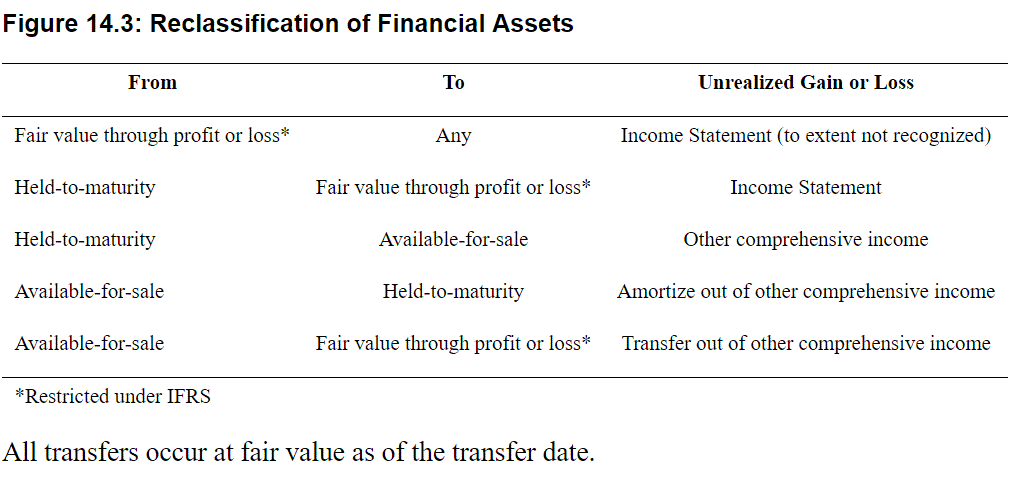
- Amortized Cost - for debt securities only, same as the held-to-maturity method. Criteria for amortized cost accounting:
- Business model test: Debt securities are being held to collect contractual cash flows.
- Cash flow characteristic test: The contractual cash flows are either principal or interest on principal, only.
- Fair Value Through Profit or Loss - for debt and equity securities, essentially “held for trading”. Once classified, the choice is irrevocable. Derivatives that are not used for hedging are always carried at FVPL.
- Fair Value Through OCI - For debt and equity securities. Essentially “available for sale”
- Reclassification of equity securities under the new standards is not permitted as the initial designation (FVPL or FVOCI) is irrevocable. Reclassification of debt securities is permitted only if the business model has changed.
- The incurred loss model for loan impairment was replaced by the expected credit loss model. The new criteria results in an earlier recognition of impairment (12-month expected losses for performing loans and lifetime expected losses for nonperforming loans).
Summary of Classifications of Financial Assets
Fair Value Option
U.S. GAAP allows equity method investments to be recorded at fair value. Under IFRS, the fair value option is only available to venture capital firms, mutual funds, and similar entities. The decision to use the fair value option is irrevocable and any changes in value (along with dividends) are recorded in the income statement.
Excess of Purchase Price Over Book Value Acquired
- At the acquisition date, the excess of the purchase price over the proportionate share of the investee’s book value is allocated to the investee’s identifiable assets and liabilities based on their fair values. Any remainder is considered goodwill.
- It is important to note that the purchase price allocation to the investee’s assets and liabilities is included in the investor’s balance sheet, not the investee’s. In addition, the additional expense that results from the assigned amounts is not recognized in the investee’s income statement.
Transactions with the investee
In an upstream sale (investee to the investor) or a downstream sale (investor to the investee), the investee or investor has recognized all of the profit in its income statement and must eliminate the proportionate share of the profit that is unconfirmed. Profit from these transactions must be deferred until the profit is confirmed through use or sale to a third party.
Category of business combinations
- Merger. The acquiring firm absorbs all the assets and liabilities of the acquired firm, which ceases to exist. The acquiring firm is the surviving entity.
- Acquisition. Both entities continue to exist in a parent-subsidiary relationship. Recall that when less than 100% of the subsidiary is owned by the parent, the parent prepares consolidated financial statements but reports the unowned (minority or noncontrolling) interest on its financial statements.
- Consolidation. A new entity is formed that absorbs both of the combining companies.
- The acquisition method i required for business combination.
Full goodwill vs. partial goodwill
- Under U.S. GAAP, goodwill is the amount by which the fair value of the subsidiary is greater than the fair value of the acquired company’s identifiable net assets (full goodwill).
- If the full goodwill method is used, noncontrolling interest is based on the acquired company’s fair value.
- The full goodwill method results in higher total assets and higher total equity than the partial goodwill method. Thus, return on assets and return on equity will be lower if the full goodwill method is used.
- Under IFRS, goodwill is the excess of the purchase price over the fair value of the acquiring company’s proportion of the acquired company’s identifiable net assets (partial goodwill). However, IFRS permits the use of the full goodwill approach also.
- If the partial goodwill method is used, noncontrolling interest is based on the fair value of the acquired company’s identifiable net assets.
Goodwill impairment
- IFRS (single step approach): carrying amount of the unit > recoverable amount, an impairment loss is recognized.
- GAAP (two steps):
- If, carrying value of the unit > fair value of the unit, an impairment exists.
- Loss is measured as the difference between the carrying value of the goodwill and the implied fair value of the goodwill. The loss is recognized in the income statement as a part of continuing operations.
Bargain purchase
In rare cases, acquisition purchase price is less than the fair value of net assets acquired. Both IFRS and U.S. GAAP require that the difference between fair value of net assets and purchase price be recognized as a gain in the income statement.
Accounting for Joint Venture
Both U.S. GAAP and IFRS require the equity method of accounting for joint ventures.
In rare circumstances, the proportionate consolidation method may be allowed under U.S. GAAP and IFRS. Proportionate consolidation is similar to a business acquisition, except the investor (venturer) only reports the proportionate share of the assets, liabilities, revenues, and expenses of the joint venture. Since only the proportionate share is reported, no minority owners’ interest is necessary.
Special Purpose and Variable Interest Entities.
- VIE is an entity that has one or both of the following characteristics:
- At-risk equity that is insufficient to finance the entity’s activities without additional financial support.
- Equity investors that lack any one of the following:
- Decision making rights.
- The obligation to absorb expected losses.
- The right to receive expected residual returns.
- If an SPE is considered a VIE, it must be consolidated by the primary beneficiary. The primary beneficiary is the entity that absorbs the majority of the risks or receives the majority of the rewards.
Restructuring Costs
Restructuring costs are expensed when incurred—and not capitalized as part of the acquisition cost—under both IFRS and U.S. GAAP.
In-Process R&D
In-process R&D is capitalized as an intangible asset and included as an asset under both U.S. GAAP and IFRS. In-process R&D is subsequently amortized (if successful) or impaired (if unsuccessful).
Define contribution plan
- A defined contribution plan is a retirement plan whereby the firm contributes a certain sum each period to the employee’s retirement account.
- The firm makes no promise to the employee regarding the future value of the plan assets. The investment decisions are left to the employee, who assumes all of the investment risk.
- Pension expense is simply equal to the employer’s contribution. There is no future obligation to report on the balance sheet.
Defined-benefit plan
- In a defined-benefit plan, the firm promises to make periodic payments to the employee after retirement. The benefit is usually based on the employee’s years of service and the employee’s compensation at, or near, retirement.
- Since the employee’s future benefit is defined, the employer assumes the investment risk.
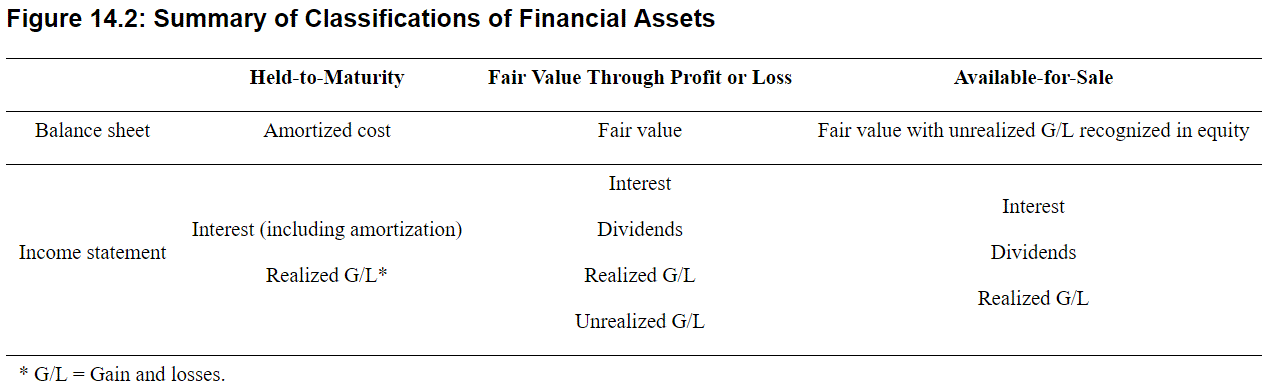
- The difference in the benefit obligation and the plan assets is referred to as the funded status of the plan.
Funded status of the plan
- If the plan assets exceed the pension obligation, the plan is said to be “overfunded.”
- if the pension obligation exceeds the plan assets, the plan is “underfunded.”
Other post-employment benefit plan
Pension plans are typically funded at some level, while other post-employment benefit plans are usually unfunded. In the case of an unfunded plan, the employer recognizes expense in the income statement as the benefits are earned; however, the employer’s cash flow is not affected until the benefits are actually paid to the employee.
Projected Benefit Obligation (PBO)
[known as present value of defined benefit obligation (PVDBO) under IFRS
Actuarial present value (at an assumed discount rate) of all future pension benefits earned to date, based on expected future salary increases. It measures the value of the obligation, assuming the firm is a going concern and that the employees will continue to work for the firm until they retire.
PBO changes as a result of
- Current service cost is the present value of benefits earned by the employees during the current period. It includes an estimate of compensation growth (future salary increases)
- Interest cost is the increase in the obligation due to the passage of time.
- Past (prior) service costs are retroactive benefits awarded to employees when a plan is initiated or amended.
- Changes in actuarial assumptions are the gains and losses that result from changes in variables such as mortality, employee turnover, retirement age, and the discount rate. An actuarial gain will decrease the benefit obligation and an actuarial loss will increase the obligation.
- Benefits paid reduce the PBO.
Past (prior service cost)
- Retroactive benefits awarded to employees when a plan is initiated or amended.
- Under IFRS, past service costs are expensed immediately.
- Under U.S. GAAP, past service costs are amortized over the average service life of employees.
Funded status of a pension plan