Mispricing by analyst
IVanalyst − price = (IVactual − price) + (IVanalyst − IVactual)
Investment value
Investment value is the value of a stock to a particular buyer. Investment value may depend on the buyer’s specific needs and expectations, as well as perceived synergies with existing buyer assets.
Valuation
Valuation is the process of estimating the value of an asset by
- Using a model based on the variables the analyst believes influence the fundamental value of the asset or
- Comparing it to the observable market value of “similar” assets.
5 elements of industry structure (Porter’s five forces)
- Threat of new entrants in the industry.
- Threat of substitutes.
- Bargaining power of buyers.
- Bargaining power of suppliers.
- Rivalry among existing competitors.
3 strategies to compete and generate profits
- Cost leadership
- Product differentiation
- Focus
Categories of quality of earnings issues
- Accelerating or premature recognition of income
- Reclassifying gains and nonoperating income
- Expense recognition and losses
- Amortization, depreciation, and discount rates
- Off-balance-sheet issues
Absolute vs. relative valuation model
- An absolute valuation model is one that estimates an asset’s intrinsic value, which is its value arising from its investment characteristics without regard to the value of other firms.
- Dividend discount models estimate the value of a share based on the present value of all expected dividends discounted at the opportunity cost of capital.
- Free cash flow approach and the residual income approach. Expand the measure of cash flow to include all expected cash flow to the firm that is not payable to senior claims.
- Asset-based models. Estimates a firm’s value as the sum of the market value of the assets it owns or controls. Commonly used to value firms that own or control natural resources.
- Relative valuation model is to determine the value of an asset in relation to the values of other assets. This is the approach underlying relative valuation models. The most common models use market price as a multiple of an individual financial factor of the firm, such as earnings per share.
Sum-of-the-parts valuation
Rather than valuing a company as a single entity, an analyst can value individual parts of the firm and add them up to determine the value for the company as a whole. The value obtained is called the sum-of-the-parts value, or sometimes breakup value or private market value. This process is especially useful when the company operates multiple divisions (or product lines) with different business models and risk characteristics (i.e., a conglomerate).
Conglomerate discount
Conglomerate discount is thus the amount by which market value under-represents sum-of-the-parts value. It is based on the idea that investors apply a markdown to the value of a company that operates in multiple unrelated industries, compared to the value a company that has a single industry focus.
Three explanations for conglomerate discounts are:
- Internal capital inefficiency
- Endogenous (internal) factors
- Research measurement errors
Bottom-up, Top-down, and Hybrid
- Bottom-up analysis starts with analysis of an individual company or its reportable segments.
- Top-down analysis begins with expectations about a macroeconomic variable, often the expected growth rate of nominal GDP.
- A hybrid analysis incorporates elements of both top-down and bottom-up analysis. A hybrid analysis can highlight any inconsistencies in assumptions between the top-down and bottom-up approaches. It’s the most common type.
Primary determinants of gross interest expense
The primary determinants of gross interest expense are the level of (gross) debt and market interest rates.
Net debt
Net debt is gross debt minus cash, cash equivalents, and short-term securities.
Net Interest expense
Net interest expense is gross interest expense minus interest income on cash and short-term debt securities
3 primary tax rates
- Statutory rate is the percentage tax charged in the country where the firm is domiciled
- Effective tax rate is income tax expense as a percentage of pretax income on the income statement
- Cash tax rate is cash taxes paid as a percentage of pretax income.
Return on invested capital (ROIC)
ROIC is a return to both equity and debt and is preferable to return on equity (ROE) in some contexts because it allows comparisons across firms with different capital structures. Firms with higher ROIC (relative to their peers) are likely exploiting some competitive advantage in the production and/or sale of their products.
Return on capital employed, is similar to ROIC but uses pretax operating earnings in the numerator to facilitate comparison between companies that face different tax rates.
Dividend discount models
- Advantage
- It is theoretically justified
- DIvidends are less volatile than other measures
- Disadvantage
- It is difficult to implement for firms that don’t currently pay dividends
- It takes the perspective of an investor who owns a minority stake in the firm and cannot control the dividend policy.
- Dividends are appropriate as a measure of cash flow when:
- The company has a history of dividend payments.
- The dividend policy is clear and related to the earnings of the firm.
- The perspective is that of a minority shareholder.
Free cash flow models
Free cash flow models are appropriate:
- For firms that do not have a dividend payment history or have a dividend payment history that is not clearly and appropriately related to earnings.
- For firms with free cash flow that corresponds with their profitability.
- When the valuation perspective is that of a controlling shareholder.
Residual income approach
The residual income approach is most appropriate for:
- Firms that do not have dividend histories.
- Firms that have negative free cash flow for the foreseeable future (usually due to capital demands).
- Firms with transparent financial reporting and high quality earnings.
Present value of growth opportunities (PVGO)
The value of a firm’s equity has two components:
- The value of its assets in place (E1/r), which is the present value of a perpetual cash flow of E1 .
- The present value of its future investment opportunities (PVGO)
A substantial portion of the value of growth companies is in their PVGO. Companies in slow-growth industries have low PVGO, and most of their value comes from their assets in place.
Justified P/E
- Leading P/E: based on the earnings forecast for the next period
- Trailing P/E: based on the earnings or the previous period
H-Model
the growth rate starts out high and then declines linearly over the high-growth stage until it reaches the long-run average growth rate.
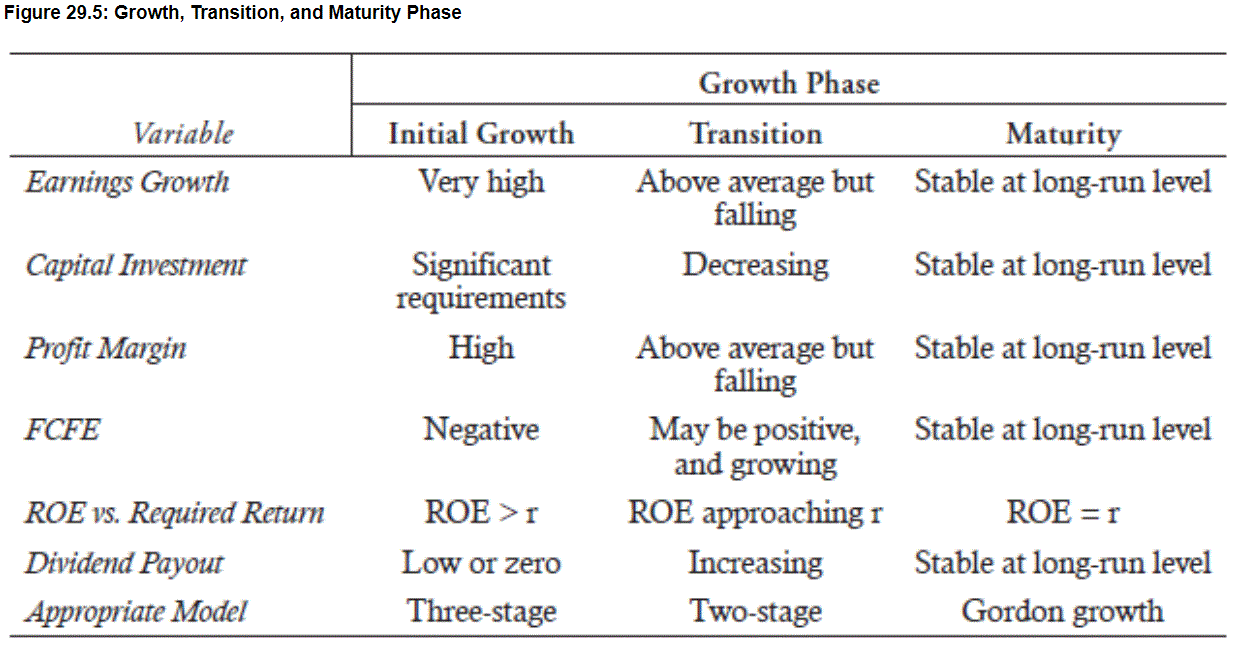
Growth Transition and Maturity Phase
Firm value and equity value
- firm value = FCFF discounted at the WACC
- equity value = FCFE discounted at the required return on equity = firm value − market value of debt
Two approaches to forecast future FCFF and FCFE
- The first method is to calculate historical free cash flow and apply a growth rate under the assumptions that growth will be constant and fundamental factors will be maintained.
- The second method is to forecast the underlying components of free cash flow and calculate each year separately. In forecasting FCFE with the second method, it is common to assume that the firm maintains a target debt-to-asset ratio for net new investment in fixed capital and working capital.




