At around two months you can expect a child to be able to do the following
Physical
- Whilst laying on tummy, baby turns their head to the side
- Whilst laying on back, baby waves arms, legs and wiggles/squirms
- Briefly holds a toy when you place it in their hand
- Follows an object or person with both eyes
Communication
- Be able to make cooing sounds such as ‘aaah’, ‘gah’, ‘ooo’
- Baby smiles when spoken to
- When you talk to your baby, they make sounds back to you
- Cries when wet, hungry tired or wants to be held
- Eye to eye contact is deliberately maintained
- Turns to voices
At around four months you can expect a child to be able to do the following
Physical
- When laying on tummy, baby will hold their head straight up and look around
- When in a sitting position, baby will hold their head steady, without support
- Whilst laying on back, baby will bring hands together over the chest, touching their fingers
- When in a sitting position, baby should start to reach for a toy close by
- When baby has a toy in their hand, they will hold it whilst looking at it, waving it about and attempting to chew it
Communication
- When in front of a mirror, baby should smile or ‘coo’ at themselves
- Baby will be able to chuckle softly and/or laugh
- After you have been out of sight, baby will smile or get excited when they see you
- Baby will make sounds when looking at toys or people
- Baby will be able to make high pitched squeals
At around six months you can expect a child to be able to do the following:
Physical
- Baby will roll from their back to their tummy
- Baby will be able to sit up with support
- Baby will be able to get into a crawling position
- Be able to grasp a toy using both hands at once
- Reach a small object using their finger and pick it up using their thumb and all fingers
- Be able to pick up a small toy with one hand and pass it to the other
- Plays with feet when laying on back
Communication
- Holds hands up to be lifted
- Makes sounds like ‘Da’, ‘ga’, ‘ka’
- Squeals and laughs
- Likes to look at themselves in a mirror
At around nine months you can expect a child to be able to do the following:
Physical
- Sits without support
- Can get into sitting position from lying down
- Will pull to stand and take weight on feet
- May crawl
- Rolls over both ways
Communication
- Copy simple sounds
- Babbles making different sounds e.g. mamma
- Baby will when asked ‘Give it to me’ or ‘Put it back’
- Recognises family members
- Clingy to familiar adults
- Has a favourite toy
At around twelve months you can expect a child to be able to do the following:
Physical
- Sits well and gets into sitting position alone
- Pulls to stand from sitting position and can sit down again
- Walks around furniture
- May crawl or bottom shuffle
- May stand alone
- Help turn the pages of a book
- Throw a small ball
- Be able to pick up a piece of string with first finger and thumb
Communication
- Points at objects
- Responds to own name
- When dressing, will hold out arm or foot to help
- Makes more meaningful sounds e.g. Mamma, Dadda
At around eighteen months you can expect a child to be able to do the following:
Physical
- Walks well
- Can walk upstairs holding an adults hand
- Can stack blocks on top of each other
- Turn the page of a book
- Put a small in their mouth, right side up
Communication
- Says several single words
- Recognises and points to parts of the body
- Enjoys nursery rhymes and tries to join in
- Obeys simple commands, such as ‘bring me your shoes’
At around two years old you can expect a child to be able to do the following:
Physical
- Tries to kick a ball
- Runs well
- Jumps with both feet leaving the floor at the same time
- Holds pencil by using thumb and first two fingers
- Can string small items such as beads, pasta onto a string
- Drinks from a cup with no lid
Communication
- Likes to pretend and role play
- Can name well known objects
- Correctly uses words like ‘I’, ‘Mine’ and ‘You’
- Will correctly put two – three words together
At around three years old you can expect a child to be able to do the following:
Physical
- Will walk on tip toes when shown
- Walks upstairs with alternate feet, still puts both feet on each step when coming down
- Catches a large ball
- Pedals a tricycle
- Climbs walls
Communication
- Can say own name, age and sex
- Can say numbers up to 10
- Pretend play is more vivid
- Plays with other children and takes turns
- Understands and uses ‘You’, ‘Me’, ‘I’
At around four years old you can expect a child to be able to do the following
Physical
- Walks up and down stairs using alternate feet
- Good on a tricycle
- Hops and stands on one foot
- Can throw, catch and kick well
- Draws a person with recognisable body parts eg head, arms and legs
- Uses a fork and spoon well
Communication
- Knows own first and last name
- Can sing several nursery rhymes
- Likes to listen to longer stories and will tell own stories
- Continues to ask lots of questions
- Takes turns and shares
- Shows sympathy to friends when hurt or upset
At around five years old you can expect a child to be able to do the following
Physical
- Can balance and stand on one foot for about 10 seconds
- Hops
- Dances
- Swings and climbs
- Slides down a slide
- Can now get dressed and undressed by self
Communication
- Speech is very clear
- Knows name, address and age
- Likes listening and telling stories
- May have best friend
- Sense of humour increasing
- Uses more imagination
- Shows more independence
Four main domains of development
- Gross motor
- Vision and fine motor
- Hearing, speech and language
- Social, emotional and behavioural
Importance of assessing development
- To help children achieve maximum potential
- Provide treatment promptly
- Act as entry point for the investigation, care and management of the child with special needs
When do developmental reviews take place?
- Newborn examination
- 6-8weeks
- 12 months
- 14-30 months
- 3-3.5 yrs
- 4-5 years - school entry hearing, vision, growth and health needs
*Every baby gets a red book with space to record development of the child
Normal age of walking
- Varies from around 11 months - 18 months
- Anything up to 18 months is normal
- Median age is 12 months
- Limit age is 18 months - 2 standard deviations from the mean
What are the limit ages for gross motor skills?
- Head control: 4 months
- Sits unsupported: 9 months
- Standing with support: 12 months
- Walking independently: 18 months
Warning signs: social, emotional and behavioural skills
- No smiling at 8-10 weeks
- Little interest in people and toys at 6m
- Persistent mouthing at 12m
- No symbolic play 2-2.5y
- Not playing with peers at 3.5y
How to observe and assess a child’s development:
- Observe: start with typically developing children, observe play
- History: ask parents about milestones, ask about baby’s gestation and current age, do the parents have any concerns?
- Examination: use available toys to test 4 domains of development: gross motor, fine motor and vision, language and hearing and social
- Interpretation: consider the 4 domains of development, is the child achieving expected developmental progress in all areas or is development delayed?
Examples of standardised assessment tools for childhood development
- Schedule of growing skills
- Provides a rapid and reliable measure of child development through the assessment of nine key areas: Passive Posture, Active Posture, Locomotor, Manipulative, Visual, Hearing and Language, Speech and Language, Interactive Social and Self-Care Socia
- Denver charts
- Assesses child’s development relevant to age - draw a ling up from their age, indictaes what child should be able to do
- Griffiths scales
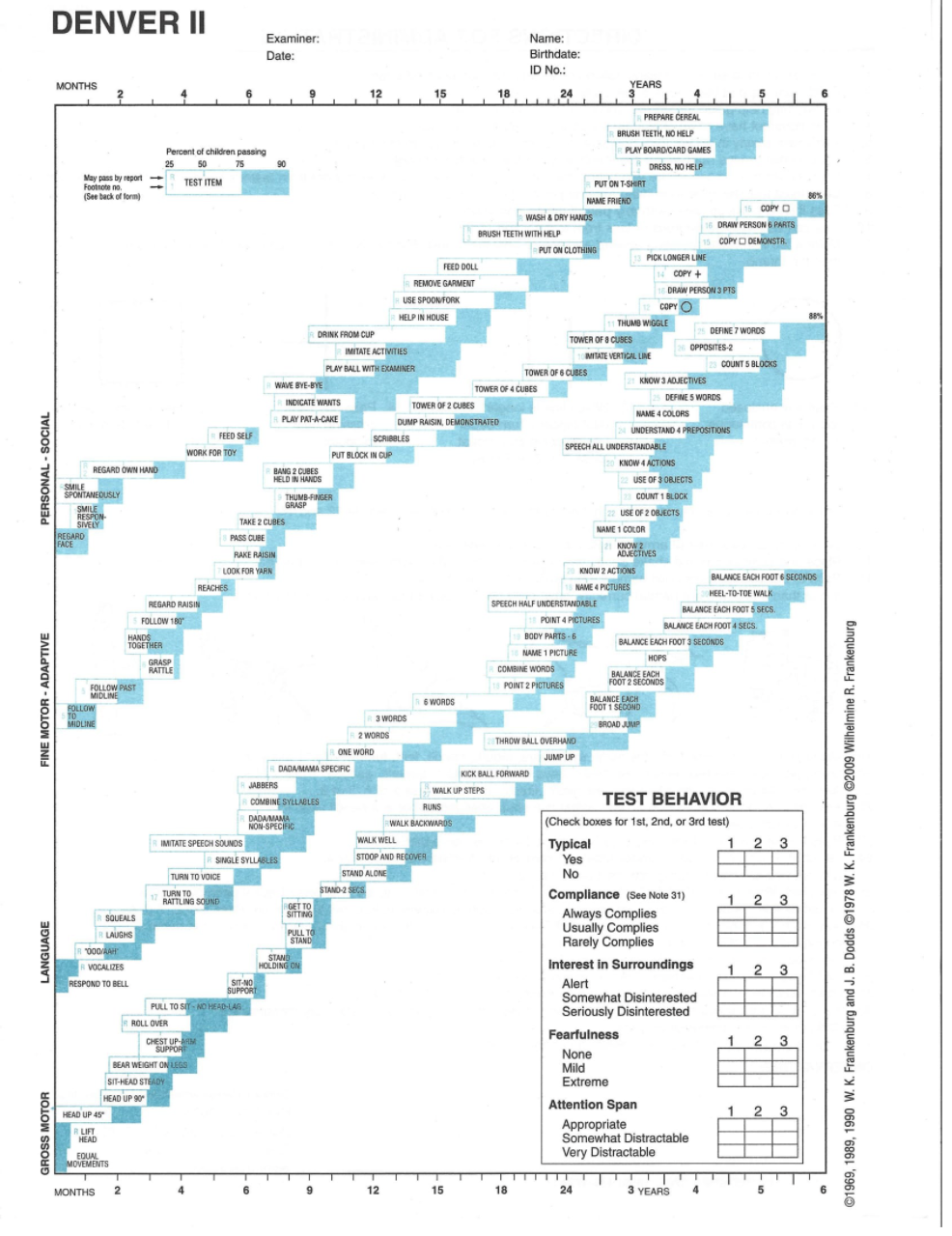
During the first year of life, which developmental domain shows the most dramatic changes?
Gross motor
Severe or moderate global delay may be first noticed because the child is slow to sit, roll, crawl and walk but the sequence of these events will occur in the normal order
List the endocrine glands
- Hypothalamus, pituitary, thyroid, pineal, parathyroid, adrenal, pancreas and gonads
- Endocrine disorders can arise as a consequence of excessive or insufficient levels of a hormone
Definition of short stature
- Defined as a height which is more than 2 standard deviations below the mean compared with others of the same age and sex i.e. blow 3rd centile on growth chart
- Or a height that is >3centiles below the mid parental height centile
- Often referrals are made but there is a pathological cause in a minority of cases
Causes of short stature
- Most often the cause if familial short stature or delay in growth and puberty but can be a presenting feature of an endocrine disease, any chronic disease or genetic condition that affects growth
Causes of short stature based on age group
- Babies/ young children: IUGR, nutritional deficiency or poor intake, chronic illness e.g. significant CHD, neglect/ abuse
- Adolescents
- Constitutional delay of growth and puberty
- All ages
- Familial, chronic illness, coeliac, hypothyroidism, growth hormone deficiency/ hypopituitarism, chromosomal e.g. Turner’s, skeletal dysplasia e.g. achondroplasia, iatrogenic e.g. steroid use
Clinical features of short stature
- Familial short stature – children are otherwise healthy
- Those with constitutional delay are also healthy – growth chart will show reduced growth velocity between 6 months – 3yrs which may normalise during childhood but growth velocity is then slowed again during early adolescence
- Pathological short stature – clinical findings depend on cause
Investigations and diagnosis of short stature
- Diagnosis
- Familial cause is diagnosed clinically based on hx and examination and growth measurements and plotting of mid-parental height
- Constitutional delay is also clinical diagnosis
- Investigations
- Not indicated in a healthy child if the hx suggests a familial cause
- Important to measure parents for yourselves – men often over report
- Imaging
- X-ray of left hand to ascertain bone age
- Bloods
- Abnormal FBC, renal function tests or inflammatory markers suggests chronic disease
- Screen for coeliac and TFTs should be done
- Karyotyping for Turner’s
- Growth hormone stimulation test to rule out growth hormone deficiency
- Random GH measurement is not useful because release is pulsatile


-
Neonatal period155
-
Elimination problem84
-
Abnormal gait/ posture99
-
Collapse and seizures12
-
Examination of a child15
-
Head injury1
-
Failure to gain weight or height29
-
Breathing difficulties48
-
ENT conditions8
-
Abdominal pain6
-
Urogenital disorders74
-
Child with chronic condition35
-
Developmental delay, behavioural disorders and learning difficulty121
-
Childhood cancers40
-
Fever21
-
Allergies, immunodeficiency and infection46
-
Community child health27
-
Haematological conditions15
-
Paediatric cardiology62



