Olecranon Bursitis
Definition:
- Filling of the subcutaneous bursa of the elbow with blood or serous fluid
Aetiology:
- Trauma, Inflammation, Infection, Prolonged leaning on the elbow, Acute or chronic onset
Epidemiology:
- More common in males aged 30-60 years
- Incidence largely unknown
- 0.01%-0.1% of hospital admissions
- Post-traumatic olecranon bursitis is the most common form
Risk Factors:
- Gout – Rheumatoid arthritis – Previous or repetitive trauma – Obesity – Immuno-suppression
Clinical Symptoms:
- Swelling over the tip of the elbow persisting for several hours to days
- Pain, however the lump may be painless
- Fever in 50% of cases of septic bursitis:
- An abscess and pus may form over the area
- Erythema can be present in both septic and non-septic forms of bursitis
- Residual lumps post swelling
Physical Assessment:
- Notable swelling
- Palpable mass of varying tenderness
- May contain firm nodules
- May be red, and hot upon palpation
- Measure dimensions to track progress
- Mild flexion restriction in AROM and PROM
- Pain on palpation and AROM and PROM (Flexion)
- Otherwise unremarkable
Distal Biceps Tendinopathy
Occurs on a spectrum of degeneration:
- Tendinitis, tendinosis, partial tear, rupture
- Changes include:
- Hypertrophic change of the radial tuberosity
- Abrasion of the tendon
- Bicipital bursitis
The current literature supports the concept of distal biceps tendinosis as one of the chronic enthesopathies of middle age
Mechanism of Injury:
- Repetitive flexion or supination
Aetiology:
- Acute or chronic onset
- Lifting
- Throwing:
- Repetitive hyperextension and pronation
- Forceful eccentric contraction
Clinical Presentation:
- Dull ache
- Gradual onset
- Localised tenderness:
- Distal belly
- Bicipital insertion
- Radial tuberosity
- Pain may radiate distally or proximally
- Flexion contracture
- Weakness with flexion or supination
Differential Diagnosis:
- Biceps tendon rupture
- Cubital bursitis
- Brachioradialis Tendonitis
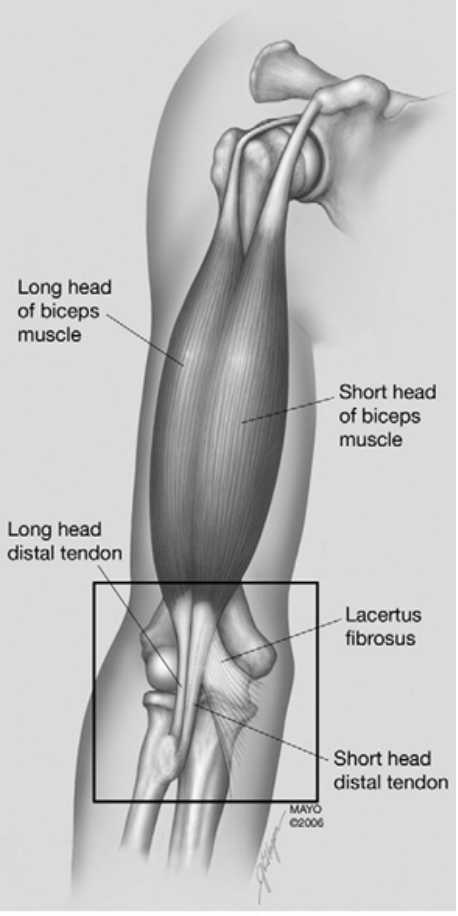
Distal Biceps Avulsion/Rupture
Definition: Catastrophic disruption of the biceps tendon or the insertion of the biceps into the radial tuberosity
Epidemiology:
- Rare, accounting for only 3% to 12% of all biceps tendon injuries:
- 1.2 per 100,000 people, the dominant arm being affected 86% of the time
- Average age of patients is 50 years old with an age range of 18 to 72 years of age
Aetiology:
- Irregularity of the radial tuberosity
- Radial bursitis
- Hypovascularity
- Steroid use
- Body builders
- Smoking
- Loaded eccentrically from a flexed to extended position
Clinical Features:
- Sudden episode of severe pain while performing a forced eccentric contraction in the anterior elbow
- Painful ‘pop’ or ‘snap’ in the region of the elbow
- Immediate loss of elbow flexion power or even pseudo-paralysis
Physical Assessment:
- A palpable defect or emptiness of the antecubital fossa
- Ecchymosis on the medial aspect of the elbow that may extend proximally and distally:
- An intact lacertus fibrosus may confine the hematoma and thus prevent ecchymosis formation
- Proximal migration of the biceps musculo-tendinous unit
- +ve Biceps Hook Test
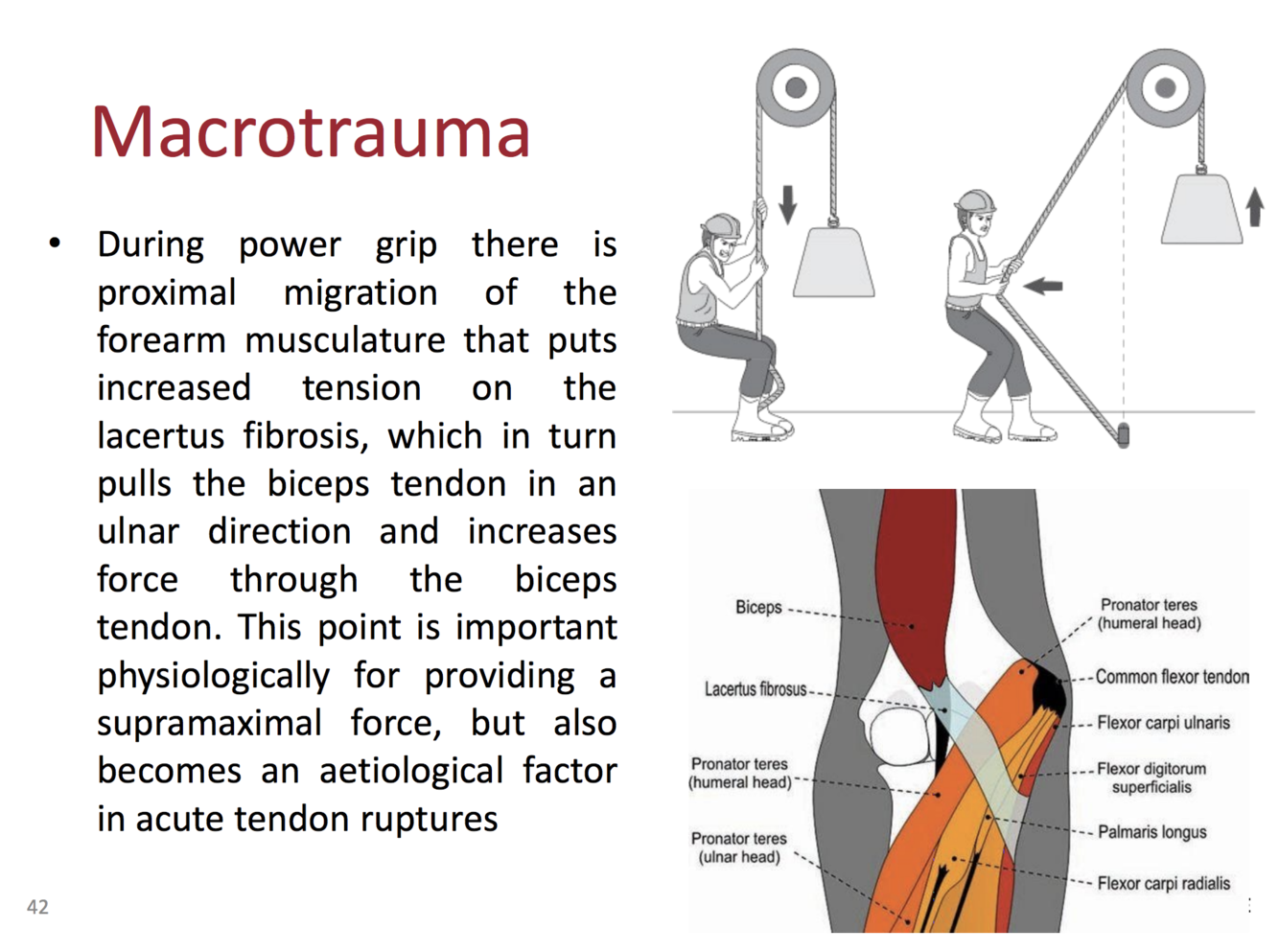
Distal Triceps Tendinopathy
Also referred to Triceps enthesopathy
Mechanism of Injury:
- Overuse and forceful elbow extension or hyperextension:
- Elbow extension and supination:
- e.g. Tennis backhand, serve or overhead shot
- Elbow extension and supination:
- Occurs on a spectrum of tendinopathy
- Olecranon spurring may also be present
Clinical Presentation:
- Pain localized to the triceps insertion
- Pain with activities that require elbow extension
Physical Examination:
- Pain on palpation over the triceps insertion
- ROM is typically preserved
- Pain on resisted elbow extension and passive flexion
Differential Diagnosis:
- Olecranon bursitis
- Olecranon stress fracture
- Fracture of an olecranon osteophyte
- Partial tendon tear
Distal Triceps Rupture/Olecranon Avulsion
Triceps tendon can rupture from its attachment at the olecranon process or the olecranon can avulse from the ulnar
Epidemiology:
- Least common of all tendon ruptures
Aetiology:
- Most commonly FOOSH, elbow extension
- Most commonly insertional
- Observed associations:
- Body building
- Anabolic steroid use
- Hyper-parathyroidism
- Renal osteodystrophy
- Olecranon bursitis
- Osteogenesis imperfecta
- SLE
- Marfan’s Syndrome
- Local corticosteriod injections
Clinical Presentation:
- Pain at insertion of the triceps
- Pain with active arm extension in cases of partial avulsion/rupture
- Swelling and bruising on the posterior arm
Physical Assessment:
- Palpable defect
- Weakness/pain with elbow extension
- Ecchymosis and swelling posterior arm
- +ve Triceps squeeze test
Differential Diagnosis:
- Triceps tendonitis
- Olecranon bursitis
- Olecranon stress fractures
- Posterior elbow impingement
Snapping Triceps Tendon
A sensation caused by a portion of the triceps mechanism slipping medially or laterally:
- May be confused with subluxation of the ulnar nerve over the medial epicondyle of the humerus on flexion and extension of the elbow
Aetiology:
- Abnormal medial or lateral triceps insertion (therefore often B/L)
- An aberrant triceps tendon (fluid accumulation)
- Cubitus varus and is typically present with concurrent irritation of the ulnar nerve
Clinical Presentation:
- Usually posteromedial pain and crepitation
- Aggravating factors
- Overhead activities
- Push-ups
- Resisted flexion and extension of the elbow
Lateral Epicondylopathy
Overuse syndrome of the extensor tendons of the forearm:
- Colloquially called ‘tennis elbow’
Epidemiology:
- Common
- No gender predilection
- Incidence:
- 1-3% of the general population
- Peaking between 30 and 50 years
- Most commonly in the dominant arm
- Prone to chronicity:
- Natural course 12-24 months
Aetiology:
- History of repetitive work or recreational activity:
- Wrist dorsiflexion with pronation and supination
- Occupations requiring prolonged computer work or heavy loads or tools
- Inexperienced racquet- or stick-sport athlete:
- Concentric forces on the tendon causing microtears and inflammation
Clinical Presentation:
- Patients complain of lateral elbow pain localized to the lateral epicondyle and the common extensor tendon or just distal to it
- Patients may complain of pain on grasping movements
- Possible referred pain down the extensors
Physical Assessment:
- Symptoms reproduced by:
- Resisted wrist extension / forearm supination (Cozen’s test)
- Passive wrist flexion and pronation (Mill’s test)
- Resisted middle finger extension (Middle finger sign)
- Elbow ROM is typically unaffected
- Reduced grip strength due to pain
Differential Diagnosis:
- Radial n. entrapment
- OCD of the capitellum
- Radiocapitellar arthritis
Medial Epicondylopathy
Commonly referred to as ‘Golfer’s elbow’
Repetitive stress of the flexor-pronator group causing degenerative changes at the common flexor tendon at the medial epicondyle
Aetiological factors:
- Direct-blow
- Eccentric overload
- Wrist pronation and flexion or repetitive valgus overload
- Common in:
- Golf players
- Throwing athletes
- Manual work (hammer use)
Epidemiology:
- Less common than lateral epicondylopathy
Clinical Presentation:
- Localized tenderness:
- Anterior tip of anteromedial epicondyle
- Pain can be localised to 2cm distal along PT or FCR
- Can have associated ulnar neuropathy
Physical Assessment:
- Localized pain and swelling over the tendon or site of origin
- Pain on resisted wrist flexion and pronation
- Pain on passive wrist extension and supination
- Possible pain on elbow valgus stress tests
- Postive Test for medial epicondylopathy
Radial Nerve Entrapment
Radial Nerve:
- Terminal branch of the posterior cord of the brachial plexus (C5, C8, T1)
- Motor supply (elbow):
- Triceps
- Aconeus
- Brachioradialis
- Lateral half or brachialis
- Two branches:
- Superficial sensory branch
- Deep motor branch (Posterior interosseous n.)
Epidemiology:
- Uncommon
Aetiology:
- Tumour, humeral fracture, crutches, sleeping outstretched/hyperabducted:
- Saturday night palsy
Clinical Presentation:
- Sensory loss
- Motor loss:
- Wrist drop
Radial Nerve Entrapment - Proximal Humerus
Epidemiology:
- Most common form of radial n. entrapment
Aetiology:
- Commonly fibrous arcade and spiral groove
- Repetitive forceful arm movements
- Forceful adduction of GH:
- Gymnastics
- Wrestling
- Running
- Throwing
- Fracture/dislocation of the humerus
Clinical Features:
- Motor and sensory symptoms in the radial nerve distribution
Radial Nerve Entrapment - Radial Tunnel
The radial tunnel extends from the level of the radiocapitellar joint to the level of the proximal aspect of the supinator muscle
Aetiology:
- Compression by fibrous bands of brachioradialis
- Trauma to the humerus or radial head
- Inflammation associated with lateral epicondylopathy
Clinical Features:
- Pain and weakness on resisted supination
- Positive middle finger sign
- Pain on resisted wrist extension
- Possible sensory change
- Motor weakness uncommon
- Night pain
- Burning pain along the lateral aspect of the forearm that can mimic lateral epicondylopathy
Posterior Interosseous Nerve Entrapment - Arcade of Frohse
The arcade of Frohse is the fibrous arcade between the deep and superficial branches of the supinator muscle
Aetiology:
- Thickened tendinous edge of the supinator muscle, most likely due to repetitive pronation and supination movements
Clinical Presentation:
- Weakness in wrist, finger, thumb extension:
- Partial paralysis
- Pain about the supinator origin
- No sensory loss
Superficial Radial Nerve Entrapment
Also known as Cheiralgia paresthetica or Wartenberg disease
Aetiology:
- Crush or twisting injuries of the forearm
- Compression from wrist bands, casts or even handcuffs
Clinical Features:
- Pain or burning over the anatomical snuff box and the back of the hand
Ulnar Nerve Entrapment - Proximal Humerus
Subscapularis
Arcade of Struthers:
- Intermuscular septum of triceps
- Hypertrophy compression
Aetiology:
- Direct compression
- Humeral fracture
Clinical Presentation:
- Pain
- Paresthesia in the fifth and half of the fourth finger
- Motor weakness in fourth and fifth finger flexors
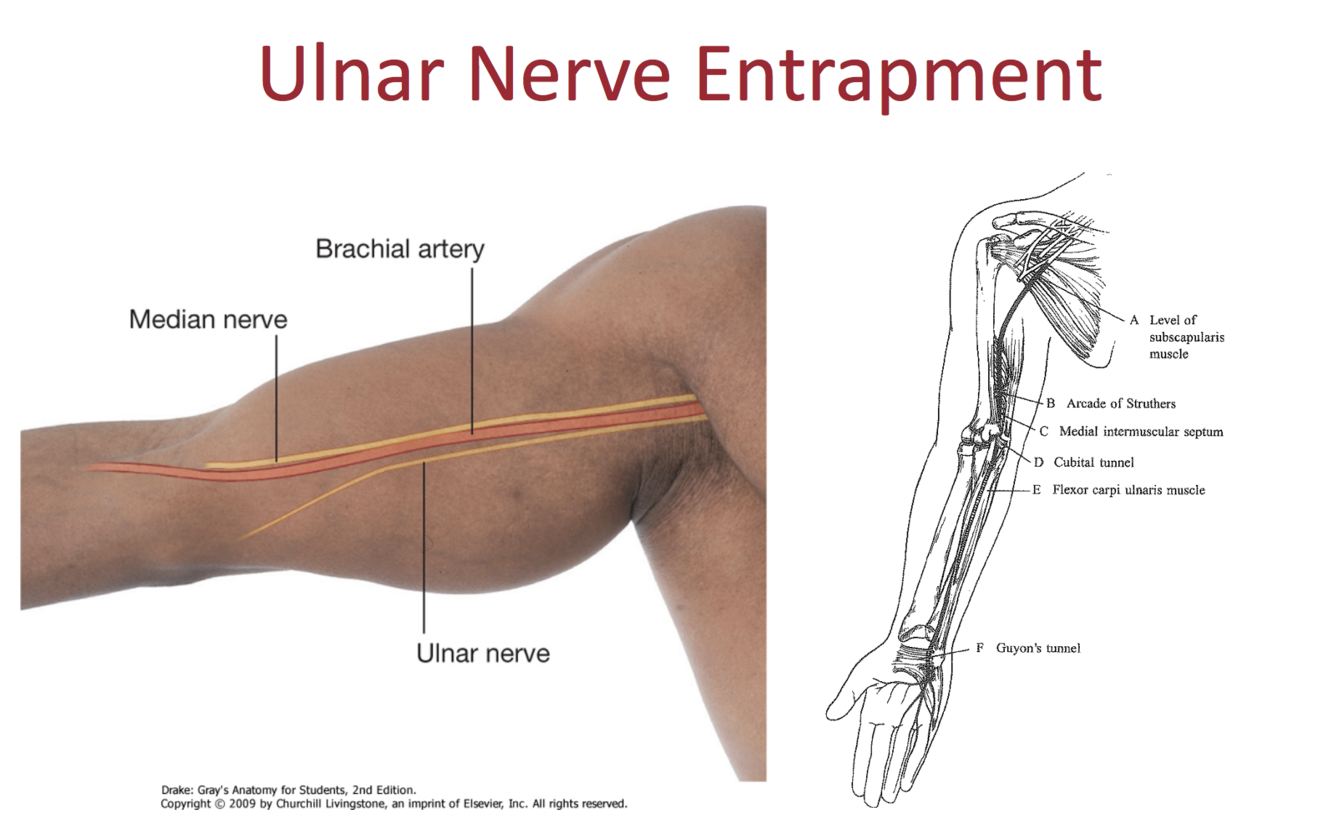
Ulnar Nerve Entrapment - Cubital Tunnel
Aetiology:
- Occupations that involve elbow flexion
- Acute trauma
- Overuse injury
- Bony spurring
- Dynamic compression:
- Ulnar nerve subluxation
- Cubitus valgus deformity
- Snapping medial triceps tendon
Clinical Presentation:
- Pain and aching at the medial elbow
- Paresthesia in the fifth and half of the fourth finger
- Motor weakness in fourth and fifth finger flexors
- Chronic compression can lead to claw deformity
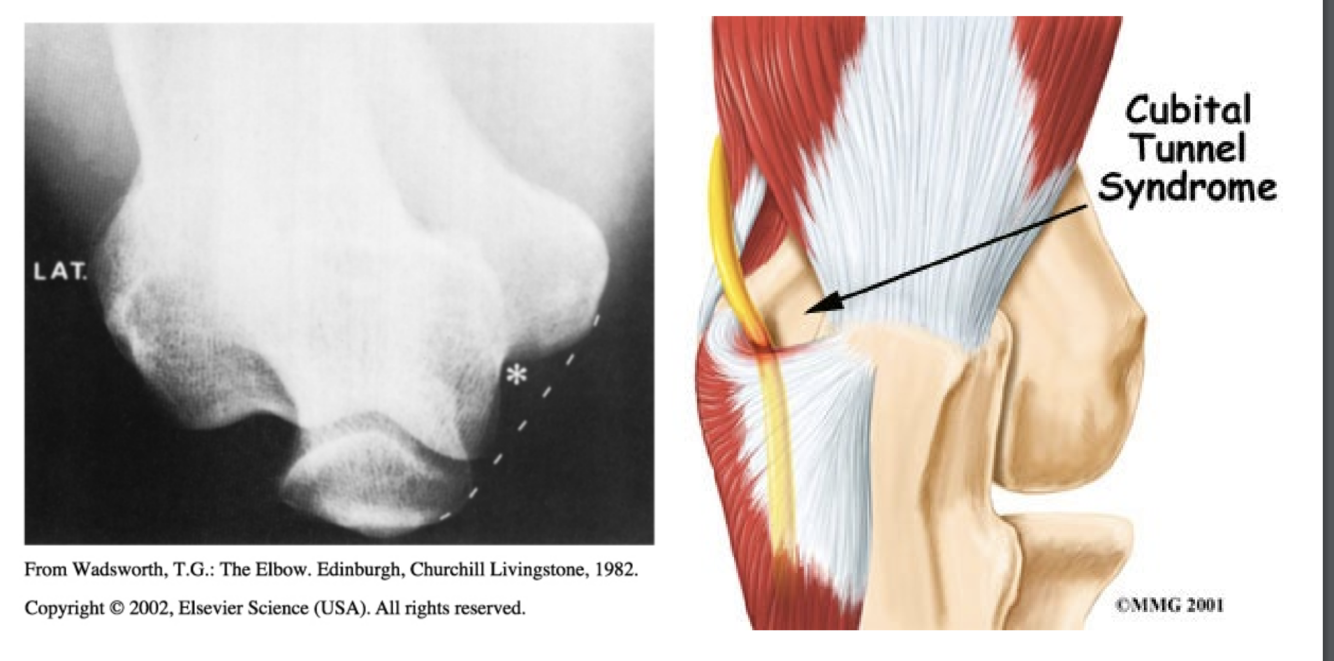
Median Nerve Entrapment – Proximal Humerus
Location:
- Infra-clavicular entrapment
- Subscapularis
- Ligament of Struthers
Aetiology:
- Fibrous adhesions
- Thickening of fascia and ligaments
- Vascular events
- Fractures
- Biceps hypertrophy
Median Nerve Entrapment - Elbow
Location:
- Antecubital fossa:
- Lacertus fibrosus
- Pronator Teres muscle:
- Proximal edge of flexor digitorum superficialis
Aetiology:
- Fibrous edges of muscles
- Hypertrophy
- Masses, SOL or contusions in the forearm
- Dynamic compression by repetitive supination/pronation
- Congenital anomalies
- Conditions that lead to enlargement of tissues within various tunnels and spaces e.g. hypothyroidism
Clinical Presentation:
- Pronator Teres syndrome:
- Pain and paresthesia in the median nerve distribution that may mimic carpal tunnel syndrome
- Symptoms aggravated by overuse of pronator teres
- Symptoms are not typically worse at night as with carpal tunnel syndrome
- Anterior Interosseous Nerve syndrome:
- Neuritis of unknown origin
- Motor weakness:
- Inability to pinch the thumb and index finger together (Pinch grip test):
- Palsy of flexor pollicis longus and flexor digitorum profundus
- Inability to pinch the thumb and index finger together (Pinch grip test):
Physical Examination:
- Pronator Teres Syndrome:
- Sensory deficit in the median nerve distribution
- Pain on resisted pronation of the forearm that is worsened with elbow extension
- Tinel’s sign at the carpal tunnel is typically negative
- Test for pronator teres
- AIN Syndrome:
- Positive Pinch grip test
Elbow Sprains
- The elbow is stabilized by the locking of the olecranon process in its fossa when the joint is extended
- Strain can occur when the elbow is in the flexed position
- Valgus or varus forces are dissipated through the collateral ligaments:
- Valgus stresses are the most common cause of injury
- Tensile forces on one side of the joint result in compressive forces on the opposite side
Ulnar Collateral Ligament Injury
History:
- Trauma:
- Macro (less common)
- Micro – Valgus loading of the humeroulnar joint
- Repetitive valgus overload
- Throwers late cocking & acceleration
Predisposing Factors:
- Internal rotation (Sh°) deficits (GIRD) in the throwing athlete
- Cubitus varus
Clinical Presentation:
- Pain on the medial aspect of the elbow
- Gradual onset in cases of micro trauma
- Worse with motion
- Radial nerve compression can cause neuropathic pain into the forearm and fingers
- Tensile forces on the ulnar nerve can cause paresthesia in the ulnar nerve distribution
Physical Examination:
- Swelling over the anteromedial and posterior aspects of the elbow
- Ecchymosis over anteromedial aspect of the elbow
- Tenderness around medial elbow (2cm inferior from the medial epicondyle)
- Crepitus may be present
- Restricted ROM due to pain and stretching of muscles and ligaments especially in flexion
- Painful active wrist flexion
- Pain on end range supination and extension
- Passive wrist extension is painful at end range
- Decreased strength of wrist flexors
- Possible muscle weakness or sensory changes (radial or ulnar neuropathy)
- Positive valgus stress test (>10-25°) – Positive moving valgus stress test
Neurological Screening:
- Ulnar sensory or motor changes
- Possible radial sensory or motor changes
- Possible +ve Tinel’s sign at the elbow:
- Radial n.
- Ulnar n.
Functional Assessment:
- Decreased velocity in throwing athletes
- Pain and discomfort during various phases of throwing
DDx:
- Pronator m. strain
- Supinator m. strain
- Ulnar neuropathy
- FCR m. strain – FCU m. Strain
- Flexor avulsions
- Medial epicondylopathy
Valgus Extension Overload Syndrome (VEOS)
Impingement of the posteromedial olecranon on the medial wall of the olecranon fossa:
- Also known as posteromedial impingement syndrome
History:
- Preceded by MCL injury/insufficiency
- Common in throwing athletes, but also in swimmers, gymnasts, volleyball and racket sports
- Valgus stress, radiocapitellum compression
Clinical symptoms:
- Pain at the medial aspect of the olecranon that is usually present at the acceleration and deceleration phase of throwing
- Limited extension
- Locking, crepitus, catching from loose bodies and osteophytes or chondromalacia
- Ulnar nerve irritation
Physical Examination:
- Tenderness over MCL, joint line and the posteromedial tip of the olecranon process
- Reduced extension:
- Flexor contracture
- Positive Valgus stress test (>10-25°)
- Positive Valgus extension overload test
- Positive moving valgus stress test
- Potential ulnar and/or radial neuropathy
Functional Assessment:
- The location of pain during various movement is a very important diagnostic clue
- Medial pain at the start of the acceleration phase
- UCL injury
- Posterior pain at full extension
- VEOS
Differential Diagnosis:
- Triceps tendinopathy
- UCL lig. Injury
‘Little Leaguer’s Elbow’
Term used to describe several overuse injuries in young throwing athletes that commonly result from valgus overload
History:
- Repetitive valgus stress in skeletally immature individuals
- Inadequate intervals of rest
- Poor throwing mechanics
- Use of breaking pitches
- Common in pitchers and quarterbacks
- Stresses occur during the cocking and acceleration phases
Clinical Symptoms:
- Medial elbow pain during cocking and acceleration phases of the throw
- Possible referred pain into the flexors and pronators
- Potential ulnar neuropathy
Predisposing Factors:
- Altered shoulder or scapula biomechanics
- Poor throwing stance
- Skeletal immaturity
- High throwing frequency
- Position played
- Strength and flexibility imbalances
- Type of throwing activities
Physical Assessment:
- Pain at the medial and posteromedial elbow (tensile forces)
- Pain at the lateral elbow (compressive forces)
- Increased flexor/pronator tone
- Possible crepitus/clicking/locking
- Flexor contracture
- Reduced grip and flexor strength
- Pain on end-range wrist extension, elbow pronation and extension
- Pain with resisted pronation
- Pain with valgus stress usually without instability
Differential Diagnosis:
- Flexor/pronator m. strain/tear
- Olecranon/capitullum/epicondylar fracture
- Valgus extension overload syndrome
- Lateral epicondylopathy
- Medial epicondylopathy
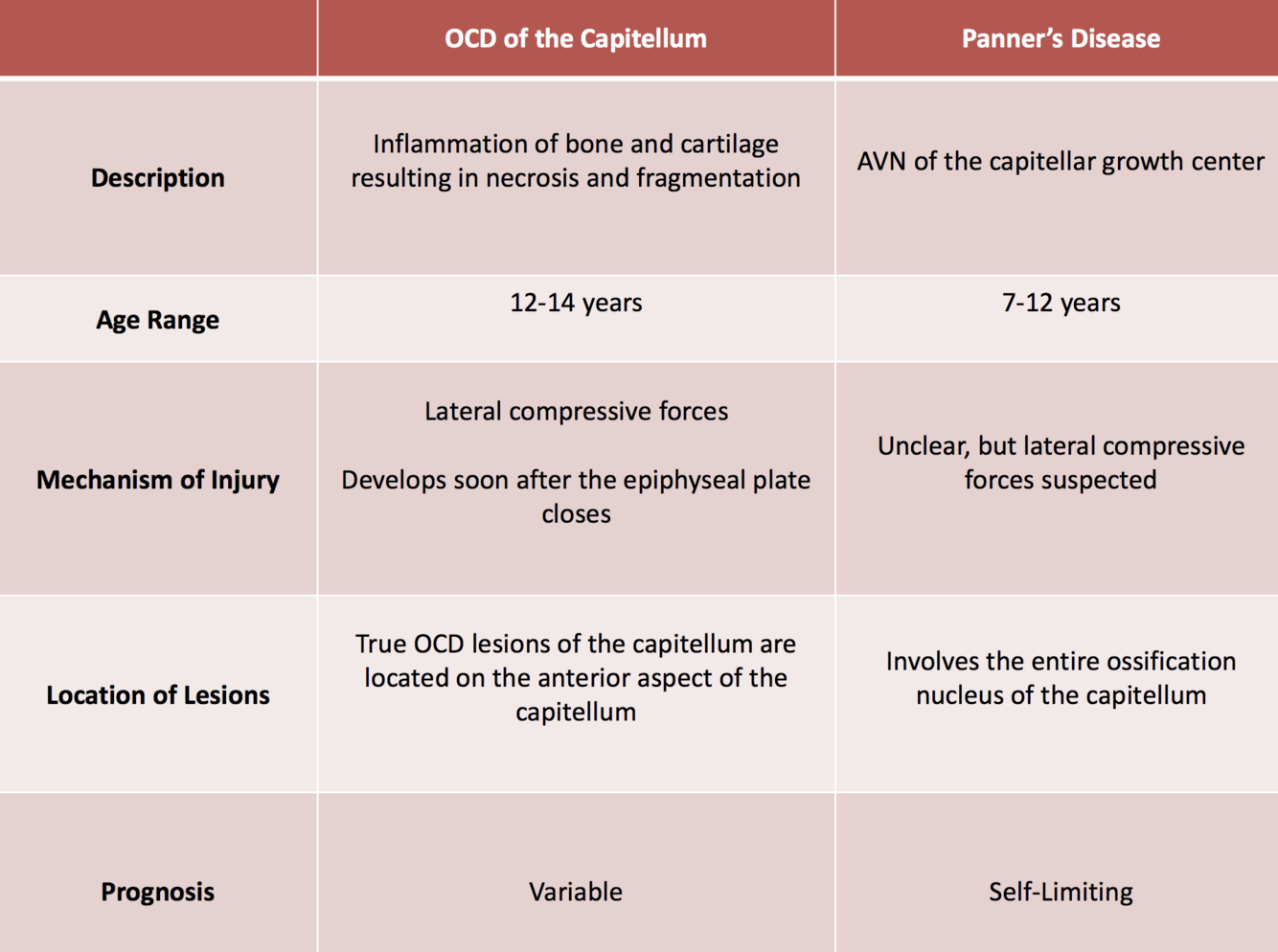
Panner’s Disease
Panner’s Disease is characterized by necrosis and subsequent regeneration of the capitellar ossification centre
- An osteochondrosis of the epiphyseal region of the humerus
History:
- May be directly related to trauma or to changes in the circulation to the entire capitellar growth centre
- Panner’s disease is the most common cause of lateral elbow pain in the young child and is typically seen in patients younger than 10 (6-15 years)
Aetiology:
- Thought of as the Legg-Calve Perthes’ disease equivalent of the elbow
- Thought to be secondary to valgus forces at the elbow compromising the blood flow to the capitellar ossification centre
- More commonly seen in males
- The condition tends to be self-limiting
Clinical Symptoms:
- Pain (dull ache)
- Swelling over the lateral elbow
- Limitation of range of motion in a non-capsular pattern of restriction:
- Particularly flexion
- Sometimes locking, crepitus, or clicking
- Possibly joint effusion
- Always in the dominant elbow
Differential Diagnosis:
- OCD of the capitellum
- Lateral epicondylopathy
Radiocapitellar Overload Syndrome
Radiocapitellum Function:
- Secondary stabiliser to valgus stress after the MCL
- Transfers axial loads during pushing movements
Repetitive compressive forces to the radiocapitellar joint can result in excessive radial head abutment against the capitellum:
- Chronic, repetitive radiocapitellar joint force may result in chondromalacia, followed by cartilage and bony degeneration
Clinical Features:
- Lateral elbow pain in athletes or manual workers who perform repetitive overhead or pushing activities
- MCL deficiency
Radial Head and Neck Fractures
The radio-capitellar articulation takes more than half of the load transmitted across the elbow joint
Greatest axial loads are placed on the radiocapitellar joint with 0-30° extension and pronation of the forearm
Mechanism of injury is usually FOOSH incidents
Epidemiology:
- Represent 1% of all childhood fractures
- Most involve the physis and/or the neck
- Most are Salter-Harris Type IV #s in children
- Radial head fracture is the most common elbow fracture in adults
- Most fracture’s are extra-articular in adults
- Women 2:1
- Age 30-40 years
Concomitant injuries occur in up to 60% of radial head and neck fractures:
- Olecranon fractures
- Medial epicondyle avulsions
- Dislocations
- Terrible triad of the elbow
- Dislocation of the elbow with LUCL injury combined with radial head and coronoid fractures
Classification:
- Group 1:
- Primary displacement of the radial head
- Group 2:
- Primary displacement of the radial neck
- Group 3:
- Stress injuries
Clinical Presentation:
- Localized pain
- Swelling
- Reduced movement at the elbow
Physical Examination:
- Joint effusion
- Antalgic position
- Possible displacement of bony structures
- Severe pain could indicate possible compartment syndrome:
- Radial nerve
- Posterior Interosseous nerve (PIN)
- Brachial a., radial a. and ulnar a.
- Pain and tenderness over the radial head or neck
- Reduced and painful pronation and supination
- Possible crepitus or locking
- Often restricted due to haematoma
- Assess the wrist as the distal radioulnar joint is often involved
Associated findings:
- MCL, LCL, interosseous membrane disruptions
- Dislocations
- Fractures of olecranon and coranoid process






