Scapula Dyskinesis
Defined as observable alterations in scapular position/motion in relation to thoracic cage
- Premature or excessive elevation or pronation
- Stuttering or jogging movements
- Excessive winging or tilting
Dyskinetic patterns and abnormal resting positions are observed with arms at rest and in motion. These patterns can fall into four categories:
- Type 1 = prominence of inferior medical scapular boarder – transverse and horizontal plane
- Type 2 = prominence of entire medial border – vertical and frontal plane
- Type 3 = superior translation pf the entire scapular and prominence of the superior medial scapular boarder
- There is a shoulder shrug to initiate abduction of the shoulder
Type 4 = normal scapula positioning and normal motion
Visceral Sources of Shoulder Pain
- This is shoulder pain that is not aggravated by movement with deep, poorly localised pain and no neurological signs
- Heart = refers to anterior/superior shoulder and neck
- Liver = refers to right shoulder (anterior/superior/lateral)
- Gall Bladder = refers to right shoulder, scapular areas
- Diaphragm = refers to C4/C5 dermatome bilaterally
- Lungs = refers to shoulder
Pancoast Tumour
- Uncommon for of lung cancer that is <5% of all bronchogenic tumours
- Occurs in the upper apex of the lungs
- can infiltrate subclavian vessels, spine, brachial plexus, cervical sympathetic plexus and ribs
Clinical Presentation
- Chronic C8/T1 radiculopathy
- Progressive
- Medial arm and hand pain
- Weakness in ulnar nerve distribution
- Atrophy of the intrinsic hand muscles
- Possible Horner’s syndrome
- Ptosis, mitosis, anhidrosis
- Supraclavicular swelling
Transient Brachial Plexopathy
- Also, knowns as a stinger or burner
- Transient, unilateral injury to the cervical nerve root/s or the brachial plexus
- Patients presents with an inability to move the involved upper extremity following a high energy collision and another player
- Most common at C5-C6 level
Mechanism
- Stretch or Traction increasing acromio-mastoid distance
- Compression within IVF decreasing acromio-mastoid distance
- Contusion from direct blow to Erb’s point
Clinical Presentation
- Cradling or elevation of the arm for anti-tension purposes
- Bakody’s sign
- Slightly flexed posture in cervical spine to lessen the pressure at IVF
- Unilateral electrical or burning type pain
- Pain/paraesthesia usually <5mins
- Weakness
- Symptoms may develop hours to days after the injury
Orthopaedic Tests
- Spurling’s manoeuvre
- Bakody’s sign
- Shoulder depression
- Tinel’s tap/Doorbell sign at Erb’s point
Entrapment Neuropathies of the Shoulder
- Nerve damage typically caused by extrinsic compression or by stretching during repetitive movements
- Clinically challenging to diagnose because of the vague and variable symptomatology
Nerve
Clinical Presentation
Long thoracic Nerve (ventral rami C5,C6,C7)
- Pain radiating from the neck to the arm
- Loss of shoulder protraction
- Prominent inferior angle of scapula
- Reduced active arm elevation
- Weak serratus anterior
- Scapula winging
Suprascapular Nerve (ventral rami C4,C5,C6)
- Can be compromised through the suprascapular notch affecting both supra and infraspinatus
- Spinoglenoid compromise will only affect infraspinatus
- Atrophy of supra/infraspinatus muscles
- Pain over posterior shoulder, aggravated by arm use
- Weakness in abduction and external rotation
- Positive painful arm 90-160 degrees
- Pain with contralateral neck rotation
- Pain increased in horizontal adduction
Axillary Nerve (ventral rami C5,C6)
- Usually after traction injury of GH joint, e.g. dislocation of shoulder
- Atrophy of deltoid
- Weakness in shoulder abduction and extension
- Positive extension lag sign
Quadrilateral Space Syndrome
- Neurovascular compression of the posterior humeral circumflex and/or the axillary nerve or one of its major branches in the quadrilateral space
Aetiology
- Commonly associated with trauma
- Humeral fracture or dislocation
- Cases of repetitive trauma in throwing athletes, tennis players and volleyball player
- Fibrotic band compressing neurovascular bundle
- Hypertrophied muscular boundaries
- Glenoid osteophytes
- Ganglion cysts
Clinical Presentation
- Atrophy of deltoid
- Pain and paraesthesia of military path distribution
- Non-dermatomal referral to forearm and hand
- Localised tenderness in the quadrilateral space
- Pain with adduction, external rotation and extension of shoulder
Acromioclavicular joint sprain
- Disruption of the acromioclavicular complex with possible inclusion of the coracoclavicular complex
- Trauma usually the cause
- Fall onto tip of shoulder
- Direct blow to adducted shoulder
- Fall onto outstretched hand (FOOSH)
Classifications
- Type I: AC ligament and capsule sprain
- Type II: Disruption of AC ligament and capsule + coracoclavicular ligament sprain
- Type III: Disruption of both AC ligament and capsule and coracoclavicular ligaments
- Type IV-VI: Same as type III with ectopic clavicle location
Clinical Presentation/Physical Assessment
- Localised pain in the AC region
- Painful motion particularly at end ranges
- Grade II or higher the scapular displaces downwards relative to the clavicle
- Grade II or higher the shoulder contour will display a prominent clavicle
- AC joint tender to palpation
- Pain on passive abduction from 90-180 degrees
- Pain on passive horizontal adduction
- +ve O’brain Test
The Rotator Cuff
The Rotator Cuff
- Made up of the supraspinatus, infraspinatus, teres minor and subscapularis
- They allow for greater movement of the GH joint by preventing bony structures coming in contact with each other creating impingement
- The rotator cuff muscle help maintain congruency in the GH joint increasing stability throughout movement
Subacromial Impingement Syndrome
- The compression of the rotator cuff against the inferior aspect of the acromion and the coracoacromial ligament
Neer’s Classification of Subacromial Impingement
- Type I: <25 years old, reversible, swelling, tendonitis, no tears, conservative treatment
- Moderate pain during exercise, no loss of strength and no limitation in movement. Edema and/or haemorrhage may be present. This stage generally occurs in patients less than 25 years of age and is frequently associated with an overuse injury. At this stage, the syndrome could be possibly reversible.
- Type II: 25-40 years old, Permanent scaring, tendonitis, no tears, subacromial decompression
- Pain is usually reported during ADL and especially during the night. loss of mobility is associated with this stage. Type II is more advanced and tends to occur in patients between 25 to 40 years of age. The pathological changes show fibrosis as well as irreversible tendon changes.
- Type III: >40 years old, result of continued mechanical compression of rotator cuff tendon, full or partial thickness tear, bicep lesions and bony alteration of the AC and acromion can be associated with this stage due to repetitive stress to the shoulder
Extrinsic and Intrinsic Classification of Subacromial Impingement Syndrome
- Primary Extrinsic are structural changes outside of the rotator cuff that cause narrowing of the subacromial space.
- Congenital deformation, osteophytic change, bony malposition
- Secondary Extrinsic are related to altered scapulothoracic kinematics, strength imbalances creating changes in the cantering of the humeral head during movement of the GH joint, GH instability
- Over developed prime movers of the GH joint (deltoid, traps) with weakness in the RC muscles
- Impingement more likely to occur at the coracoacromial space due to anterior translation of the humeral head
- Internal Glenoid Impingement is probably the most common cause of posterior shoulder pain in the throwing or overhead athlete. Caused by impingement of the articular surface (intra-articular) of the Rotator Cuff (posterior edge of the supraspinatus and the anterior edge of the infraspinatus) against the posterior-superior-glenoid and glenoid labarum. Mainly seen with repetitive overhead activities, this positioning becomes pathologic during excessive external rotation, anterior capsular instability, scapular muscle imbalance, and/or upon repetitive overload of the rotator cuff musculature. These deficiencies result in poor scapulohumeral control.
Clinical Presentation/Physical Examination
- Sudden onset of pain with tearing sensation
- Gradual increase in pain with overhead activities, possible SIS
- Location lateral, superior or anterior, can refer to deltoid
- Pain can be sharp, dull, catching, burning or throbbing
- Functional symptoms, sports or occupation specific
- Stiffness with decreased IR/ER or Abduction
- Positive PA and SIS tests
Causes of SIS
Primary
Secondary
- Increased subacromial loading
- Acromioclavicular arthrosis (inferior osteophytes)
- Coracoacromial ligament hypertrophy
- Coracoid impingement
- Subacromial bursal thickening and fibrosis
- Prominent humeral greater tuberosity
- Trauma (direct microtrauma or repetitive microtrauma)
- Overhead activity (athletic and nonathletic)
- Rotator cuff overload/soft tissue imbalance
- Eccentric muscle overload
- GH laxity/instability
- Long head of biceps tendon laxity/weakness
- Glenoid labral lesions
- Muscle imbalance
- Scapula dyskinesia
- Posterior capsular tightness
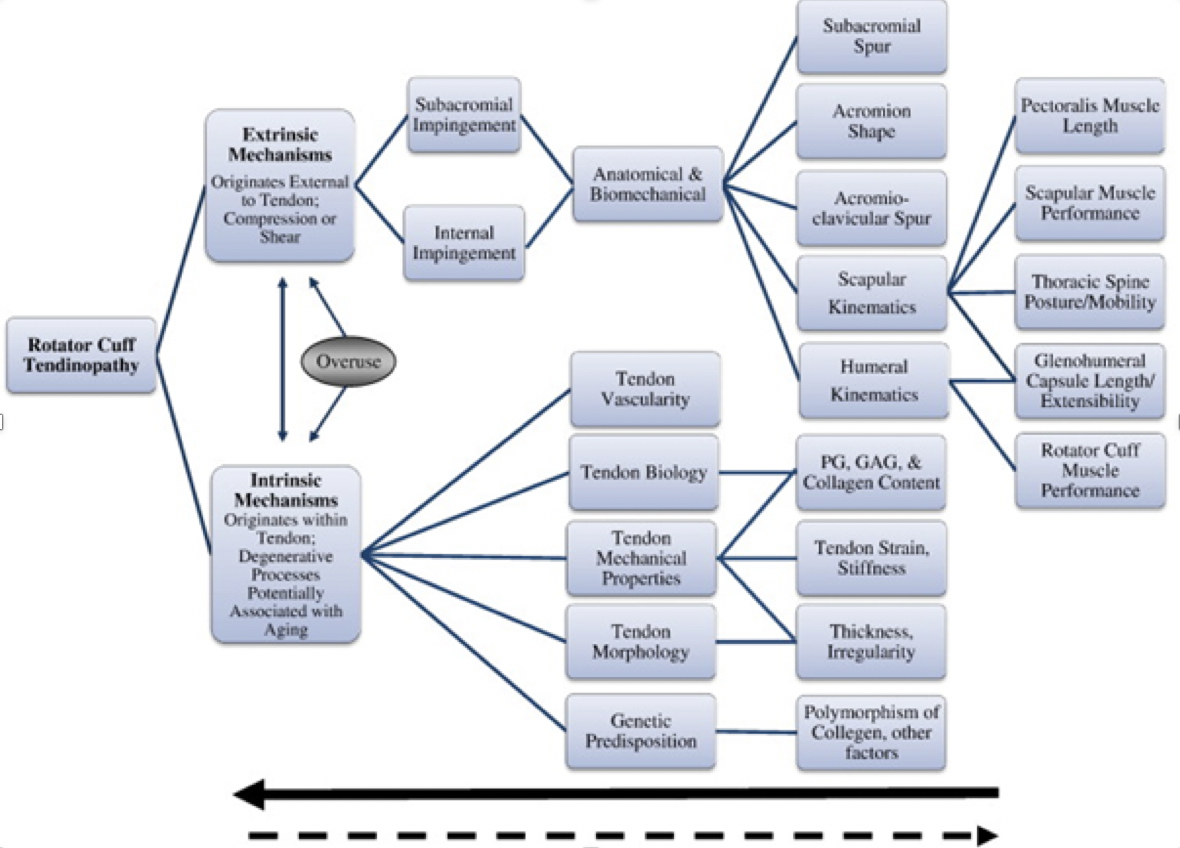
Rotator Cuff Tendinopathy
- Tendinopathy is term used to describe pain originating from a tendon, the pathology of the pain is caused by either tendinosis (degeneration) or tendonitis (inflammation)
- Tendinosis will be pain free typically but have weakness in muscle testing due to the unorganised collagen fibres of the tendon
- Tendonitis will be pain provoking by generally not have a lack in strength during muscle testing
Shoulder Instability
- Laxity: is the measured translation (linear displacement) of one articular surface in relation to the other. (laxity is not a pathological state unless it is qualified as such). It may predispose to instability
- Instability: Instability is the symptomatic manifestation of pathological movement of one joint surface in relation to the other. Inability to maintain the humeral head in the instantaneous centre of motion, therefore is symptom generating
- Principally, glenohumeral or shoulder instability is a continuum of pathologies characterised by symptomatic abnormal motion of the GH joint which can present as pain or sense of displacement (subluxation or dislocation) of the humeral head with respect to the glenoid.
Types of Classification:
- A traumatic (AMBRII = Atraumatic, Multidirectional, Bilateral, Rehabilitation, Inferior capsular shift, Interval (rotator) closure
- Typically, multidirectional combination of 2 or 3 instabilities, anterior, posterior or inferior
- Often associated with congenital hypermobility syndrome
- Patients often <30 years
- No Hx of trauma, although may result from repetitive trauma
- Mid-range symptoms
- Altered muscle activation
- LTP and SA activity decreased, pec minor and lat dorsi activity increased
- Position of scapula protraction and glenoid tilting
- The diagnosis is predominantly based on the clinical examination, which covers bilateral affection of the shoulders in association with generalised hyperlaxity of ligaments and joints
- Test stability: elbow, knee, wrist, thumb hyperextension
- Hypermobility if 3 are indicated
- Traumatic Instability (TUBS = Traumatic, Unidirectional, Bankart lesion, Surgery)
- Typified by specific traumatic event, followed by other episodes of dislocation or subluxation with unidirectional pattern, traumatic instability can occur in an anteroinferior direction when a sudden force overwhelms the anterior capsular structures while the patient arm is in an abducted, externally rotated, and extended position
- Anterior Instability
- Posttraumatic as a result of an acute episode of trauma causing anterior dislocation or subluxatio
- Atraumatin
- Combination
- Frequency: Most common type of instability with the recent literature suggesting prevalence levels between 88-95%
TUBS and AMBRII have been supplemented with a further grouping mainly comprised of overhead athletes with so called “micro instability” or micro traumatic instability.
AIOS = Acquired, Instability, Overstress, Surgery
Micro instability
- Occurs in athletes with repetitive overhead motion (simmers, throwers, tennis)
- Age up to 40
- High velocity forces associated with overhead activity increases stress and microtrauma of anterior capsule thus causing humeral head shift
- Pathological laxity of the joint without frank dislocation can lead to dysfunctional GH force coupling
Micro instability can lead to:
- Subacromial impingement
- Possible secondary capsular or labral damage
- Secondary impingement
- Internal impingement
- Rotator cuff tears
SLAP Lesion
- Avulsion of the anterior-superior labarum from the glenoid rim where the long head of biceps attached
- Type 1 = Frayed and degenerated
- Type 2 = Detachment with biceps
- Type 3 = Bucket handle tear
- Type 4 = Bucket handle extending into biceps
- Type 2 lesions described as the most common of the SLAP lesions, occurring in 41% of patients
- Type 3 lesions were found to be the second most prevalent among the patients, 33% of the total number of patients
- Patients under 40 often have associated Bankart lesion
Signs and Symptoms
- Non-specific shoulder pain with overhead or cross body activities
- Popping, clicking or catching
- Possible signs of instability are associated Bankart lesion
Bankart Lesion
A Bankart lesion is a lesion of the anterior part of the glenoid labarum of the shoulder. This injury is caused by repeated anterior shoulder subluxations. The dislocation of the shoulder joint (anterior) can damage the connective tissue ring around the glenoid labarum. It can also bring damage to the connection between the labarum and capsule. Usually it has to do with none or poorly construction of the medial glenohumeral ligament. This injury is common for athletes that practice volleyball, tennis, handball, people who do overhead activities.
Signs and Symptoms
- Pain that is no localised
- Pain worse when holding arm behind the back
- Weakness and instability of the shoulder
Hills-sach Lesion
A Hill-Sachs lesion is a compression fracture or “dent” of the posterosuperolateral humeral head that occurs in association with anterior instability or dislocation of the glenohumeral joint. This is associated with anterior shoulder instability and Bankart lesions.
Adhesive Capsulitis
Adhesive capsulitis (AC), often referred to as Frozen Shoulder, is characterized by initially painful and later progressively restricted active and passive glenohumeral (GH) joint range of motion with spontaneous complete or nearly-complete recovery over a varied period of time.
- Three subcategories of secondary frozen shoulder include:
- Systemic (diabetes mellitus and other metabolic conditions);
- Extrinsic factors (cardiopulmonary disease, cervical disc, CVA, humerus fractures, Parkinson’s disease)
- Intrinsic factors (rotator cuff pathologies, biceps tendinopathy, calcific tendinopathy, AC joint arthritis).
Three Phases
- Acute inflammatory
- 2 to 9 months
- Mimic bursitis/tendonitis
- Stiffening
- Progressive loss of ROM
- 4 to 12 months
- Thawing
- 6 to 9 months
- Decreasing pain
- Increasing ROM
Symptoms and Signs
- Thickening of capsular structures: GH ligaments, CCH ligament
- Adhesion of sub acromial bursa
- Progressive fibrosis of the cuff
- Loss of external rotation of shoulder




