1
Q
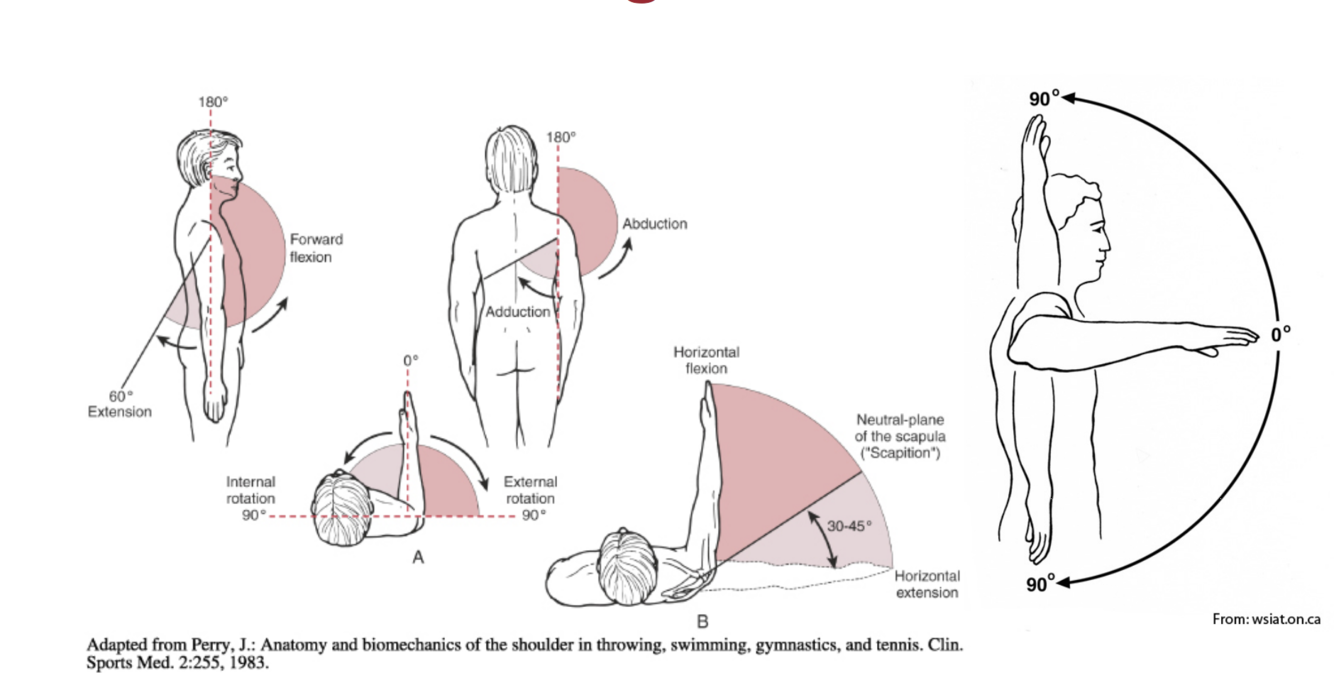
Active ROM: Shoulder
A
- Abduction (170 – 180°)
- Adduction (50 – 75°)
- Flexion (160 – 180°)
- Extension (50 – 60°)
- External rotation (80 – 90°)
- Internal rotation (60 – 100°)
- Horizontal adduction (120° from the coronal plane)
- Horizontal abduction (30° from the coronal plane)
2
Q
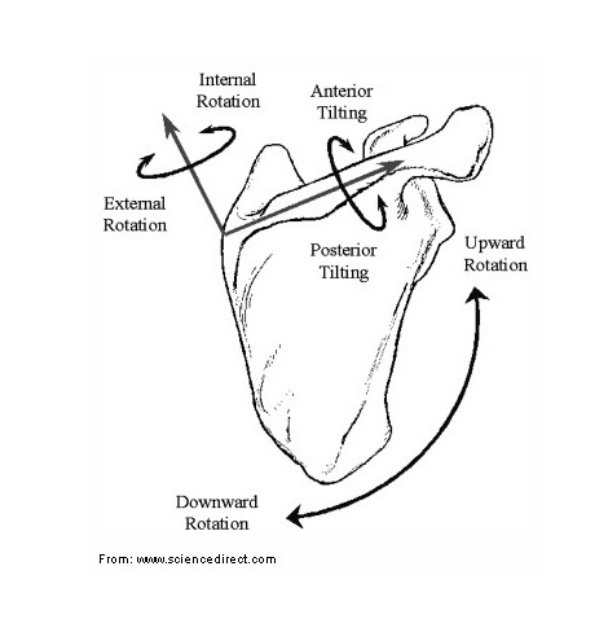
Scapula Movement
A
- Protraction
- Retraction
- Elevation
- Depression
- Anterior tilting
- Posterior tilting
- Upward rotation
- Downward rotation
- Internal rotation
- External rotation
3
Q
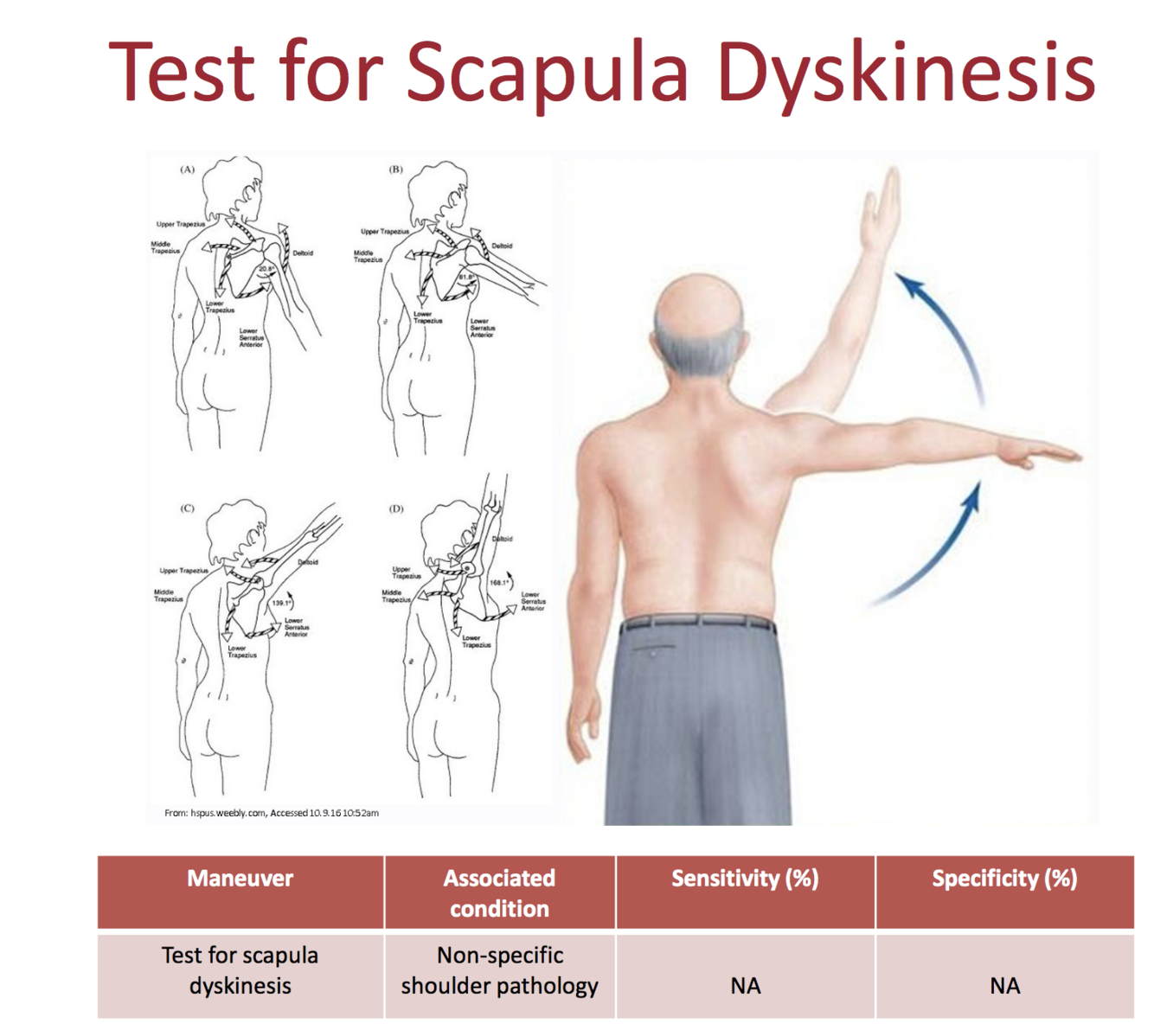
Test for Scapula Dyskinesis
A
- Purpose:
- Used to detect aberrant scapula movement or abnormal scapula resting position
- Procedure:
- The patient is sitting
- The examiner is positioned behind the patient in order to observe for abnormal or restricted movement or the shoulder and/or the scapula
- The patient is instructed to raise their arms above their head in the plane of the scapula
- The practitioner observes for the normal scapulohumeral rhythm and any abnormal movement patterns
- Positive Test:
- Abnormal resting position of the scapula relative to the spine and thoracic cage
- Premature movements or abnormal stuttering or jogging motions of the scapula during abduction
- Differences in the degree and quality of movement between the left and right sides
- Indication of a Positive Test:
- Scapula dyskinesis – Grades I-III
- Non-specific shoulder pathology
- Note:
- The test can be sensitized by using light (2-4kg) hand weights during the abduction analysis
- The test should be performed in flexion, abduction, and abduction in the scapula plane
4
Q
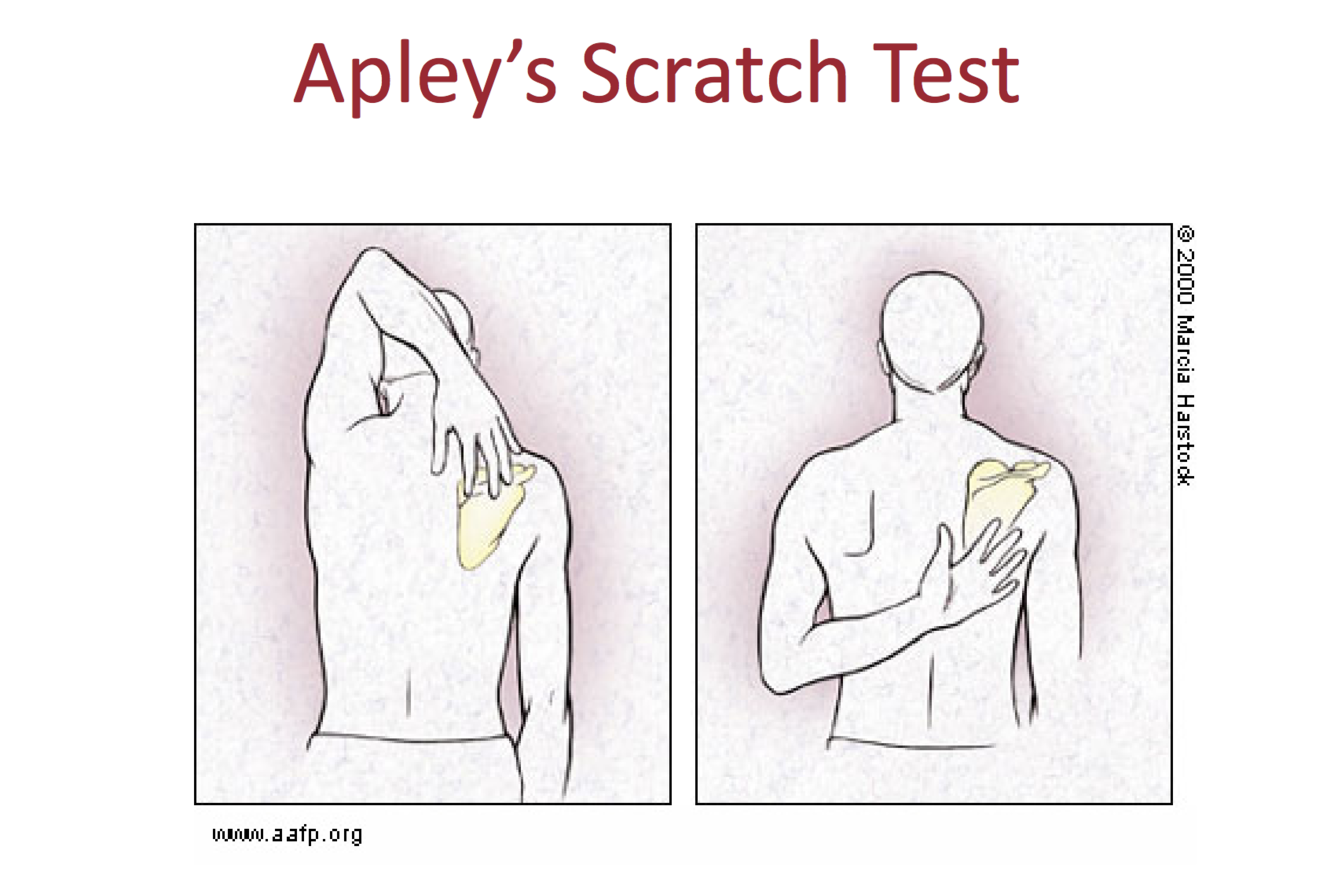
Apley’s Scratch Test
A
- Purpose:
- Used to highlight the functional status of the patient by combining various glenohumeral and scapulothoracic joint movements
- Described as a ‘Screening test’ of the shoulder
- Procedure:
- The patient is sitting or standing
- The examiner is positioned behind the patient in order to observe for abnormal or restricted movement or the shoulder and/or the scapula
- The patient is instructed to reach upward and over their head to scratch the middle of their back with one hand
- With the other hand the patient is asked to reach backward behind the lower back to scratch the back
- The test is repeated on the opposite side
- Positive Test:
- Differences in the degree and quality of movement between the left and right sides
- Reproduction of the patient’s symptoms
- Indications of a Positive Test:
- This test may highlight problems in any one of the joints/structures in the kinematic chain
- The test can be performed with both arms at once or with each arm individually
5
Q
Passive ROM: Shoulder
A
- Performed standing, sitting, or supine:
- Flexion (Tissue stretch)
- Extension (Tissue stretch)
- Internal rotation (Tissue stretch)
- External rotation (Tissue stretch)
- Abduction (Bone to Bone or Tissue Stretch)
- Adduction (Tissue approximation)
- Horizontal adduction (Tissue stretch or approximation)
- Horizontal abduction (Tissue stretch)
6
Q
Resisted Isometric Movements: Shoulder
A
- Performed standing, sitting, or supine:
- Resisted flexion
- Resisted extension
- Resisted internal rotation
- Resisted external rotation
- Resisted abduction
- Resisted adduction
- Resisted flexion of the elbow
- Resisted extension of the elbow
- Functional Assessment:
- Questionnaires:
- Disabilities of the Arm, Shoulder, and Hand Scale (DASH)
- Shoulder pain and disability index (SPADI)
- American Shoulder and Elbow Surgeons Standardised Shoulder Assessment Form (ASES)
- Questionnaires:
7
Q
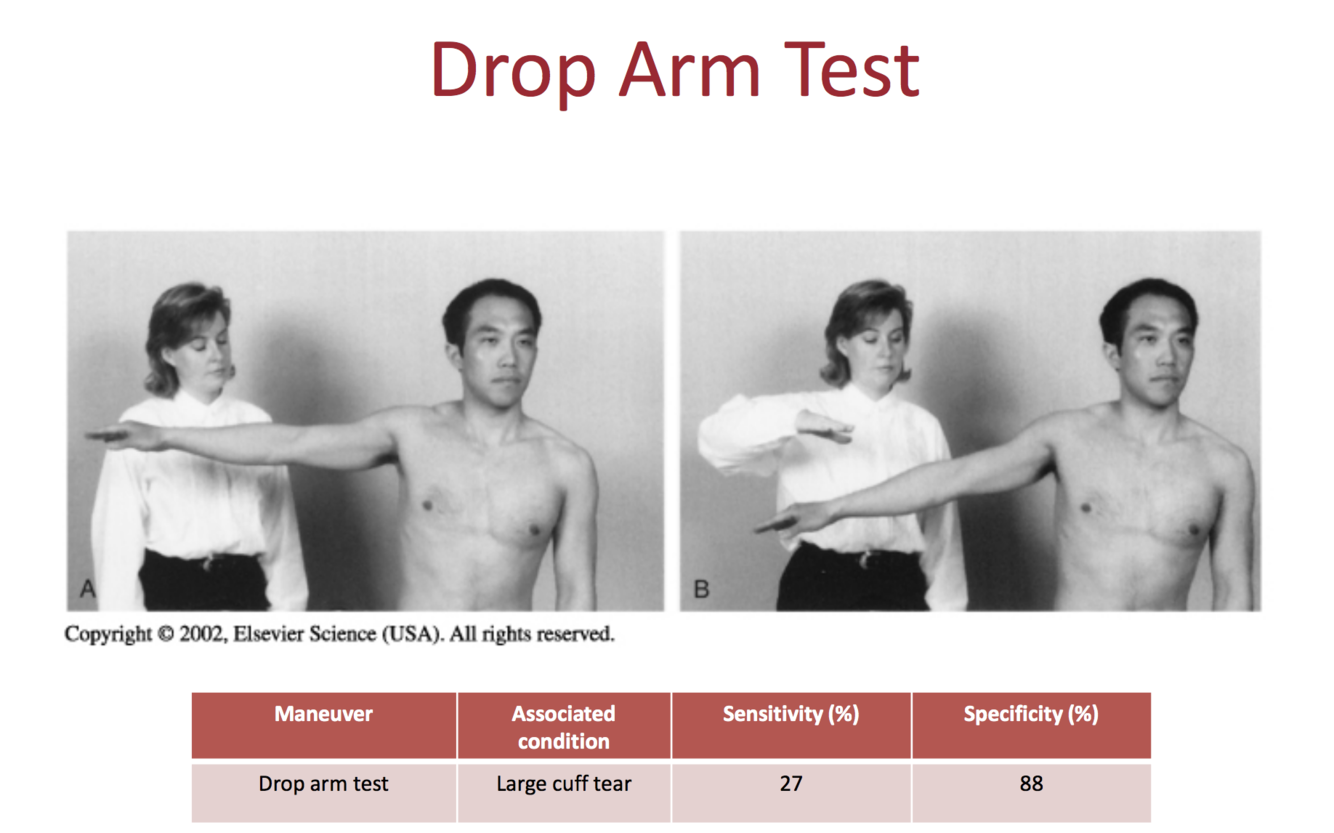
Drop Arm Test
A
- Purpose:
- Drop arm is a test that is used to identify whether a tear is present in the rotator cuff tendon (namely supraspinatus)
- Procedure:
- The patient is standing
- The practitioner stands behind the patient
- The patient is passively pre-positioned to 90º of shoulder abduction, and then is asked to slowly and actively lower the arm
- The test is repeated with a quick and gentle tap (forced adduction) on adduction as a sensitizing procedure
- Positive:
- If the patient cannot lower the arm to the slide in a slow, controlled fashion or the arm drops immediately ± pain
- Indication of a Positive Test:
- Complete tear of cuff (common in 40yrs+)
- Younger patient partial tear or tendinopathy <40 years
8
Q
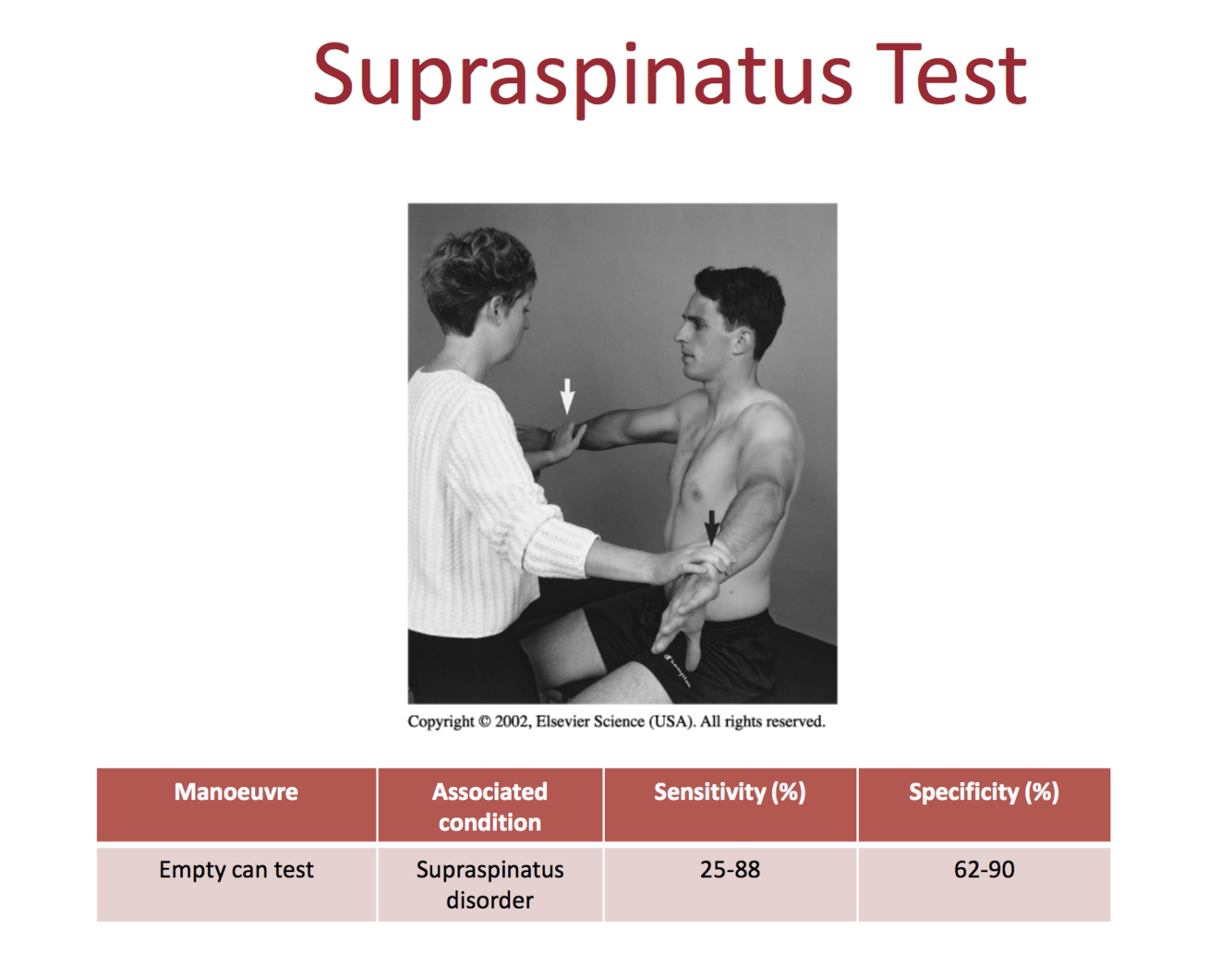
Supraspinatus Test
A
Also known as ‘Empty Can Test’ or ‘Jobe’s Test’
- Purpose:
- To assess the integrity of supraspinatus
- Procedure:
- The patient is standing
- The practitioner stands in front of the patient
- The shoulder is passively abducted to 90 degrees in the plane of the scapula
- The arms are then internally rotated so that the thumbs point toward the floor ‘empty can’
- The patient is then asked to resist the practitioner as he/she pushes in a caudal direction on the patient’s arm
- Both arms may be assess at the same time
- Positive:
- The patient cannot resist the practitioners caudally directed pressure on the affected side
- Indication of a Positive Test: – Supraspinatus tendon pathology
9
Q
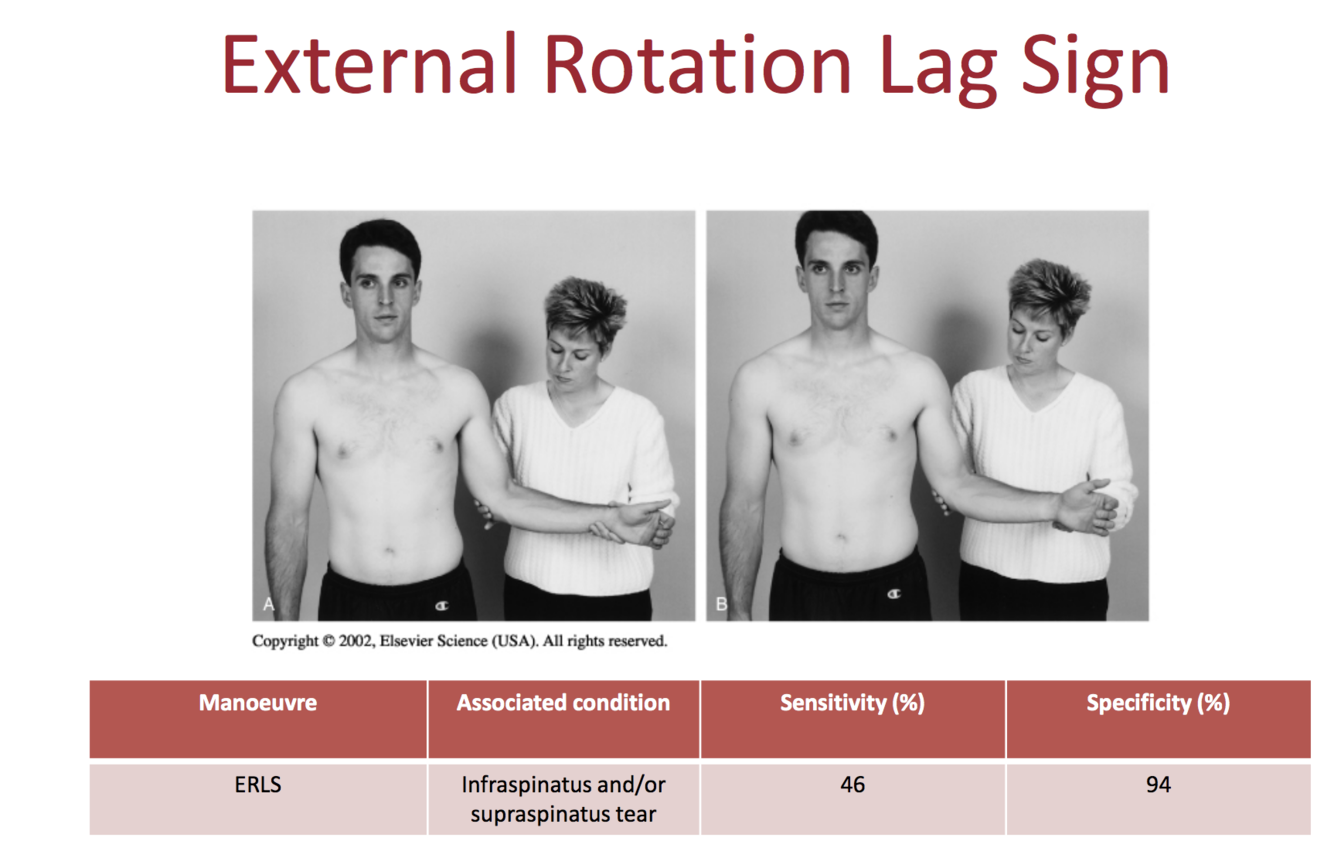
External Rotation Lag Sign
A
- Purpose:
- To assess of the integrity of the posterior superior rotator cuff (1º Infraspinatus, 2º Supraspinatus and occasionally teres minor)
- Procedure:
- The elbow is passively flexed to 90 degrees, and the shoulder is held at 20 degrees abduction (in the scapular plane) and externally rotated to end range by the examiner
- The patient is then asked to actively maintain the position of external rotation in abduction as the examiner releases the wrist while maintaining support of the limb at the elbow
- Positive:
- The sign is positive when a lag, or angular drop occurs.
- The magnitude of the lag is recorded to the nearest 5°
- Indication of a Positive Test:
- Pain/dysfunction/tear of the infraspinatus, supraspinatus or teres minor muscle
- Note:
- Testing and interpretation are complicated by pathologic changes in the passive range of motion
- When the passive range of motion is reduced because of capsular contracture or increased because of a subscapularis rupture, for instance, false-negative and false-positive results can occur
10
Q
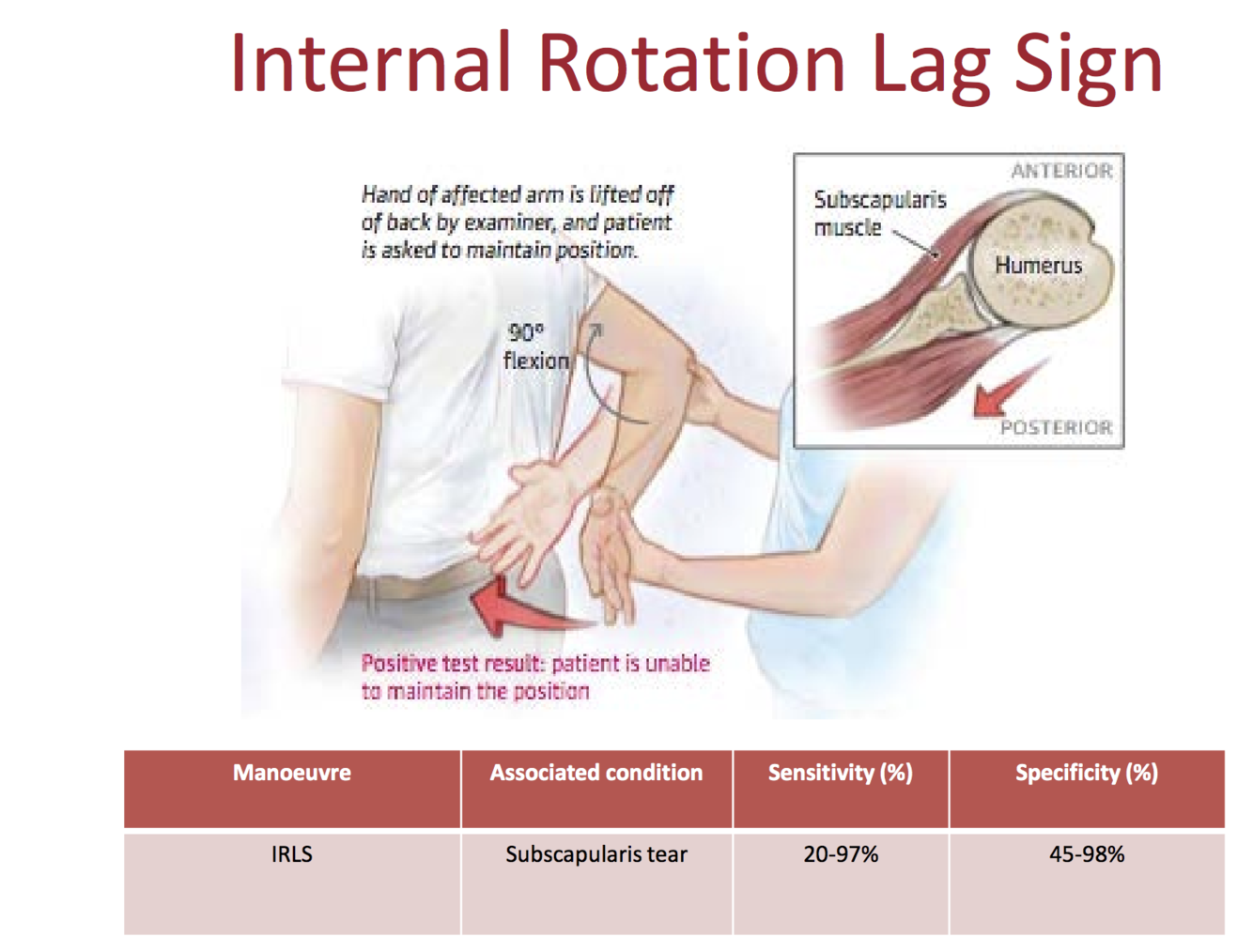
Internal Rotation Lag Sign
A
- Purpose:
- To assess of the integrity of the subscapularis muscle
- Procedure:
- The patient is asked to place the back of their hand on the small of their back
- The practitioner passively internally rotates the patient’s arm to the end range or internal rotation
- The patient is then asked to actively maintain the position of maximal internal rotation as the examiner releases the wrist while maintaining support of the limb at the elbow
- Positive:
- The sign is positive when a lag, or angular drop occurs.
- The magnitude of the lag is recorded to the nearest 5°
- Indication of a Positive Test:
- Pain/dysfunction/tear of the subscapularis
- Note:
- Testing and interpretation can be complicated by pathologic changes in the passive range of motion
11
Q
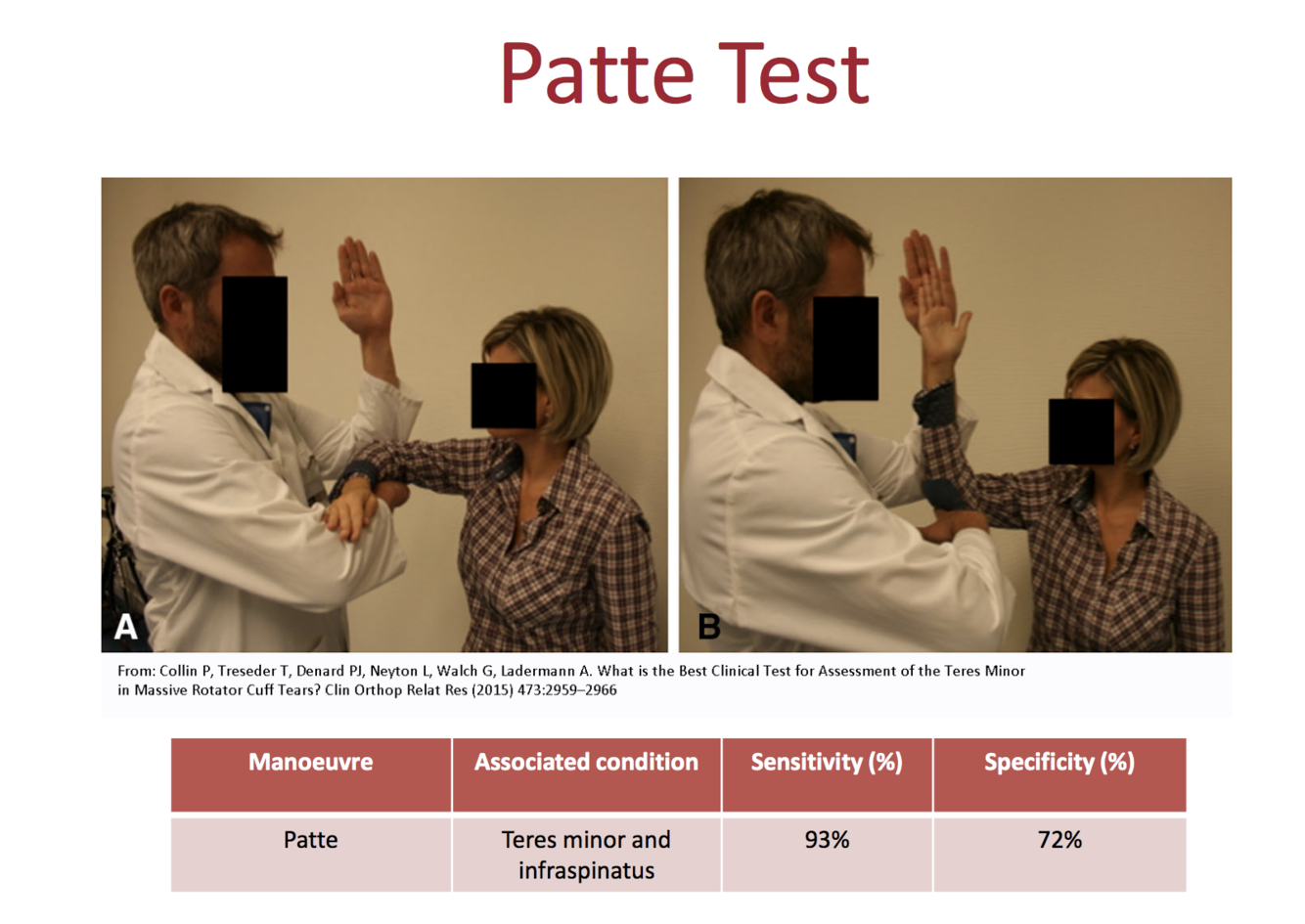
Patte Test
A
- Purpose:
- To assess the integrity of the Teres minor muscle
- Procedure:
- The patient’s shoulder is passively abducted to 90° in the scapular plane
- The patient’s elbow is flexed to 90°
- The examiner supports the patient’s arm and the patient is asked to externally rotate the arm, first against gravity, then against the practitioner’s resistance
- The practitioner notes any associated weakness and grades the muscle strength
- Muscle tests should be held for a minimum of 5 seconds
- Positive:
- Pain or an inability of the patient to resist the practitioner’s attempts to internally rotate the arm
- Indication of a Positive Test:
- Tear or dysfunction of the teres minor muscle
12
Q
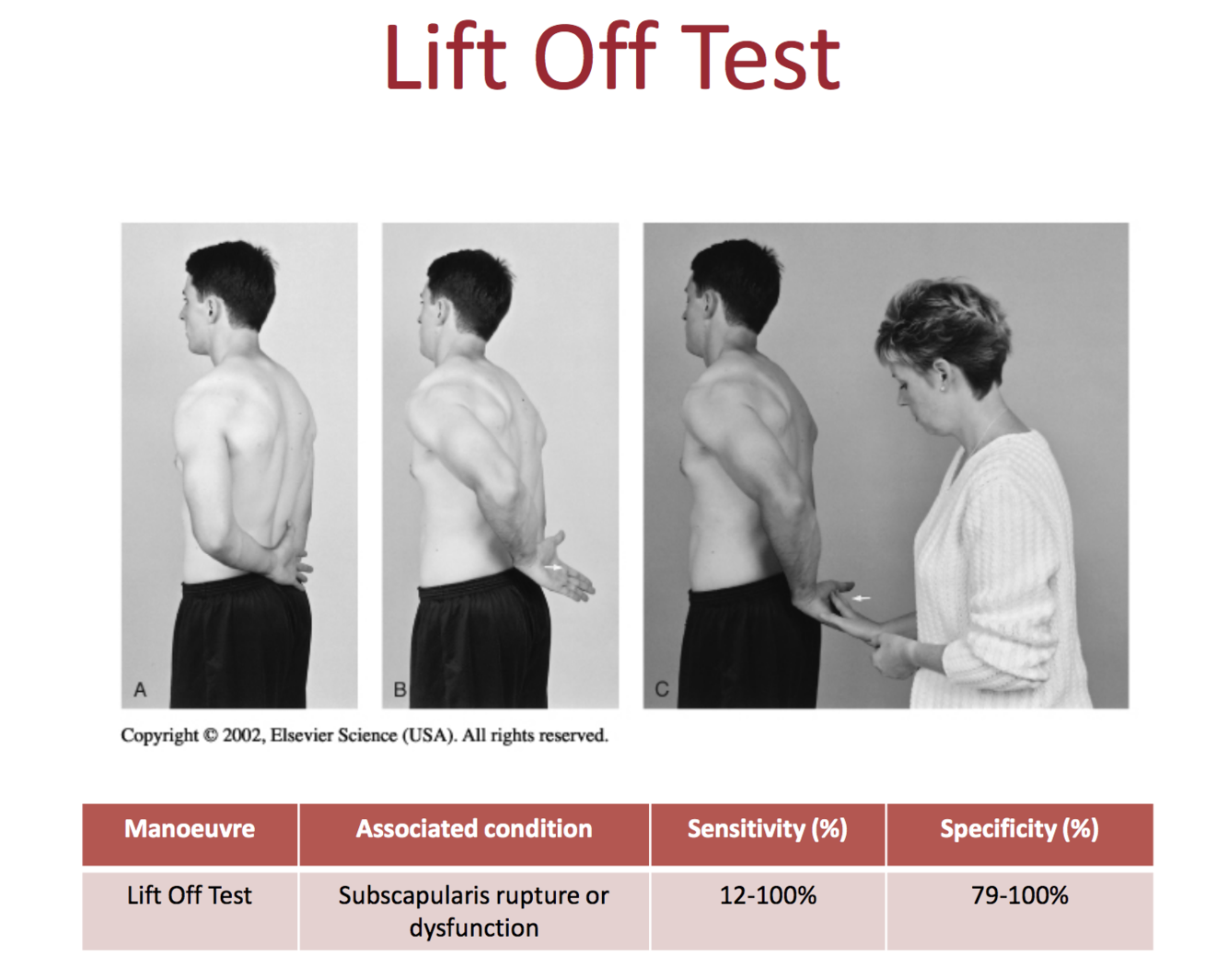
Lift Off Test
A
- Purpose:
- To assess the integrity of the subscapularis muscle
- Procedure:
- The patient stands and places the dorsum of their hand on their lower back
- The practitioner stands behind the patient
- The practitioner then applies over pressure in a P-A direction on the patient’s wrist
- The patient is then asked to actively lift their hand away from the back
- Positive:
- An inability to lift the arm away or maintain the position in response to overpressure
- Indication of a Positive Test:
- Subscapularis rupture or dysfunction
13
Q
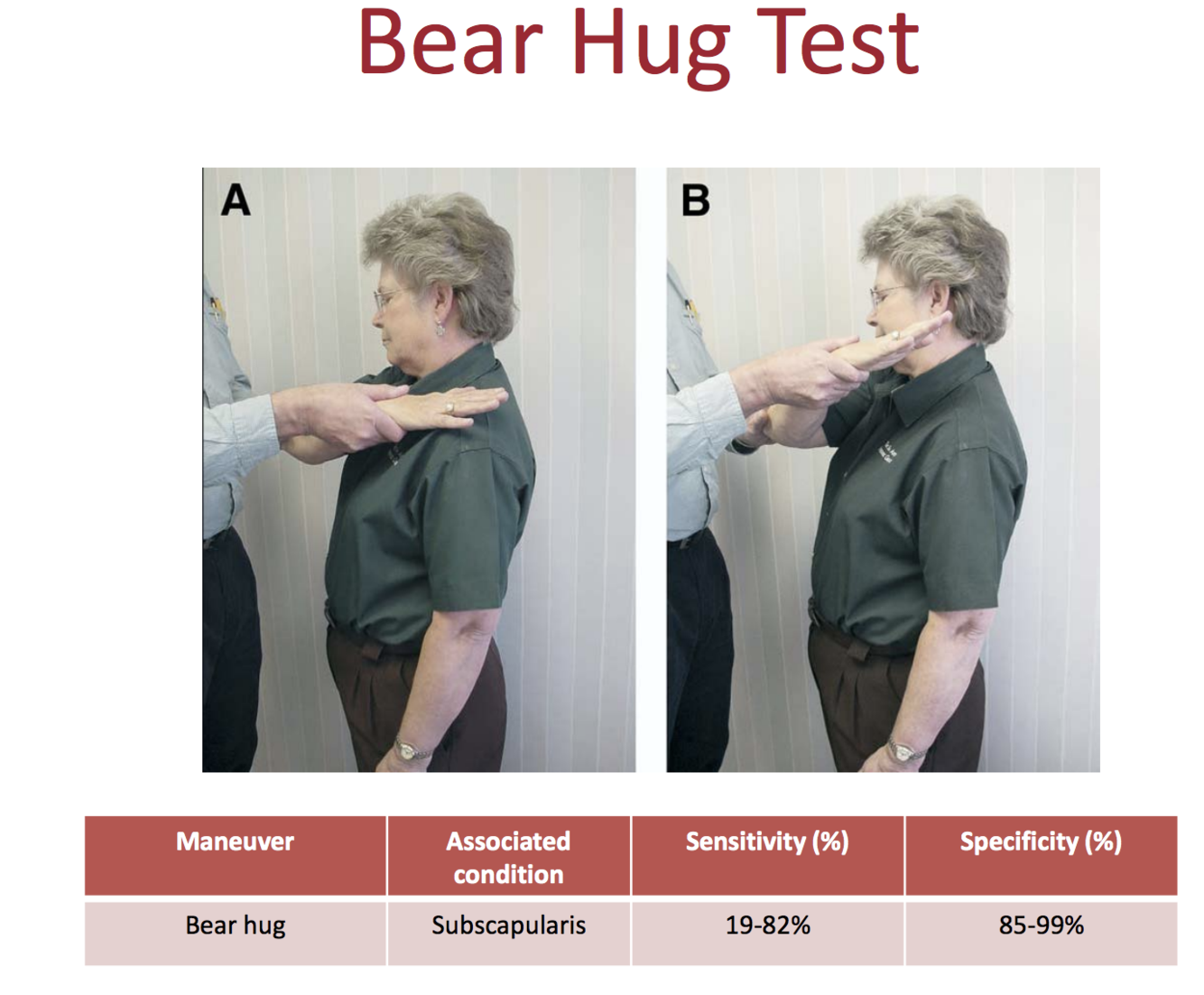
Bear Hug Test
A
- Purpose:
- Assess the integrity of subscapularis
- Procedure:
- The patient is standing
- The practitioner stands in front of the patient
- The patient places the palm of the involved side on the opposite shoulder with the fingers extended (so that the patient could not resist by grabbing the shoulder or adjacent clothing) and the elbow positioned anterior to the body
- The patient is then asked to hold that position (resisted internal rotation) as the physician tries to pull the patient’s wrist from the shoulder with a P-A force applied perpendicularly to the patient’s forearm
- Positive:
- A positive bear-hug test results when the patient cannot hold the hand against the shoulder as the examiner applies a P-A force to the wrist
- Indication of a Positive Test:
- Subscapularis tear
14
Q
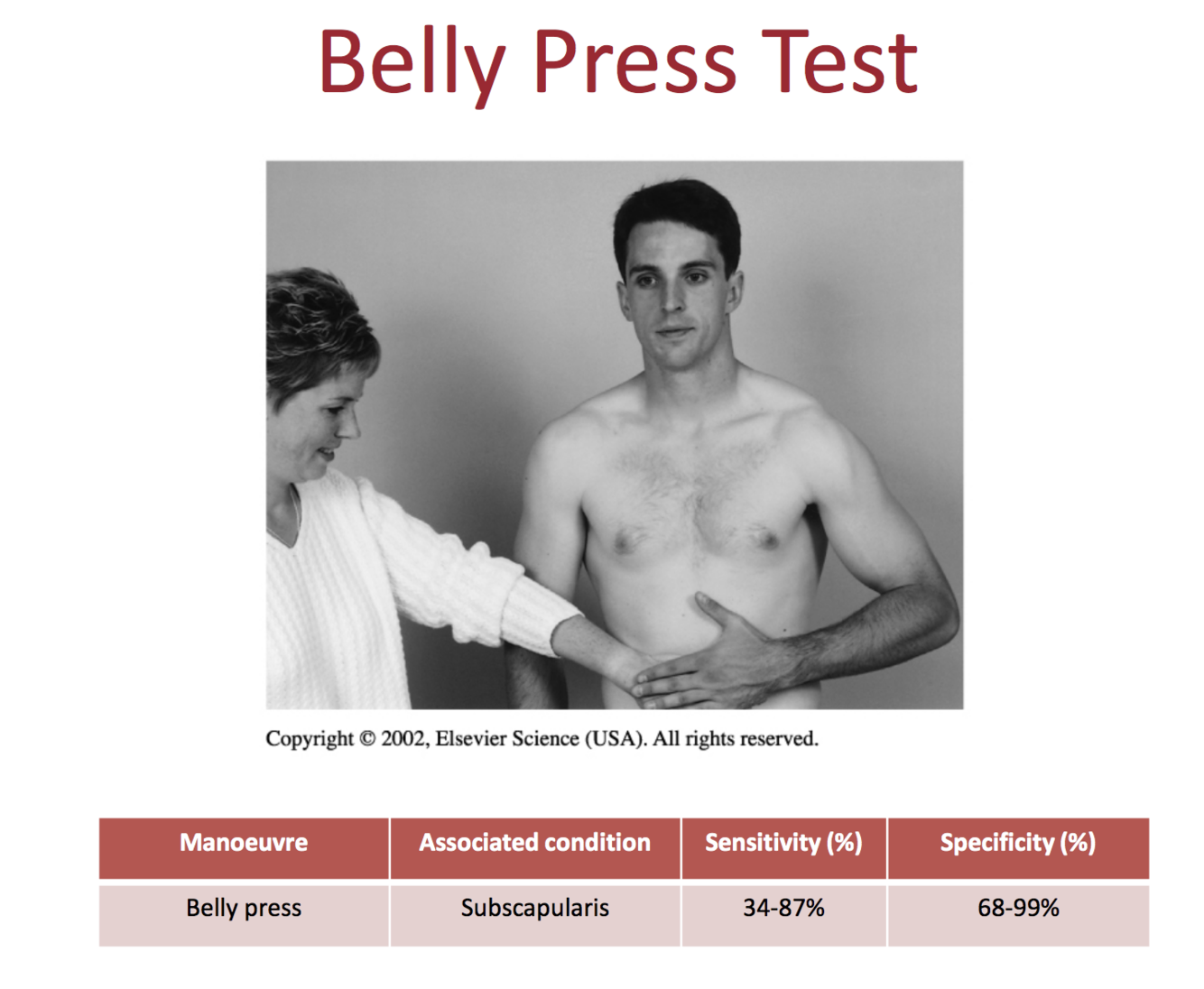
Belly Press Test
A
- Purpose:
- Assess the integrity of the subscapularis muscle
- Procedure:
- The patient is standing
- The practitioner stands in front of the patient
- The belly-press test is performed by having the patient press their palm into their abdomen by actively internally rotating the shoulder
- The practitioner observes the quality and type of movement produced
- Sensitizing procedure: A-P overpressure on the patient’s test elbow
- Positive:
- A positive sign for the belly-press test is noted if the patient compensates by dropping the elbow behind the trunk and extending the arm in order to maintain pressure against the abdomen, rather than internally rotating the shoulder
- Indication of a Positive Test:
- Subscapularistear/dysfunction
- Clinical Note:
- This test has been shown to be clinically reliable and is often used when a patient is unable to perform the lift-off test because of pain or limited range of motion
15
Q
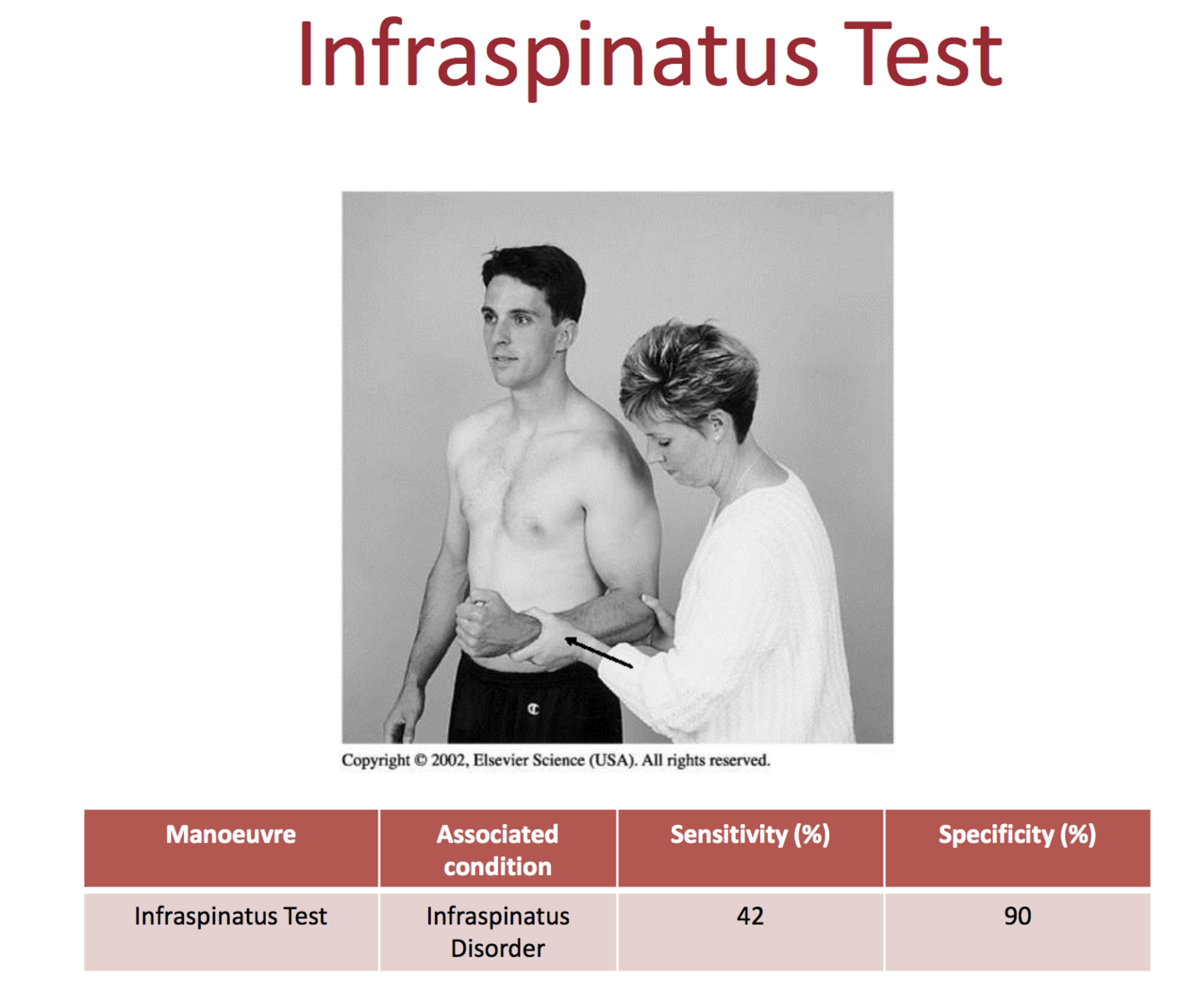
Infraspinatus Test
A
- Purpose:
- Screening test for infraspinatus dysfunction
- Procedure:
- In either the seated or standing position the patient is pre-positioned with the arm by the side and the elbow flexed to 90°
- The practitioner stands adjacent to the test shoulder
- The examiner applies a force designed to medially rotate the patient’s humerus which the patient is asked to resist
- Positive:
- Pain and weakness compared to the contralateral side
- Indication of a Positive Test:
- Infraspinatus or teres minor tendinopathy/strain/tear
- Serves as a confirmatory test for impingement due to its high specificity
16
Q
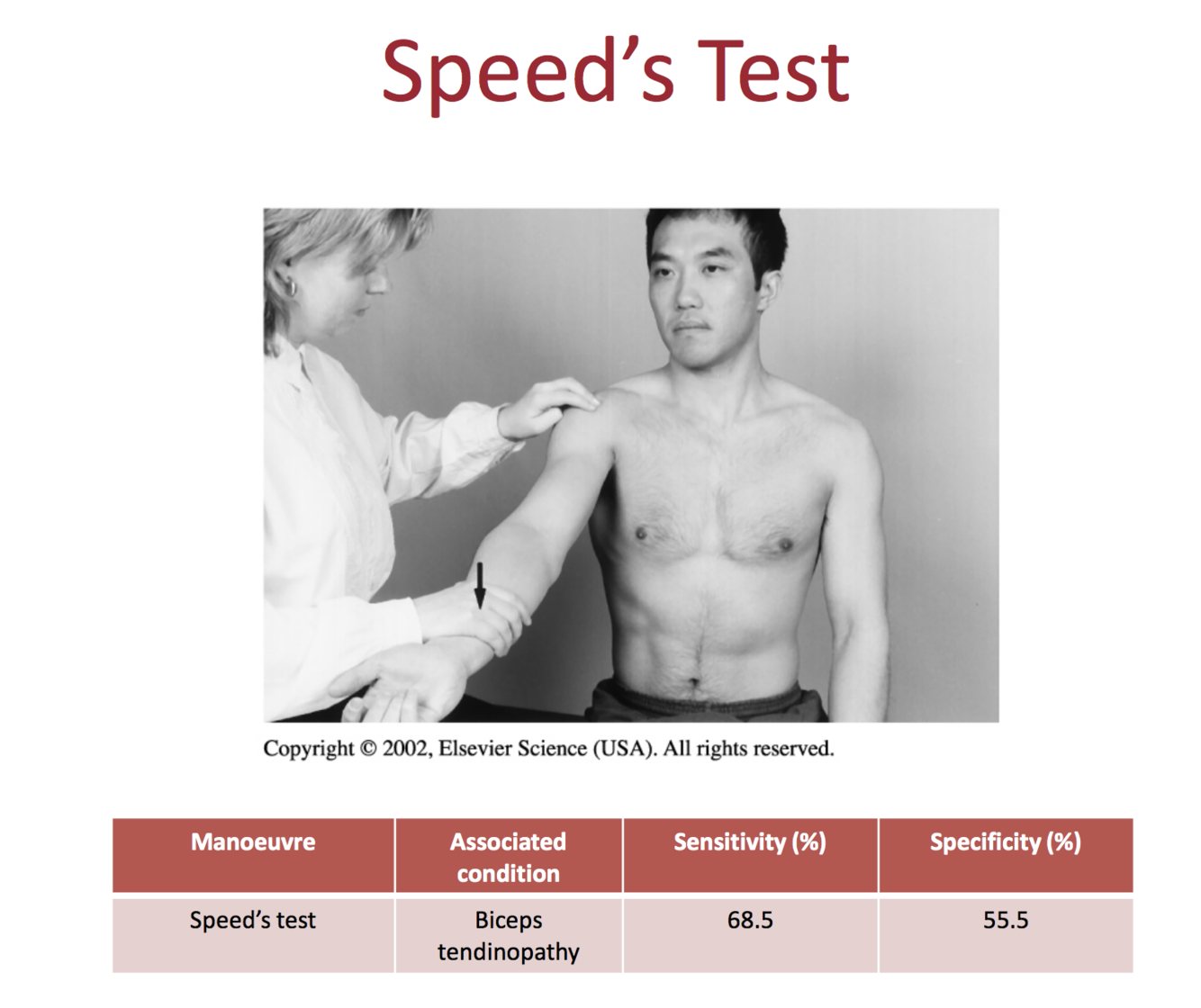
Speed’s Test
A
- Purpose:
- To assess the integrity of the tendon of the long head of the biceps brachii
- Procedure:
- The patient is sitting or standing
- The practitioner stands adjacent to the test shoulder
- The patient’s upper extremity is placed into 90° of shoulder flexion, full supination and full elbow extension
- The practitioner applies a downward force in the direction of shoulder extension
- The patient is asked to resist the practitioner’s force
- Positive:
- Pain experienced by the patient in the anterior shoulder (intertubercular groove) when pressure is applied indicates a positive result
- Indication of a Positive Test:
- Bicipital tendinopathy
17
Q
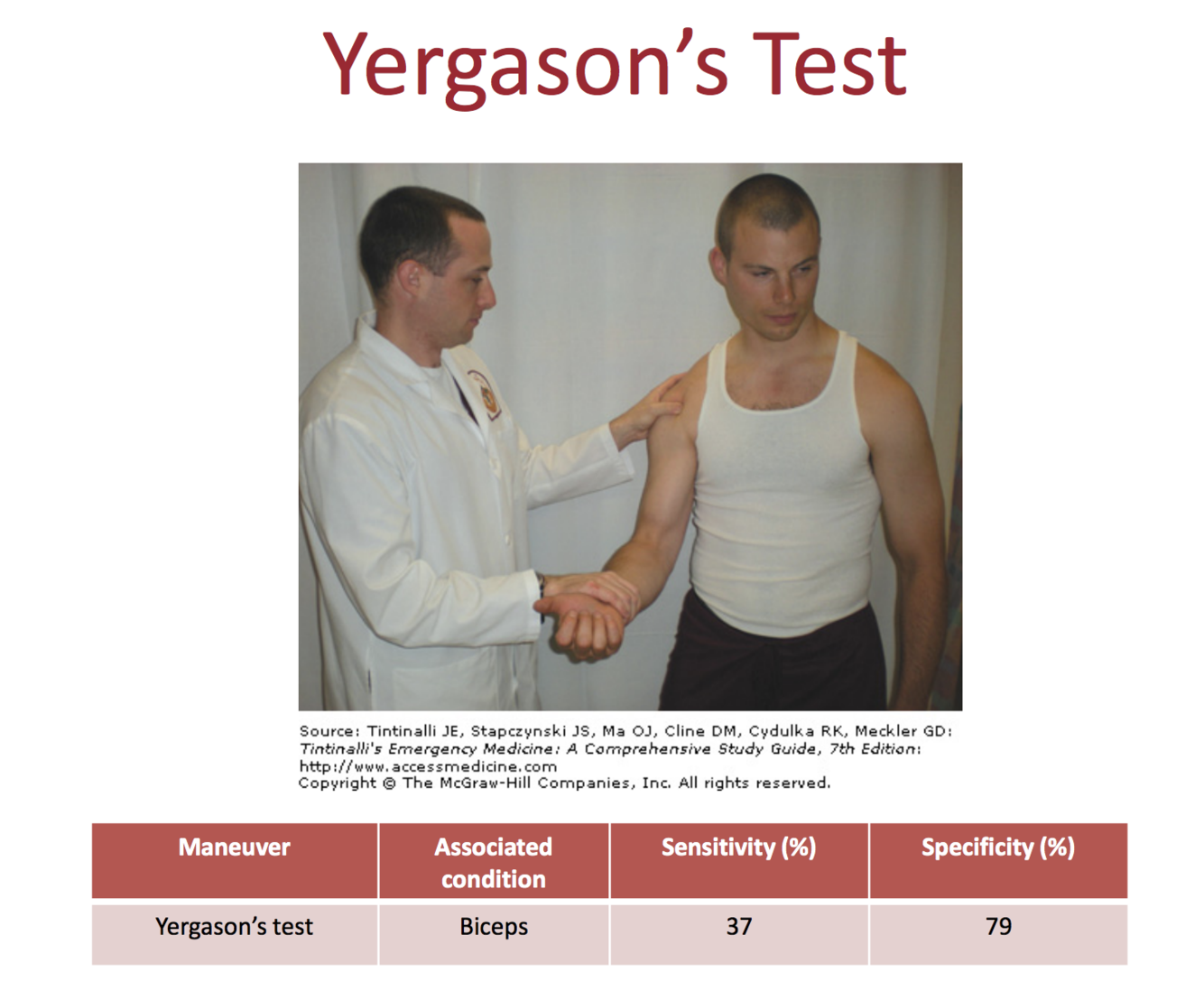
Yergason’s Test
A
- Purpose:
- Assess the integrity of the long head of biceps tendon and the transverse humeral ligament
- Procedure:
- The patient is sitting or standing
- The elbow is flexed to 90°, and the forearm is in a neutral position
- The examiner directs the patient to actively supinate the forearm
- The practitioner simultaneously palpates the bicipital groove, resists the patient’s attempts at supination, and passively externally rotates the patient’s humerus
- Positive:
- A positive test result should produce pain into the biceps region
- A palpable click/pop in the bicipital groove
- Indication of a Positive Test:
- Bicipital tendinopathy if painful
- Transverse humeral ligament rupture if a palpable click/pop is felt
18
Q
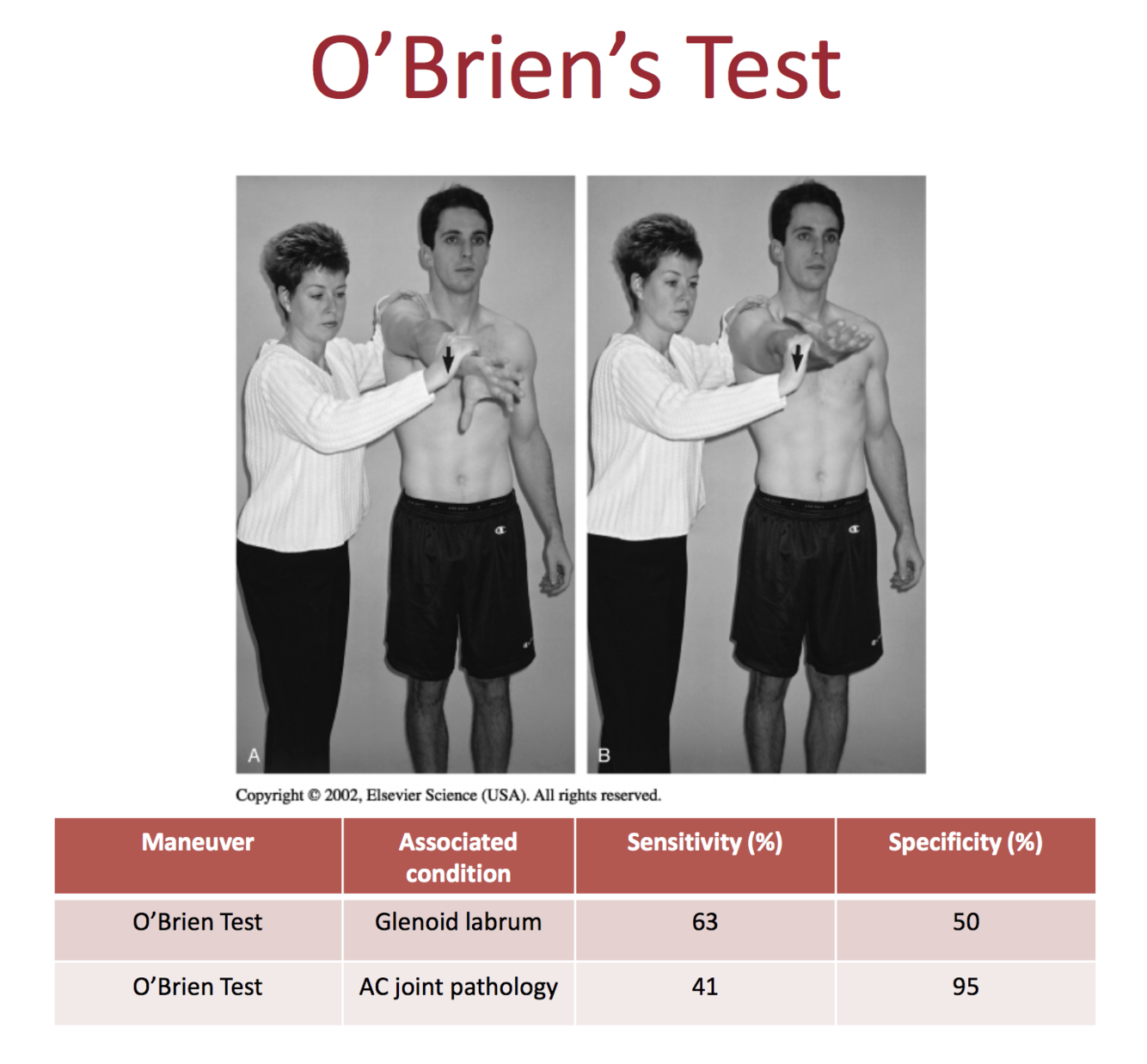
O’Briens Test
A
- Purpose:
- To differentiate between the presence of labral tears and acromioclavicular joint abnormalities
- Procedure:
- Patient standing with shoulder flexed to 90°, elbow in full extension, arm horizontally adducted 10-15° internally rotated it so that the thumb points downward
- The examiner, standing lateral to the patient, applies a caudally directed force on the patient’s arm
- The test is then repeated, this time with the thumb pointing upwards
- Positive:
- The test was considered positive if pain was elicited during the first manoeuvre, and reduced or eliminated with the performance of the second procedure
- Pain localized to the acromioclavicular joint or “on top” was diagnostic of acromioclavicular joint abnormality, whereas pain or painful clicking described as “inside” the shoulder was considered indicative of labral abnormality
- Indication of a positive test:
- Either superior labral pathology or AC joint pathology
19
Q
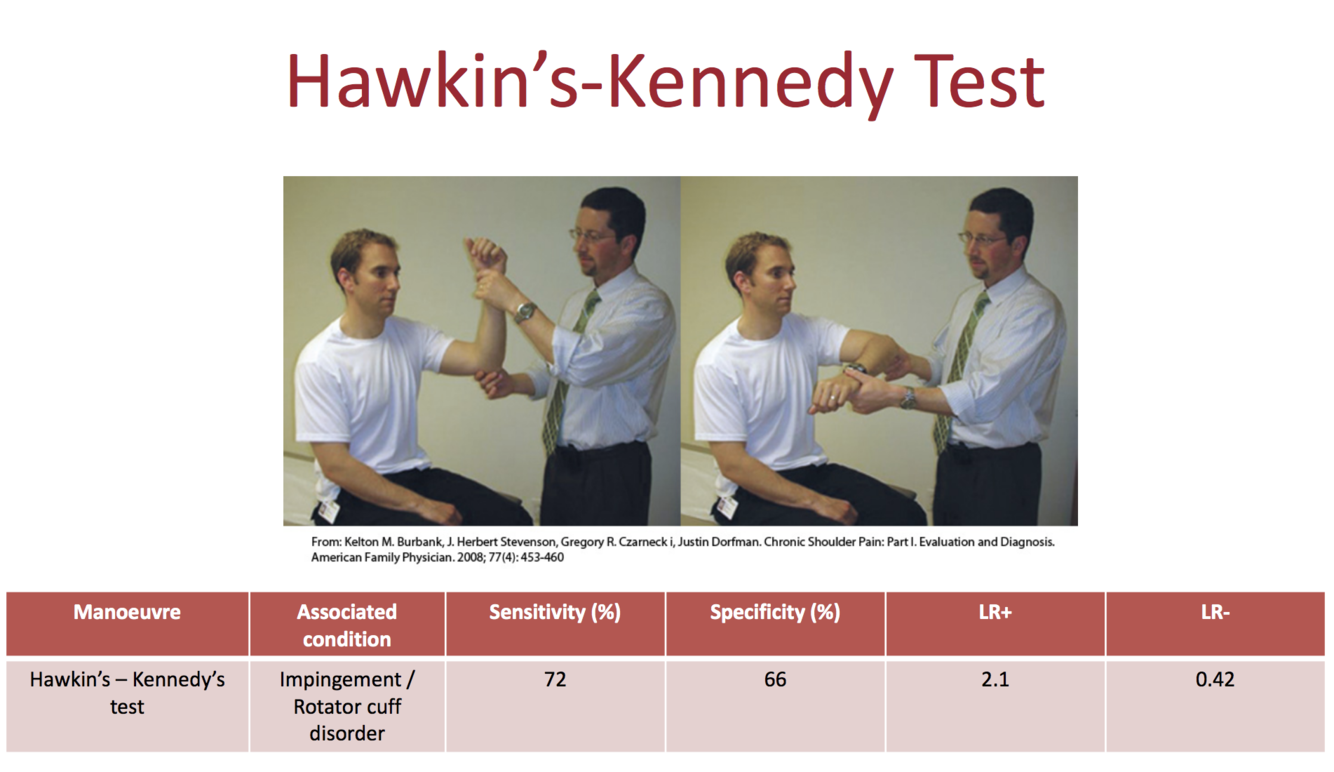
Hawkins - Kennedy’s Test
A
- Purpose:
- Screening test for sub-acromial impingement
- Procedure:
- The patient is examined in a seated position with their arm flexed to 90° and their elbow flexed to 90°
- The practitioner supports the patient in this position to ensure maximal relaxation
- The examiner then stabilises proximal to the elbow with their outside hand and holds just proximal to the patient’s wrist with the other hand
- The practitioner then moves the patient’s the arm into internal rotation
- Positive:
- Pain about the sub-acromial space
- Indication of Positive Test:
- External shoulder impingement
- Soft tissue contact with the inferior aspect of the acromion
20
Q
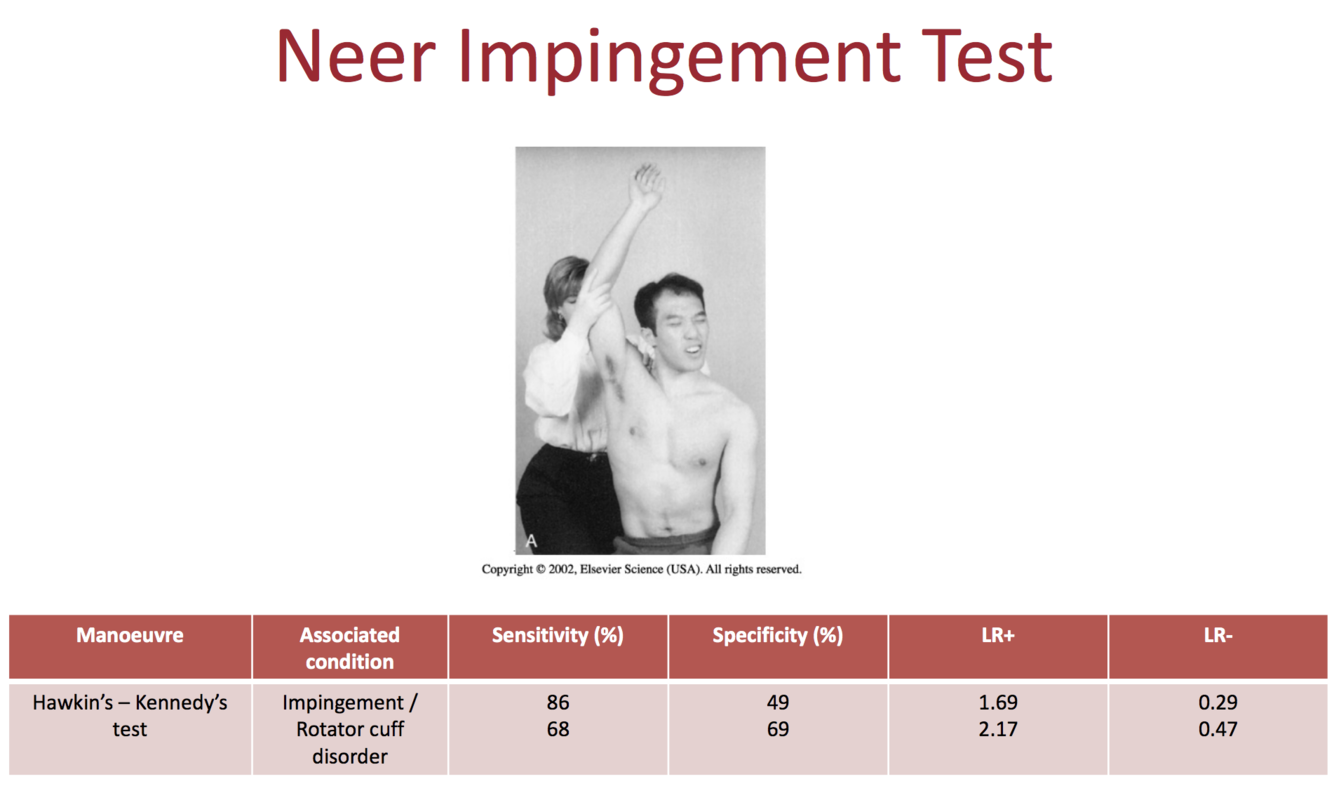
Neer Impingement Test
A
- Purpose:
- Screening test for sub-acromial impingement
- Procedure:
- The examiner stabilises the patient’s scapula to prevent rotation while passively moving the patient’s internally rotated arm into maximal abduction in the plane of the scapula (midway between flexion and abduction)
- The internal rotation component is added as the in the final phase of the abduction movement (from approximately 120° onwards)
- Positive:
- Pain about the sub-acromial space with or without facial grimace
- Indication of Positive Test:
- External shoulder impingement
- Soft tissue contact with the inferior aspect of the acromion
21
Q
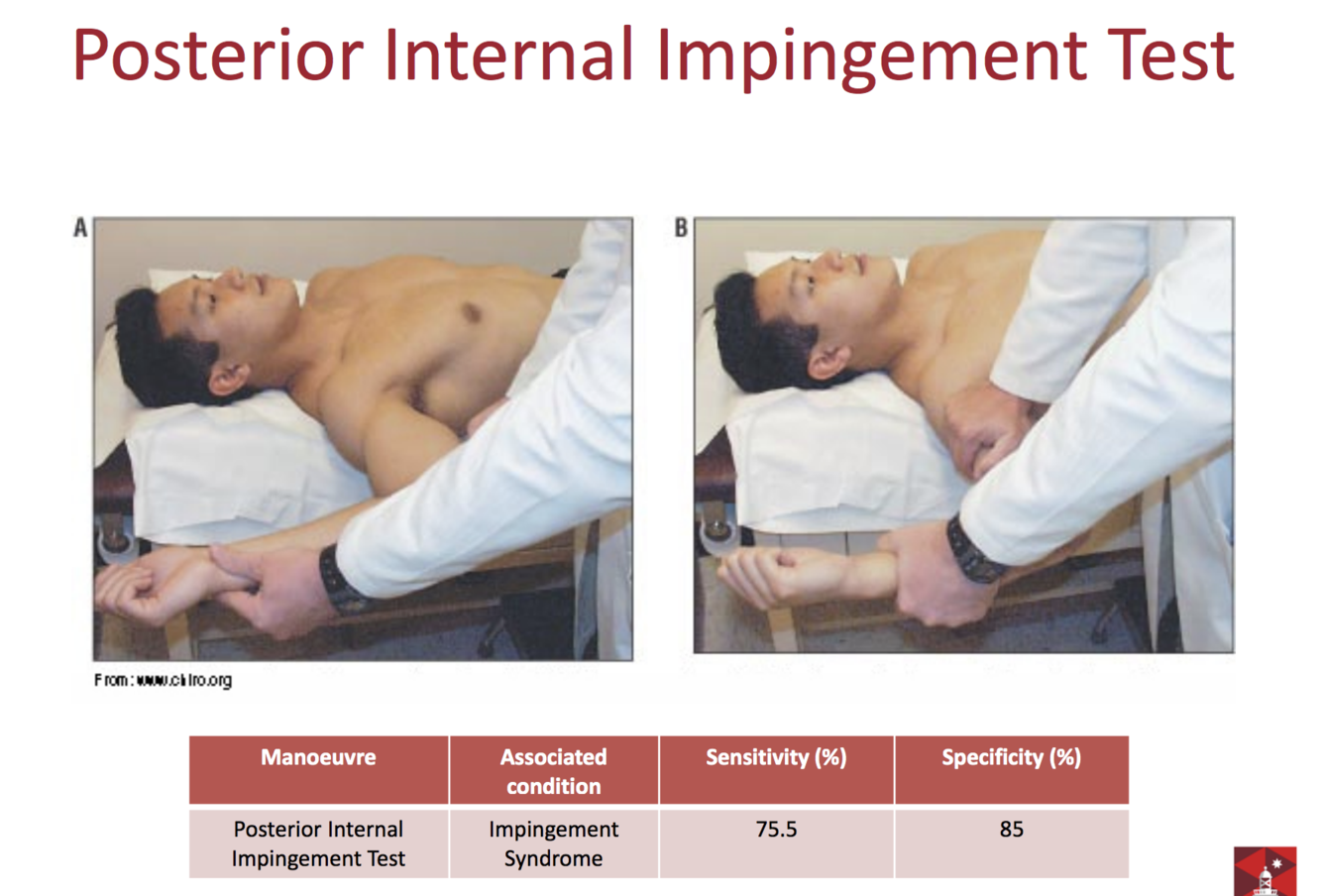
Posterior Internal Impingement Test
A
- Purpose:
- Screening test for internal impingement
- Procedure:
- Part A: The examiner passively abducts the patient’s shoulder to 90-110° with 15-20° of horizontal abduction and maximal external rotation
- Part B: the examiner may then place a posteriorly directed force on the anterior aspect of the glenohumeral joint to relocate the humeral head within the glenoid fossa
- Positive:
- Localized pain in the posterior shoulde Part A
- The patient will report a reduction of symptoms in Part B of the test
- Indication of positive test:
- Internal shoulder impingement
- Rotator cuff impingement between the greater tuberosity/humeral head and the posterosuperior edge of the glenoid
22
Q
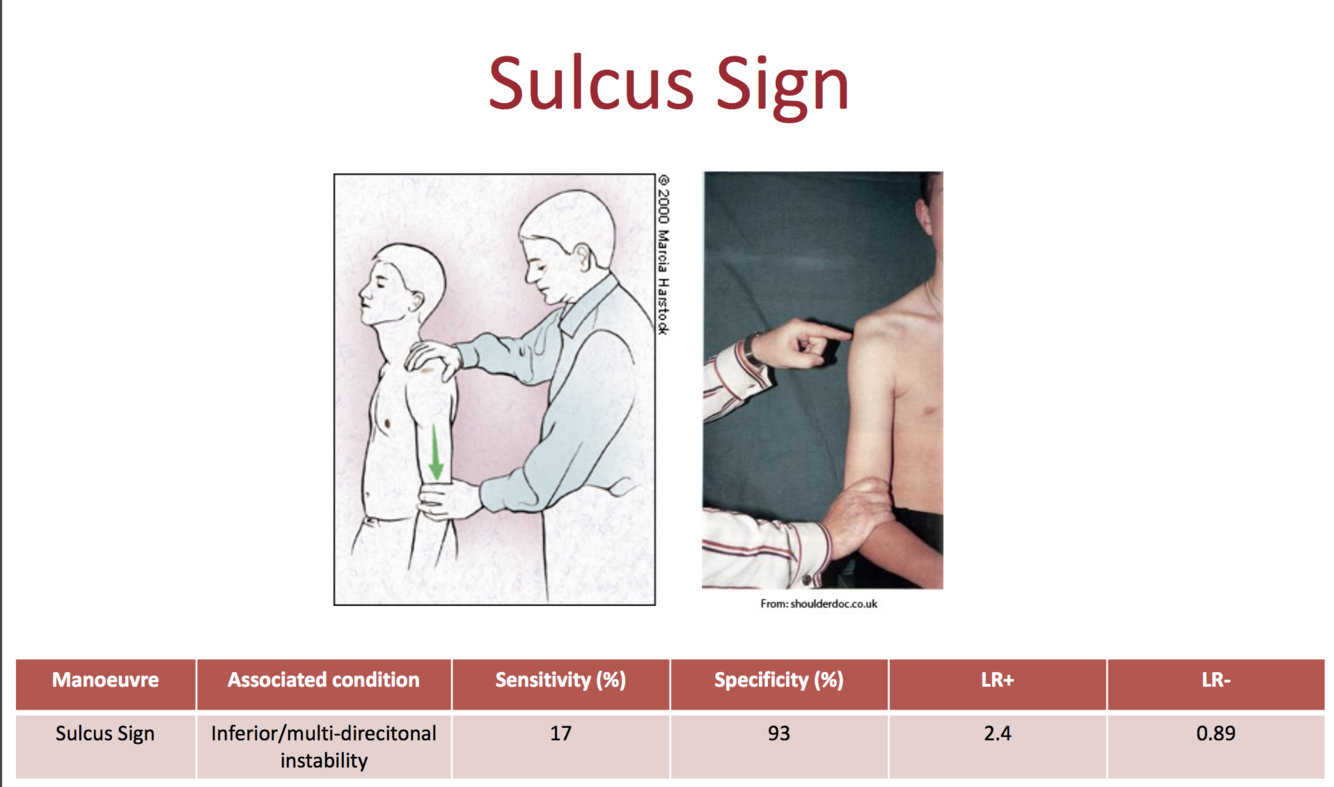
Sulcus Sign
A
- Purpose:
- Assessment of inferior and multidirectional GH joint stability
- Procedure:
- The test is performed with the arm at rest by the patient’s side
- The practitioner stands adjacent to the test arm
- The practitioner contacts the patient’s elbow and creates a distractive force in a caudal direction
- Positive:
- In a positive test a sulcus (dimple) appears in the subacromial region as the humeral head translates inferiorly in response to the practitioner’s distractive force
- Grading: • +1: up to 1cm • +2: 1-2cm • +3: >2cm
- Indication of Positive:
- Inferior or multidirectional GH instability when compared to the contralateral shoulder
23
Q
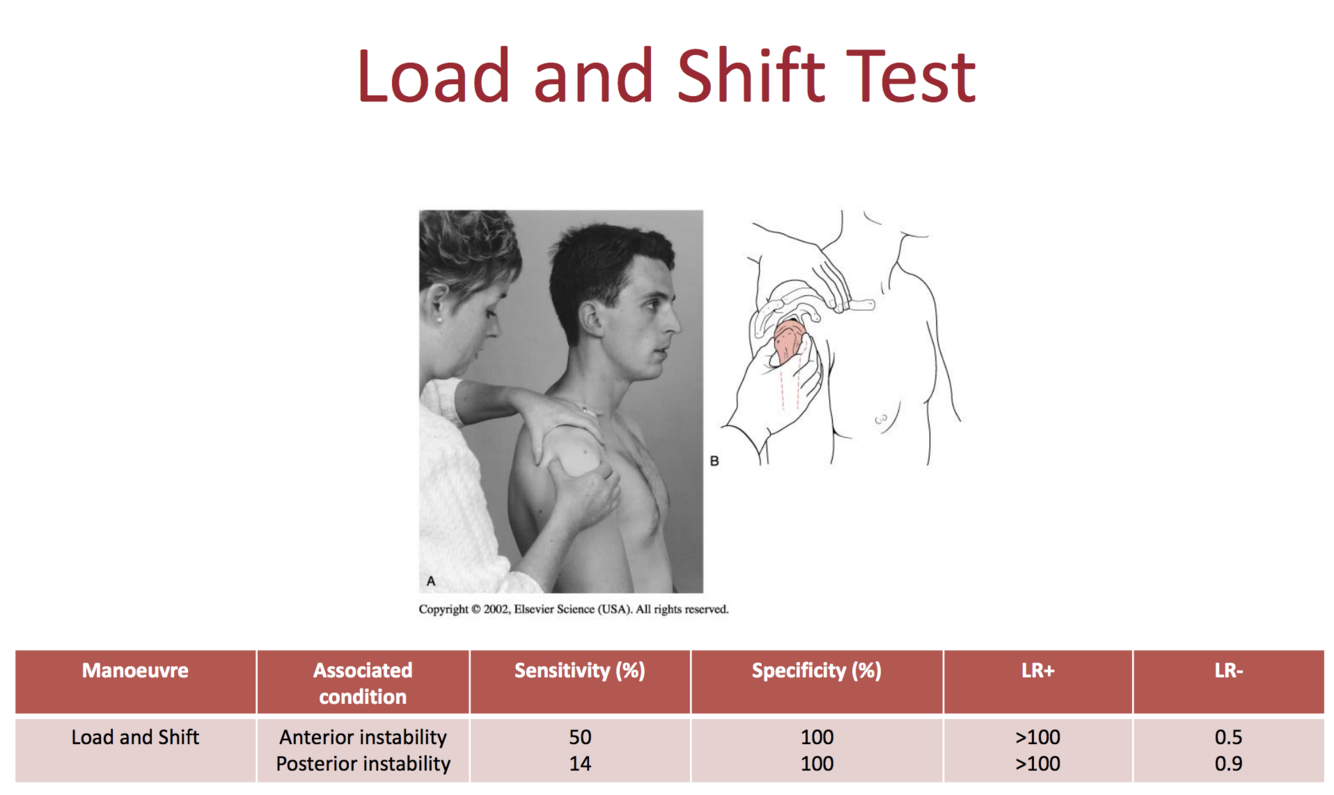
Load and Shift Test
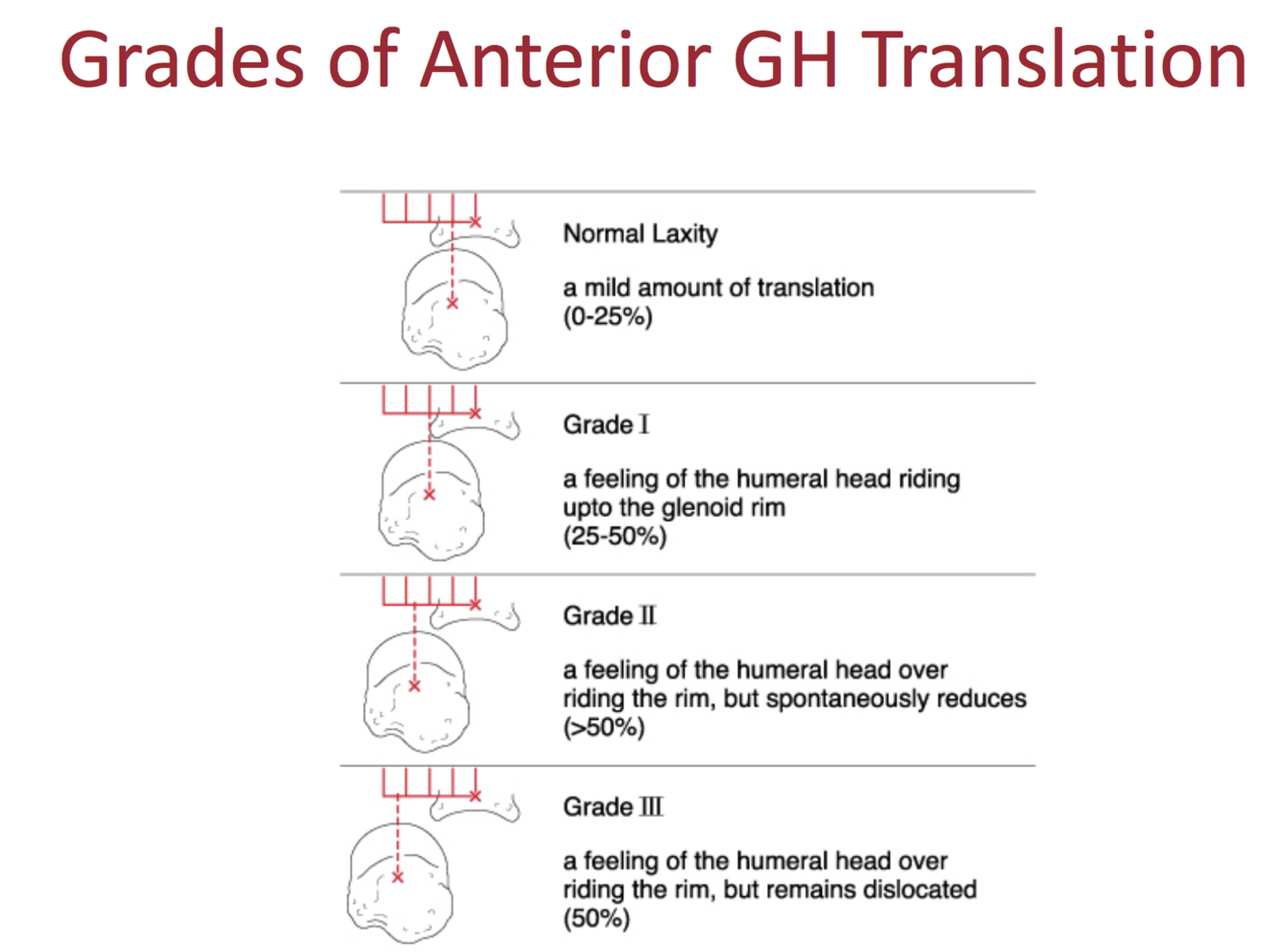
A
- Purpose:
- Assessment of anterior and posterior GH joint stability
- Procedure:
- Part 1:
- Patient is sitting upright with the shoulder muscles relaxed
- The practitioner stabilizes the patient’s scapula with the secondary contact
- The practitioner grasps the patient’s humeral head with a pincher grip with the primary hand and then creates a loading force to relocate the humeral head centrally in the glenoid fossa
- The practitioner then attempts to translate the humerus, first anteriorly, and then posteriorly
- As the stress is applied to the humeral head may be felt to ride up (and potentially over) the glenoid rim
- Part 2:
- The test is then repeated in the supine position
- For this position the arm is grasped and positioned in about 45-60° of abduction in the plane of the scapula
- The humeral head is again loaded then posterior and anterior stresses are applied
- Part 1:
- Indication of Positive:
- Laxity compared to the contralateral side
- Anterior or posterior glenohumeral laxity or instability
- Clinical Note:
- Although translation is assessed initially in the neutral position with the arm by the side, it is important to assess translations in other positions as well
- This test not only assesses the amount of translation but also provides an idea of the adequacy of the glenoid rim
- It is critically important to compare the two shoulders to appreciate similarities or differences in translation
24
Q
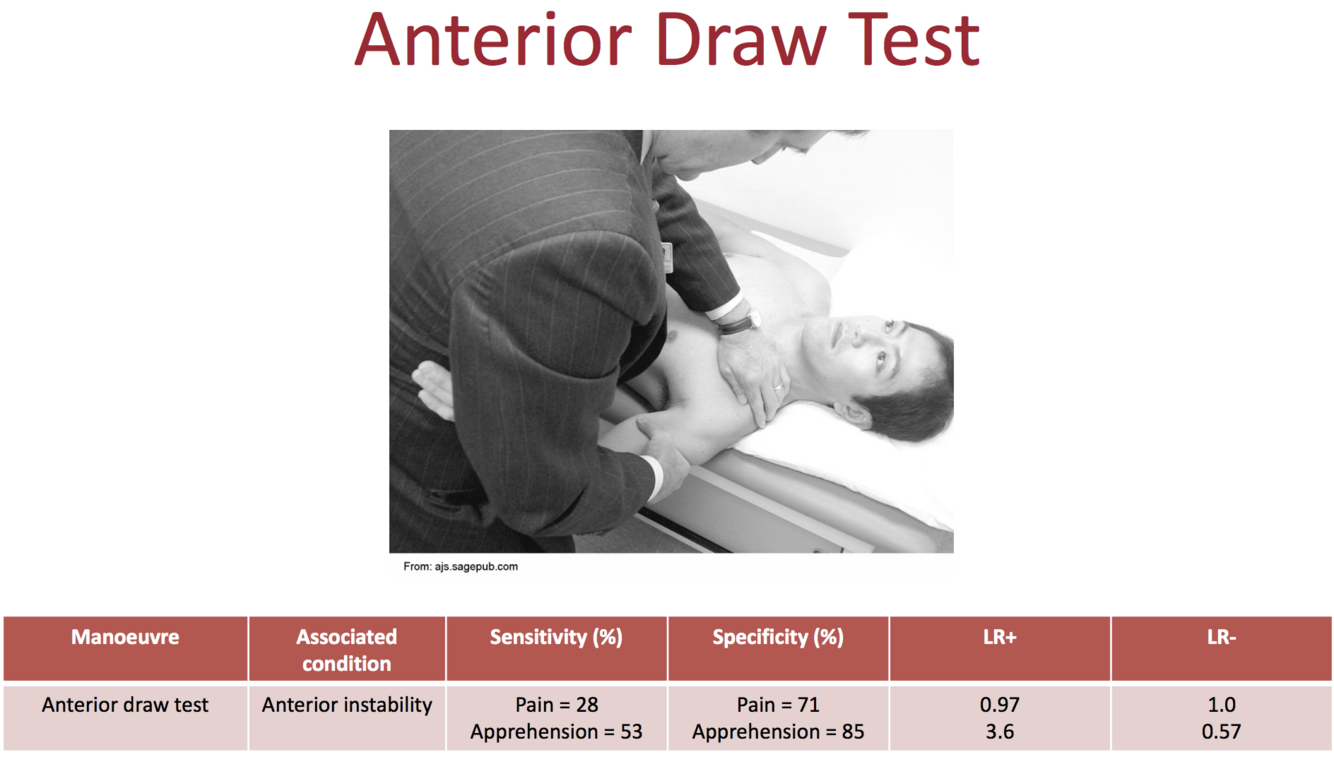
Anterior Draw Test
A
- Purpose:
- To assess and grade laxity or insufficiency of the anterior GH joint
- Procedure:
- Ideally this test should be performed with the patient in the supine position, as the sitting and standing positions have been shown to be unreliable with respect to reproducibility
- The examiner stands facing the affected shoulder
- The examiner stabilises the patient’s scapula with the secondary hand
- The affected shoulder is held at 80-120° of abduction, 0-20° of horizontal adduction, and 0-30° of external rotation
- The practitioner positions their primary hand in the patient’s axilla grasping the humerus and draws it anteriorly
- Positive:
- Laxity compared to the contralateral side
- Pain and/or apprehension
- Indication of Positive:
- Anterior GH laxity or instability
- Clinical Note:
- It is possible to repeat the anterior drawer in different positions of abduction and external rotation as described in the load and shift test to test the individual components of the GHL complex
25
Anterior Apprehension (Crank) Test
* Purpose:
* Assessment of anterior GH stability
* Procedure:
* The practitioner stands adjacent to the patient’s affected limb
* The patient is positioned supine with the scapula supported by the edge of the examining table
* The humerus is positioned in 90° of both abduction and external rotation, with the elbow flexed to 90°
* The practitioner contacts the patient’s humerus and incrementally applies external rotation while watching for apprehension on the part of the patient
* Positive:
* Apprehension in the form of grimace, muscle guarding, positional retraction and pain
* Pain alone is not indication of a positive sign (note location of pain however)
* In the case of a positive test then proceed to the relocation test
* Indication of Positive:
* Anterior GH instability

26
Anterior Relocation Test
* Purpose:
* To assess the anterior stability of the GH joint
* Procedure:
* The examiner notes the amount of external rotation before the onset of apprehension while performing the anterior apprehension test
* The patient is then returned to the starting position
* The test is either repeated while the practitioner applies a A-P force on the patient’s humeral head or a A-P force is applied at the point of apprehension during the anterior apprehension test
* Positive:
* An increase in the external rotation range before symptom/apprehension reproduction with application of the posterior glide on the humeral head
* It is important to note that according to Speer (1994) pain alone is not nearly as reliable regarding instability as apprehension
* Indication of Positive:
* Disappearance of Symptoms:
* GH anterior instability, subluxation , dislocation or impingement
* Disappearance of Apprehension:
* GH anterior instability, subluxation or dislocation – Disappearance of Pain:
* GH pseudo laxity, anterior instability, secondary impingement, posterior SLAP lesion

27
Anterior Release Test
* Purpose:
* Assessment of anterior shoulder stability
* Procedure:
* This test should be performed immediately after a positive ‘Anterior Relocation Test’ by suddenly removing the posteriorly directed force that is relocating the humeral head
* Positive:
* A positive test occurs when the patient’s apprehension symptoms are increased by this manoeuvre
* Pain and forward translation of the humeral head
* Indication of Positive:
* Anterior shoulder instability
* Labral lesions
* Clinical Note:
* Perform with this test with extreme caution as this procedure can result in anterior dislocation, and understandably is not recommended as a practitioner-patient ‘trust building exercise’…

28
Posterior Draw Test
* Purpose:
* Designed to detect and grade laxity or insufficiency of the posterior G/H joint
* Procedure:
* The patient is supine
* The practitioner stands adjacent to the patient’s affected arm
* The patient’s arm is grasped with one hand and placed into 80 to 120° abduction and 20° to 30° flexion with the elbow flexed to 120°
* The other hand grasps the scapula, fingers on the scapula spine, and thumb lateral to the coracoid process
* The arm is horizontally adducted to 60° to 80° while the thumb of the other hand attempts to sublux the humeral head posteriorly
* Positive:
* In a positive test the thumb is felt to slide past the coracoid – Apprehension on the part of the patient
* Indication of Positive:
* Posterior GH laxity or instability

29
Posterior Apprehension Test
* Purpose:
* Assessment of posterior shoulder stability
* Assessment of posterior labral tear
* Procedure:
* Patient is supine
* The patient’s arm is abducted 90° in the plane of the scapula and internally rotated to 90°
* An axial force is applied through the patient’s humerus while simultaneously horizontally adducting and further internally rotating the patient’s arm
* The practitioner feels for a ‘clunk’/’click’ and watches the patient’s face for apprehension or grimacing
* Positive:
* Posterior clunk or click with or without sharp pain suggests a positive test result
* Indication of Positive:
* Posterior instability if not painful – Labral tear if painful

30
Biceps Load Test II
* Purpose:
* Diagnostic test for isolated SLAP lesions of the shoulder
* Procedure:
* The test is conducted with the patient in the supine position
* The examiner sits adjacent to the patient on the same side as the affected shoulder and grasps the patient’s wrist and elbow gently
* The arm to be examined is elevated to 120° and externally rotated to its maximal point, with the elbow in 90° of flexion and the forearm in the supinated position
* The patient is asked to flex the elbow against resistance from the examiner
* The practitioner watches the patient’s face for apprehension
* Positive:
* The test is considered positive if the patient complains of pain during the resisted elbow flexion and also considered positive if the patient complains of more pain from the resisted elbow flexion regardless of the degree of pain before the elbow flexion manoeuvre.
* The test is negative if pain is not elicited by the resisted elbow flexion or if the pre-existing pain during the elevation and external rotation of the arm is unchanged or diminished by the resisted elbow flexion
* Indication of Positive:
* SLAP lesion of the Shoulder

31
Dynamic Labral Shear Test
* Purpose:
* Diagnostic test for isolated SLAP lesions of the shoulder
* Procedure:
* The test is conducted with the patient in the seated or standing position.
* The practitioner flexes the patient’s elbow to 90° and abducts the arm to 120° in the plane of the scapula
* The patient’s arm is then maximally externally rotated by the practitioner and taken into maximal horizontal abduction
* The examiner then applies a shear load to the joint by maintaining external rotation and horizontal abduction and lowering the patient’s arm from 120° to 60° of abduction
* Positive:
* A positive test is indicated by reproduction of the patient’s pain and/or a painful click or catch in the joint line along the posterior joint line between 120° and 90° abduction
* Indication of Positive:
* SLAP lesion of the shoulder


Orthopaedic Testing
flashcards
Decks in class (17)
# Cards



