Diabetes Insipidus
Cause and types:
Presentation
Investigations:
Treatment:
- Cause:
- Cranial/central (posterior pituitary fails to secrete ADH) - pituitary tumour, infection (meningitis), sarcoidosis
- Nephrogenic (collecting ducts insensitive to ADH) - ↑ Ca, ↓ K, lithium, inherited (AVPV2 gene), idiopathic
- Presentation:
- Polyuria (including nocturia) – UO often >3L
- Polydipsia
- Symptoms of hypernatremia: lethargy, irritability, confusion
- Investigations:
- General: U&Es (Ca, Na, K), glucose (to exclude DM)
- Diagnostic: water deprivation test (if urine osmolaltiy <400 then diabetes insipidus - if after desmopressin, urine concentrates by more than 50% then cranial, if not then nephrogenic )
- Treatment:
- Treat the cause
- Cranial: intranasal desmopressin
- Nephrogenic: thiazide diuretic (decreases Na+ absorbtion in distal convoluted tubule and therefore more Na+ absorbed in proximal with water) or NSAIDs (inhibit prostaglandin synthase and prostaglandin inhibits ADH )
Diabetes Melitus
Cause and types:
Risk factors
Presentation
Investigations:
Treatment:
- Cause and types:
- Type 1: Hyperglycaemia due to deficiency of insulin production (autoimmune destruction of beta cells in 90%)
- Type 2:Hyperglycaemia due to ↑ peripheral resistance to insulin action
- Risk factors:
- Type 1: HLA DR3/4 - Other autoimmune conditions
- Type 2: Obesity, FH, ethnicity (south asian), drugs
- Presentation:
- Type 1:
- Polyuria + polydipsia
- Tiredness & weight loss
- DKA: N&V, abdo pain, Kussmaul breathing, sweet breath
- Type 2: Polyuria + polydipsia
- Type 1:
- Investigations: Blood glucose measurement: Fasting ≥7 mmol/L, Random >11.1 mmol/L
- Treatment:
- Type 1:
- Insulin
- Patient education
- In DKA 1st line treatment is fluids
- Type 2:
- 1st line = diet and lifestyle
- 2nd line = metformin
- +/- sulphonylurea +/- insulin
- Type 1:
What the normal range of sodium?
135-145 mmol/L
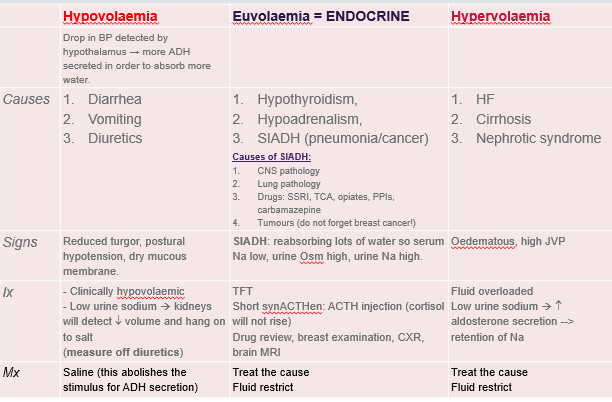
Hyponatraemia
Cause:
Signs:
Investigations:
Investigations:
look at urine Na
Hypernatraemia
Causes:
Presentation:
Management:
Causes: vomiting, diarrhea, diabetes insipidus, primary aldosteronism
Presentation: lethargy, irritability, thirst, signs of dehydration, confusion, coma, fits
Management: replace water
SIADH
Causes:
Diagnosis:
Management:
- Causes:
CNS pathology
Lung pathology
Drugs: SSRI, TCA, opiates, PPIs, carbamazepine
Tumours (do not forget breast cancer!)
- Diagnosis: So serum Na ↓, urine Osm ↑, urine Na ↑
- Management:
- Treat underlying cause
- Fluid restrict to 0.5-1L
- If ineffective give demeclocycline or vasopressin receptor antagonist e.g. tolvaptan
Hyperprolactinaemia
- causes
- presentation
- Investigation
- Treatment
- causes
- •Pituitary prolactinoma (commonest)
- •Hypothyroidism
- •Drugs e.g. metoclopramide, antipsychotics (DA antagonists)
- •Physiological! Pregnancy, breast feeding
- Presentation:
- •Women: galactorrhoea, amenorrhoea, infertility, loss of libido
- •Men: loss of libido, infertility, galactorrhoea uncommon
- •Mass effects of tumour: headache, loss of visual fields
- Investigations:
- •Prolactin
- •TFTs
- •Pituitary MRI
- Management:
1st line = DA agonist e.g. bromocriptine and carbergoline
2nd line = surgery
Hyperthyrodism:
- causes
- presentation
- Investigation
- Treatment
- Causes
- Increase thyroid hormone synthesis: graves and plumbers
- Increased release of stores thyroid hormones: De Quervain’s viral thyroiditis
- Presentation:
- General
- Heat intolerance, sweating
- Palpitations, irregular pulse
- Irritable
- Weight loss but good appetite
- Diarrhoea
- Menstrual irregularities in females, impotence in men
- Tremor
- GRAVE’s - exophthalmos, pretibial myxedema and thyroid acropachy
- De Quervain’s thyroiditis: Post-viral, fever, high ESR. Causes painful goitre. Self-limiting (treat with NSAIDs)
- Toxic multinodular goitre: In elderly and iodine deficient areas
- Adenoma (Plumbers): Solitary nodule producing T3/4
- General
- Investigation: ↓ TSH, ↑ T3/4
- Radioisotope Scan:
- Grave’s disease - Diffuse increased uptake (smooth diffuse goitre)
- De Quervain’s thyroiditis - NO uptake
- Toxic multinodular goitre - Multiple areas of increased uptake
- Adenoma- Single area of increased uptake
- Radioisotope Scan:
- Treatment:
- Medical - control of hyperthyrodism: Thionamide: Carbimazole and propythiouracil & control of symptoms: Beta blockers
- Surgical: removal of thyroid
Hypothyrodism:
- causes
- presentation
- Investigation
- Treatment
- causes:
- Autoimmune Hashimoto’s thyroiditis (commonest cause in the West)
- Iodine deficiency (commonest cause worldwide)
- Iatrogenic: post-surgery, radioiodine, amiodarone
- De Quervain’s thyroiditis à hyperthyroidism then hypothyroidism. Usually self resolving but may need thyroxine replacement for a few weeks
- Congenital thyroid dysgenesis
- presentation:
- Cold intolerance
- Bradycardia
- Lethargy
- Weight gain
- Constipation
- Menstrual disturbance in females
- Dry skin, cold hands
- Investigation: ↑TSH, ↓T3/4
- Treatment: levothyroxine 25-200 micrograms/day (monitor TFTs at 6 weeks and adjust dose accordingly)
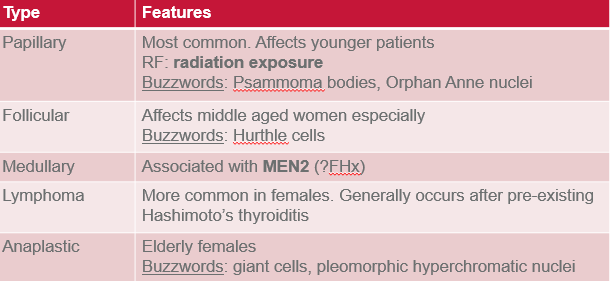
What are the different types of thyroid cancers?
What are their features?
Acromegaly:
- Cause:
- presentation
- Investigations
- Treatment:
- Cause: in adults- acromegaly/ in kids gigantism
- Usually caused by a GH secreting adenoma in the pituitary. -> GH stimulates release of IGF-1 à growth of bones and soft tissues
- presentation: rings and shoes become right, ↑ sweating, coarse facial features, sleep apnoea, weight gain, headaches/visual disturbance, carpal tunnel syndrome, hypertension, insulin resistance
- Investigations:
- Screening: serum IGF-1
- Diagnostic: OGTT à acromegalics fail to suppress GH after 75g glucose load
- MRI brain to visualise the pituitary tumour
- Treatment:
- 1st line = transphenoidal hypophysectomy
- 2nd line = somatostatin analogue e.g. ocreotide
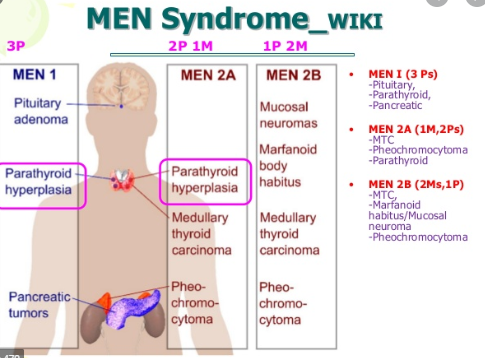
What are the different MEN syndromes?
What mutation do they involve?
What organ do they affect?
What is the caricnoid syndrome?
Where are common sites for it?
What is the presentation?
What are the investigations?
What is the caricnoid syndrome? symptoms caused by the systemic release of humeral factors (serotonin, histamine, tachykinins and prostagladin) from carcinoid tumours
Where are common sites for it? appendix and rectum
What is the presentation? : paroxysmal flushing, diarrhea, crampy abdominal pain, wheeze, sweating, palpitations
What are the investigations?
- 24 hour urine collection: ↑ 5-HIAA levels (serotonin metabolite)
- CT/MRI to localize tumour. Also consider looking for underlying MEN 1
A 49 year old woman presents with 4kg weight loss over 2 months. She complains of feeling hot all the time and her partner mentions that she’s been more irritable recently. On examination she has a smooth goitre, and you also notice proptosis and a rash on her shins. What is the most likely diagnosis?
- De Quervain’s thyroiditis
- Toxic multinodular goitre
- Grave’s disease
- Menopause
- Medullary thyroid cancer
- De Quervain’s thyroiditis
- Toxic multinodular goitre
•Grave’s disease
- Menopause
- Medullary thyroid cancer
A 16 year old boy presents to the GP with polyuria and polydipsia. He is diagnosed with diabetes insipidus. This condition is characterized by underproduction of which of the following?
- Antibodies against insulin-producing beta cells of the pancreas
- Anti-diuretic hormone
- Brain natriuretic peptide
- Oxytocin
- Aldosterone
•Antibodies against insulin-producing beta cells of the pancreas
•Anti-diuretic hormone
- Brain natriuretic peptide
- Oxytocin
- Aldosterone
A 35 year old female presents with 4 month history of amenorrhoea. On examination, she is noted to have loss of peripheral vision. What is the most likely underlying problem?
- Second cranial nerve palsy
- Stroke
- Hyperparathyroidism
- Prolactinoma
- Pregnancy
Second cranial nerve palsy
- Stroke
- Hyperparathyroidism
•Prolactinoma
•Pregnancy
A 49 year-old man presents with a history of difficulty sleeping. He reports feeling increasingly tired and general weakness which he attributes to his poor sleep pattern. Additionally, the patient has noticed he has gained weight and sweats more easily. On examination, the patient has coarse facial features. What is the most likely diagnosis?
- Hyperthyroidism
- Cushing’s disease
- Acromegaly
- Hypothyroidism
- Diabetes
- Hyperthyroidism
- Cushing’s disease
•Acromegaly
- Hypothyroidism
- Diabetes
A 50 year old Asian man is referred to diabetes clinic after presenting with polyuria and polydipsia. He has a BMI of 30, a blood pressure measurement of 137/88 and a fasting plasma glucose of 7.7mmol/L. The most appropriate first-line treatment is:
- Dietary advice and exercise
- Sulphonylurea
- Exenatide
- Thiazolidinediones
- Metformin
•Dietary advice and exercise
- Sulphonylurea
- Exenatide
- Thiazolidinediones
- Metformin
A 15 year old girl complains of headaches which started 6 weeks ago. The headaches initially occurred 1-2 times a week but now occur up to five times a week, they are not associated with any neurological problems, visual disturbances, nausea or vomiting. The girls also reports a white discharge from both of her nipples. She has not started menstruating. The most appropriate investigation is:
- Lateral skull X ray
- CT scan
- MRI scan
- Thyroid function tests
- Serum prolactin measurement
- Lateral skull X ray
- CT scan
- MRI scan
- Thyroid function tests
•Serum prolactin measurement
A 58 year old woman presents with an acutely painful neck, the patient has a fever, blood pressure is 135/85, and heart rate is 102 bpm. The patient explains the pain started 2 weeks ago and has gradually become worse. She also experiences palpitations and believes she has lost weight. She presents one week later complaining of intolerance to cold temperatures. What would you see if you performed a radioisotope scan on her?
- Single area of increased uptake
- Multiple areas of increased uptake
- Diffuse increased uptake
- No uptake
- She does not need a radioisotope scan
Single area of increased uptake
- Multiple areas of increased uptake
- Diffuse increased uptake
•No uptake
•She does not need a radioisotope scan

-
Headache28
-
Upper GI39
-
Bones and Calcium Metabolism38
-
Sodium and LFTs23
-
Acute Neuro36
-
Acute medicine19
-
cardiac conditions: chest pain32
-
cancer and bleeding conditions30
-
chronic shortness of breath16
-
Neurodegenerative disease22
-
Vascular diseases25
-
cranial and ophtalmology33
-
Cardiac causes of SOB27
-
Acute respiratory problems14
-
ENDO20
-
infections and antibioticcs28
-
Urology30
-
Vasculitis and Autoimmune disease43
-
from oxford handbook61
-
Lower GI21
-
Derm35
-
breast18
-
anaemia55
-
acute GI30
-
Valvular disease and HTN42
-
Biliary and liver49
-
Arthritis21
-
Infectious diseases31
-
renal83
-
ECG and CXR55
-
Adrenal30
-
Cough27
-
ABGs30
-
Infectious disease 232
-
Questions for cardio42
-
Extra questions155



