What is DCF valuation?
Discounted cash flow valuation = the process of valuing an investment by discounting its future cash flow.
What is the payback rule?
A method used to assess potential investments from the amount of time it takes for an investment to generate cash flows sufficient to recover its initial cost.
What is the shortcomings of the payback rule compared to NPV?
- The payback rule does not discount, thus ignoring the time value of money
- Does not include any risk differences (same calculation for very risky and less risky investments)
- It is very hard to come up with the “right” cutoff period
What is the main reason why the discounted payback rule most often is not used?
If you have to discount the cash flows anyway, the discounted payback rule is no longer faster than NPV, wherefore NPV is used as the best choice.
What is the AAR?
Average Accounting Return
Definition used in the book (definitions differ):
Average net income / Average book value
What are the shortcomings/drawbacks of the AAR rule?
- It is not a ROR. It is instead a ratio of two accounting measures.
- It ignores time value of money
- The target AAR is a number drawn up from a hat like the payback period
- It looks at the wrong things. Instead of cash flow and market value it uses net income and book value (poor substitutes)
What is the IRR?
The internal rate of return.
The discount rate that makes the NPV of an investment zero.
In other words, the IRR on an investment is the required return that results in a zero NPV when it is used as the discount rate.
How do you calculate the IRR?
By trial and error
You try to figure out what return rate you should discount at for the NPV to be zero.
Or using a financial calculator (IRR)
In which cases is the decision using NPV and IRR the same and different?
Always the same UNLESS
- The cash flow is not conventional meaning that it starts with one negative cash outflow followed by purely positive inflows
- In such cases the IRR rule breaks down completely and should be avoided as multiple rates can give NPV = 0
- The cash flow is not independent. If the decision on one investment affects the decision on another investment, the decision using the two different approaches will most likely not be the same.
- The decision will depend on the required return as investment B can be better than A and vice versa at different required return rates due to different payback times ⇒ Again… Stay with NPV
For what reason is the IRR rule often preferred to the NPV rule?
IRR focuses on rates of return whereas NPV gives dollar values.
Rates of return are often easier to use for calculations.
What are the MIRR approaches?
Modified internal rate of return
- The discounting approach
- discount all negative cash flows back to the present as the required return and add them to the initial cost (making the numbers conventional)
- The reinvestment approach
- Compounds all cash flows (positive and negative) EXCEPT the first out to the end of the project’s life and then calculate the IRR.
- The combination approach
- A combination of method 1 and 2 above
- Negative cash flows are discounted back to the present, and positive cash flows are compounded to the end of the project.
What is the profitability index?
The present value of an investment’s future cash flows divided by its initial cost.
Benefit-cost ratio.
(problematic with mutually exclusive investments)
What are the differences between debt and equity?
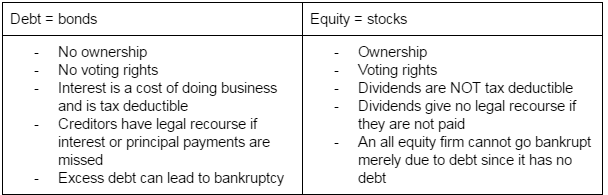
What is incremental cash flows?
The difference between a firm’s future cash flows with a project and those without a project ⇒ Also means cash flows that are independent of the decision of the specific project are irrelevant.
“any and all” changes in the firm’s future cash flows as a direct consequence of taking the project.
What is the stand-alone principle?
You evaluate a project based on its incremental cash flows ⇒ Completely independent from everything else.
You see the project as a “minifirm” and look at its cash outflow and inflow.
What are classic pitfalls when evaluating projects and their incremental cash flows?
- Including sunk costs in the calculation
- Forgetting opportunity costs
- Forgetting side effects (spillover effects, both good and bad)
- Forgetting costs to additional net working capital
- Including financing costs: interest, dividends, principal (this will be done when discounting the cash flow)
- Thinking “accrued”. We are using cash-based accounting to look at investment projects as we are interested in their cash flows.
What is erosion?
The cash flows of a new project that come at the expense of a firm’s existing projects.
What are pro forma financial statements?
Financial statements projecting future years’ operations
How do you calculate project operating cash flow for each year?
Earnings before interest and taxes
- Taxes
+ Depreciation
(and for the last year we also subtract the change in net working capital; we get the money “back” maybe with slight difference due to sales on credit or costs we have not yet paid) ⇒ subtract so if the change is negative it will be minus minus = plus
When is something a tax on capital gain?
Using a general (albeit rough) rule, a capital gain occurs only if the market price exceeds the original cost
⇒ thus not in case you have depreciated your asset too much such that book value is lower than market value (you will still pay a tax but not capital gain tax).
What are some alternative ways to calculate operating cash flow (OCF)?
- Bottom-up approach:
- Net income and then add any non-cash deductions such as depreciation
- Only useful if interest expense has not been subtracted from net income
- Net income and then add any non-cash deductions such as depreciation
- Top-down approach
- Sales - Costs - Taxes
- Start at the top of the income statements and work down by adding and subtracting net cash flow
- The Tax Shield Approach
- OCF = (Sales - Cost) * (1 - T) + Depreciation * T
- T = tax rate (34 % = 0.34)
- OCF = (Sales - Cost) * (1 - T) + Depreciation * T
What does depreciation tax shield mean?
The tax savings that results from the depreciation deduction, calculated as “Depreciation * T”
What is EAC?
Equivalent annual cost (EAC)
The present value of a project’s costs calculated on an annual basis (makes it possible to compare equipment options)
What is ACRS?
Accelerated cost recovery system
A depreciation method under U.S. tax law allowing for the accelerated write-off of property under various classifications.

-
ME2016Q3 (Lars)142
-
FA2016Q4302
-
IE2016Q4328
-
S2016Q5196
-
GLOBEEU2016136
-
CG2016Q5114
-
BRM2016Q6122
-
GLOBEMB148
-
GLOBEMIC81
-
GLOBEFM128
-
GLOBEFMP236
-
IOA2017Q13164
-
FMGLOBEP289
-
MBFINAL155
-
IBL2017111
-
GSCM2017234
-
Thai Basic83
-
FINANCECAPCI187
-
CIP37
-
IBS2018190
-
2018THESIS48
-
SPANISH BASIC 11317
-
GMAT396
-
GMAT - Verbal71
-
SPANISH BASIC 2108
-
PythonPart2(logic)8
-
PythonBasics530
-
SQL and NoSQL Databases39
-
Cloud Computing98
-
Lars Spanish ESADE97
-
AWSexam_1796
-
AWSExam_2338



