What is the shape of the stomach?
What are the 3 main sections of the stomach?
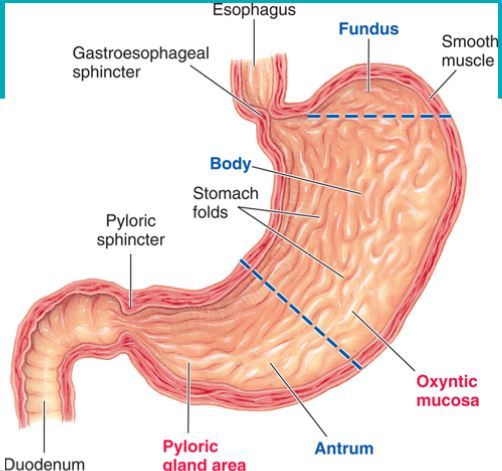
•The stomach is a J-shaped saclike chamber lying between the esophagus and the small intestine
–Sections: fundus, body, and antrum
The stomach stores food and begins protein digestion:
What does it produce?
chyme
What does gastric filling involve?
What does this allow?
- Gastric filling involves receptive relaxation
- Allows the stomach to accommodate the meal
Label a cross section of the stomach
- Fundus- helps with storage of gas produced by breakdown of stamch contents
- Body- Largest secton of the stomach
- Antrum- Thicker muscle helps ejection of contents into the duodenum
Musculatoure gets thicker further down the stomach Stomach contents can mechancically grind and propel the chyme
Gastric Storage and Mixing:
Where does gastric storage take place?
Where does gastric mixing take place?
How long does it take for the stomach to eject contents into the duodenum
•Gastric storage takes place in the body of the stomach
–Food is gradually fed from the body into the antrum, where mixing takes place
•Gastric mixing takes place in the antrum of the stomach
–Repulsion: churning action that shears and grinds the chyme
Takes about 20 mins for the stomach to eject contents into the duodenum?
What is gastric emptying largely controlled by?
•Gastric emptying is largely controlled by factors in the duodenum
–Factors in the stomach that influence the rate of gastric emptying
•Amount and fluidity of chyme
–Factors in the duodenum that influence the rate of gastric emptying
•Fat, gastric acid, hypertonicity of chyme, and distension of duodenum
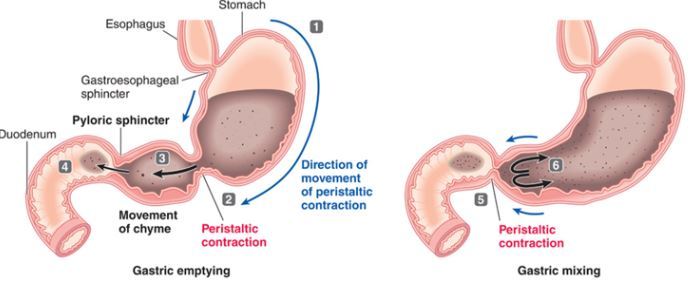
Describe the process of gastric emptying (1-4) and gastric mixing (5-6)
- A peristaltic contraction originates in the upper fundus and sweeps down toward the pyloric sphincter
- The contraction becomes more vigorous as it reaches the thick-muscled antrum
- The strong antral peristaltic contraction propels the chyme forward
- A small porrtion of chyme is pushed through the partially opens sphincter into the duodenum. The stronger the antral contraction, the more chyme is emptied with each contractile wave
- What the peristal contraction reaches the pyloric sphincter, the sphincter is tightly closed and no further emptying takes place
- When chyme that was being proelled forward hits the closed sphincter, it is tossed back into the antrum. Mixing of chyme is accomplished as chyme is propelled forward and tossed back into the antrum with each peristaltic contraction a process called retropulsion
Gastric Motility:
Can emotions influence gastric mobility?
Does the stomach actively participate in vomiting?
•Emotions can influence gastric motility
–Act through the autonomic nerves to influence the degree of gastric smooth muscle excitability
•The stomach does not actively participate in vomiting
–Causes of vomiting: throat stimulation, irritation, elevated intracranial pressure, etc.
–Effects of vomiting: large losses of secreted fluids and acids can lead to dehydration
Gastro-enteric nervous system: Describe nervous control of peristalsis
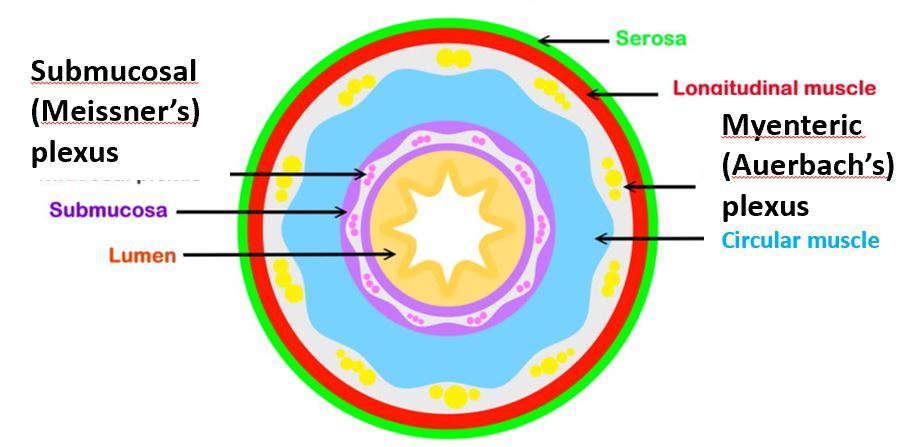
- Intrinsic gastro-enteric nervous system = system of interconnected ganglia
Meissner’s (submucosal) plexus-between circular muscle and submucosa
Auerbach’s (myenteric) plexus- between longitudinal and circular muscle
- Extrinsic gastro-enteric nervous system:
Post-ganglionic sympathetic.
Some cholinergic, some adrenergic
Pre-ganglionic parasympathetic.
Mainly cholinergic causing contraction
Some intrinsic nerves are peptidergic
Gastro-enteric nervous system: Describe hormonal control of peristalsis
Somatostatin
- Decrease acetylcholine release by myenteric nerves, causing decreased peristalsis
Substance P
- Stimulates intrinsic myogenic activity causing increased peristalsis
- Capsaicin is a chili pepper extract with analgesic propeties (mimics the effect of substnace P) and speeds up gastric activity
Motilin
- Stimulates extended contractions
- Causing ‘migrating motor complext’
What are the main gastric Secretions?
What are their functions?
•Gastric digestive juice is secreted by glands located at the base of gastric pits
Stomach also has ridges of muscle tissue called rugae to incresase surface area
–Exocrine secretory cells in the walls of the pits and glands: mucous, chief, and parietal
–Mechanism of H+ and Cl- Secretion
–Functions of HCl:
pH2- antimicrobial
helps break down stomach contents
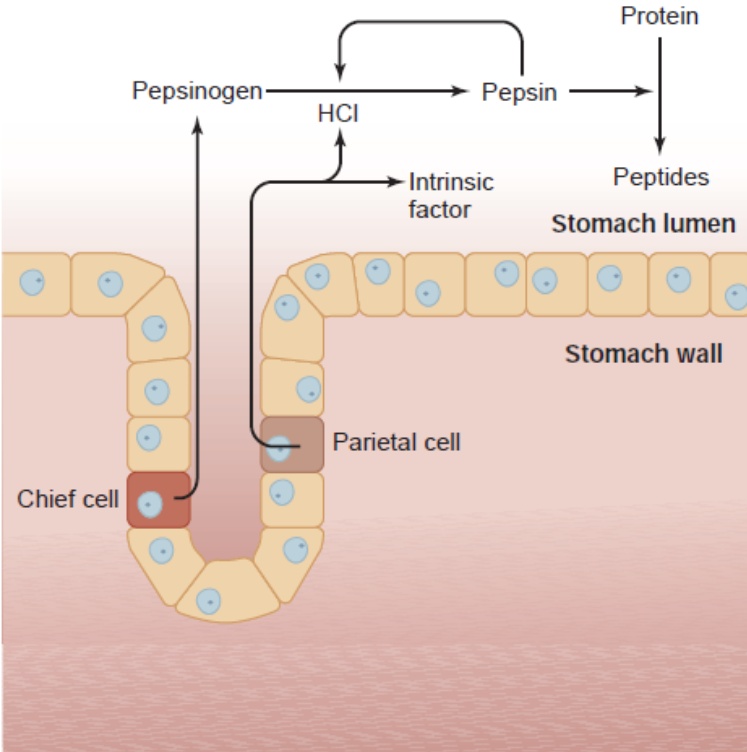
—Hydrochloric acid is secreted by parietal cells and activates pepsinogen
Describe mechanism of hcl secretion
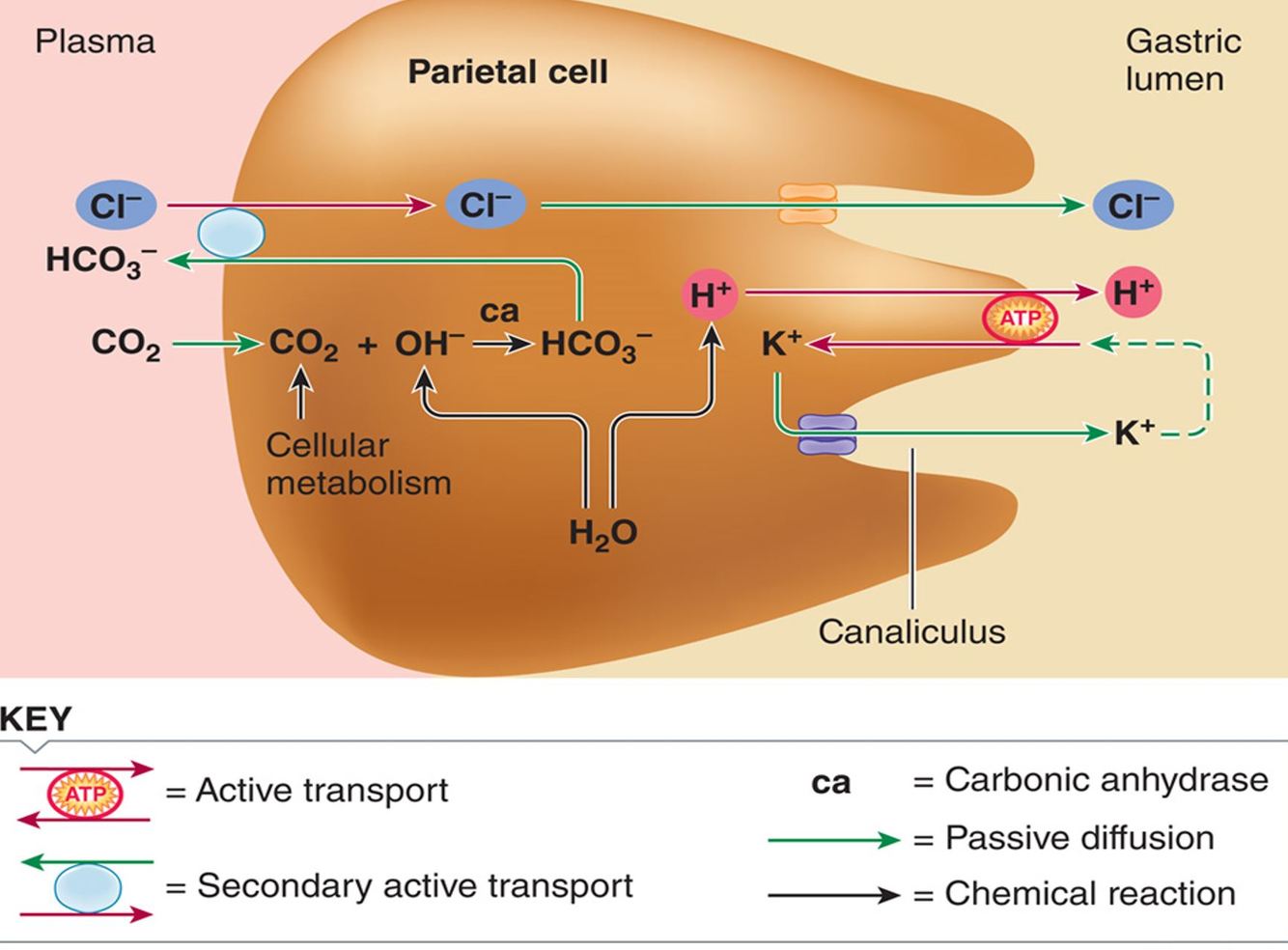
The stomach’s parietal cells actively secrete H1 and Cl2 by the actions of two separate pumps. H1 is secreted into the lumen by a primary H1–K1 ATPase active-transport pump at the parietal cell’s luminal border. The H1 that is secreted, as well as HCO32, is formed within the parietal cell from H2O and CO2 in a reaction catalyzed by carbonic anhydrase. Cl2 is secreted by secondary active transport. Driven by the HCO32 concentration gradient, a Cl2–HCO32 antiporter in the basolateral membrane transports HCO32 down its concentration gradient into the plasma and simultaneously transports Cl2 into the parietal cell against its concentration gradient. Cl2 secretion is completed as the Cl2 that entered from the plasma diffuses out of the cell down its electrochemical gradient through a luminal Cl2 channel into the lumen.
FIGURE FOCUS: What effect does a drug that blocks the parietal cells’ H1–K1 ATPase pump have on gastric HCl secretion and on the pH of the venous blood leaving the stomach?
Describe the structure of the stomach cells at the micro level
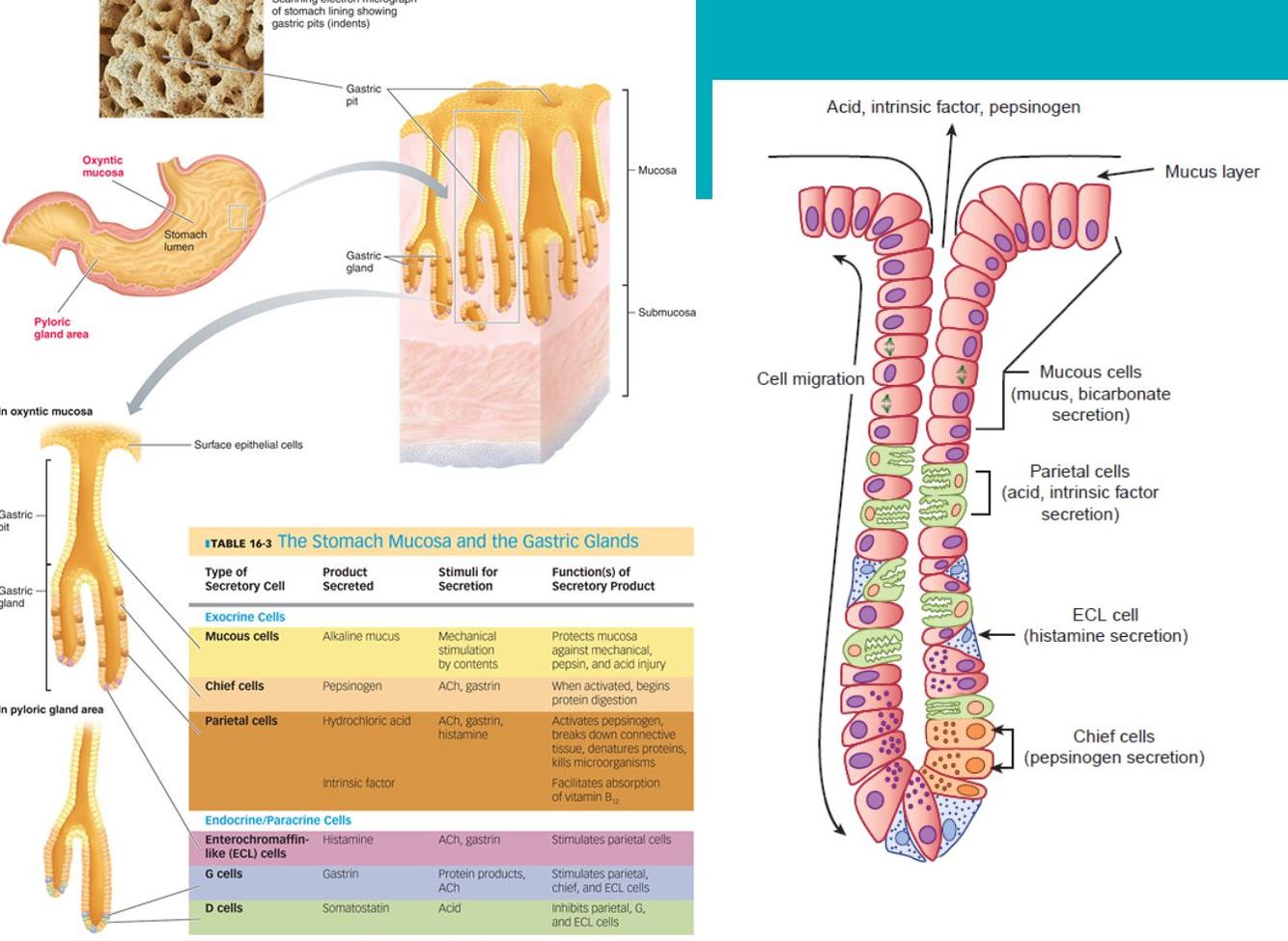
- Mucus cells near the top- secrete thick mucus to protects the stomach
- Parietal cells that secrete HCL and intrinsic factor which helps with absorption of viatmin B12- pernicious anaemia is the disease where people dont produce intrinsic factor therefore cannot absorb vitamin B12
- ECL cell- histamine secretion
- Chief cell (pepsinogen secretion)- activated by HCL produced by parietal cells
What is the inactive form of pepsin?
What substance lubricates, protects the stomach wall, and protects against acid injury?
What is essential for absorption of vitamin B12
-Secretory product of the parietal cells
•Pepsinogen is activated to pepsin, which begins protein digestion
–Major digestive constituent of gastric secretion
•Mucus is protective
–Lubricates, protects the stomach wall, and protects against acid injury
•Intrinsic factor is essential for absorption of vitamin B12
–Secretory product of the parietal cells
Control of Gastric Secretion:
- Multiple regulatory pathways influence the parietal and chief cells
- Control of gastric secretion involves three phases:
–Cephalic phase
–Gastric phase
–Intestinal phase
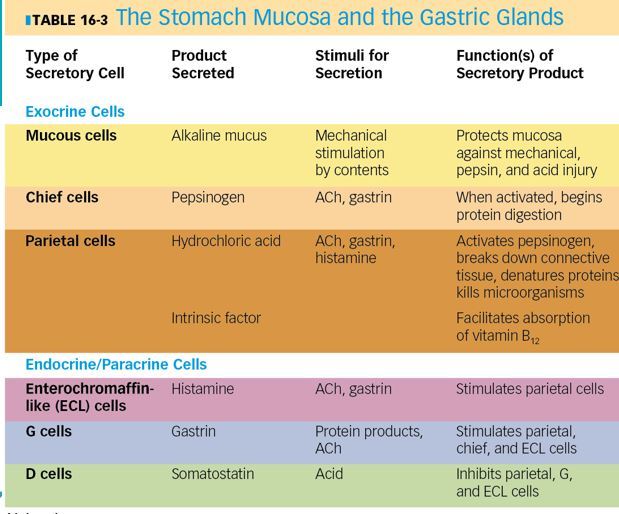
The Stomach Mucosa and the Gastric Glands
Explain the phases of gastric acid secretion
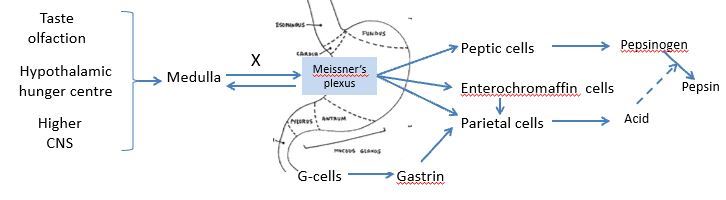
Cephalic phase
- Vagal reflex
- Stimulates pepsinogen secretion (peptic cells) directly
- Stimulates acid secretion (parietal cells) directly and indirectly via enterchromaffin cells releasing histamine (paracrine route) which stimulates H2 receptors on parietal cells
- Food in antrum and duodenum stimulates G-cells to release hormone gastrin (endocrine route) to stimulate parietal cells
Gastric phase
- Intrinsic gastric reflexes and extrinsic (vago-vagal )reflexes to stimulate parietal and peptic cells
- Further stimulation of gastrin secretion
Intestinal phase
• Mostly secretion of gastrin by duodenal G-cells
Taste olfaction, Hypothalamic hunger centre, Higher CNS
The Gastric Mucosal Barrier
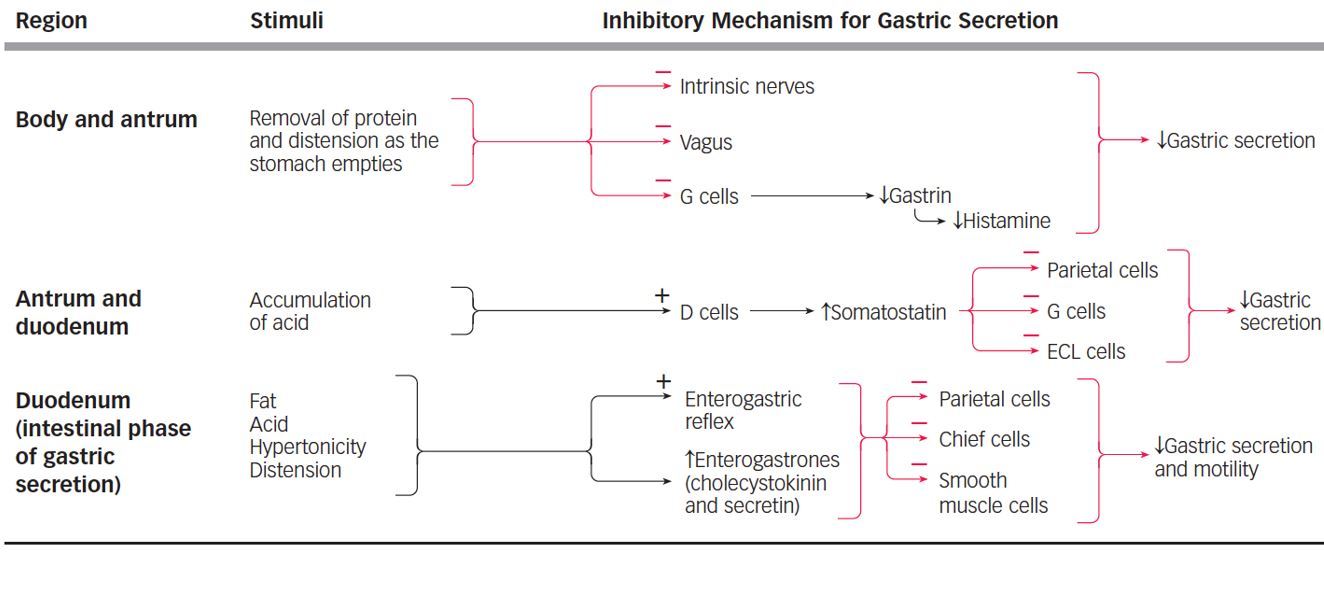
•Gastric secretion gradually decreases as food empties from the stomach into the intestine
–Refer to next slide
•The gastric mucosal barrier protects the stomach lining from gastric secretions
–Properties of the gastric mucosa that enable the stomach to contain acid without injuring itself
Describe the Inhibitory mechanism of Gastric Secretion of the stimuli for the 3 stomach regions
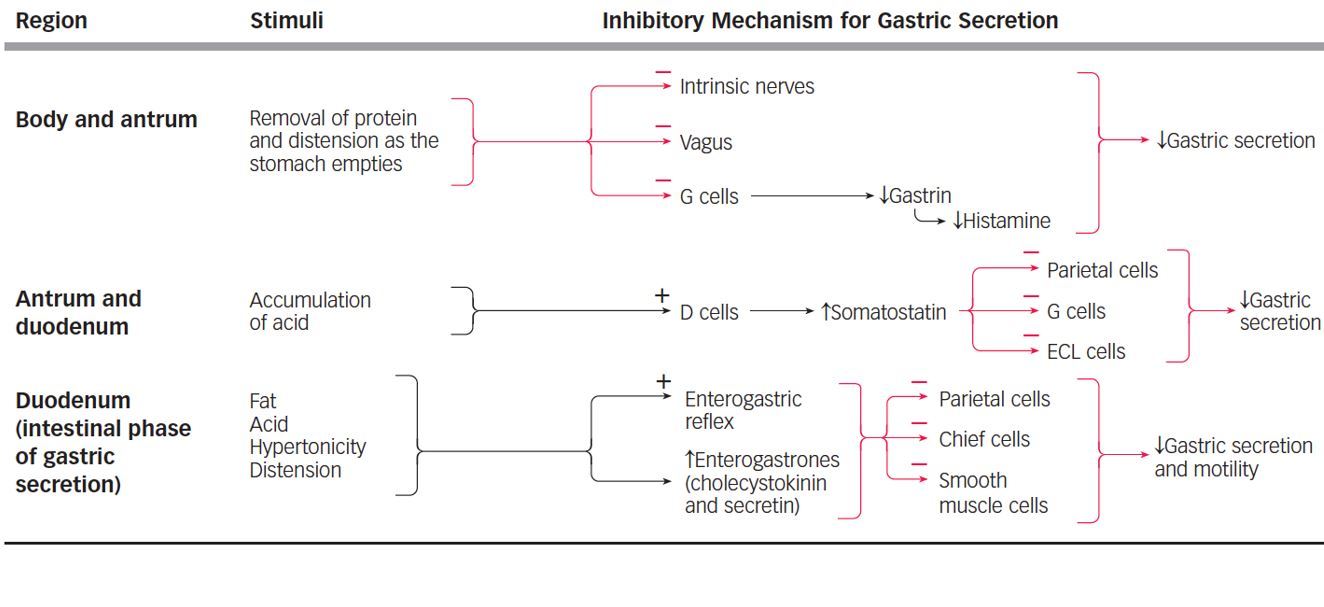
Inhibition of Gastric Secretion
Digestion and adsorption
•Carbohydrate digestion continues in the body of the stomach
–Protein digestion begins in the antrum
•The stomach absorbs alcohol and aspirin but no food
–No food or water is absorbed into the blood through the stomach mucosa, but alcohol and aspirin are directly absorbed
Pancreatic and Biliary Secretions
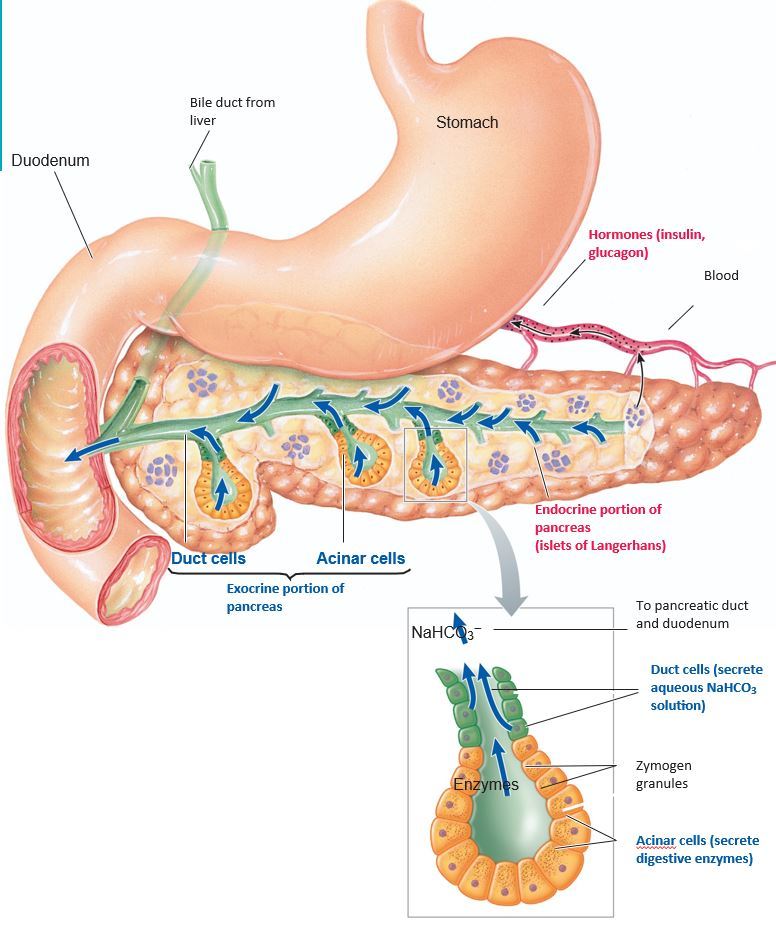
•The pancreas is a mixture of exocrine and endocrine tissue
–Elongated gland that lies behind and below the stomach
•The exocrine pancreas secretes digestive enzymes and an alkaline fluid
–Pancreatic proteolytic enzymes
–Pancreatic amylase and pancreatic lipase
–Pancreatic aqueous alkaline secretion
Describe Exocrine and endocrine portions of the pancreas
The exocrine pancreas secretes into the duodenal lumen a digestive juice composed of digestive enzymes secreted by the acinar cells and an aqueous NaHCO3 solution secreted by the duct cells.
The endocrine pancreas secretes the hormones insulin and glucagon into the blood.



-
Respiration 148
-
FR1-Respiration44
-
Respiration 276
-
Respiration 343
-
Energy balance 134
-
FR1-Energy Balance35
-
Energy balance 234
-
FR2- Energy Balance37
-
Energy balance 338
-
FR3-Energy balance8
-
Muscle Physiology-Skeletal Muscle46
-
FR-Muscle physiology33
-
Muscle Physiology-Skeletal Muscle:Mechanics, control of force of contraction, energy sources25
-
Muscle 329
-
Gut 139
-
Fr1- Gut 149
-
Gut 233
-
FR2- GUT 256
-
Gut 338
-
FR3-GUT 352
-
FR4-GUT 329
-
Urinary 143
-
Urinary 225
-
Urinary 335



