Describe the properties of tubular reabsorption
•Tubular reabsorption is tremendous, highly selective, and variable
–Quantity reabsorbed of each substance is the amount required to maintain proper internal fluid environment composition and volume
Which type of transport does tubular reasbsorption involve?
•Tubular reabsorption involves transepithelial transport
–Transepithelial transport (requires energy)
–Passive and active reabsorption
Describe the reabsorbtion processes from tubular lumen to peritubular capillary
Compounds need to cross:
- The luminal cell membrane
- The cytosol inside the tubular epitherlial cells
- The basolateral cell membrane (furthest away from the lumen)
- The interstitial cell membrane
- The interstitial fluid
- The capillary walls to get back unti the blood
Epithelial cells are either side of the tubular lumen and they provide a parrier to compounds that are in the filtrate from just being absorbed. There are tight junction found in the lateral spaces between tubular epithelial cells which limit the ability of compunds to move in between cells to get into the extracellular fluid from the filtrate. This leaves the transcelular route for reabsorption
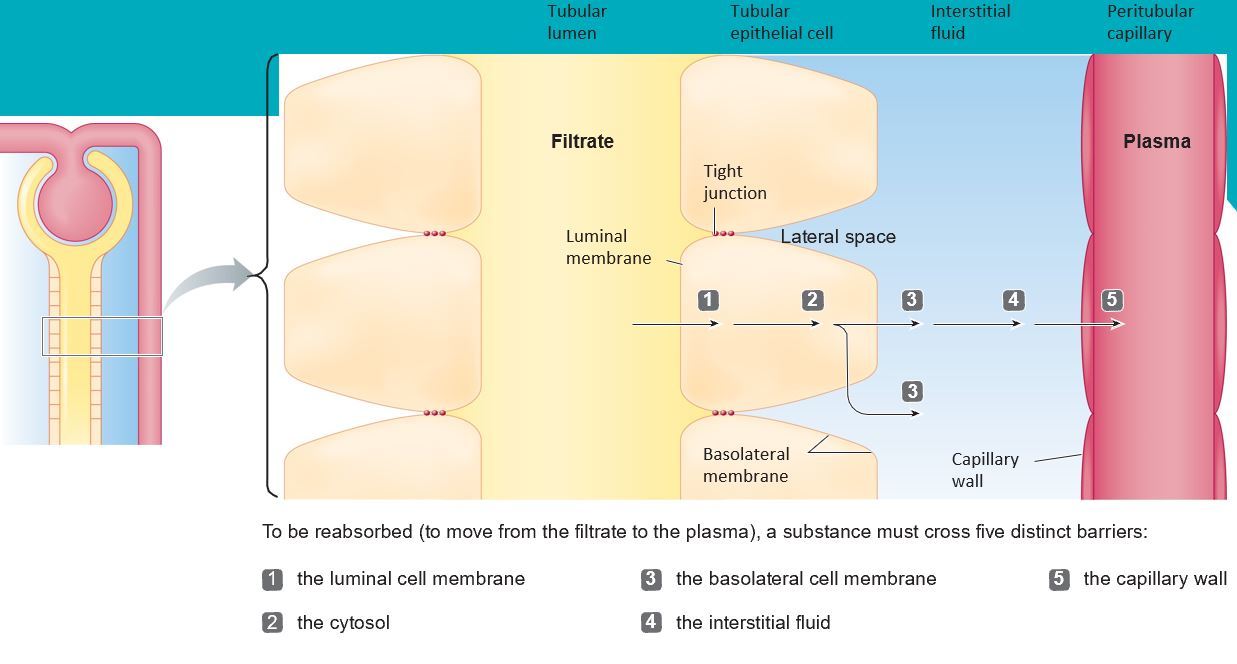
Tubular Reabsorption: What does Na+ reabsorption depend on?
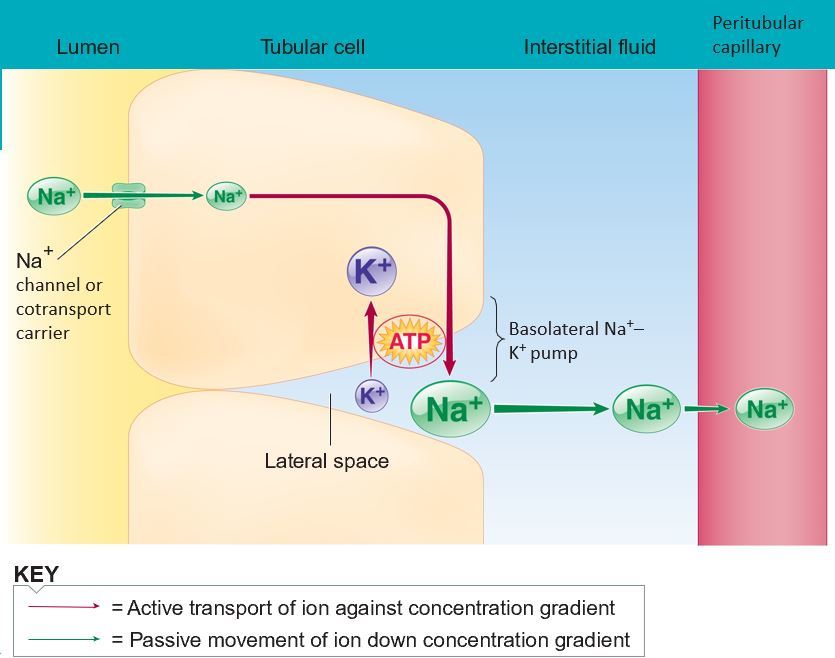
•Na+ reabsorption depends on the Na+–K+ ATPase pump in the basolateral membrane (futhest away from the filtrate)
Of the Na+ reabsorbed, on average, how much is reabsorbed in the proximal tubule, loop of henle and in the distal and collecting tubules?
Does sodium reabsorption play different important roles in each of these segments?
–Of the Na+ reabsorbed, on average 67% is reabsorbed in the proximal tubule (earliest tubular compoennts of the nephron- more permeble), 25% in the loop of Henle, and 8% in the distal (latest parts of the tubular components of the nephron- less permeable)and collecting tubules
– Yes
Sodium reabsorption plays different important roles in each of these segments, its reabsorbption contributes to the reabsorption of water and chloride
State the transport methods involved in sodium reabsorption from the lumen to the peritubular capillary
- Sodium channels or co-transporters (e.g. SGLT 2) tansports a molcule of sodium and glucose across the lumenal membrane of the epithelial cells
- Sodium is pumped out at the basolateral side of the cell via Na+-K+ ATPase pump
- Sodium diffuses across the interstitial fluid and then into the blood
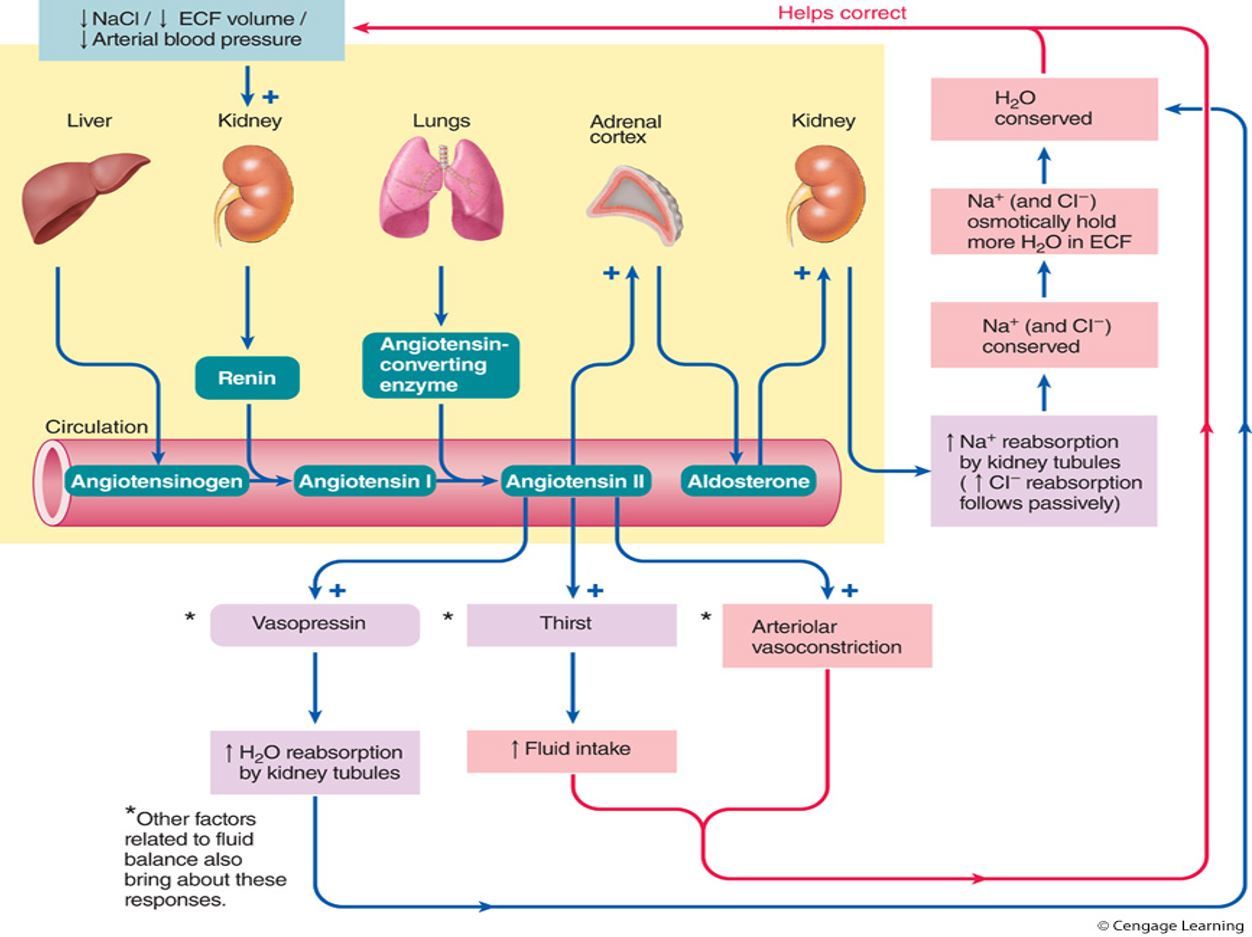
Aldosterone and Na+ Reabsorption in the Distal and Collecting Tubules: Explain the Renin–angiotensin– aldosterone system (RAAS)
- Activated by ↓ in NaCl, ECF volume, and arterial blood pressure
- Juxtaglomerular cells secrete renin into blood
- Renin acts as an enzyme to activate angiotensinogen into angiotensin I
- Angiotensin I is converted into angiotensin II by angiotensin-converting enzyme (ACE)
- Angiotensin II is the main stimulus for secretion of the hormone aldosterone from the adrenal cortex
What is the function of the RAAS?
What is it largely activated by?
State the direct connection between the kidney and the cardiovasciular system
- To increase Na+ reabsorption by principal cells (not intercalated cells)
- It is largely activated not by dehydration but by changes in blood pressure
- (The kidney reabsorbs water and salt, that will change the volume of water in the blood and therefore it is a key regulator of blood pressure- direct connection between the kidney and the cardiovasciular system)
- A drop in sodium (and to a lesser extent chloride ions) in extraceullar fluid will be picked up by osmorecepors (found in the hypothalamus
- If there is a drop in the volume of extraceullular fluid, it will be detectected by baroreceptors in blood vessels- there is less stretch on blood vessels so they will fire fewer action potentials and this will be detected as a drop in blood pressure
- RASS is involed in various disease states e.g hypertension and heart failure
Describe factors related to fluid homeostasis and blood pressure
- Pro-renin cleaved to renin
- Renin cleaves antiotensingoen to antgiotensin
- Angiotensin converting enzyme converts angiotensin I to antgiotensin II
- Angiotensin II drives thirst and is a potent arteriolar vasoconstrictor
- Angiotensin II stimulates the realease of vasoproessin (from posterior pituitary gland- pores)
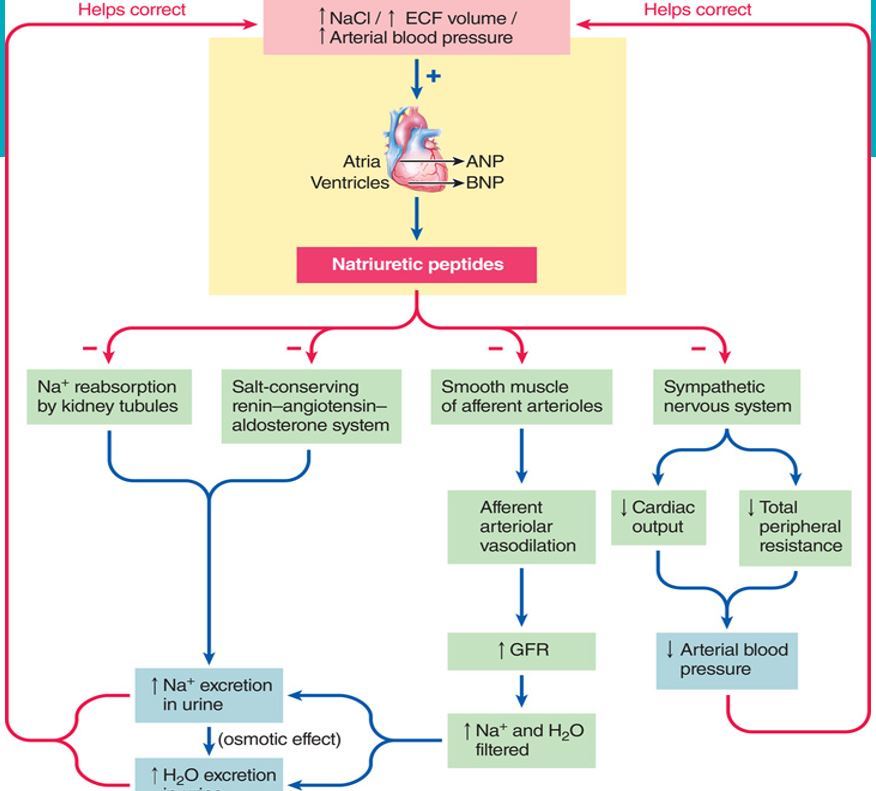
Natriuretic Peptides Inhibit Na+ Reabsorption:
What produces natruresis (the process of releasing sodium in the urine) ?
•Atrial natriuretic peptide (ANP) and brain natriuretic peptide (BNP) produce natriuresis
How are glucose and amino acids reabsorbed?
•Glucose and amino acids are reabsorbed by Na+ -dependent secondary active transport
–Specialized symport carriers transfer Na+ and the specific organic molecule from the lumen into the cell
Naturiuretic peptides: What happens after an increase in electrolyte levels / ECF volume/ arterial blood pressure?
- Increase in electrolyte levels/ ECF volume/ arterial blood pressure
- release of naturetic peptides
- naturetic peptides inhibit sodium reabsorption, RAAS, smooth muscles of afferent arterioles and the sympathetic NS
- inhibit vasocronstriction in arterioles and dampen down sympathetic NS signalling (decreased CO and TPR)
- More Na+ and H2O excreted in the urine
- This corrects the initial stimulus
Describe water reabsorption
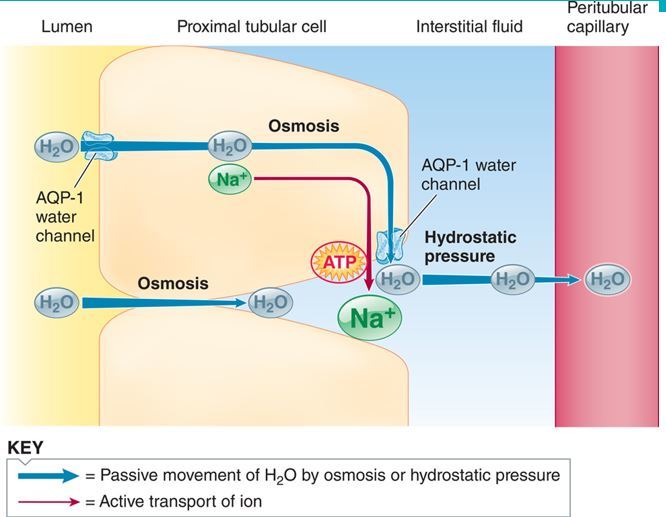
There is some paracellular movemenent and this is osmotically driven- into the interstitial fluid
More controlled method of water reabsorption:
Via aquaporins (AQP-1, AQP-2, AQP-3, AQP4) these are the water channels that vasopressin cause to be translocated to the lumen membrane to allow water to mmove in and out of the cell
AQP-1 and AQP-2 are generally found on the luminal membrane
AQP-3 and AQP-4 are generally found on the basolateral membrane
When water passes into the interstitial fluid there is an increase in hydrostatic pressure and this forces water into the blood vessels
Actively Reabsorbed Substances (Normally) Exhibit a Tubular Maximum:
How is glucose reabsorbed?
What is the tubular maximum for glucose?
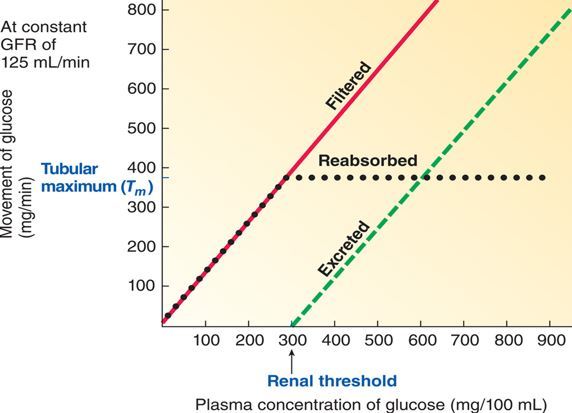
- Maximum reabsorption rate
- Glucose is an actively reabsorbed substance not regulated by the kidneys
–Freely filtered
–Tubular maximum for glucose (Tm) is 375mg/min (normally none in urine)
–Reason why the kidneys do not regulate glucose
Describe the relationship between tubular maximum and renal threshold
All of the filtered glucose is reabsorbed up to the 300 mh/100mL limit
Above this limit, it is excreted
Therefore there wont be any glucose in the urine unless there is an increase in the rate of glucose being filtered
Tubular Secretion:
What hastens elimination of foregin compounds?
Explain the importance of organic ion secretory system
•Organic anion and cation secretion hastens elimination of foreign compounds
–Importance of organic ion secretory system
- H+ secretion controls acid:base balance
- K+ secretion maintains the ECF levels of K+ and is regulated by aldosterone
- Secretion removes foreign organic chemicals, including food additives, environmental pollutants, etc.
Tubular Secretion:
What is extremely important in acid-base balance?
–Renal H+ secretion is extremely important in regulating acid–base balance in the body
Tubular secretion:
Potassium ion secretion is controlled by aldosterone
–Mechanism and control of K+ secretion (aldosterone)
–Effect of H + secretion on K + secretion (intercalated cells)
–Importance of regulating plasma K + concentration (membranes)
Describe the passive diffusion and active transport of potassium from the peritubuar capillary to the lumen
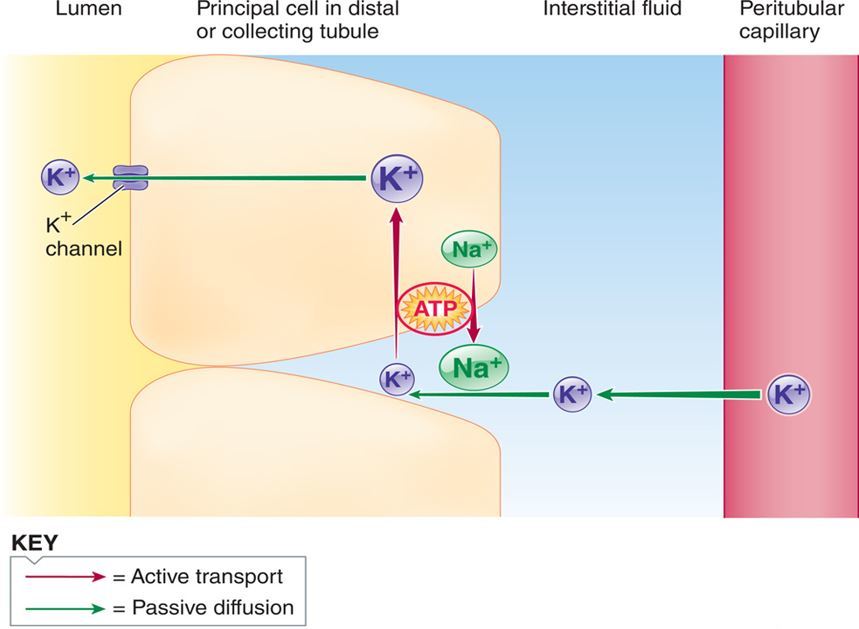
The route for potassium secretion is the opposite for sodium reabsorption
- Potassium in the blood will diffuse out in the interstitial fluid
- It will be pumped using energy via the Na+-Ki+ ATPase across the basolateral membrane of the cell into the cytosol of the cell
- It will then be released via a potassium channel which could involve the release of H+ or the release of bicarbonate into the lumen where it can then be excreted
Describe the factors that stimulate and effect the response of aldosterone
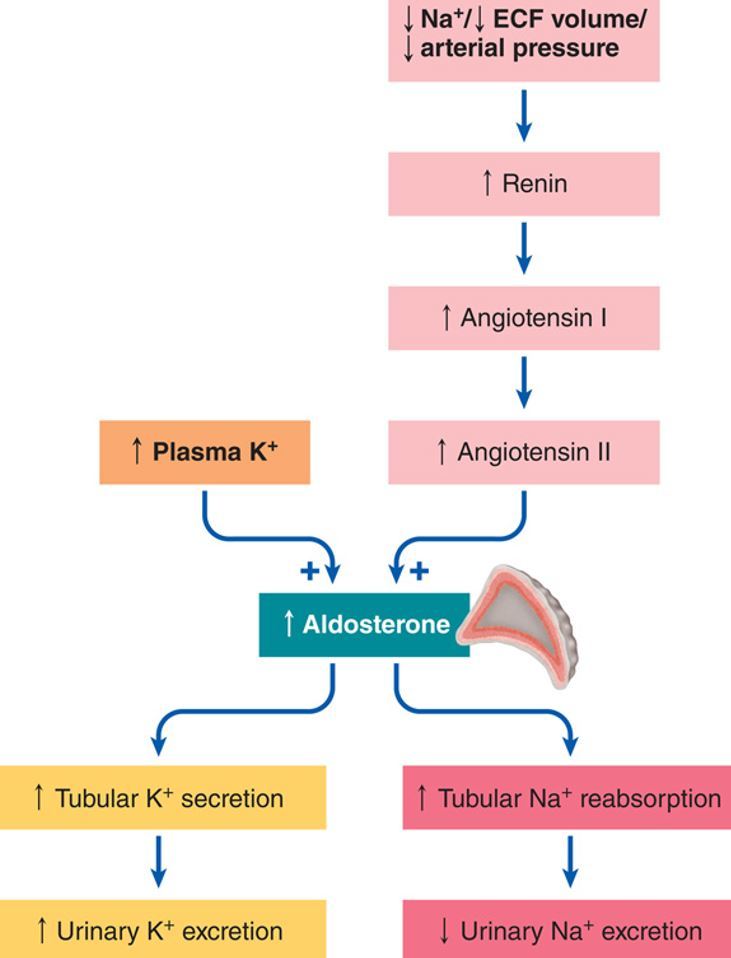
- Stimulated by an increase in plasma potassium which will cause aldosterone release which will increase the tubular potassium secretion which will increase the urinary potassium excretion
- Stimulated by angiotensin II which will increase tubula Na+ reabsorption and decrease urinary Na+ excretion
Give a summary of secretion across the proximal tubule portion of the nephron
- Variable H+ secretion, depending on acid-base status of body
- Organic ion secretion; not subject to control
Give a summary of reabsorption across the proximal tubule portion of the nephron
- 67% of filtered Na+ actively reabsorbed, not subject to control; Cl-follows passively
- All filtered glucose and amino acids reasorbed by secondary active transport; not subject to control
- Variable amounts of filtered Po43- and other electrolytes reabsorbed; subject to control
- 65% of filtered H2O osmotically reabsorbed; not subject to control
Give a summary of reabsorption across the distal tubule and collecting duct of the nephron
- Variable Na+ reabsorption, controlled by aldoesterone; Cl- follows passivelly
- Variable H2O reabsorption, controlled by vasopressin
Give a summary of secretion across the distal tubule and collecting duct of the nephron
- Variable H+ secretion, depending on acid-base status of body
- Variable K+ secretion, controlled by aldoesterone

-
Respiration 148
-
FR1-Respiration44
-
Respiration 276
-
Respiration 343
-
Energy balance 134
-
FR1-Energy Balance35
-
Energy balance 234
-
FR2- Energy Balance37
-
Energy balance 338
-
FR3-Energy balance8
-
Muscle Physiology-Skeletal Muscle46
-
FR-Muscle physiology33
-
Muscle Physiology-Skeletal Muscle:Mechanics, control of force of contraction, energy sources25
-
Muscle 329
-
Gut 139
-
Fr1- Gut 149
-
Gut 233
-
FR2- GUT 256
-
Gut 338
-
FR3-GUT 352
-
FR4-GUT 329
-
Urinary 143
-
Urinary 225
-
Urinary 335



