Define heart failure
-pathophysiologic state in which the heart is unable to pump blood at a rate commensurate with the body’s requirements, OR can do so only from an elevated filling pressure -has NOTHING to do with ejection fraction
Main causes of heart failure
-Primary cardiac causes: ischemic heart disease is most common -HTN, DM, toxins (alcohol, adriamycin), thyrotoxicosis
Syndrome of heart failure
-constellation of sxs including dyspnea, fatigue, exercise intolerance, swelling -can be acute or chronic
Stages vs classes of heart failure. Which is preferred?
-stages: 1 = high risk pts without sxs (HTN, DM, CAD, fam history, cardiotoxic drugs), 2: structural heart disease (LVH, MI, low LVEF, dilation, valve dz) without sxs, 3: prior, current sxs 4. refractory (need LVAD or transplant) -classes I: asymptomatic, II sxs with moderate-strenuous exercise, III: with mild exertion IV at rest. -prefer the use of stages since they capture those without sxs but underlying structural dz
Gender and survival differences in HF
-mean have more CVD at younger ages, but women over take them with age -women may have slight survival advantage -perhaps bc women have less compliance LV
2 classifications of HF
- heart failure with reduced LVEF (/50%: diastolic HF Note the definition of heart failure has nothing to do with EF, but this classification does
Evolution of HF
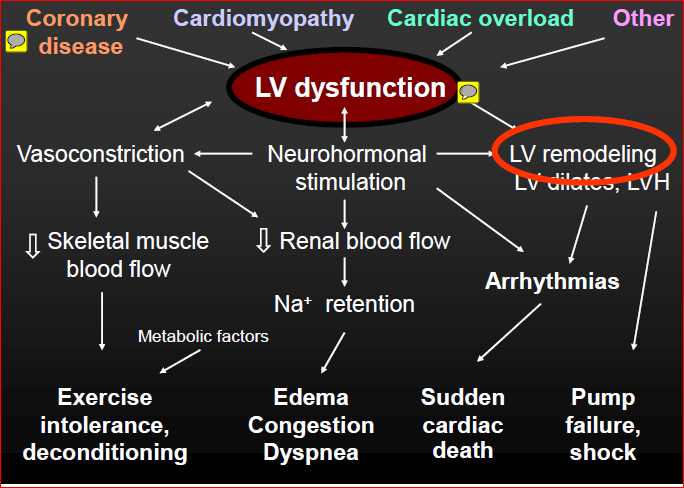
Myocardial failure is due to a ________________. There are several main physiological adjustments to stabolize or increase myocardial perforamce. Name 4.
- due to a specific acute or chronic insult to pump function
- increase preload, increased contractile elements, increased HR, increase contractility
Why does the mechanism of increasing preload in heart failure turn into a bad idea?
-in severe LV dysfunction, the Frank-Starling curve has a peak, but then a downward portion at higher LV filling Ps. So with increased preload, eventually an increase in CO is not achieved. So blood pools in the heart, and raises LA pressure and can cause pulmonary congestion among other issues.
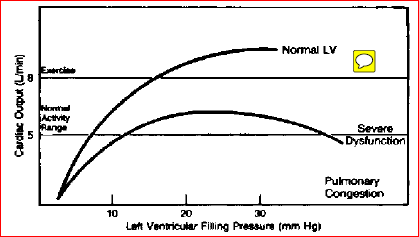
Clinical correlations of increasing preload to a detrimental level in HF
- sxs of V overload: pulmonary congestion (cough, dyspnea, orthopnea, PND), visceral congestion (Liver, GI) leading to abdominal bloating, swelling, early satiety, anorexia, and peripheral edema can be seen.
- physical findings: JVD, HJR, peripheral edema, ascites, anasarca, displace diffuse apex, gallop rhythm
Scenarios LV remodeling occurs in and what is the definition
- Many scenarios: HTN, acute MI, cardiomyopathy, valve dz, chronic ischemia
- process by which ventricular size, shape, and function are regulated by mechanical, neurohormonal, local, systemic, and genetic factors
When the heart faces a hemodynamic burden, it can compensate in 3 general ways. name them and why they go wrong in HF
- increase preload via Frank-Starling to increase cross-bridge formation, but this is limited and leads to dilatation
- augment muscle mass to bear this extra load: remodeling and hypertrophy
- recruit neurohormones to augment contractility: deleterious as chronic mechanism
Which patterns of heart failure lead to systolic vs diastolic HF?
- concentric: diastolic HF; preserved EF
- eccentric: systolic HF; reduced EF–can also have mitral valve regurgitation due to change in ventricular structure
Patients with myocardial disease due to ischemic heart disease or cardiomyopathy have an increased incidence of ________.
- Left bundle branch block
- makes things worse by altering timing for LV mechanical events
Some effects and hemodynamic sequelae due to LBBB in heart disease
- delayed mitral and aortic valve opening and closing, prolonged LV isoV contraction time, loss of intra and interventricular synchrony, abnormal diastolic function
- results in reduced LVEF, paradoxical septal motion, reduced CO and MAP, increased LV filling rate and volume, increased duration of mitral regurgitation
- these lead to further remodeling and progression of dz
T/F: There is evidence of genetic factors in HF.
-true, ultimately it is thought that genetically susceptible people undergo a “second hit” causing LV dysfunction.
3 principal hemodynamic changes seen in HF that lead to neurohormonal activation.
- increased ventricular wall stress
- atrial HTN due to diastolic dysfunction, or fluid overload due to systolic dysfunction
- reduced CO
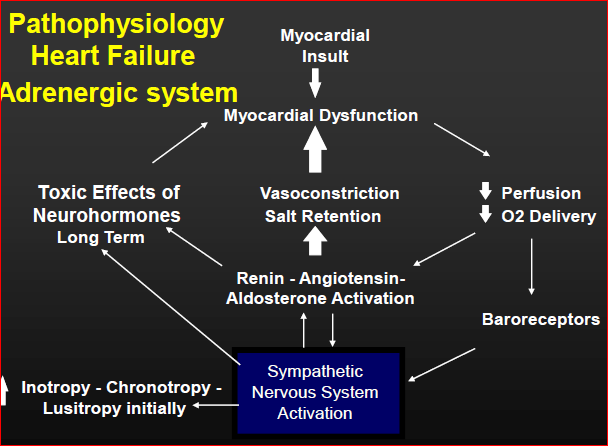
Overview of neurohormonal axis in HF
Role of plasma NE levels in HF patients.
-patients with higher levels of NE died soon
Clinical correlations of a patient with HF with an activated adrenergic system
- sxs: diaphoresis, anxiety, palpitations
- tachycardia, arrhythmias, initial increased inotropy, remodeling
- peripheral: cool, clammy extremities due to increased SVR
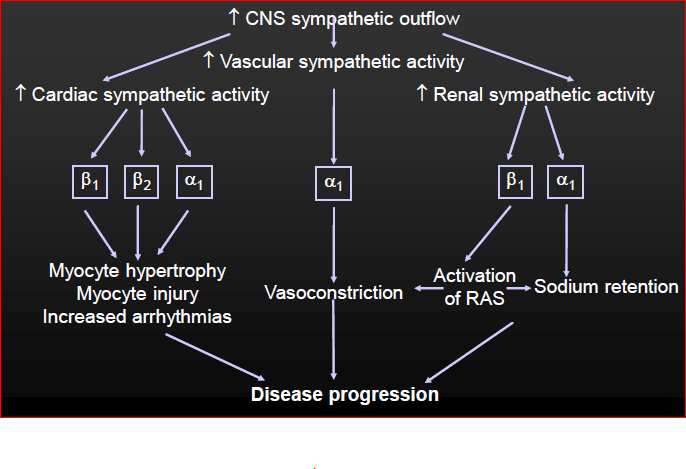
What happens to the sensitivity to the adrenergic system over time in HF?
-patients become sensitized to B response and down regulate B receptors.
Overview of RAAS system.
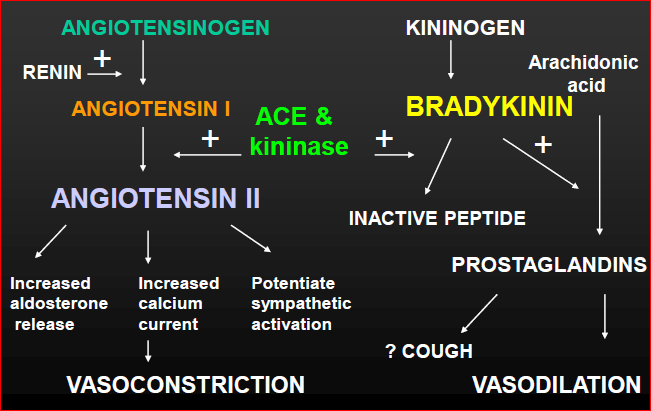
Effects of AngII on heart, adrenal, brain, kidney, and vascular muscle
heart: positive inotrope/chronotropy; LV growth/LVH/remodeling
adrenal: aldosterone production and release
Brain: stimulates SNS, stimulate thirst and sodium appetite, release ADH, suppresses renin release, stimulates release of NE
Kidney: efferent and afferent arteriolar constriction, constrict mesangial cells, stimulates reabsorption of Na and bicarb
-VSMCs: hypertrophy, fibrosis and constriction (?)
Aldosterone effects
- Na retention
- K and Mg loss
- myocardial and vascular fibrosis
- baroR dysfunction
- impairs arterial compliance
- prevent NE reuptake in myocardial cells (longer half life)
- regulates Na transport in colon, sweat, and salivary glands

-
Vasoactive Peptides and Inhibitors: RAAS34
-
Hypertension Overview 9/10/201430
-
Antihypertensive drug therapy60
-
Heart failure38
-
Cardiac Valve Stenosis47
-
Inotropic agents55
-
B agonists20
-
Autonomic ANTAGONISTS25
-
Cholesterol and Lipoprotein Metabolism34
-
Drugs for Lipoprotein issues57
-
Regurgitations50
-
HTN Pathology60
-
Atherosclerosis 138
-
Ischemia pathophysiology41
-
Ischemia Pathology51
-
Unstable ischemic coronary syndromes42
-
Peripheral vascular disease and physiology29
-
Atherosclerosis Meds21
-
Atherosclerosis risk factors: Diet and exercise24
-
Atherosclerosis and Restenosis Mechanisms25
-
Genetic determinants of CVD35
-
Gender issues in CVD37
-
Valvular Disease Patho47
-
Cardiovascular Development50
-
Congenital Heart Disease 1-377
-
Pathology and Pathophys of Myocardial Dz98
-
Antiarrhythmic Drugs42



