T/F: A valve can be regurgitant or stenotic, but not both.
-false; can coexist
4 differences (general concepts) between stenosis and regurgitation
-unlike stenosis, regurgitation is: 1. better able to increase forward stroke volume and CO 2. can be acute or chronic 3. 2 chambers affected by volume load 4. regurgitant volume and regurgitant fraction better express severity of lesion than simply regurgitant orifice area
Consider the mitral valve as part of the ______ and the aortic valve as part of the _______ when thinking of regurgitation.
-LV: normal LV size and shape is integral to normal MV function -Aorta: enlargement of the aorta can lead to AR in addition to disease of leaflets
LVH
-CHRONIC adaptive response to volume and/or pressure overload as an attempt to reduce or normalize LV wall stress and optimize myocardial O2 consumption -increase in myocyte MASS not NUMBER
Eccentric hypertrophy occurs due to _______ overload. Explain this using LaPlace
-volume overload= increase in wall stress associated with increase in diastolic volume and pressure -add myofibrils in series -Wall stress is increased by an increase in chamber radius, so increase in wall thickness helps reduce this -end result: increase LV wall thickness, increase LV mass, no change in RWT
5 components of mitral anatomy and function
-annulus (saddle shaped) -leaflets: overlap=redundancy -chords: primary, secondary, tertiary -papillary muscles -ventricular function and geometry
T/F: Chordae and papillary muscles are responsible for closing the valve.
-false; P closes it, pap muscles keep it closed!
Functional classification of Mitral Regurgitation (Capentier Classification)
-type 1: normal leaflet motion; endocarditis hole is ex -type 2: increased leaflet motion (prolapse in systole) -type 3: decreased leaflet motion (3a is rheumatic dz, 3b is ventricular issue)
Degenerative MR: capentier type II
-myomatous degeneration aka degenerative disease; GENETIC and progressive -prolapse, flail, floppy, billowing -2 commonly occurring but very different diseases: fibroelastic deficiency (ruptures chord in 1 segment) and Barlow’s disease (abnormal leaflets, elongates chordae)
Functional mitral regurgitation
-leaflets normal -LV modeling moves pap muscles towards apex and laterally–gets worse with LVH -also component of mitral annular dilation -decreased closing forces from decreased LVEF -class 3b
Endocarditis capentier and potential issues
-Type 1 MR -vegetations interfere with coaptation -leaflet perforation due to infection
Rheumatic disease capentier and isses
-type III -thickened leaflet tips prevents coaptation -shortened or ruptured chords due to rheumatic process -often coexists with MS as well
What is unique about MVR endocarditis?
-it can happen acutely! as opposed to myxomatous degeneration or rheumatic disease
2 meanings for ischemia MR
- can be used to refer to transient MR which occurs during ischemic episodes– posteromedial papillary muscle more vulnerable to ischemia (single blood supply) 2. more typically used as description of mechanism of MR with prior MI which results in FOCAL LV remodeling and distortion -mostly inferior infarctions cause restriction of posterior leaflet motion
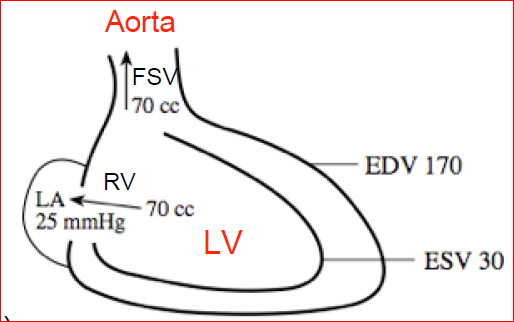
Regurgitant V, forward stroke V, total stroke V, regurgitant fraction, LVEF definitions in MR
- regurg volime (ml/beat):RV 2. FSV: ml/beat 3. TSV: FSV+RV 4. regurg fraction: RV/TSV 5. EF: TSV/EDV
Absolute volume of MR depends on what 3 things?
- size of regurgitant orifice surface
- pressure gradient from LV to LA (drives flow)
- LV systolic ejection time and time orifice is regurgitant
Theoretical possibility of lowering SVR in MR may allow….
-greater direct proportion of blood flow into systemic circulation (mostly when acute)
Explain why pulmonary edema occurs in AR. Describe what happens to effective CO and how this is dealt with.
- RV results in acute LA P transmitted back to lungs=pulmonary edema
- LV stroke volume is now divided between FSV and RV which decreases effective CO. TSV increases due to more complete emptying (lower afterload due to dec SVR in acute MR); increased preload due to RV= increased SV and EF
- AMR: higher preload, lower afterload, normal contractile function, higher EF than normal
Compensatory mechanisms in acute MR
- LV dilation (increased preload) due to increased LV volume helps to preserve FSV
- reduced afterload (acute) allows emptying down to smaller ESV
- activate reflexes (adrenergic activation) to increase HR and CO; increase contractility of LV with rise LVEF, vasoconstriction to maintain BP/organ perfusion (despite this, still an acute decrease in afterload)
Acute MR symptoms
- with a too large of an addition of RV: rapid and sudden increase in LAP= acute pulmonary edema
- dont have time to develop eccentric hypertrophy!!
- despite normal contractile function, pt suffers acute CHF
- therapy= supportive (o2), diuresis, vasodilator therapy, and immediate surgery to repair/replace valve
What is uniquely seen on acute MR hemodynamic LA LV pressure waveforms?
-quick, large V waves due to regurgitation to LA during systole
Compensatory changes in chronic MR
- slow increment in MR or management of acute MR into chronic phase
- initial LV dilation increases EDV and TSV
- LV eccentric hypertrophy occurs to allow increased LVEDV at lower LVEDP: increased compliance, serves to normalize wall stress (laplace)
- increased LA compliance
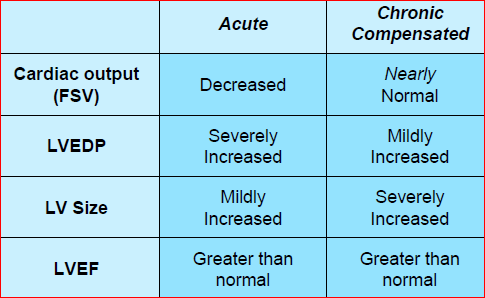
Chronic compensated MR
- eccentric hypertrophy reduced diastolic wall stress, normalizes afterload, increases FSV to almost normal
- regurg fraction remains the same with a greater regurgitant volume
- decrease preload, increased afterload, normal contractile function, decreased EF, same RF, increase FSV vs AMR
Acute vs Chronic MR in CO (FSV), LVEDP, LV size, LVEF



-
Vasoactive Peptides and Inhibitors: RAAS34
-
Hypertension Overview 9/10/201430
-
Antihypertensive drug therapy60
-
Heart failure38
-
Cardiac Valve Stenosis47
-
Inotropic agents55
-
B agonists20
-
Autonomic ANTAGONISTS25
-
Cholesterol and Lipoprotein Metabolism34
-
Drugs for Lipoprotein issues57
-
Regurgitations50
-
HTN Pathology60
-
Atherosclerosis 138
-
Ischemia pathophysiology41
-
Ischemia Pathology51
-
Unstable ischemic coronary syndromes42
-
Peripheral vascular disease and physiology29
-
Atherosclerosis Meds21
-
Atherosclerosis risk factors: Diet and exercise24
-
Atherosclerosis and Restenosis Mechanisms25
-
Genetic determinants of CVD35
-
Gender issues in CVD37
-
Valvular Disease Patho47
-
Cardiovascular Development50
-
Congenital Heart Disease 1-377
-
Pathology and Pathophys of Myocardial Dz98
-
Antiarrhythmic Drugs42



