What is the average wage gap between blacks and nonblacks in this model?
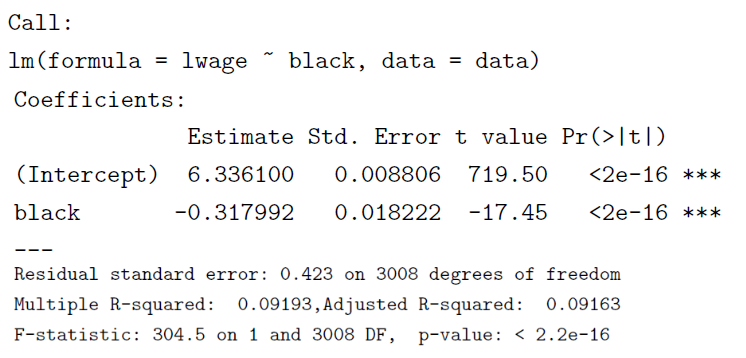
The UNCONDITIONAL log wage gap is -0.318. I.e. blacks have a
(e-0.318-1) * 100% = -27.2%
lower wage than nonblacks on average.
What is the average wage gap between blacks and nonblacks in this model?
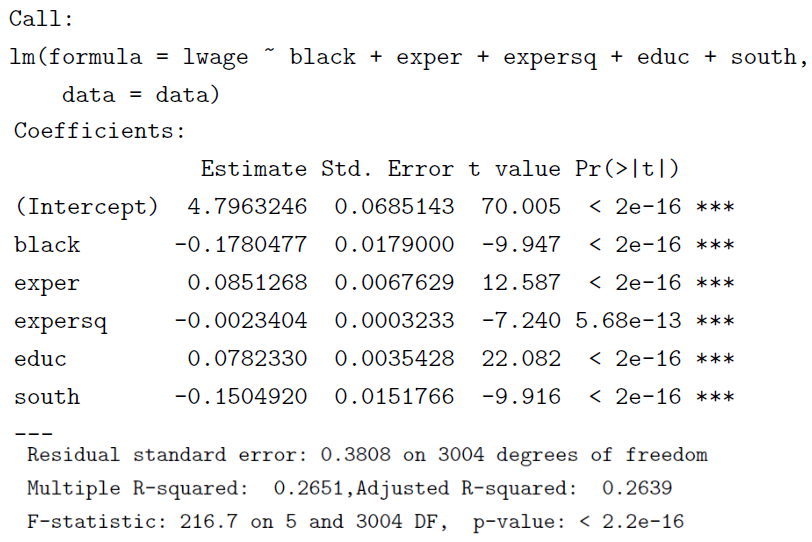
The CONDITIONAL log wage gap is
-0.178 = (e-0.178-1) * 100% = -16.3%
lower wages.
Give an economic explanation as to why the estimated
gaps di er between the models. What do you conclude concerning underspecification and possible endogeneity problems?
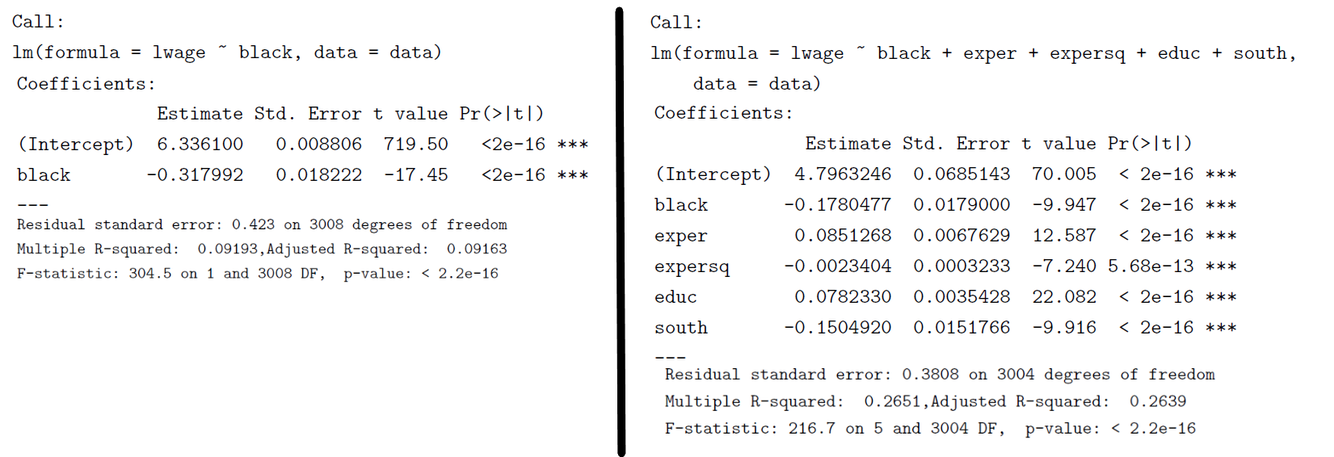
Part of the unconditional difference is driven by fact that wage also depends on education, experience, and region. The gap is smaller in the second model, because blacks are more likely to have less education, experience and live in the south.
The first model is clearly underspecified, as important predictor variables for the wage were omitted. Since these omitted variables are correlated with “black”, the effect of “black” in model1 is biased.
Model 3 additionally includes interaction terms between black and experience and experience squared to analyze whether the racial wage gap depends on experience. Calculate the average wage gap between blacks and non-blacks for workers with x years of experience.
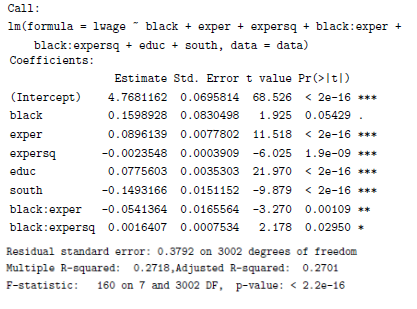
difference calculation (calculate only the terms that are multiplied with “black”, as only these differ):
0.15989 + exper*-0.0541 + exper² * 0.00164
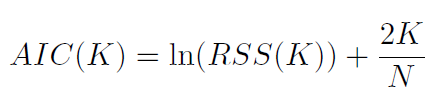
Explain the idea of AIC and the role of the two components of the AIC formula.
- Idea: bias-variance tradeoff, more parameters decrease bias but increase variance
- RSS(K): As K increases, RSS decreases -> less bias. This rewards the quality of the approcimation
- 2K/N: As K increases, variance increases. This part “punishes” simply adding additional parameters.
What are the advantages of the AIC compared to R2 for the purpose of model selection?
The R2 only cares about the bias, and thus always suggests the model with the largest number of parameters. The AIC is better because it weights bias and variance against each other.
Based on the results, which model do you prefer?
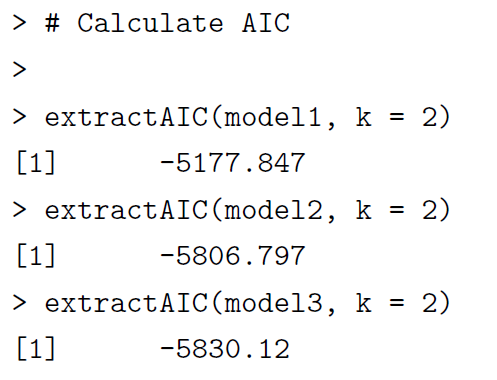
Model 3 performs best (lowest AIC) and is therefore preferable.
Show theoretically that OLS regression residuals are in general not homoskedastic, even if the error terms are homoskedastic.
- Bring residuals in appropriate form:
e = Y - X^β = Y - X(X’X)-1X’Y = (IN - P) Y - Detect distribution (homo- or heteroskedastic):
Var(e) = Var( (IN - P) Y ) = (IN - P) Var(Y) (IN - P)’ =
= M Var(ε) M’ = M σ²IN M’ - As M is the residual maker and idempotent so that MM’ = M: Var (e) = (IN - P) σ²IN
- From (IN - P) we see that residuals are generally not homoskedastic
Explain how you would use residual analysis to check for heteroskedasticity.
Transform the residuals to standardized or studentized residuals and plot against fitted values.
How can the OLS regression residuals be transformed in an appropriate way to detect heteroskedasticity graphically?
- We know that OLS residuals have Var(ei) = (1 - Pii)σ²
- Standardized residuals are defined by:
* *ẽi = e / [σ√(1-pii)]** - Therefore the variance of standardized residuals is:
* *Var(ẽi) = [1 / σ√(1-pii)] Var(ei) [1 / σ√(1-pii)]’** - Through simplification, you get Var(ẽi) = 1
Explain how the White test for heteroskedasticity is implemented.
- H0: E [ei² | xi] = σ² = constant
- H1: E [ei² | xi] ≠ constant
Regress squared OLS residuals on all variables from the linear model (incl. interaction term and squares), intercept is the constant variance. Under H0, the regressors should be jointly insignificant.
The results of the White test for model 3 are given in the output. How do you interpret the result of the test? What do you conclude?
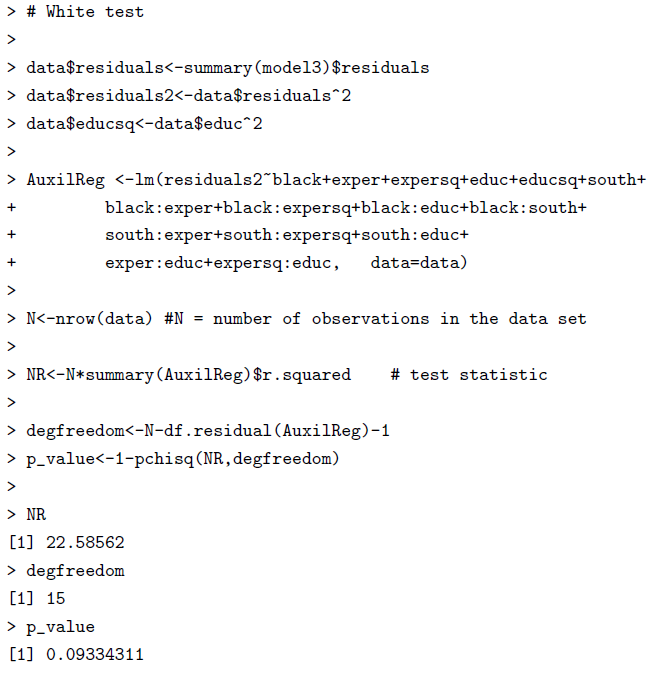
p-value = 0.093
At 5% significance, we fail to reject H0 (homoskedasticity).
At 10% significance, we reject H0 (homoskedasticity).
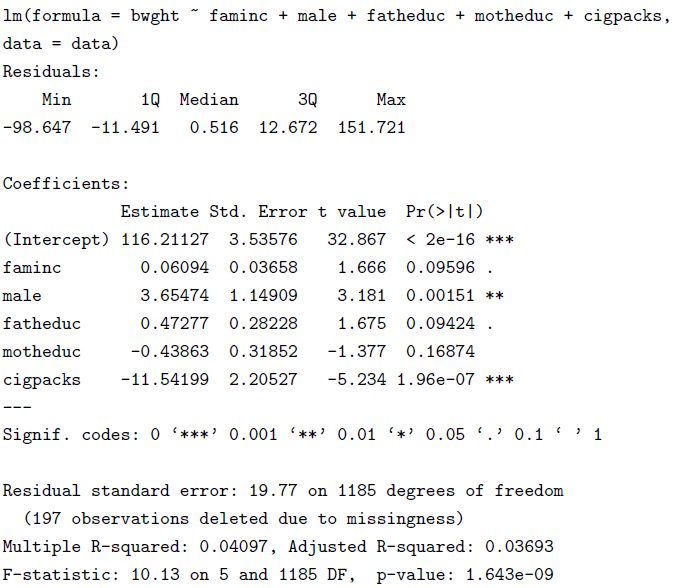
What is the interpretation of the coefficient on cigpacks?
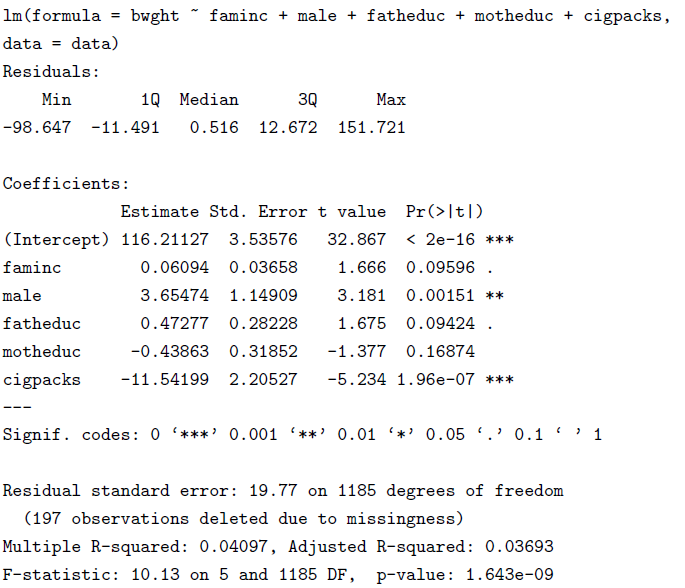
Each additional pack of cigaretts decreases the birth weight by 11.5 ounces, holding the other variables fixed. The effect is statistically significant at the 1%-level.
Under which condition is the OLS estimator of the effect of cigpacks unbiased? Under which condition is it consistent? Do you think these conditions are fulfilled in the given example?
- Condition for unbiasedness: E(ε|X)=0
- Condition for consistency: E(X’ε) = 0 or Cov(ε, X)=0
Conditions are likely not fulfilled. There could be some unobserved characteristics of the mother (e.g. health, personality traits etc.) that affect both smoking during pregnancy and the child’s weight.
Which two conditions have to be fulfilled for an instrument to be valid? Can these conditions be tested, and if yes, how?
- RELEVANCE of the instrument: Cov (X, Z) ≠ 0
- -> Can be tested by regressing X on Z (and all other variables to check if the effect on Z is significant - EXOGENEITY of the instrument: E(εi‘z) = 0
- -> Can not be tested
In the present example, we use the variable cigprice as an instrument for cigpacks. Interpret the results below. Do you think cigprice is a suitable instrument in this context? Can you identify problems in the IV estimation of this example?
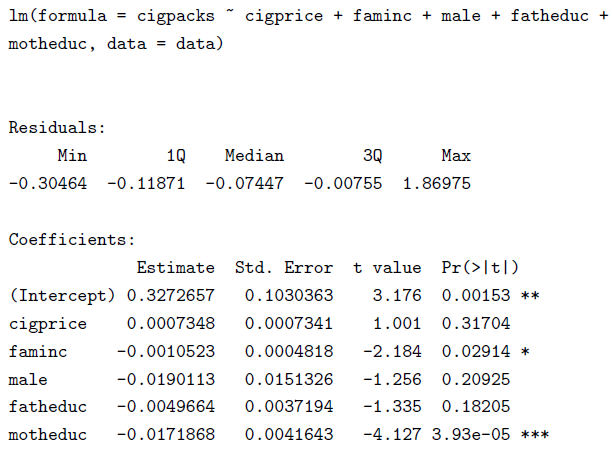
Instrument is not statistically significant (p-value 0.317), i.e. the cigarette price has no effect on cigarette consumption.
–> The “relevance” condition for the instrument is clearly not fulfilled, and the instrument should not be used!
In the present example, we use the variable cigprice as an instrument for cigpacks. Interpret the results below. Do you think cigprice is a suitable instrument in this context? Can you identify problems in the IV estimation of this example?
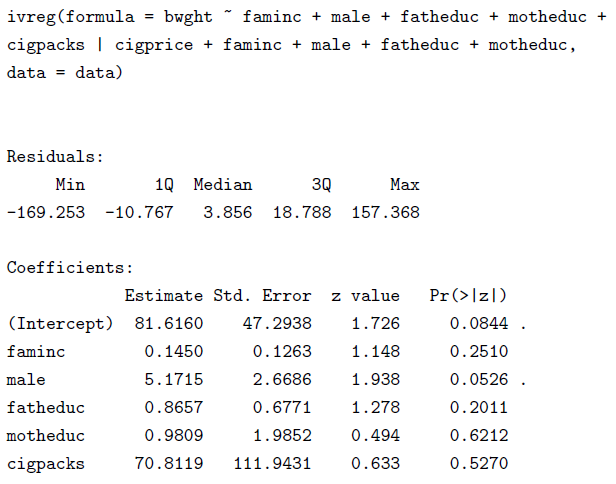
- One additional pack increases (!) the birth weight by 70.8 ounces, ceteris paribus.
- Effect is not statistically significant.
- Result is unexpected: positive sign and very large magnitude. The IV estimation is highly suscept given the weak instrument in the First Stage.
–> This is an example that weak instruments can sometimes produce extreme results.
What is the purpose of the Hausman test in the case of IV estimation? In the present example, the Hausman test gives a p-value of 0.278. Interpret this result. What are the limitations of the Hausman test in the present example?
Wu-Hausmann test tests whether variable is actually exogenous:
- H0: cigpacks is exogeneous, H1: cigpacks is endogenous
- p-value of 0.272 –> Fail to reject the H0 of exogeneity, i.e. there is no evidence that there is an endogeneity problem. OLS is consistent.
LIMITATIONS:
- Assumes that the instrument is valid
- May fail to reject H0 if standard errors are high
Assume that the data are generated according to the first model below, but we estimate the coefficient of x on the basis of the second model. What are the necessary steps to show the bias of the OLS estimator ^β?
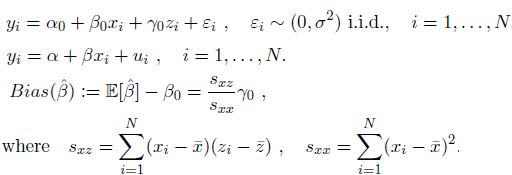
- Get rid of the intercept by defining the residual maker P0 = X(X’X)-1X’ (in this case, X = 1N)
- Transform the model by multiplying each component with the residual maker M0 = IN - P0
- Calculate the bias (^β) = E [^β] - β0
- Use that E [^β] = E[(X’X)-1X’Y]
How is the residual maker M defined?
M = I - P = I - X(X’X)-1X’
How can you rewrite the average of y = ȳ as a sum?
1/N Σi=1N yi
What is |m|?
the number of model parameters = k
What is the average of pii?
avg(pii) = 1/N Σi=1N pii =1/N tr(P) = 1/N tr(Ik) = K/N
Which model would you choose? Discuss first whether it is possible to compare all three models by the given AIC values.
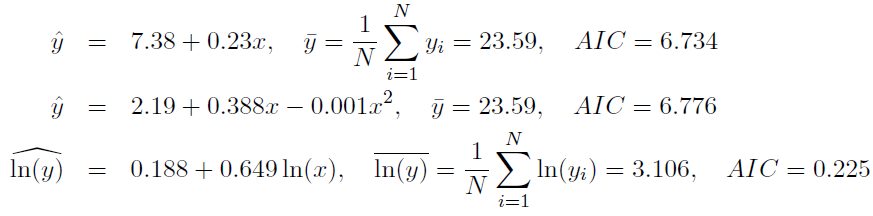
The three models cannot directly be compared:
- the first two are normally distributed, but
- the third assumes a normal distribution for log(y)
Of the first two, I’d choose the first which has a lower AIC.


-
1 - Mathematical Basics1
-
Tutorial 1: Introduction & Linear Regression Model34
-
Tutorial 2 - Linear Regression II (Polynomials, Dummy variables, logs...)8
-
Tutorial 3 - Model Misspecification, Model Choice, Model Diagnostics, Multicollinearity34
-
Tutorial 4 - Frisch-Waugh Theorem, Omitted Variables, Instrumentral Variables Estimation30
-
HW 127
-
Tutorial 5 - Panel data, Pooled OLS, Random-Effects-Estimator, Fixed-Effects-Estimator40
-
Tutorial 6 - Binary Dependent Variables23
-
Tutorial 7 - Censored Variables18
-
HW 211
-
Tutorial 8 - Time Series10



