What structures make up the Integumentary system?
- Hair
- Nails
- Skin
- oil glands
- sweat glands
- and sensory receptors.
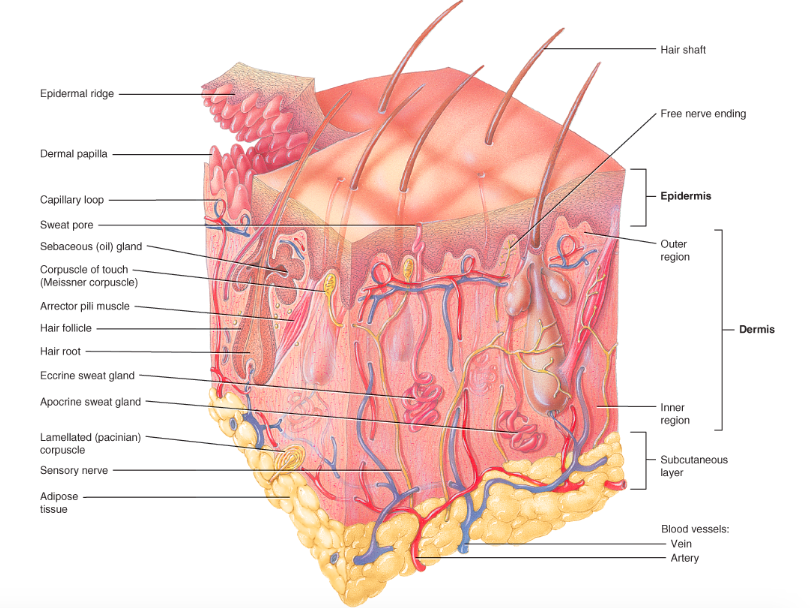
Name the layers of the skin; describe the structure of each, and name the general functions of the skin.
- Epidermis:
- superficial, thinner portion composed of keratinized stratified squamous epithelial tissue
- made up of 4 main cells;
- keratinocytes
- melanocytes
- intraepidermal macrophages (Langerhans cells)
- tactile epithelium cells (Merkel Cells)
- Keratin helps protects the skin from abrasions, heat, microbes and chemicals
- Dermis:
- The deeper, thicker connective tissue portion
- the superficial layer is composed of areolar connective tissue, which has fine elastic fibres
- the superficial layer joins with the endothelial tissue with small, fingerlike projections called dermal papillae
- The deeper part of the dermis contains dense irregular connective tissue
- It provides strength, ability to stretch, and ability to return to its original shape.
- Subcutaneous Layer (subQ) (or called hypodermis):
- Deeper to the dermis but not part of the skin.
- consists of areolar tissue and adipose tissues
- It serves as an area for
- fat storage
- blood vessel passage
- pressure nerve endings.
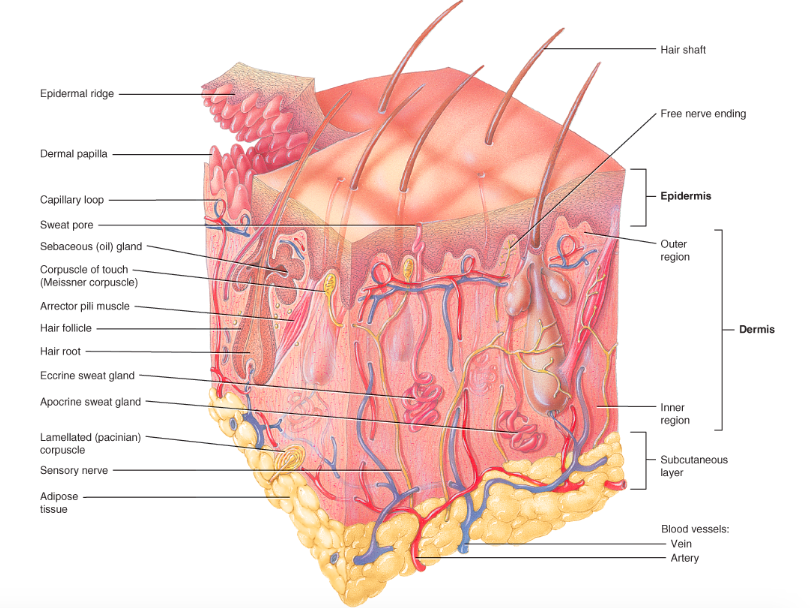
what are lamellated Corpuscles?
Nerve endings found in the subcutaneous layer under the skin.
look like a lollipop
Discuss the four cell types of the epidermis.
- Keratinocytes
- consist of 4-5 layers
- produce keratin
- which helps protect the skin and underlying tissue from heat, microbes, and chemicals
- produces lamellar granules
- release water-repellent sealant
- Melanocytes
- produce pigment melanin
- contributes to skin colour
- absorbs ultraviolet light
- protects cells from UV damage
- produce pigment melanin
- intraepidermal macrophages (Langerhans Cells)
- fight against microbes trying to enter into the body
- help other cells recognize an antigen so it can be destroyed
- Tactile Epithelial cells (Merkel Cells)
- contact sensory neurons to detect touch sensation
- made up of a tactile disk and the cells.
List the four/five layers of the epidermis.
Most regions have 4 layers which consist of; (Deepest to most superficial)
- Stratum basale
- Stratum spinosum
- Stratum Granulosum
- Stratum Corneum (thin)
Exposure to greater amounts of friction fingertips, palms, soles have 5 layers. (Deepest to most superficial)
- Stratum Basale
- Stratum Spinosum
- Stratum Granulosum
- Stratum Lucidum
- Stratum Corneum (thick)
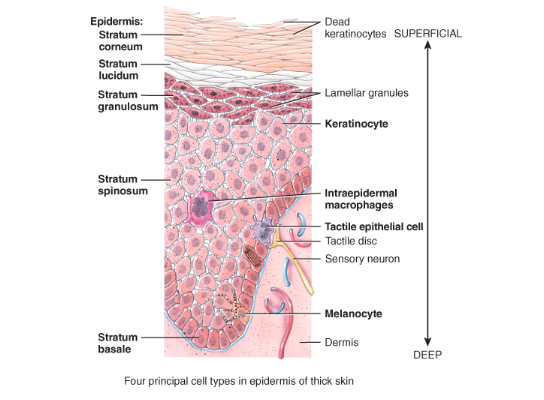
Explain the process of keratinization.
- newly formed cells in the stratum basale are slowly pushed to the surface
- the cells move through the different layers acquiring more and more keratin and losing their contents
- This occurs until they become the superficial layer and get sloughed off the body
- his happens every 2-4weeks.
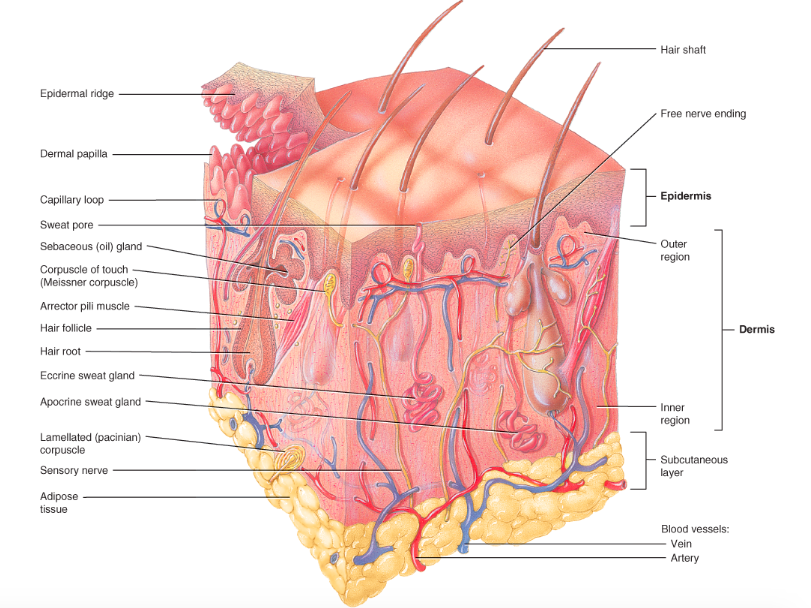
Distinguish between the papillary layer and the reticular layer of the dermis, and locate the appropriate sensory receptor in each of these layers.
The dermis, composed of connective tissue containing collagen and elastic fibres, has two regions.
The Papillary Layer:
- some contain capillary loops (blood capillaries)
- contains receptors called corpuscles of touch (Meissner corpuscles)
- nerve endings sensitive to touch
- Free nerve endings
- sensitive to warmth, coolness, pain, tickling, and itching.
The Reticular Layer:
- in the deeper part of the dermis
- contains dense irregular connective tissue
- bundles of collagen fibres
- some elastic fibres
found here are the following;
- hair follicles
- nerves
- oil and sweat glands
Epidermal ridges increase friction for better grasping ability and provide the basis for fingerprints and footprints. Typically, the ridges reflect contours of the underlying dermis.
Name the pigments responsible for skin and hair colour, and explain how people of different races (and skin colour) differ with respect to these pigments; name the cell types that synthesize and store them.
- Melanin (melanocytes)
- causes skin colour to vary from pale yellow, reddish-brown, to black
- number of cells is the same
- colour change due to the amount of pigment the melanocytes produce and transfer to keratinocytes.
- Hemoglobin (red blood cells)
- produces a red colour
- based on the amount of oxygen content moving through the blood
- Carotene (vitamin A)
- yellow-orange pigment
- used to synthesize pigments needed for vision, accumulates in the stratum corneum and fatty areas of the dermis and subQ layer
The reason skin is different has to do with different amounts of melanin in the epidermis. The darker the skin the more melanin they produce. Ranging from yellow to red to tan to black.
People that have less melanin have lighter skin. Epidermis will appear translucent and skin colour ranges from pink to red. Depending on oxygen levels in blood.
Melanocytes, Red Blood Cells, and Vitamin A carry the colours.
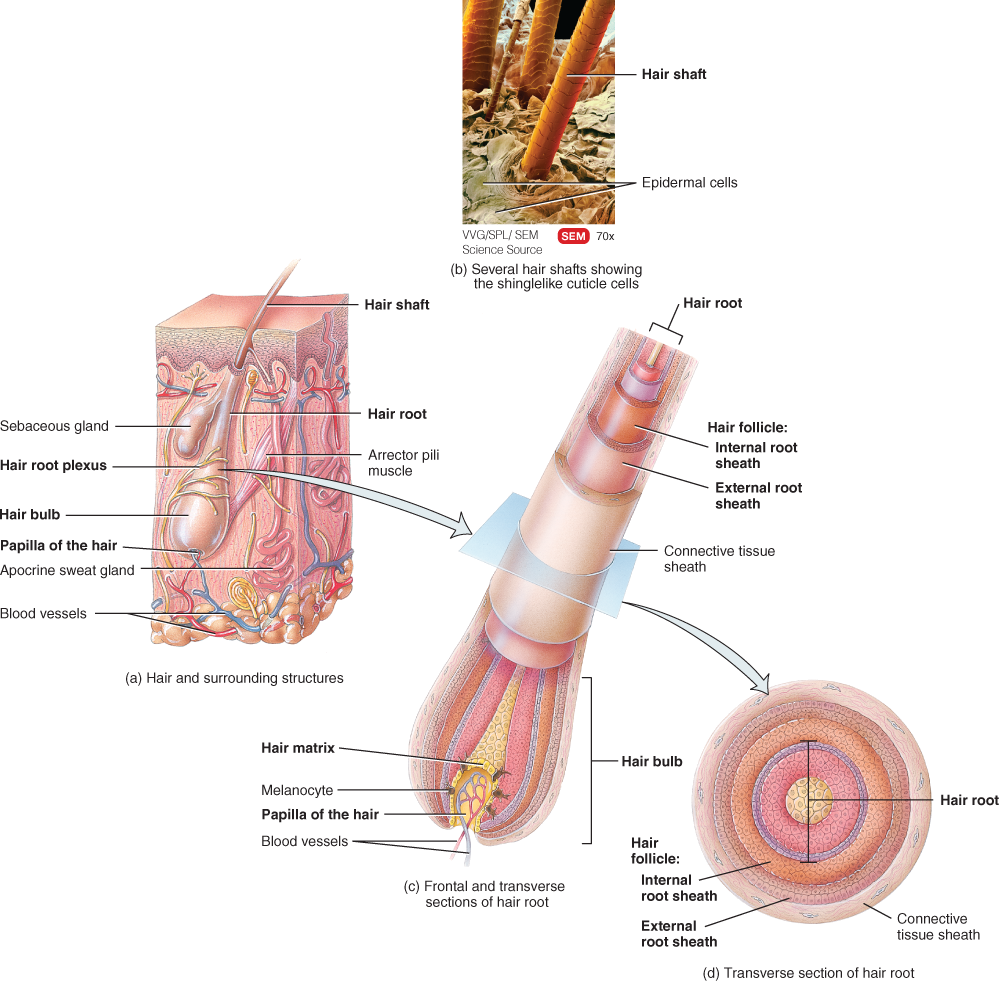
Describe the general structure of hair.
hair is an extension of the epidermal layer. which drops down into the dermal layer of skin.
Hair consists of a:
- Shaft above the surface of the skin.
- Root that penetrates the dermis and subcutaneous layer.
- Hair follicle consisting of two epidermal layers surrounding the root.
- Connective Tissue Sheath (outside)
- External root sheath
- Internal Root Sheath
- Hair Root
The hair follicle consists of
- an enlarged base called the hair bulb
- a hair papilla
- has many blood vessels to nourish the growing hair
- A hair matrix
- produce new hairs through cell division.
- contain melanocytes that produce pigments that create hair colour.
- dark colour hair produces mostly brown and black melanin
- blond and red hair contain variants of yellow to red melanin which have iron and more sulphur
- A Hair Root Plexuses
- Nerve endings that surround each hair follicle
- (sensitive to touch)
- Nerve endings that surround each hair follicle
- The Arrector Pili
- smooth muscle pulls at the base of hair follicle
- Sebaceous Glands
- a little superior and laterally
- secrete sebum
- keep hair from drying out
- inhibits growth of certain bacteria
- prevents excessive evaporation of water from the skin
The functions of hair include protection, decreasing heat loss, and sensing light touch.
List the glands associated with the skin and the products they secrete.
Sebaceous (oil) glands
- usually, are connected to hair follicles
- they are absent in the palms and soles.
- Sebaceous glands produce sebum,
- which moistens hairs, waterproofs and softens the skin, and inhibits bacterial growth.
Sudoriferous (sweat) glands
are divided into apocrine and eccrine types.
- Eccrine sweat glands help to regulate body temperature through evaporation and eliminate wastes such as urea.
- Apocrine sweat glands are limited to the skin of the axilla, pubis, and areolae; their ducts open into hair follicles.
Ceruminous glands
- modified sudoriferous glands that produce a waxy substance called cerumen.
- waterproofs that canal
- prevents bacteria and fungi growth
- These glands are found in the external auditory canal.
- provides a sticky barrier that stops foreign bodies and insects.
Discuss the functions of the skin
- Body Temperature Regulator
- liberates sweat at its surface
- high temperatures increases eccrine sweat gland production
- Low temperature decreases eccrine sweat gland production
- adjusts blood flow in the dermis
- high temperatures blood vessels dilate
- low temperatures blood vessels restrict
- liberates sweat at its surface
- Protection through physical, chemical and biological barriers
- Keratin
- protect the underlying surface against microbes, abrasion, heat, chemicals
- tight locked keratinocytes resist against microbe invasion.
- Lamellar Granules
- release lipids that stop water evaporation off skin, protecting from dehydration.
- Oily sebum
- prevents hair from drying out
- contains bactericidal chemicals that kill surface bacteria
- Perspiration
- the acidic environment slows the growth of microbes
- Melanin
- provides protection against damaging UV light
- Intraepidermal macrophages
- alert immune system to the presence of harmful microbial invaders through recognition and processing
- macrophages in the dermis phagocytize bacteria and viruses that manage to bypass the epidermal layer.
- Keratin
- Cutaneous Sensations
- sensations for the skin
- tactile
- touch, pressure, vibration, and tickling
- thermal
- warmth, and coolness.
- tactile
- sensations for the skin
- Excretion and Absorption
- secretion through sweat and oil ducts
- absorption from the external environment to body cells
- Synthesis of Vit D
- exposure to ultraviolet radiation activated vit D
- Vit D is converted to a hormone called calcitriol
- aids in absorbing calcium and phosphorus from the gastrointestinal tracker into the blood.
- Immunity
- Blood reservoir
List the features of each epithelial cell layer.
stratum basale
- is the deepest layer of the epidermis
- contains some stem cells capable of undergoing cell division to form new cells.
- This layer is sometimes called the stratum germinativum
- indicates its role in the formation of new cells.
stratum spinosum
- provides strength and flexibility to the skin.
stratum granulosum
- marks the transition between the deeper, metabolically active strata and the dead cells of the more superficial strata.
- This layer is also where a water-repellent sealant forms between the cells.
stratum lucidum
- is present only in the fingers, palms, and soles.
stratum corneum
- is the most superficial layer; it consists of dead cells.
- Lamellar granules in this layer make it water-repellent.
- Constant exposure to friction causes this layer to increase in depth by forming a callus, an abnormal thickening of the epidermis.
What is a Melanocyte, and in which layer of the skin is it found?
Melanocytes are pigment-synthesizing cells of the epidermis.
(Page 95)
Describe the structure of the hypodermis.
The hypodermis (subcutaneous) is a layer of areolar connective tissue and adipose tissue that anchors the dermis to the underlying tissues.
(Page 93; Fig. 5.1)
What are dermal papillae?
Dermal papillae increase the surface area of the skin. They also allow for the sensation of light touch, coolness, warmth, tickling, and itching.
(Page 96)
Identify the three main epidermal accessory structures:
a) Hair
b) Glands
c) Nails
(Pages 97–101)




