Define the term tissue.
A tissue is a group of similar cells that usually have a similar embryological origin and are specialized for a particular function.
Name the four primary adult tissue types, and give a brief description of each.
Depending on their function and structure, the various tissues of the body are classified as the following four principal types:
- Epithelial tissue covers body surfaces; lines hollow organs, body cavities, and ducts; and forms glands. Epithelial tissue provides external protection for underlying tissue.
- Connective tissue protects and supports the body and its organs, binds organs together, stores energy reserves as fat, and provides immunity.
- Muscle tissue is responsible for movement and generation of force.
- Nervous tissue initiates and transmits action potentials (nerve impulses) that help coordinate body activities, monitors the external environment, and contribute to homeostasis.
What is the function of Epithelial Tissue?
- Epithelial tissue covers body surfaces;
- lines hollow organs, body cavities, and ducts
- forms glands.
- Epithelial tissue provides external protection for underlying tissue.
What is the function of Connective Tissue?
Connective tissue protects and supports the body and its organs, binds organs together, stores energy reserves as fat, and provides immunity.
What is the function of Nervous tissue?
Nervous tissue initiates and transmits action potentials (nerve impulses) that help coordinate body activities, monitors the external environment, and contribute to homeostasis.
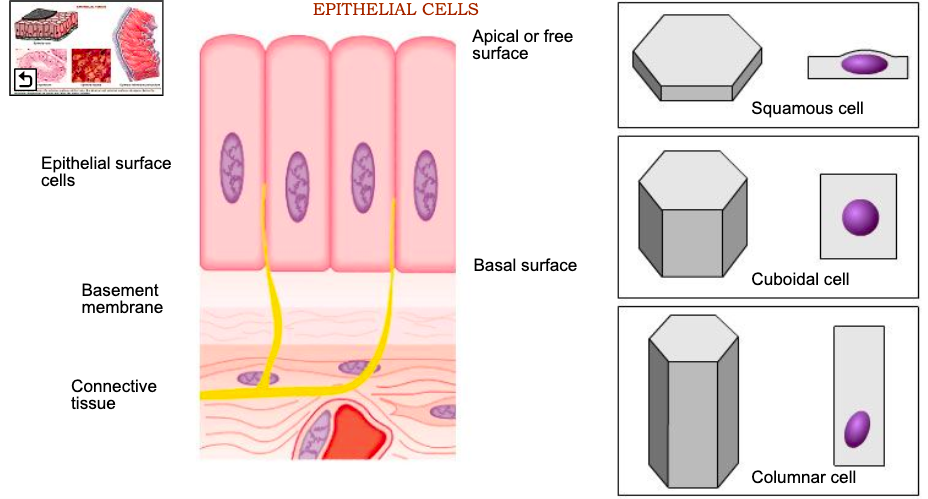
Describe the features of epithelial tissue.
- arranged in sheets, in either single or multiple layers.
- consists mostly of packed cells with little extracellular material. In epithelial tissues, many cell junctions are present, providing secure attachments among cells.
- has an apical surface and a basal surface attached to a base membrane.
- Epithelia adhere firmly to nearby connective tissue through a thin extracellular layer called the basement membrane. Epithelia have a nerve supply and a high capacity for renewal (a high mitotic rate).
- The basement membrane is made up of a cellular layer of collagen and glycoproteins called the basal lamina; often, it is underlain with a layer of reticular fibres and glycoproteins called the reticular lamina.
- Epithelial tissue is avascular; the exchange of materials between epithelium and adjacent connective tissue is by diffusion.
- Functions of epithelia include protection, filtration, lubrication, secretion, digestion, absorption, transportation, excretion, sensory reception, and reproduction.
What are the different types of simple epithelial tissues?
Simple Squamous Epithelium Simple Cuboidal Epithelium Simple Columnar Epithelium (non-ciliated and ciliated) Pseudostratified columnar Epithelium (non-ciliated and ciliated)
What are the different types of stratified epithelium?
Stratified squamous Epithelium Stratified cuboidal Epithelium Stratified columnar Epithelium Transitional Epithelium
Discuss the classification scheme for epithelia.
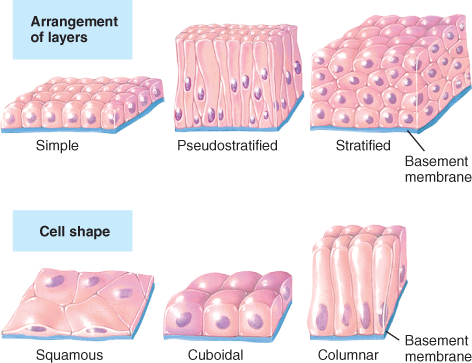
The covering and lining of the epithelia can be classified as a combination of layers and shapes of cells. The name of the specific type of stratified epithelium depends on the shape of the surface cells.
Layers are arranged as simple (one layer), stratified (several layers), or pseudostratified (one layer that appears as several).
Cell shapes include squamous (flat), cuboidal (cube-like), columnar (rectangular), and transitional (variable).
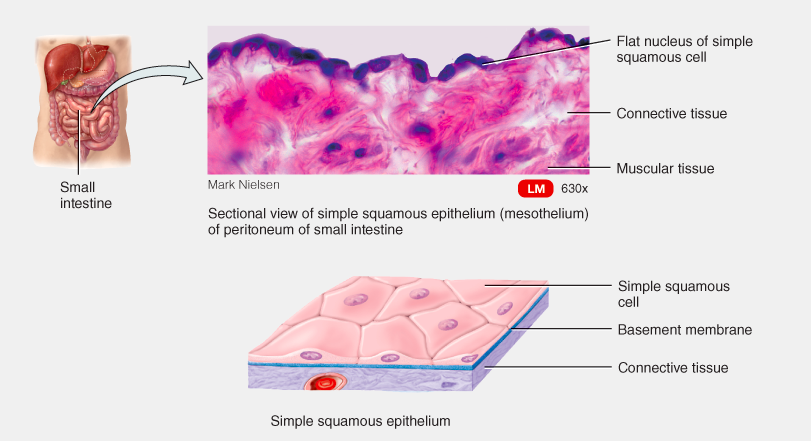
Provide a structural description of simple squamous epithelium
The simple squamous epithelium consists of a single layer of flat, scale-like cells.
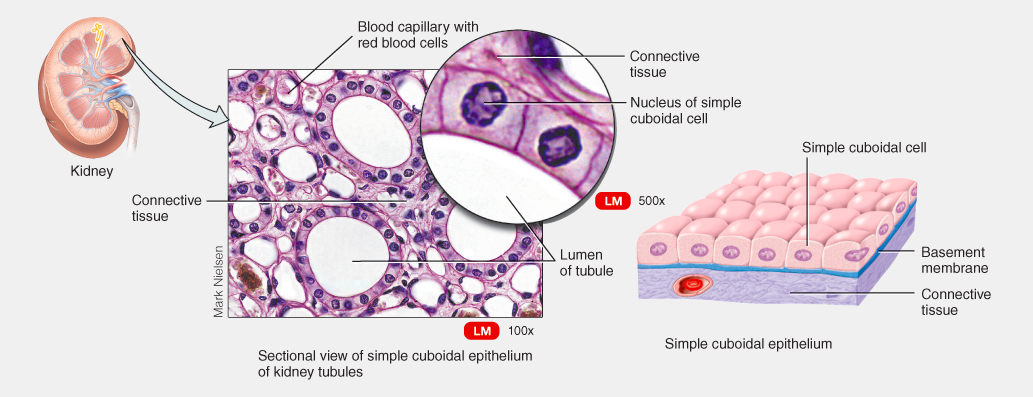
Provide a structural description of the Simple Cuboidal Epithelium.
- consists of a single layer of cube-shaped cells,
- round
- centrally located nucleus.
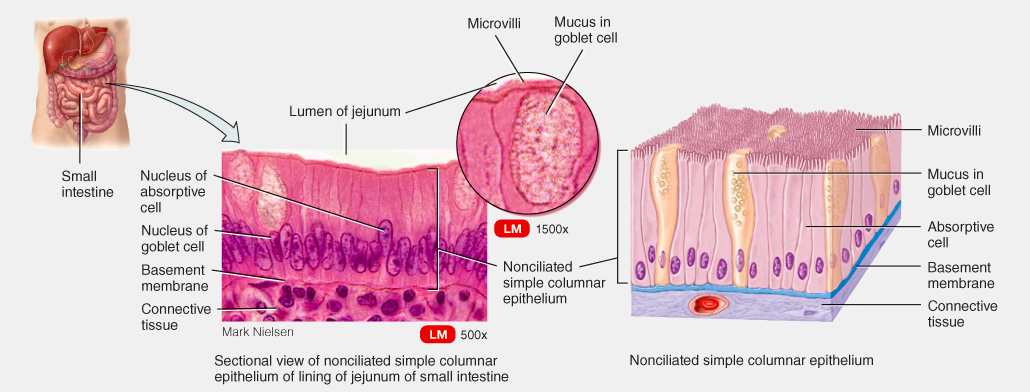
Provide the structural description of Nonciliated simple columnar epithelium.
- single layer of non-ciliated column-shaped cells
- nuclei near the base of the cell
- contains cells with microvilli
- Contains goblet cells..
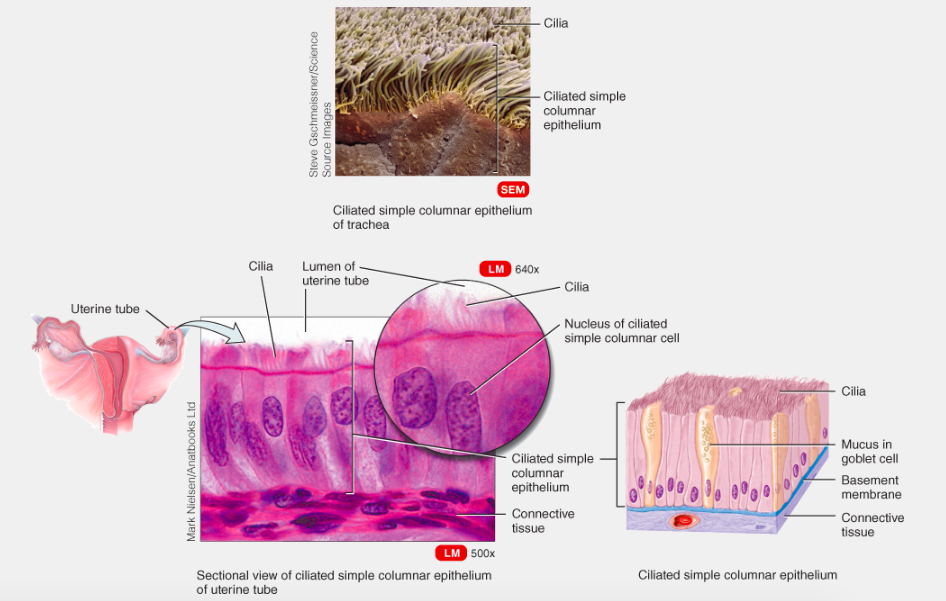
Provide a structural description of Ciliated Simple Columnar Epithelium.
- single layer of ciliated column-like cells with nuclei near bases
- contains cilia
- contains goblet cells in some locations.
what are microvilli?
microscopic finger-like projections, which increase the surface area of the plasma membrane increasing the absorption rate.
What are goblet cells?
modified columnar cells that secrete mucus at their apical surface.
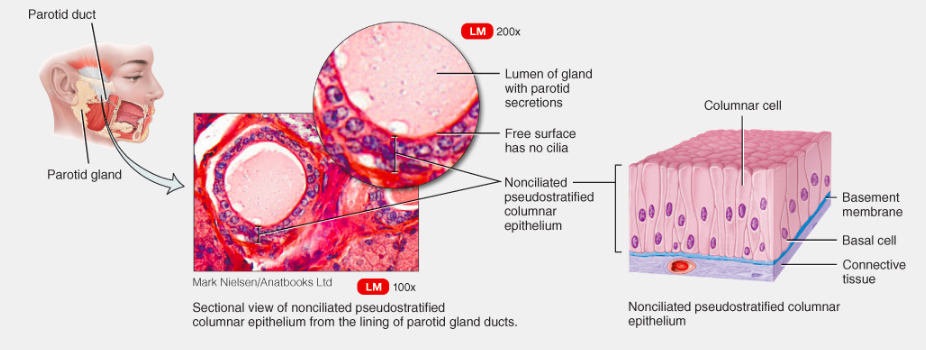
Provide a structural description of Nonciliated Pseudostratified Columnar Epithelium.
- Appear to have several layers due to the nuclei being at different levels
- All cells attach to the basement cell
- not all cells extend to the apical level of the cell.
- It does not have goblet cells
- does not have cilia or mircovilli.
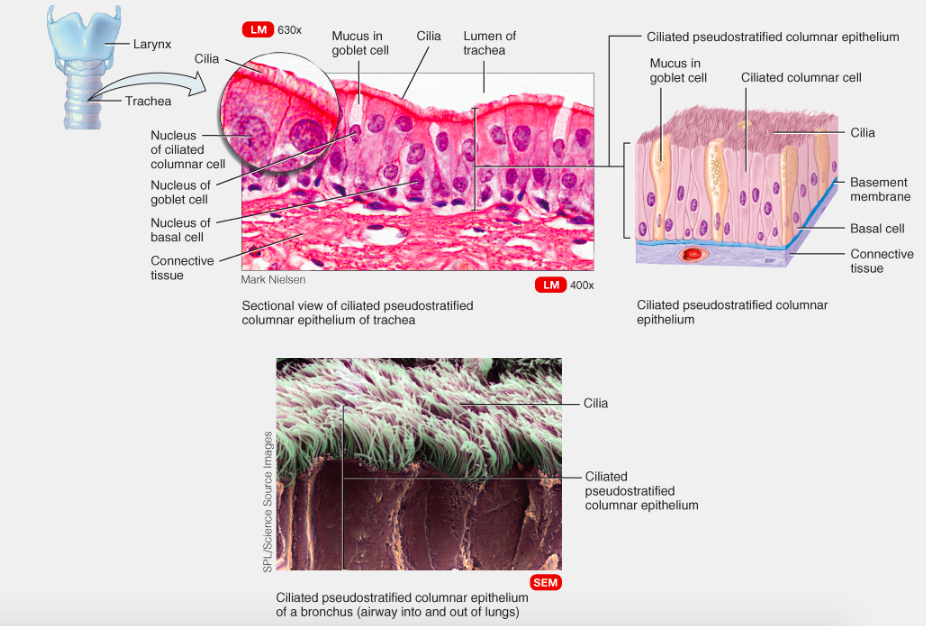
Provide a structural description of Ciliated Pseudostratified columnar epithelium.
- Appear to have several layers because the nuclei are at different levels.
- All cells attach to the basement cell
- not all cells extend to the apical level of the cell.
- It contains cells that extend to the surface and either contain cilia or secrete mucus (goblet cells)
Provide a structural description of stratified squamous epithelium
- Consists of several layers.
- The apical and several deeper layers are squamous.
- The deeper layers beyond that vary from cuboidal or columnar.
- Basal (deepest) cells continually undergo cell division.
- New cells push the old cells closer to the top.
- Skin closer to the top keratinizes
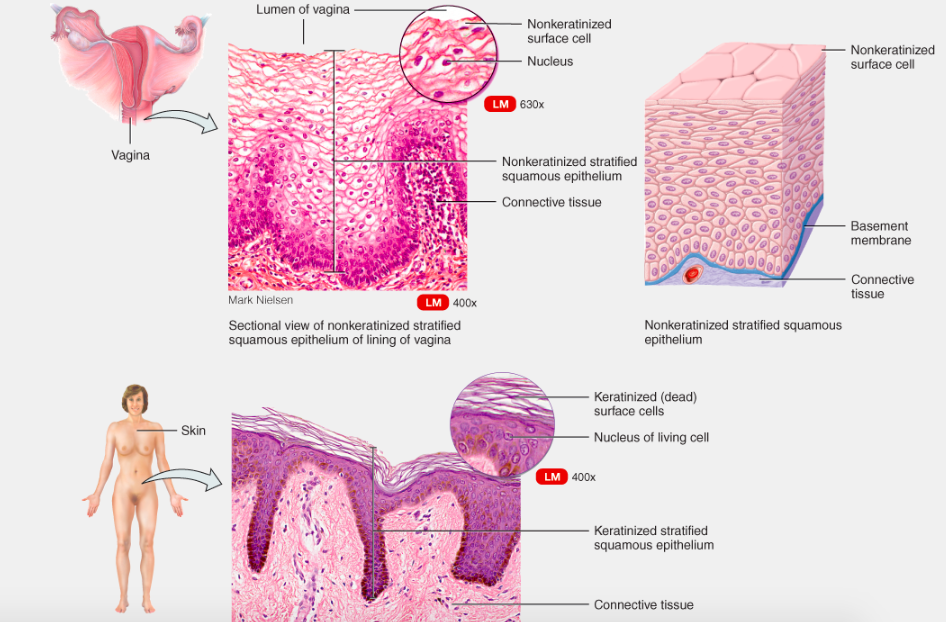
what is keratinization of the cell?
when a tough layer of skin develops in the apical layer of skin. Helps protect skin and underlying tissues from microbes, heat and chemicals.
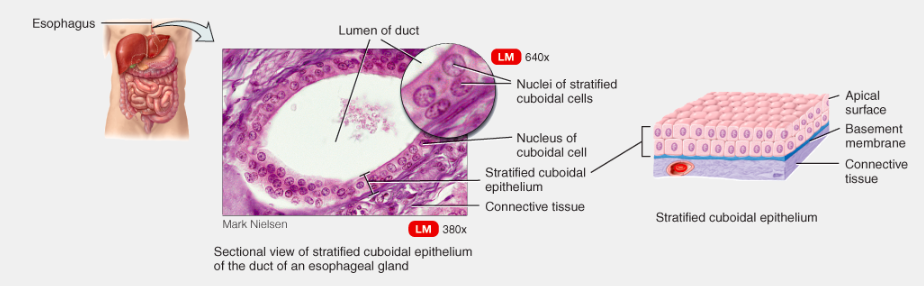
Provide a structural description of Stratified cuboidal epithelium
- 2 or more layers of cells
- the apical layer are cube-shaped
- fairly rare type.
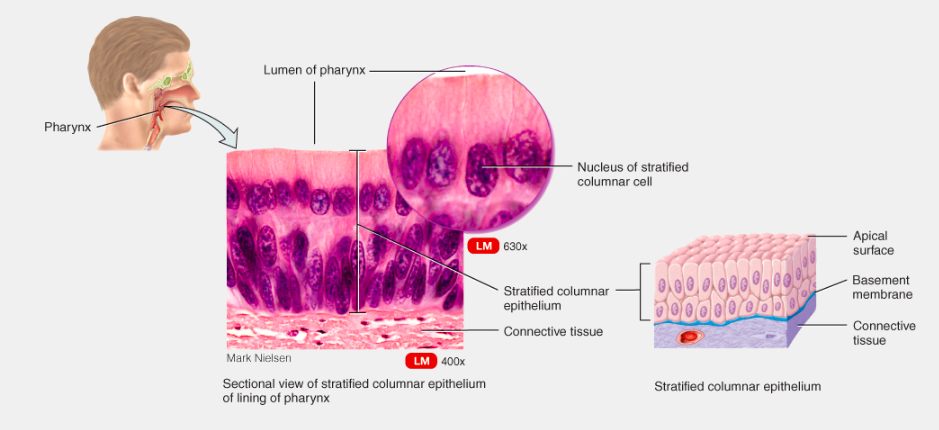
Provide a structural description of stratified columnar epithelium
- basal layer consists of shortened
- irregularly shaped cells
- the apical layer has columnar cells.
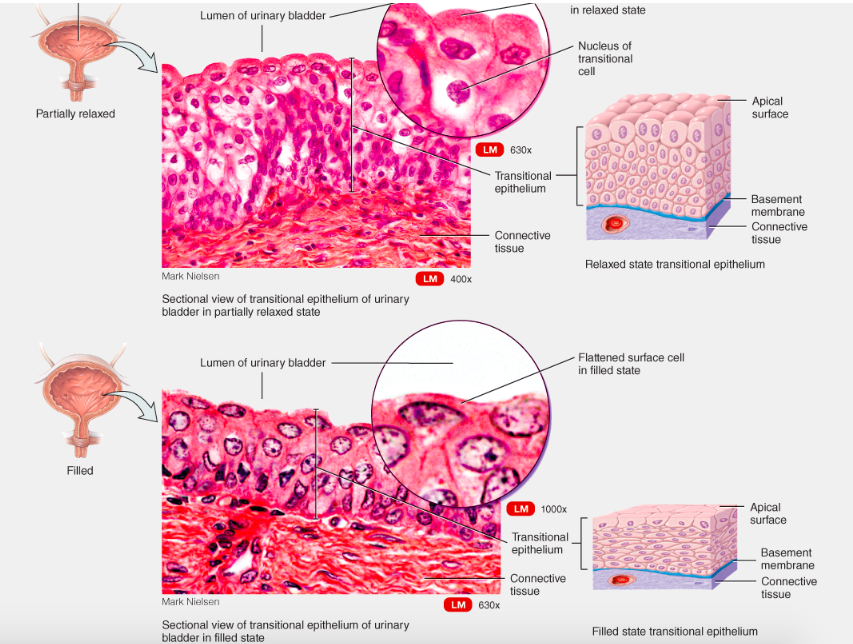
Provide a structural description of Transitional Epithelium.
- Appearance is variable.
- An unstretched or relaxed state looks like a stratified cuboidal epithelium.
- The apical layer tend to be large and rounded.
- A stretched state the cells become flatter, look like stratified squamous epithelium.
Define gland, and differentiate between exocrine and endocrine.
Is a single cell or a group of epithelial cells adapted for secretion.
Endocrine glands secrete hormones into interstitial fluid then the blood
Exocrine glands (mucous, sweat, oil, and digestive glands), secrete into ducts or directly onto a free surface.
Describe the general characteristics of connective tissues (CTs), and discuss their major structural differences from epithelial tissue.
- consists of 2 basic elements: cells and extracellular matrix. (material between widely spaced cells)
- extracellular matrix consists of protein fibres and ground substance (material between cells and fibres)
- The extracellular matrix is secreted by the cells of the connective tissue and determines the tissue’s qualities.
- for example, in bone, the extracellular matrix is firm and not pliable, in cartilage, it’s firm but pliable.
- Unlike epithelial tissue, connective tissues do not occur on free surfaces.
- Unlike epithelium, connective tissue is highly vascular (except for cartilage and tendons).
- like epithelium, has a nerve supply (cartilage does not)






