BI supports three classes of decision making
Strategic Decisions
- long term consequences, broader implications
- acquire a company, launch a product, change suppliers
Tactical decisions
- weekly or monthly
- changing distribution routes
Operational decisions
- more detailed, daily
- approving a loan
describe the relationship between the value of decisions and their frequency
- Strategic – high value, low freq
- Tactical – medium value, more freq
- Operational – low value, high freq
Define a database
A shared collection of logically related data (and a description of this data), designed to meet the information needs of an organisation.
A self describing collection of integrated records
What is SQL
SQL is a special-purpose programming language designed for
- managing data held in a relational database management system (RDBMS)
- stream processing in a relational data stream management system (RDSMS).
SQL consists of a data definition language, data manipulation language, and Data Control Language. The scope of SQL includes data insert, query, update and delete, schema creation and modification, and data access control. Although SQL is often described as, and to a great extent is, a declarative language (4GL), it also includes procedurall elements.
3 general types of processes in BI:
- Management process, e.g. strategic planning
- Operational processes, e.g. taking orders,
- Supporting processes, e.g. recruitment, call centre
4 basic DB operations
CRUD - create, read, update, delete
The Five Cs of Data
In order for a BI programme to deliver actionable information, data needs to be
- Clean
- Consistent
- Conformed
- Current
- Comprehensive
Clean: Dirty data has missing items, invalid entries and other problems that create havoc with automated data integration and data analysis. A big challenge in BI is data cleansing
Consistent: Be certain which version of data is the correct one
Conformed – data must conform to standards set by the business
Current – decide which consistency the data must have
Comprehensive
The Five Vs of Big Data
- Volume
- Variety (types of data)
- Veracity (messiness or trustworthiness of the data)
- Velocity (speed of which new data is generated and transported)
- Value
Where does BI get its data?
(4 types of systems)
- Systems of Record – traditional IT (transactional systems)
- Systems of Engagement – people, not processes (mobile, social, etc.)
- Systems of Automation – Internet of Things, etc.
- Systems of Insight - Data Lakes (multiple sources)
What does BI deliver to the business?
- Reports
- Visualization
- Dashboards (several related visualisations on one page)
- Analytics
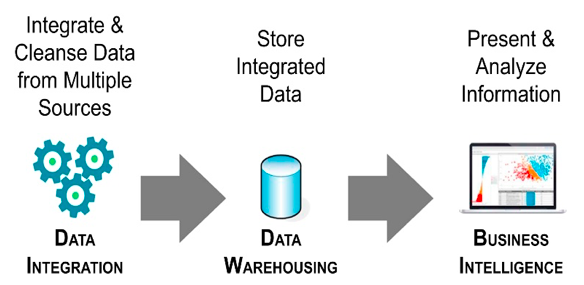
3 core processes of Business Intelligence
Relevant Data Protection Laws
- GDPR 2018 (EU wide)
- UK Data Protection Act 1988
- IPA: Investigatory Powers Act 2016
- FoI: Freedom of Information Act
- UK Data Protection Bill 2017
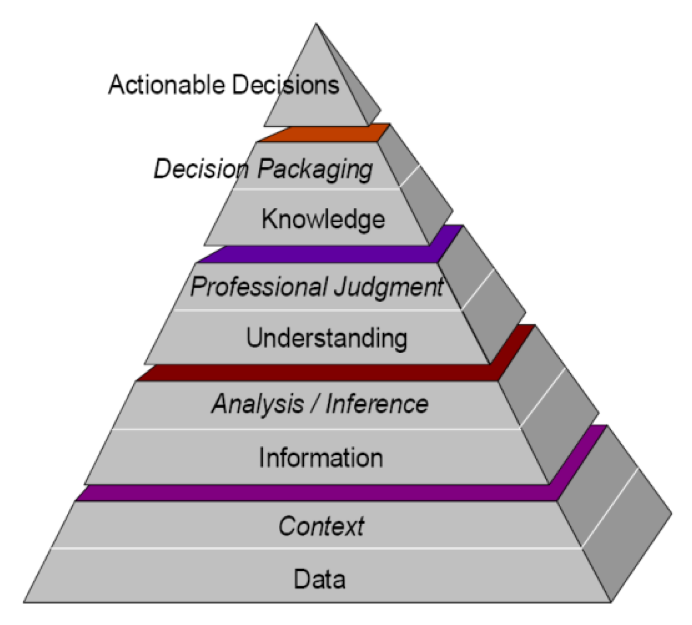
Explain the DIKW Pyramid
Hierarchy
data -> information -> knowledge -> wisdom
or alternative below
Some use cases of BI
- HR – for workload balancing
- E-commerce – deciding which products to sell and which not
- Social media – target prospective customers
- Online marketing, pricing, stocking
- Inside a company – to help restructuring



