- What does the dorsal nucleus of the cochlear nuclei project to?
Inferior Colliculus
- What does the ventral nucleus of the cochlear nuclei project to?
Superior Olive
- What are the different cell types in the cochlear nuclei?
- Fusiform - long, elongated
- Bushy
- Octopus
- What part of the auditory system compares the intensity of sound?
Lateral Superior Olive
- What part of the auditory system compares the time difference of sound?
Medial Superior Olive
- What are the key components of the Core and Belt pathways and what information do they carry?
Core
- key sound characteristics
- travels from central ICol to MGv to A1
Belt
- integrates and associates the sound information with other systems eg somatosensory/visual/emotional - to make sense of it
- travels from dorsal/external ICol to MGm/d to A2
- How does “pure word” deafness differ from conductive or sensorineural deafness?
There is no damage to the auditory system and the sound information is still received by the cortex but the problem comes with understanding of the sound and comprehension, typically of language (hence pure ‘word’), due to Wernicke aphasia and thus impacted function of the higher order processing.
(Conductive - problem in sound conduction to inner ear from external/inner ear)
(Sensorineural - hair fibre damage and thus impeded nerve impulses)
- Describe how sound is conducted through the ear to stimulate a signal in the cochlear. [SAQ]
Sound waves travelling through the external acoustic meatus are picked up by the tympanic membrane and vibrations transferred along 3 tiny bones to the fluid in the inner ear cochlear.
This fluid, similar to CSF, starts to move in response to the vibrations and the movement is picked up by a specialised organ in the tubes of the cochlear - the organ of Corti.
This component has numerous hairs that when triggered, transform the mechanical movement of the fluid into an action potential, which is sent along the cochlear nerve fibres combining into the vestibulocochlear nerve (CN8).
This will synapse predominantly onto the cochlear nuclei (dorsal and ventral) in the medulla.
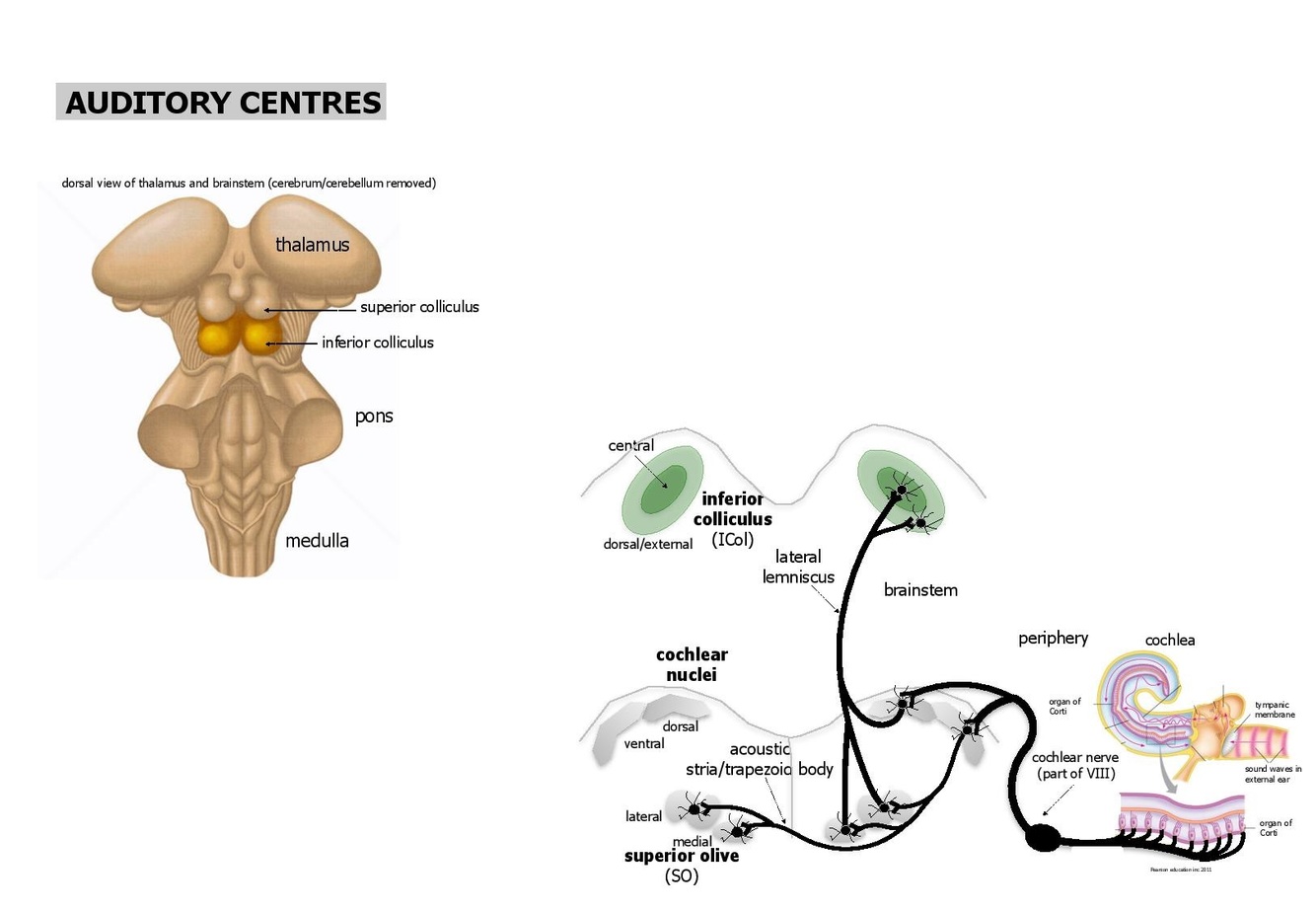
- How is the Inferior Colliculus involved in audition?
In Summary:
3 nuclei: central, dorsal/external
Acts as a nexus for converging information of the stimulus
- Integrates, filters and discriminates input (eg own voice dampened against others)
- Auditory motor reflex (like visual avoidance reflex but for sound)
Detail:
Receives projections from the dorsal cochlear nuclei.
This is where auditory inputs are integrated with other inputs, such as emotional, somatosensual, visual, etc. That is, it’s the first place where the brain tries to make sense of what the auditory stimulus is.
Filters and discriminates inputs, for example, the ICol ‘dampens’ the sound perception of your own voice so you can hear other sounds.
Similar to how the superior colliculus works in avoidance reflexes like moving the head and neck away from something that crosses the visual field close to the face, the ICol does for the auditory pathways. Eg a large ‘bang’ will influence an avoidance ‘reflex’ to move away from the startling sound.
- How are the Superior Olives involved in audition?
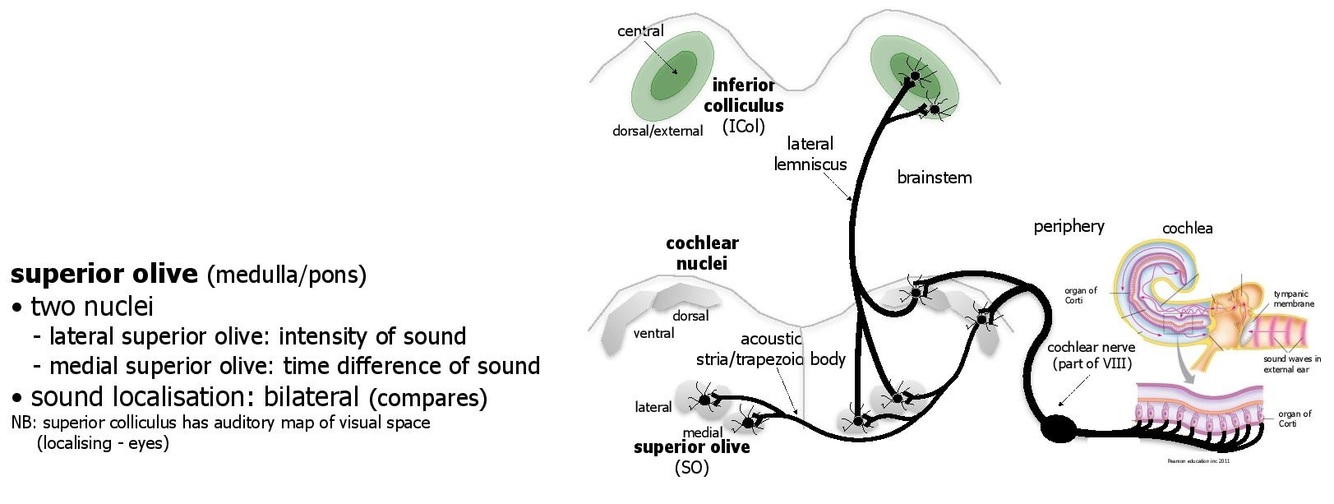
In the medulla/pons: two nuclei
- Lateral SO: intensity of sound
- Medial SO: time difference of sound
Sound localisation: bilateral (compares).
For the auditory system, basic mapping is not by visual location, but sound frequency. Location is determined by both sides (SO) comparing the intensity and the time it takes the sound to reach both sides. There is some computation of differences between these factors, eg the arrival of an audible stimulus ‘a little quicker’ on one side than the other allows the brain to determine which side the sound might be closer to and hence location.
- Describe the main areas that relay and process audition stimuli.
Summary:
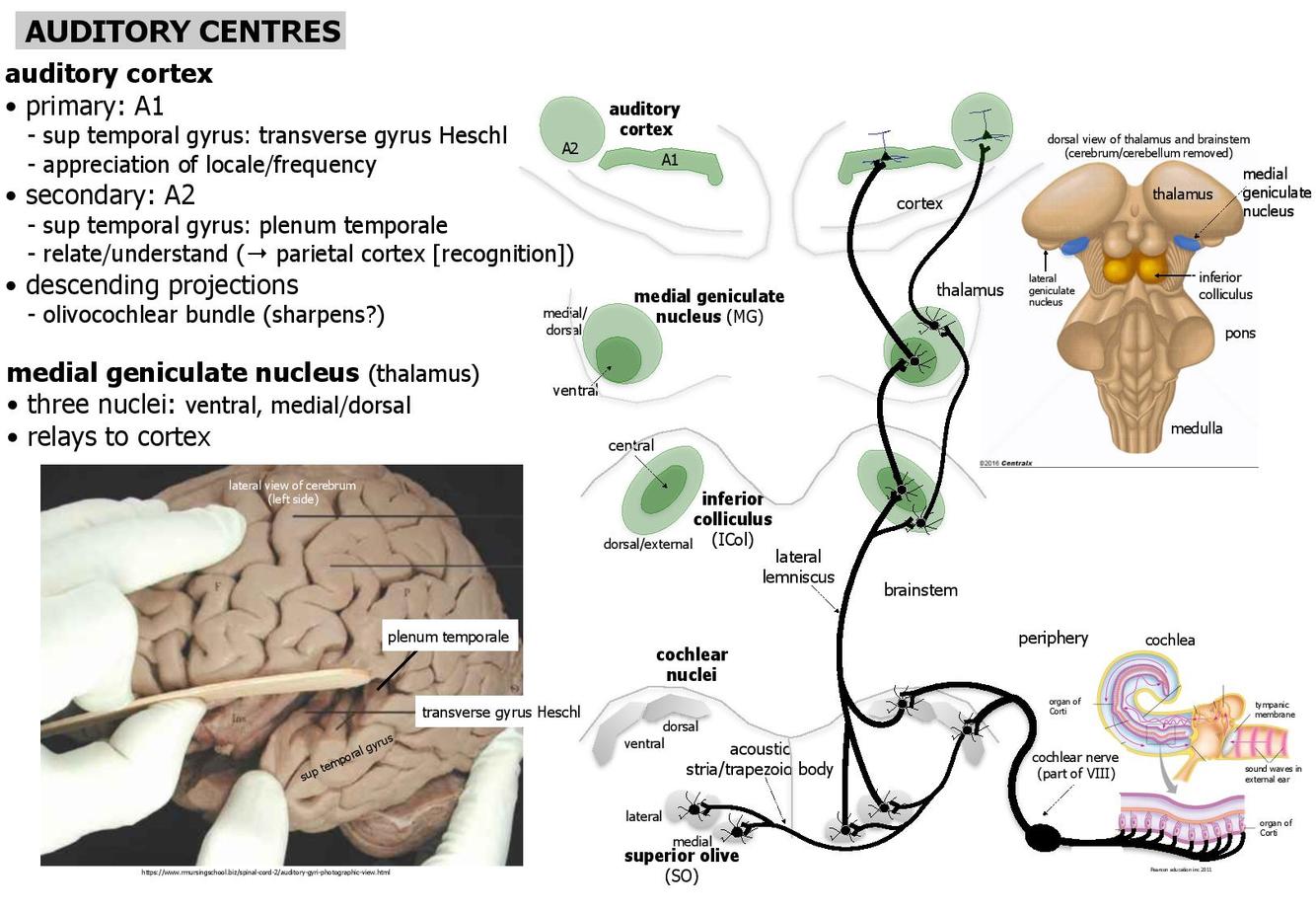
Auditory cortex:
- Primary: A1
- Sub-temporal gyrus: transverse gyrus of Heschl
- Appreciation of locale/frequency
- Secondary: A2
- Sub-temporal gyrus: plenum temporale
- Relate/understand (-> parietal cortex [recognition])
- Descending projections:
- Olivocochlear bundle (sharpens?)
Medial Geniculate Nucleus (MG; thalamus):
- 3 nuclei: ventral (central), medial/dorsal (outer shell)
- Relays (prepares info) to auditory cortex
Detail:
Planum temporale:
- Larger on left as for most of us this is our ‘dominant’ hemisphere, and this area is involved in appreciating the ‘sound’ of language; trying to make sense of what ‘words’ are
- Tries to ‘understand’ what the sound is; tries to relate that sound to ‘something in your world’
Example - a noise coming from ‘somewhere’:
- A1 will say ‘the noise is coming from there’ - providing information about frequency and will say ‘yes, there is a sound coming from there’
- A2 (PT) will say ‘what kind of noise is that; have I heard that before?’
- This info is passed on to the parietal cortex which will ask, “what is that noise”
- Describe the “Tonotopy” Mapping of Frequency in the Auditory System.
Summary:
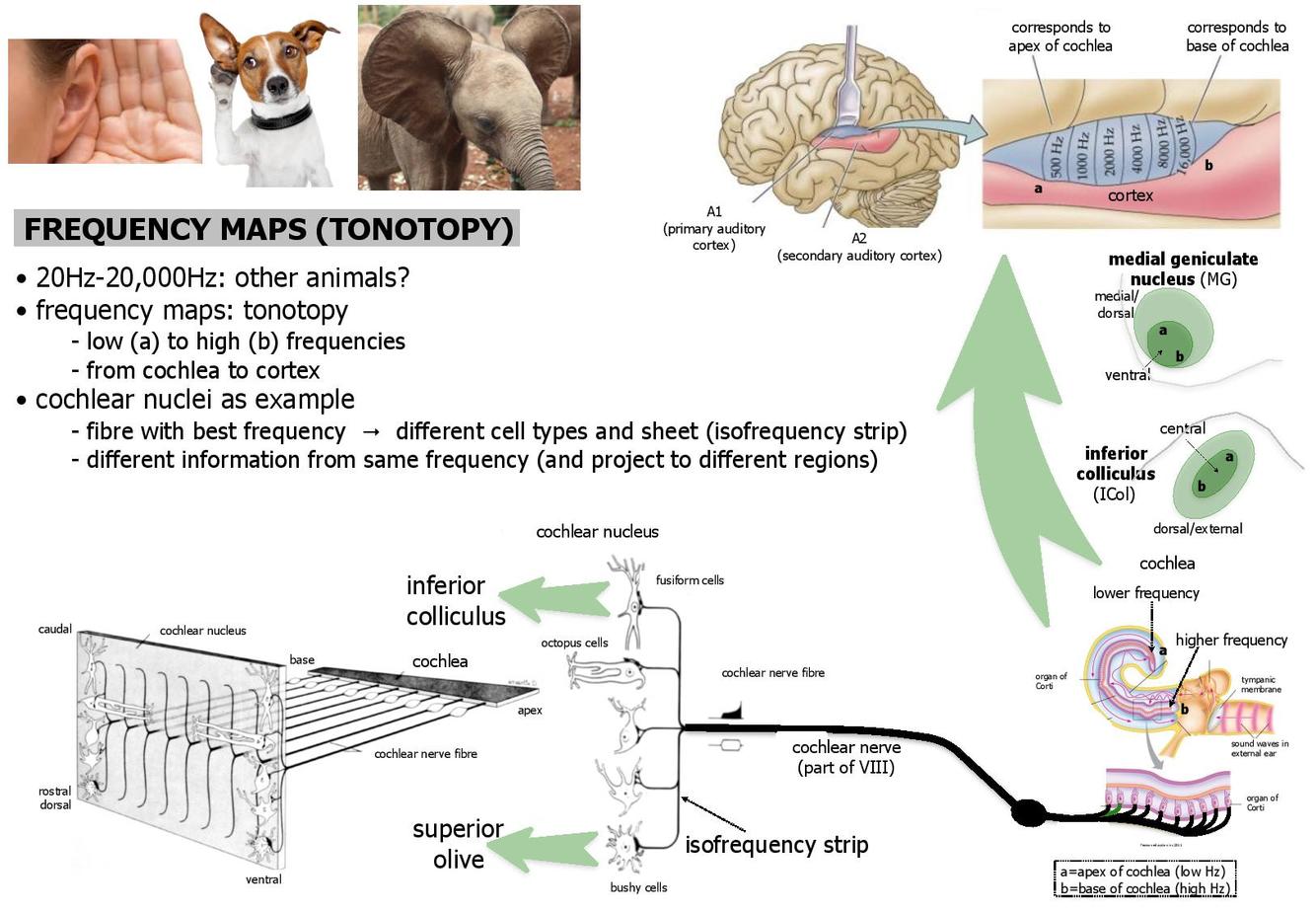
Humans hear in the frequency range 20-20,000 Hz.
Frequency maps (“tonotopic maps”) on the cochlear regions exist:
- Base - higher frequencies
- Apex - lower frequencies
A stimulated fibre will project to an ‘isofrequency strip’ of cells in the cochlear nuclei. Differing cell types in this strip will process different information from the same frequency, and project to different regions accordingly (ICol, SO)
This tonotopical organisation continues after projections to the cortex, mapping low to high frequencies correspondingly in A1 (signals from apex and base respectively).
Details:
Frequency:
- Higher end of frequency range diminishes with age
- Other animals vary, dogs hearing up to 45,000 Hz, and elephants down to 1 Hz to communicate through low frequency rumbles
Signal conduction:
- Any particular cochlear nerve fibre connected to an organ of Corti has a ‘best frequency’ in which it is stimulated, for example 1000 Hz, and will fire an action potential when that frequency is received. It will synapse onto heterogenous groups of cells in the cochlear nuclei that will extract the information from that frequency and project to different areas, eg busy cells to the SO.
- For example, two singers sing the same note, that is, the same frequency: the cells of the cochlear nucleus are able to extract the differences in tone and quality of each voice
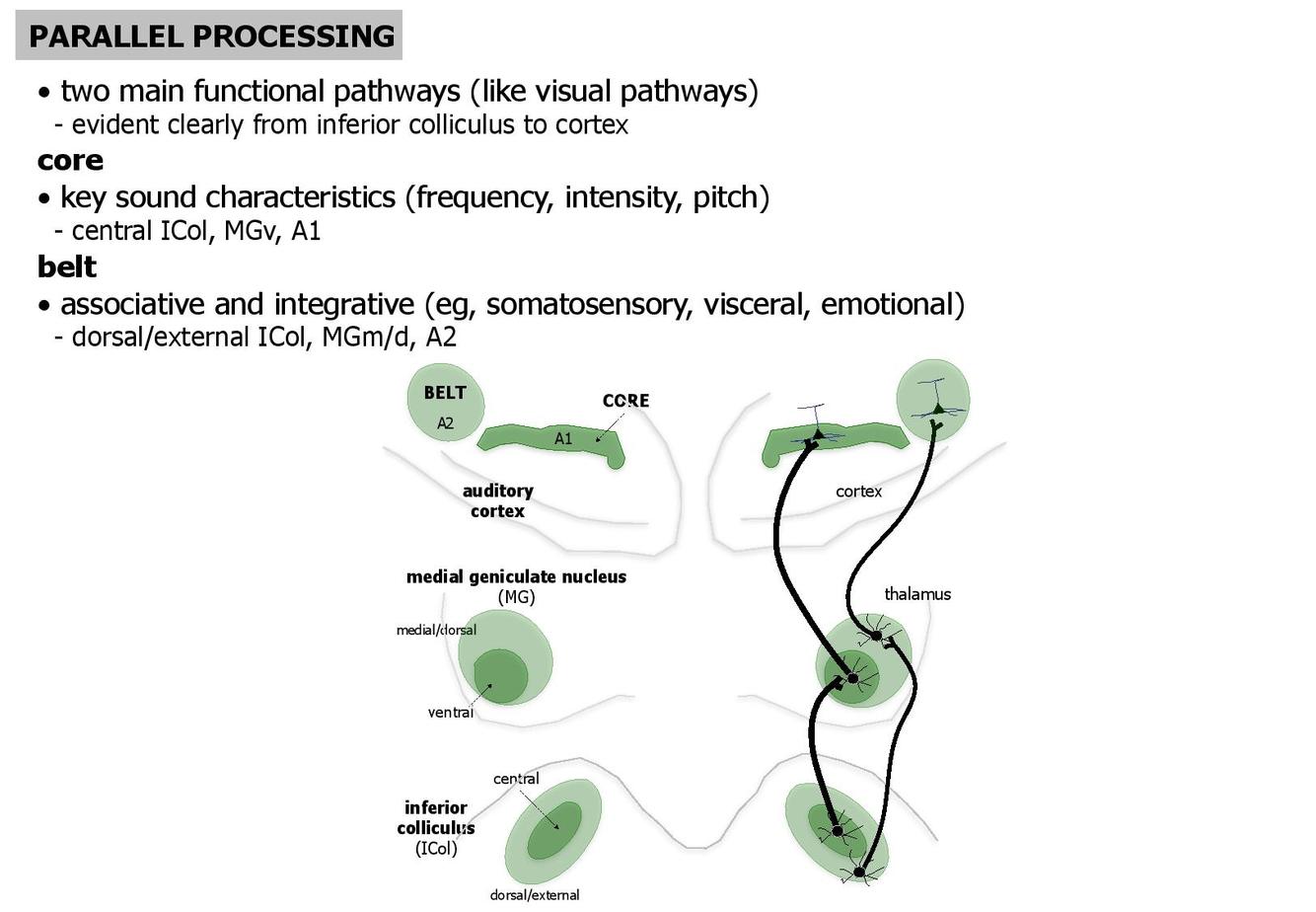
- Explain the pathways of parallel processing
Summary
Two main functional pathways (like visual) that run in parallel - evident clearly from ICol to cortex
- Core - key sound characteristics
- Frequency, intensity, pitch
- Central ICol -> MGv -> A1
- Belt - associative and integrative
- Somatosensory, visceral, emotional
- Dorsal/external ICol -> MGm/d -> A2
Details
Parallel pathways core and belt become evident at the level of the ICol - the only place you can tell them apart.
- Core is more central (in terms of nuclei position) - transmitting key aspects of sound like frequency, intensity and timing of arrival. Pathway flows from ICol central nucleus to MG ventral nucleus (remember it rhymes; central, ventral) to A1.
- Belt involves the ‘shell’ nuclei - the dorsal/external ICol to the medial/dorsal MG and finally to A2. This pathway is about integrating the sound with other aspects of our lives; other parts of the brain - with the somatosensory, visceral and emotional systems. For example, in connecting sounds with the state of emotion - some noises will make us happy, whilst others will make us feel ill.
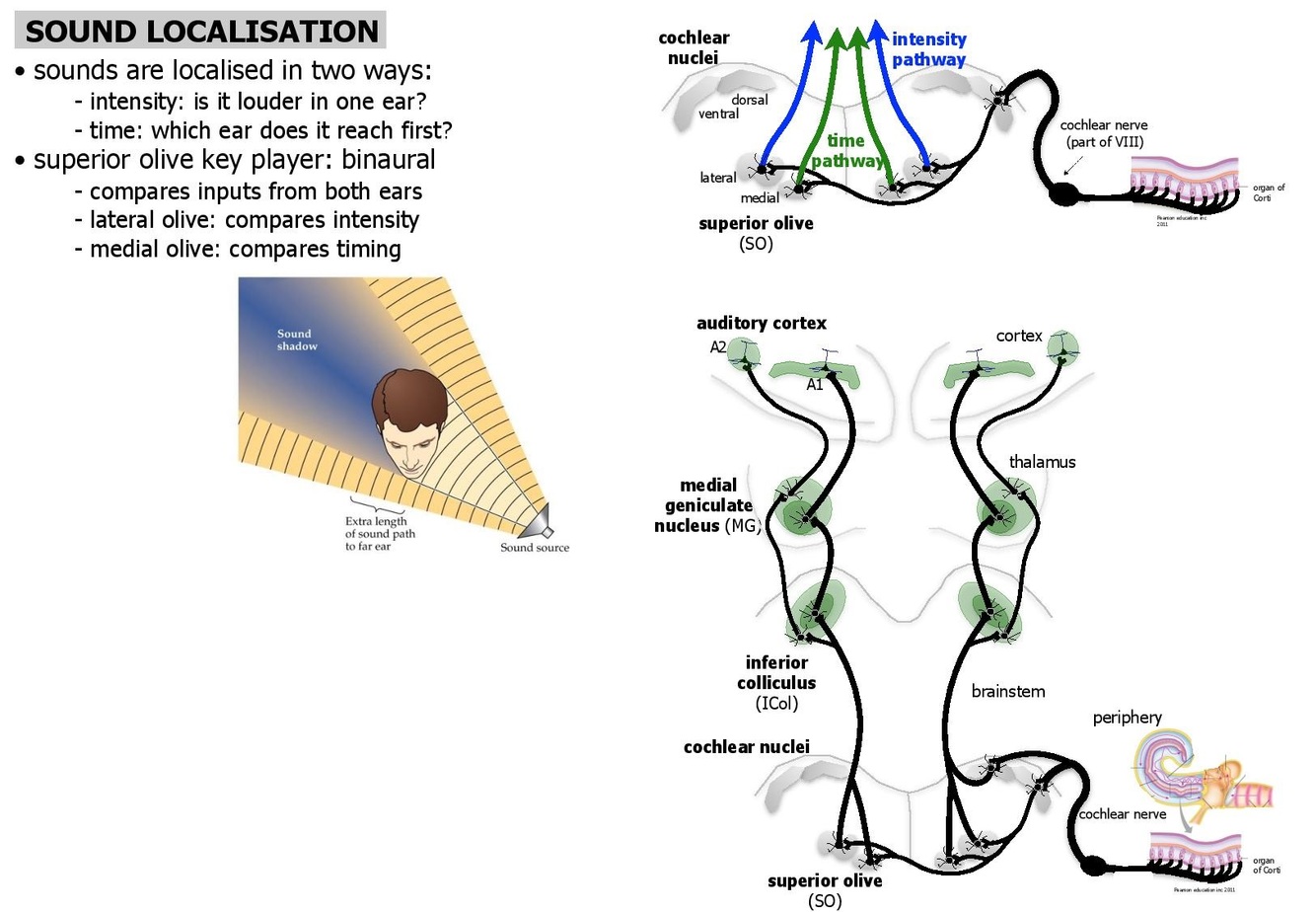
- How are sounds localised?
By Intensity (which ear is louder) and Time (which ear first)
- SO - ‘binaural’ - compares inputs from both ears
- Lateral nucleus - compares intensity
- Medial nucleus - compares timing
Detail:
Localisation by the auditory system is based on which side gets the sound louder and/or arrives first. A sound to a person’s right will obviously reach the right ear before the left. Even with a millisecond difference between being received at either ear, this lag is significant to the cochlear and in turn the Superior Olive will compare the intensity (lateral nucleus) and timing of arrival (medial nucleus). This information is sent up to the cortex which appreciates location based on that comparison.
- Describe types of Auditory Lesions that may occur
3 main types of deafness:
- Conductive: external/middle ear - most common
- Mechanical problem eg hole in tympanic membrane or lessening in the volume of air receptive to sounds
- Sensorineural: inner ear neural - loss of hair cells/nerve fibres.
- No repair - only implant, the bionic ear
- Pure word: cortex (Wernicke aphasia)
- Sounds received by the cortex but the problem is understanding them; comprehension, of language - a higher order process.
The side of deafness can be related to the problem:
- Unilateral - middle/external ear, or cochlea/cochlear nerve
- Bilateral - central brainstem (after cochlear nuclei) or cortex

-
Mid Sem Miscellaneous (W1-5)29
-
W5 Somatosensory Pathways (Physical Feelings)21
-
L1 Brain Development1
-
L16 Cerebellum16
-
L7 Vestibular System14
-
L8 Proprioception10
-
L6 Auditory Pathways15
-
L15 Motor Pathways19
-
L9 Somatosensory Pathways I10
-
L10 Nociception3
-
L19 Hypothalamus: Feeding2
-
L23 Pain and Suffering1
-
L22 Fear1
-
Spot Test Functions55
-
Brain Stem Sections31



