Outline the development of B lymphocytes, from bone marrow to secondary lymphoid tissues and back again.
3 Phases of B-cell development
- Phase 1: Antigen receptor expression Occurs in bone marrow Process creates genetically diverse cells, 1016 variations Allelic exclusion
- Phase 2: Elimination of self-reactive cells Occurs in bone marrow
- Phase 3: Terminal antigen-stimulated differentiation Occurs in secondary lymphoid tissues
Explain how mechanisms of immunoglobulin gene expression in the bone marrow contribute to antibody diversity:
Combinatorial diversity through somatic recombination
- Rearrangement of gene segments to form a functional gene
- Variable region of both light and heavy chains are rearranged
Junctional diversity: DNA cleavage and repair in the immunoglobulin chain loci
- RAG creates hairpin and cleaves
- P (palindromic) nucleotides added
- Terminal deoxynucleotidyl transferase (TdT) randomly adds nucleotides
- N (non-templated) nucleotides added
Describe how each B cell produces immunoglobulin of a single antigen specificity.
- Heavy chain is made (VDJ rearrangement) and must bind to surrogate light chain (stand-in for light chain which hasn’t been rearranged yet)
- Cell either undergoes apoptosis or moves on to rearrangement of light chain gene
- Light chain must bind to heavy chain or cell undergoes apoptosis
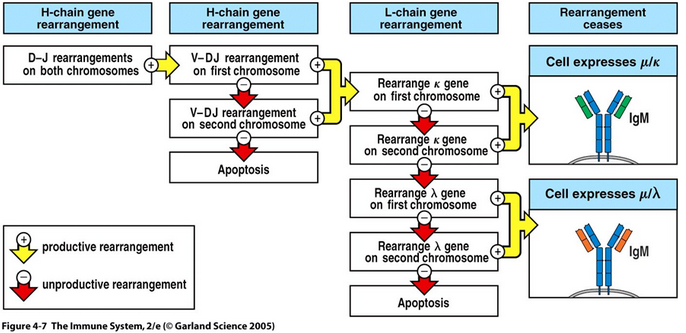
Indicate the mechanisms by which auto-reactive B cells are prevented from causing autoimmune disease.
Self-reactive B-cells outside the bone marrow either die by apoptosis or are rendered anergic when they encounter their self-antigen. This is called peripheral tolerance.
figure shows central tolerance because it is developed in a primary lymphoid organ.
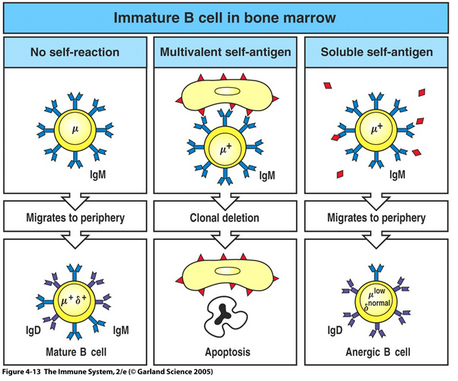
Where does central tolerance occur?
Primary lymphoid organ
(B cells = bone marrow)
(T cells = thymus)
Define central tolerance (as related to B cells)
Mechanisms which ensure B cells leaving the bone marrow are tolerant to all self antigens present in the bone marrow, many of which are present in other tissues.
Define peripheral tolerance (related to B cells)
Tolerance induced to antigens outside the bone marrow
What is somatic recombination?
DNA recombination that occurs between gene segments. It generates a complete exon composed of VJ(D) segment encoding the variable region of the gene
What is junctional diversity?
Diversity created during the process of gene rearrangement by addition or removal of nucleotides at the junctions between gene segments

-
Patient Interviewing:23
-
Pathology week 123
-
Microbiology week 110
-
Quizzes26
-
Biochemistry week 1127
-
Histology Week 147
-
Psychology27
-
Histology Week 230
-
Epidemology week 214
-
Pathology week 253
-
Biochem Week 242
-
Microbiology week 334
-
ICR Week 313
-
Histology Week 331
-
Biochem Week 339
-
Principles of Imaging Week 324
-
Epidemiology Week 322
-
Pathology Week 334
-
Epidemiology week 133
-
Quiz week 224
-
Lab 8: The Immune System | Lymphoid Tissues &Organs28
-
Lec 38: Lymphocytes and Lymphoid Organs, I & II26
-
Lec 39: Cell Interaction Molecules22
-
Lec 40: Development of B cells9
-
Lec 42: Development of T Cells14
-
Lec 43: Major Histocompatibility Complex22
-
Lec 44: Adaptive Immunity I16
-
Lec 45: Adaptive Immunity II (NSD)17
-
Lec 45: Adaptive Immunity III21
-
Lec 46: Nucleic Acid Structure/DNA Replication and Repair17
-
Lec 47: RNA Synthesis and Processing15
-
Lec 48: Protein Synthesis14
-
Lec 49: RNA Metabolism30
-
Lec 50: Eukaryotic Gene Regulation24
-
Lec 51:Pharmacology Principles13
-
Lec 52: Pharmacology: Mechanisms of Drug Action21
-
Lec 54: Medical Genetics I: Introduction to Medical Genetics31
-
Lec 55: Pharmacokinetics I12
-
Lec 56: Pharmacokinetics II11
-
Lec 57: Introduction to Hypersensitivity61
-
Lec 58: Introduction to Autoimmune Disease43
-
Lec 59: Medical Genetics II: Modes of Inheritance of Single Gene Disorders13
-
Lec 61: Gene Transfer Mechanism0
-
Lec 62: Basic Virology23
-
Lec: 63: Evidence-Appraisal: Statistical inference21
-
Lec 49: RNA Metabolism1
-
Lec: 60 Medical Genetics III - Atypical patterns of inheritance and multifactorial disease28
-
Lec: 64 Early Embryogenesis13
-
Lec 65: Cell Cycle18
-
Lec 66: Drug Absorption and Distribution and Drug Metabolism I17
-
Lec 67: Drug Metabolism II50
-
Lec 68: Clinical Genetics31
-
Lec 69: Introduction to Ethical Analysis22
-
Lec 70: Stress and Social Support23
-
Lec 71/72: Neoplasia I/II50
-
Statistical Inference: practice questions18
-
Lec 77: Quality and Patient Safety10
-
Lec 68: Part Two: Clinical Genetic Techniques19
-
Probability practice questions:16
-
quiz 328
-
Military Leadership2
-
Lec 78: Evidence-Appraisal: Hypothesis testing9
-
Stats: evidence appraisal practice questions17
-
Lec 53: Cognition2
-
Lec Pharmacogenetics17
-
Viral Pathogenesis8



