Identify the major metabolic pathways by which drugs are chemically modified.
- Phase I or Non-synthetic (drug is split)
- Phase II or Synthetic (something is added to the drug to make it more hydrophilic via conjugation)
Define the Phase I metabolic reaction.
Phase I metabolic reactions: HOR - Hydrolysis, Oxidation, Reduction Usually convert the parent drug to a polar metabolite by introducing or unmasking a functional group (-OH, NH2, SH)
Define the Phase II metabolic reaction.
Phase II metabolic reactions: *GAS* = Glucuronidation, Acetylation, Sulfation - Point is to increase polarity
- Conjugation with a polar or charged group
- require a donor molecule as source of conjugated group
- High capacity reactions (not rate limiting)
- Usually follow a non-synthetic (Phase I) reaction
- Facilitate excretion and usually inactivate
- Biological function
Name the major cytochrome P450 substrates for CYP1A2:
Substrates: Acetaminophen (important because of toxicity factor), Caffeine, Theophylline, Warfarin
Name the major cytochrome P450 substrates for CYP2A6:
Substrates: Warfarin (minor), Zidovudine
Name the major cytochrome P450 substrates for CYP2C9:
**S-Warfarin (CYP2C9 is the main enzyme that metabolizes the biologically active form of warafin)
Name the major cytochrome P450 substrates for CYP2C19:
Substrates: Diazepam, Omeprazole, Propanolol
Name the major cytochrome P450 substrates for CYP2D6
Substrates: Amitriptyline, Codeine (converts to morphine), Fluoxetine, Hydrocodone, Timolol
Name the major cytochrome P450 substrates for CYP2E1
Substrates: Acetaminophen, Ethanol
Name the major cytochrome P450 substrates for CYP3A4
*the really important one*
Substrates:
- steroids (testosterone, progesterone, cortisol, etc.)
- calcium channel blockers (nifedipine, diltiazem, verapamil)
- benzodiazepines (diazepam, triazolam)
- amiodarone
- **erythromycin (and other macrolide antibiotics)
- Can lead to toxicity if administered when CYP3A4 is blocked
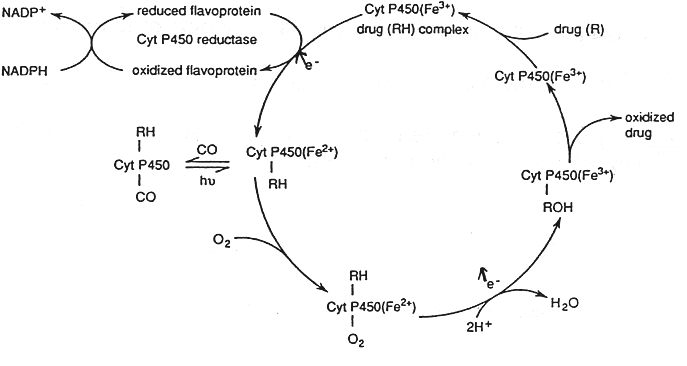
Explain the critical steps in the P450 reaction pathway, including the roles of NADPH, cytochrome P450 reductase and molecular oxygen.
Net reaction is oxidation R-H -> R-OH
Requires:
- NADPH important Cofactor - used 2x
- molecular Oxygen
- Cytochrome P450 reductase
- Drug substrate (R-H) combines with oxidized (Fe3+) cytochrome P450 to form a binary complex.
- NADPH donates an electron to the flavoprotein, NADPH cytochrome P450 reductase, which in turn reduces the oxidized CYP450-drug complex.
- The same flavone reductase introduces a second electron (also from NADPH) to reduce molecular oxygen and form an “activated oxygen” - CYP450-drug complex.
- This complex transfers oxygen to the drug substrate to form the oxidized drug product (R-OH), liberates water, and leaves free oxidized (Fe3+) CYP450 to react with another drug molecule.
Identify other non-P450 Phase I reactions.
- Oxidation–Flavin monooxygenases, alcohol dehydrogenase, amine oxidases
- Hydrolysis–Particularly esterases and amidases
- Reduction–Nitro- and Azo- compound reduction by reductases
List the major conjugation reactions (Phase II).
- Glucuronidation (the major conjugation reaction)
- Sulfation
- Acetylation
- Glutathione conjugation
- Glycine conjugation
- Methylation
Explain mechanisms that result in increased (enzyme induction) or decreased (enzyme inhibition) rates of drug metabolism or altered distribution (through changes in drug transporter expression).
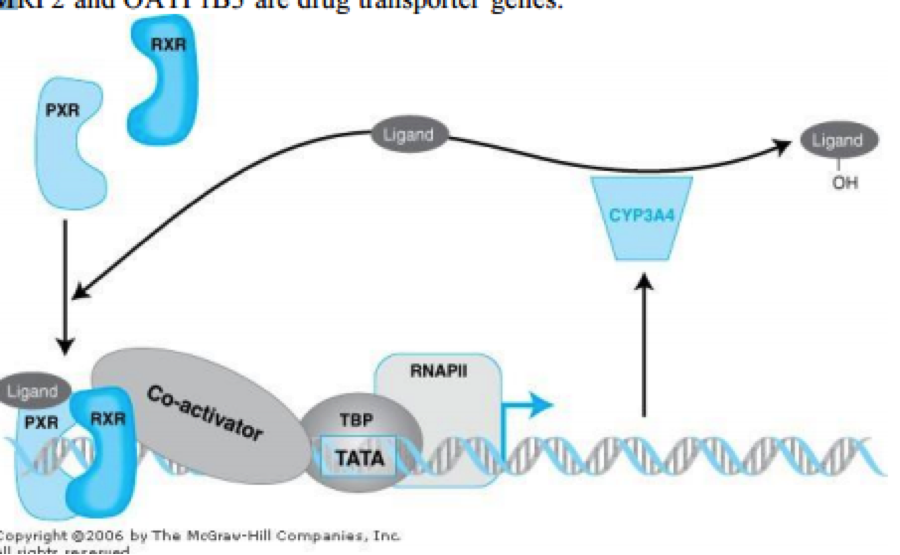
- Mechanism of enzyme induction: Ligand (substrate of metabolism enzyme) binds nuclear receptors which activate transcription of metabolic enzymes (CYP450 -> metabolize drugs; Conjugating enzymes; drug transporters). the metabolic enzyme then acts on the ligand or potentially other drugs in the body.
- Effect is increased metabolism of drugs:
- increased toxicity from metabolites
- Ineffective treatments due to drug being metabolized too fast
- Mechanism of enzyme inhibition: drugs that bind, modify, or compete for the substrates (like NADPH for P450 enzymes) of active metabolic enzymes.
- ex: erethormycin covalently binds to the heme group of P450 enzymes => inactivation
Recognize the factors (drugs, over-the-counter or herbal medications, dietary factors) that may influence drug metabolism in humans.
Nutrition:
- Grapefruit and grapefruit juice: a component of the juice binds to and inactivates CYP3A4
- Isosafrole, safrole: CYP1A1, CYP1A2 inhibitor - found in root beer and perfume.
- Ethanol: CYP2E1 inducer (note importance in acetaminophen metabolism)
- Charcoal broiling: CYP1A enzyme induction
- Tobacco (not really a food): CYP1A induction (benzo[a]pyrene)
- Cruciferous vegetables (like broccoli): CYP1A induction
Drug Classes Known to Cause Clinically Relevant Interactions:
- Anti-epileptics (low therapeutic index, CYP metabolism)
- Protease inhibitors (co-administration with CYP inducers, example: rifampin)
- Statins (metabolized by CYP3A enzymes in gut and liver)
- Warfarin (metabolized by CYPs; highly protein bound)
- Digoxin (multiple interactions, low therapeutic index)
Describe the mechanism of some common drug-drug interactions.
- Alteration in elimination - reducing ability for an organ to clear a drug leads to increased drug in body
- Physico-chemical interactions (divalent cations and fluroquinolones)
- Additive/synergistic functional interactions - the stacking effects of drugs
- stacking antibiotics -> increase thearopy
- stacking antidepresents -> increase toxisity
- stacking blood thinners -> increase bleeding

-
Patient Interviewing:23
-
Pathology week 123
-
Microbiology week 110
-
Quizzes26
-
Biochemistry week 1127
-
Histology Week 147
-
Psychology27
-
Histology Week 230
-
Epidemology week 214
-
Pathology week 253
-
Biochem Week 242
-
Microbiology week 334
-
ICR Week 313
-
Histology Week 331
-
Biochem Week 339
-
Principles of Imaging Week 324
-
Epidemiology Week 322
-
Pathology Week 334
-
Epidemiology week 133
-
Quiz week 224
-
Lab 8: The Immune System | Lymphoid Tissues &Organs28
-
Lec 38: Lymphocytes and Lymphoid Organs, I & II26
-
Lec 39: Cell Interaction Molecules22
-
Lec 40: Development of B cells9
-
Lec 42: Development of T Cells14
-
Lec 43: Major Histocompatibility Complex22
-
Lec 44: Adaptive Immunity I16
-
Lec 45: Adaptive Immunity II (NSD)17
-
Lec 45: Adaptive Immunity III21
-
Lec 46: Nucleic Acid Structure/DNA Replication and Repair17
-
Lec 47: RNA Synthesis and Processing15
-
Lec 48: Protein Synthesis14
-
Lec 49: RNA Metabolism30
-
Lec 50: Eukaryotic Gene Regulation24
-
Lec 51:Pharmacology Principles13
-
Lec 52: Pharmacology: Mechanisms of Drug Action21
-
Lec 54: Medical Genetics I: Introduction to Medical Genetics31
-
Lec 55: Pharmacokinetics I12
-
Lec 56: Pharmacokinetics II11
-
Lec 57: Introduction to Hypersensitivity61
-
Lec 58: Introduction to Autoimmune Disease43
-
Lec 59: Medical Genetics II: Modes of Inheritance of Single Gene Disorders13
-
Lec 61: Gene Transfer Mechanism0
-
Lec 62: Basic Virology23
-
Lec: 63: Evidence-Appraisal: Statistical inference21
-
Lec 49: RNA Metabolism1
-
Lec: 60 Medical Genetics III - Atypical patterns of inheritance and multifactorial disease28
-
Lec: 64 Early Embryogenesis13
-
Lec 65: Cell Cycle18
-
Lec 66: Drug Absorption and Distribution and Drug Metabolism I17
-
Lec 67: Drug Metabolism II50
-
Lec 68: Clinical Genetics31
-
Lec 69: Introduction to Ethical Analysis22
-
Lec 70: Stress and Social Support23
-
Lec 71/72: Neoplasia I/II50
-
Statistical Inference: practice questions18
-
Lec 77: Quality and Patient Safety10
-
Lec 68: Part Two: Clinical Genetic Techniques19
-
Probability practice questions:16
-
quiz 328
-
Military Leadership2
-
Lec 78: Evidence-Appraisal: Hypothesis testing9
-
Stats: evidence appraisal practice questions17
-
Lec 53: Cognition2
-
Lec Pharmacogenetics17
-
Viral Pathogenesis8



